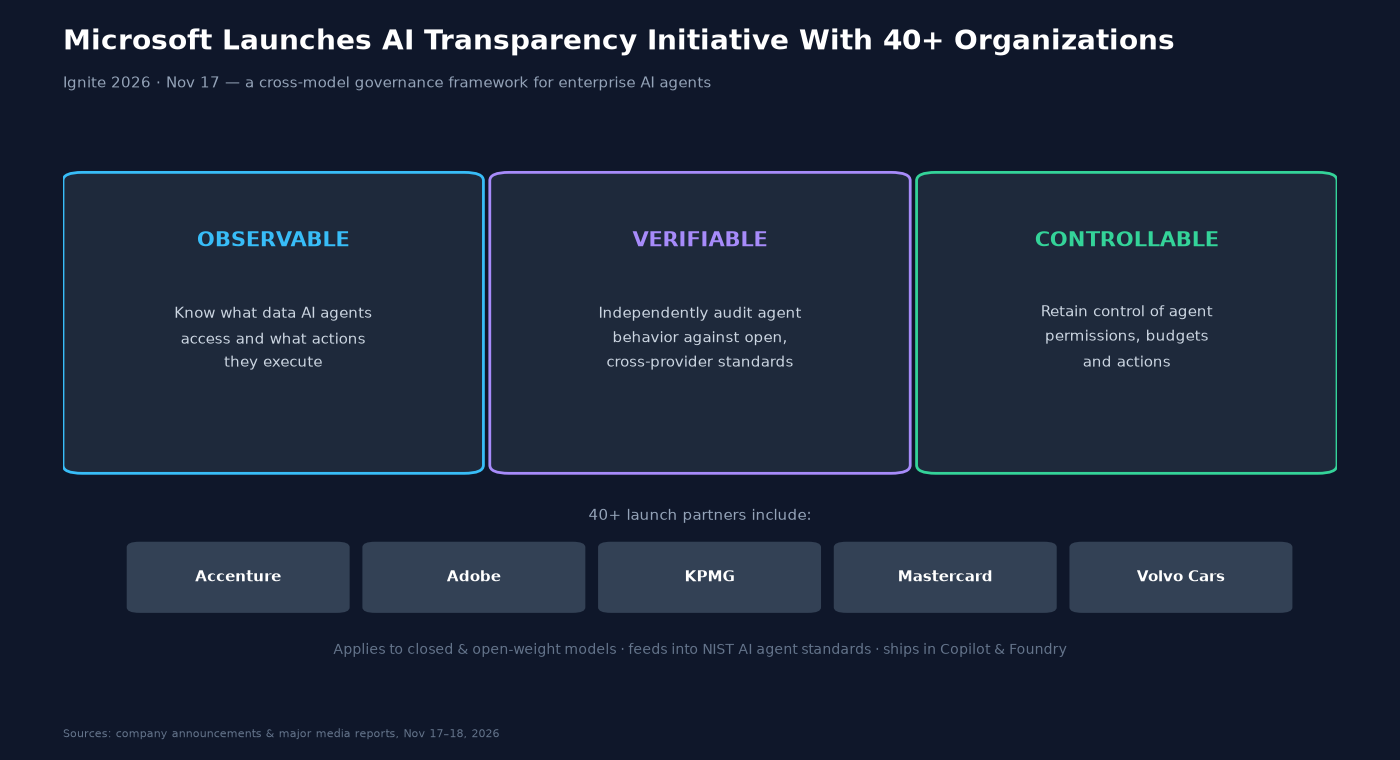
Every marketing team buying AI tools in 2026 is running the same quiet experiment: handing software increasing authority over data, budgets, and customer conversations, while having almost no reliable way to verify what that software actually does. At its Ignite conference on November 17, Microsoft made the industry’s most consequential attempt yet to close that gap, announcing an AI Transparency Initiative built with more than 40 organizations — a list that reads like a map of enterprise marketing itself: Accenture, Adobe, KPMG, Mastercard, Volvo Cars.
The premise, as CEO Satya Nadella framed it, is that today’s AI models operate as nested black boxes. Enterprises can see inputs and outputs but cannot reconstruct internal decisions, independently verify behavior, or cleanly bound an agent’s authority. That was tolerable when AI drafted copy. It stops being tolerable when AI agents query customer databases, trigger payments, and act without step-by-step human approval — which is precisely the direction every major marketing platform is shipping.
Three pillars, one procurement shift
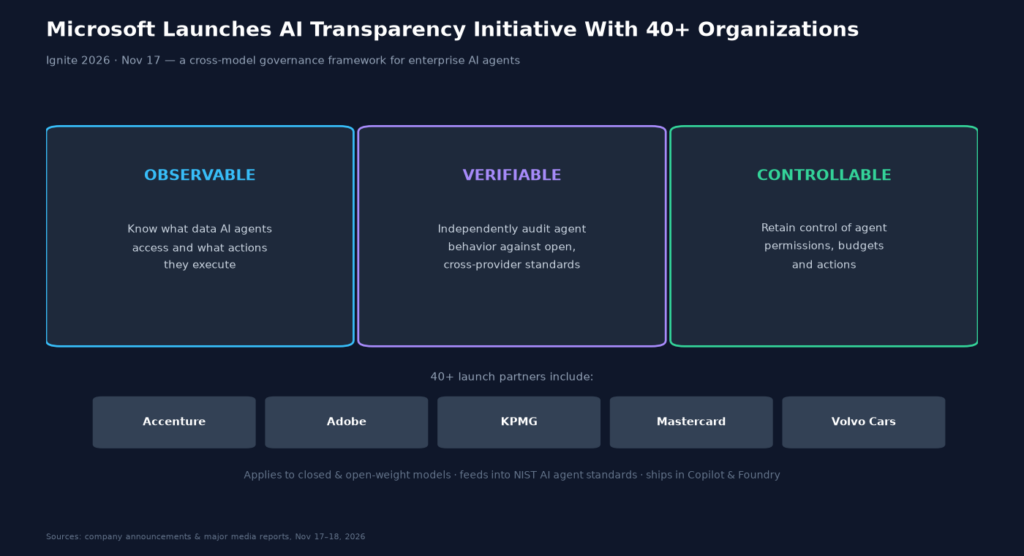
The initiative rests on three commitments. First, Microsoft is expanding its participation in the U.S. National Institute of Standards and Technology’s AI Agent Standards Initiative, using that research to push open industry standards for AI transparency, security, and governance. Second, it is working with the 40-plus partner organizations to define standards that make AI systems accountable, independently verifiable, and safe by design — regardless of which model or provider sits underneath. Third, the results will be embedded into Microsoft AI, Microsoft Foundry, and Microsoft Copilot, so that evidence of AI activity can flow into security and compliance tooling, whether that tooling comes from Microsoft or a competitor.
The design choices matter more than the press release. The framework explicitly covers both closed-source and open-weight models, which means it is not a lock-in play for Microsoft’s own MAI family. And the emphasis on portability — keep your existing audit and compliance mechanisms when you swap the underlying model — addresses the single biggest hidden cost in enterprise AI today: every model migration currently resets your governance work to zero.
Adobe’s chief security officer Aanchal Gupta and KPMG’s global CISO John Israel both anchored their supporting statements in the same concern: enterprises need to know which resources an AI agent touched, what it did there, and how to prove it. When a creative-cloud vendor and an audit giant describe the same requirement in the same launch, it is a reasonable bet that the requirement is about to appear in RFPs.
Why this lands squarely on marketing
Marketing is arguably the function most exposed to the agent-governance gap. Consider what a standard 2026 martech stack now permits: an AI agent that pulls customer segments from a CDP, generates creative variants, launches campaigns across Google and Meta, adjusts budgets intraday, and writes results back to a CRM. Each of those steps touches personal data, spends real money, or speaks to customers in a brand’s voice. Today, most teams govern that pipeline with platform-native logs of varying quality and a great deal of trust.
The transparency initiative implies a different baseline. “Observable” means your team can enumerate what data an agent accessed — a direct answer to the privacy questions that keep getting asked about AI tools trained on, or retaining, client inputs. “Verifiable” means a third party can audit behavior against a standard, rather than accepting a vendor’s self-report — the same logic that turned SOC 2 from a nice-to-have into table stakes for SaaS. “Controllable” means permissions, budget caps, and kill switches are enforced at a layer the enterprise owns, not merely offered as settings the vendor can change.
For agencies, there is a commercial angle too. Client contracts increasingly ask who is liable when an AI system mis-serves an ad, leaks a segment, or fabricates a claim. An auditable evidence trail is the beginning of an answer — and agencies that can produce one will win work from regulated clients who currently refuse agent-driven campaigns outright.
The skeptical read, and what to watch
Healthy skepticism is warranted. Standards initiatives announced by the largest incumbent often serve to shape regulation in the incumbent’s favor, and “open” frameworks have a history of converging on one company’s implementation. The initiative also ships without enforcement: nothing here compels any model provider to expose its internals, and the hardest technical problem — verifying the behavior of systems whose reasoning is not fully inspectable — remains research, not product. Competing ecosystems will weigh whether to join, extend, or route around it.
But the direction is still meaningful, because the demand side is real. The same week, Google shipped a Gemini setting letting users keep chat history while opting out of model training — another sign that data-control granularity is becoming a competitive feature rather than a compliance footnote. Buyers are asking; vendors are answering.
Marketers evaluating AI tools this quarter should add three questions to every vendor conversation: Can you show me a complete log of what your agent accessed and did? Can that log be verified by someone other than you? And when I switch models next year, does my governance survive the move? Vendors aligned with the emerging standard will answer all three without flinching. The pattern of who hesitates will tell you more than any benchmark chart.