Most post-breach case studies ask whether customers came back. The more useful question is why they came back before the profits did. Coupang’s 2026 recovery has two clocks running at different speeds, and the gap between them — call it the forgiveness spread — is the real story.
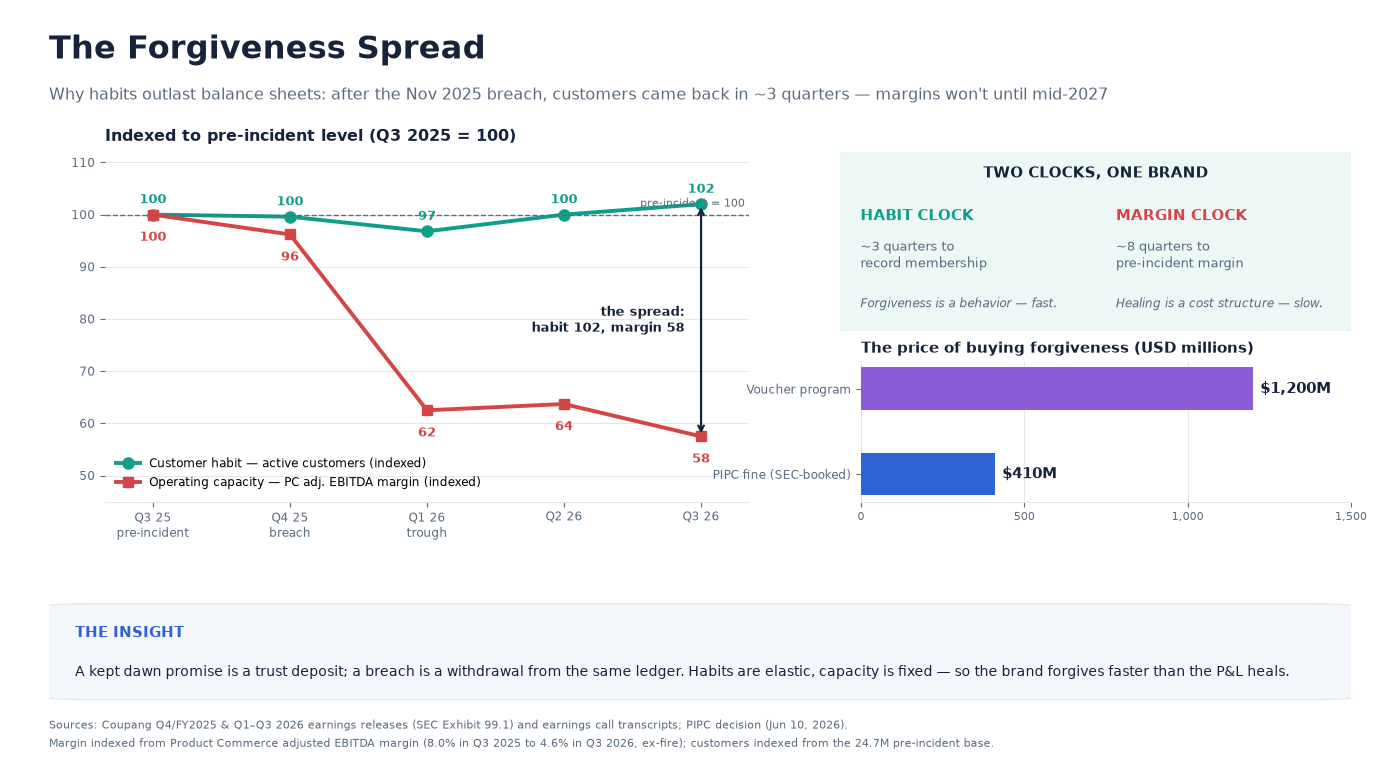
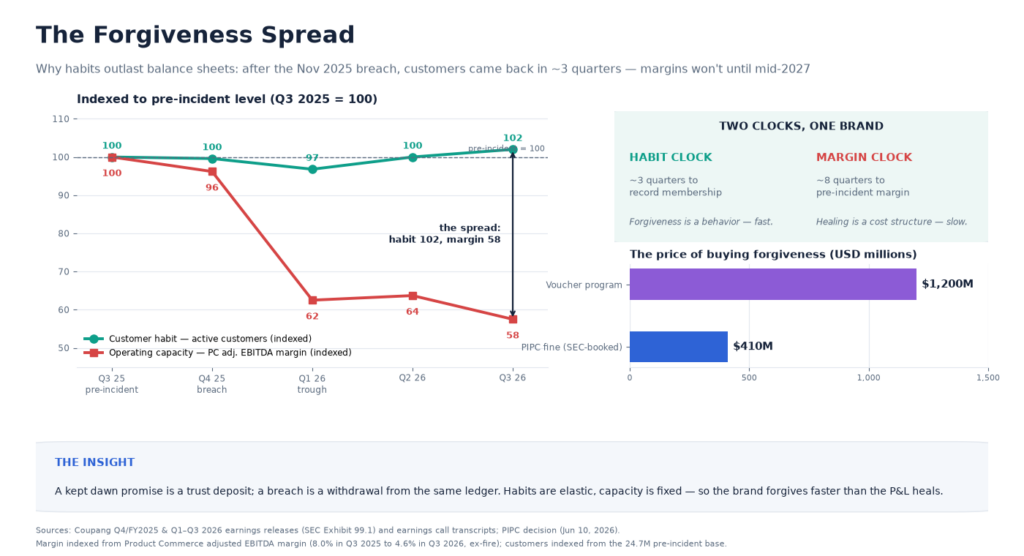
The habit clock ticked fast. Active customers bottomed at 23.9 million in Q1 2026, then returned to the pre-incident 24.7 million by Q2 and a record 25.2 million by Q3. WOW membership passed its old peak within roughly three quarters. Meanwhile the margin clock barely moved: core-commerce adjusted EBITDA margin sat at 4.6% in Q3 2026, down from about 8% before the breach, and management does not expect pre-incident levels until mid-2027 — eight quarters after the incident. Indexed to the pre-incident quarter, habit recovered to 102 while margin languished near 58.
Why the asymmetry? Because forgiveness is a behavior and healing is a cost structure. A customer decides to return in one tap, driven by a routine — milk by 7 a.m. — that no competitor has replicated. But warehouses, trucks and supply contracts were sized for the old demand curve, and you cannot shrink them on a customer’s timetable. Coupang chose to carry the idle capacity rather than cut into the service promise, which is precisely why margins lag: the company is protecting the asset that made forgiveness possible.
There is a second, harder truth underneath. Forgiveness was not free, and it was not purely organic. Coupang bought part of it — a $1.2 billion voucher program that could only be redeemed inside its own ecosystem, plus deliberate reacquisition marketing that inflated 2026 costs. The $410 million regulator fine, booked in Q2, is the price of the failure; the vouchers are the price of the apology. Notice the design: even the compensation re-enrolls you in the habit loop.
For operators anywhere, the lesson generalizes beyond Korea. Trust built through repeated operational proof behaves like a balance: slow deposits, fast withdrawals, and — if the service remains genuinely unmatched — surprisingly elastic repayment. But the spread cuts both ways. A brand whose habit is weak gets neither the quick return nor the patient margin recovery; it simply loses. The forgiveness spread is not a cushion every company owns. It is one that only years of kept promises can fund. Watch the mid-2027 margin bridge: if it closes, the moat was real. If it doesn’t, the habit was renting loyalty, not owning it.