Companion Insight to: Japan’s LINE + Yahoo: The Slow Super-App Path
Here is a subscription pitch that should not work: pay ¥650 a month so you can take back a text message without anyone knowing you took it back.
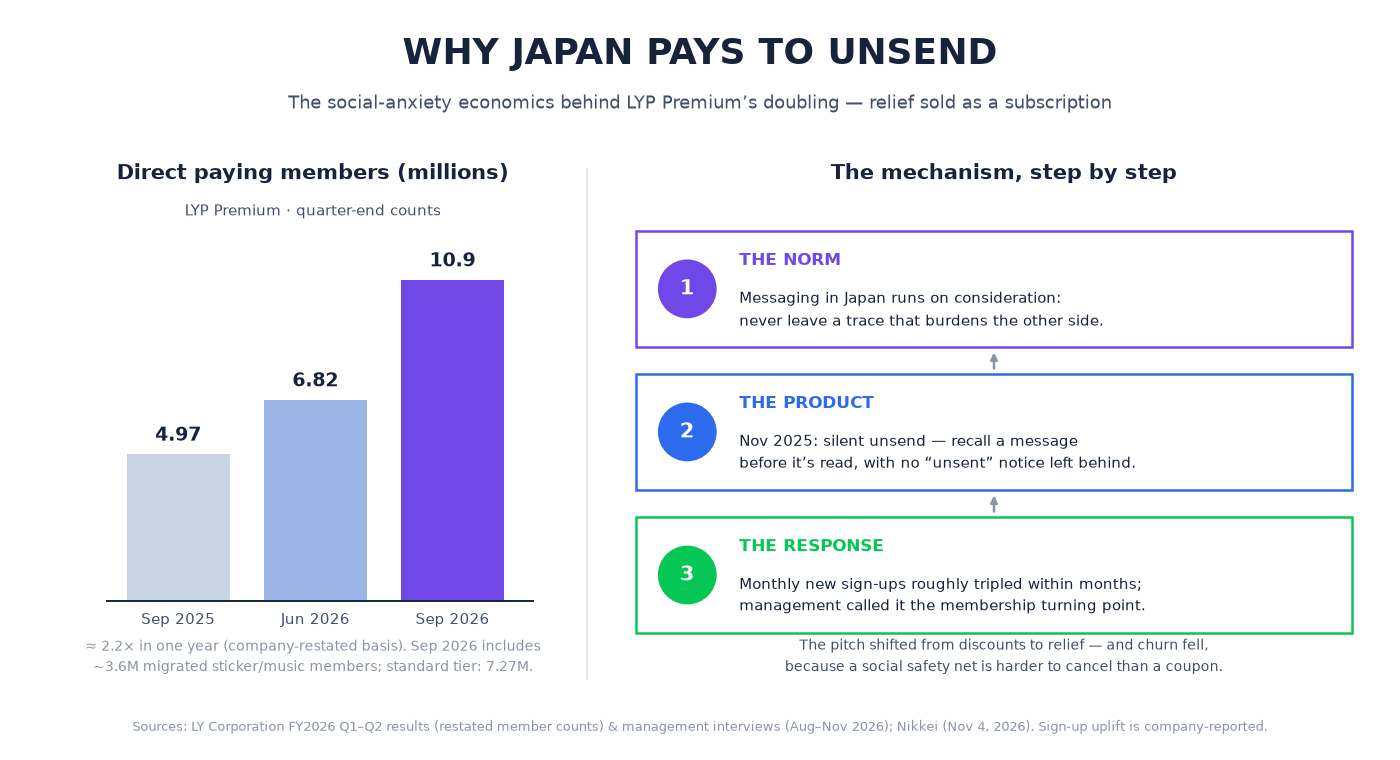
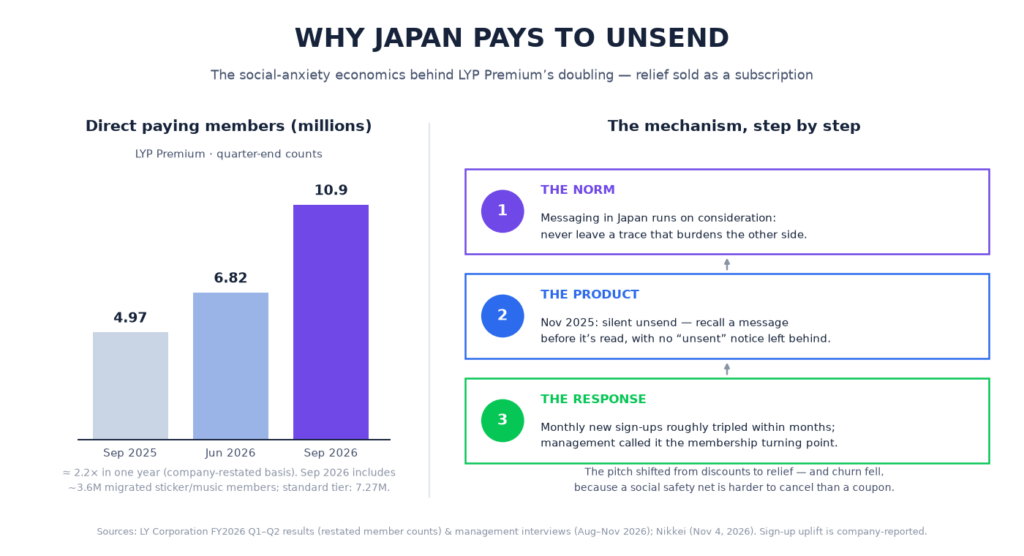
No more storage. No discount code. Just the ability to erase a small social mistake before it lands. And yet this single feature — silent unsend, launched on LINE in November 2025 — did more for LY Corporation’s paid membership than three years of coupons and point boosts. Management says monthly new sign-ups roughly tripled within months of launch, and calls it the turning point. By September 2026, direct paying members of LYP Premium hit 10.9 million, up from about 5 million a year earlier on the company’s restated basis — one of the largest paid subscription bases in Japan, built on top of an app whose entire brand promise was that it would always be free.
What is actually being sold here?
The Norm Comes First, the Product Second
Japanese messaging runs on an unwritten contract of consideration: don’t burden the other person, don’t leave traces that force them to react, don’t make your mistake their problem. A typo sent to your boss is not just a typo; it is a small debt of awkwardness. The standard unsend feature in most chat apps barely helps, because it leaves a tombstone — “message unsent” — which arguably makes things worse. Now the other side knows you regretted something, and has to wonder what it was.
Silent unsend removes the tombstone. Recall before the message is read, and it simply never happened. LINE later added message editing within 15 minutes of sending, another tool for the same job: letting people repair tiny social injuries privately.
Notice the order of operations. LY did not invent a need and market it. It found a norm that already governed 100 million users’ behavior every day, then sold relief from the norm’s harshest edge. That is why adoption felt instant — the anxiety was pre-installed.
Why Relief Beats Rewards on Retention
The economics get interesting at renewal time. A coupon membership has a brutal churn logic: the month you don’t shop, you cancel. LY’s earlier Yahoo-style perks suffered exactly this join-and-cancel pattern. But a social safety net doesn’t work like a coupon. You don’t cancel your insurance the week nothing burns down. As long as you keep sending messages — and in Japan, everyone keeps sending messages — the option value of a clean escape stays alive. Management explicitly credits feature-driven members with lower cancellation rates than the old perk-driven cohorts.
So the pricing ladder makes sense in hindsight: a ¥290 light tier for sticker fans, ¥508–650 standard tiers where the anxiety-relief features live, bundles with Netflix and LINE MUSIC to lower the entry wall. Roughly 3.6 million of the 10.9 million came from migrating existing sticker and music subscribers — consolidation, not all fresh demand, and worth saying plainly. But the 7.27 million standard-tier members are the real signal: people paying, month after month, for dignity insurance.
The Transferable Lesson
Most Western messaging apps treat privacy as a compliance cost and convenience as a free default. Japan just demonstrated that social repair is a product category — and that in a high-context culture, the strongest subscription is the one that removes embarrassment rather than adds entertainment. If you sell software into relationship-dense markets, stop asking what feature users want. Ask what small shame they would pay to prevent.



