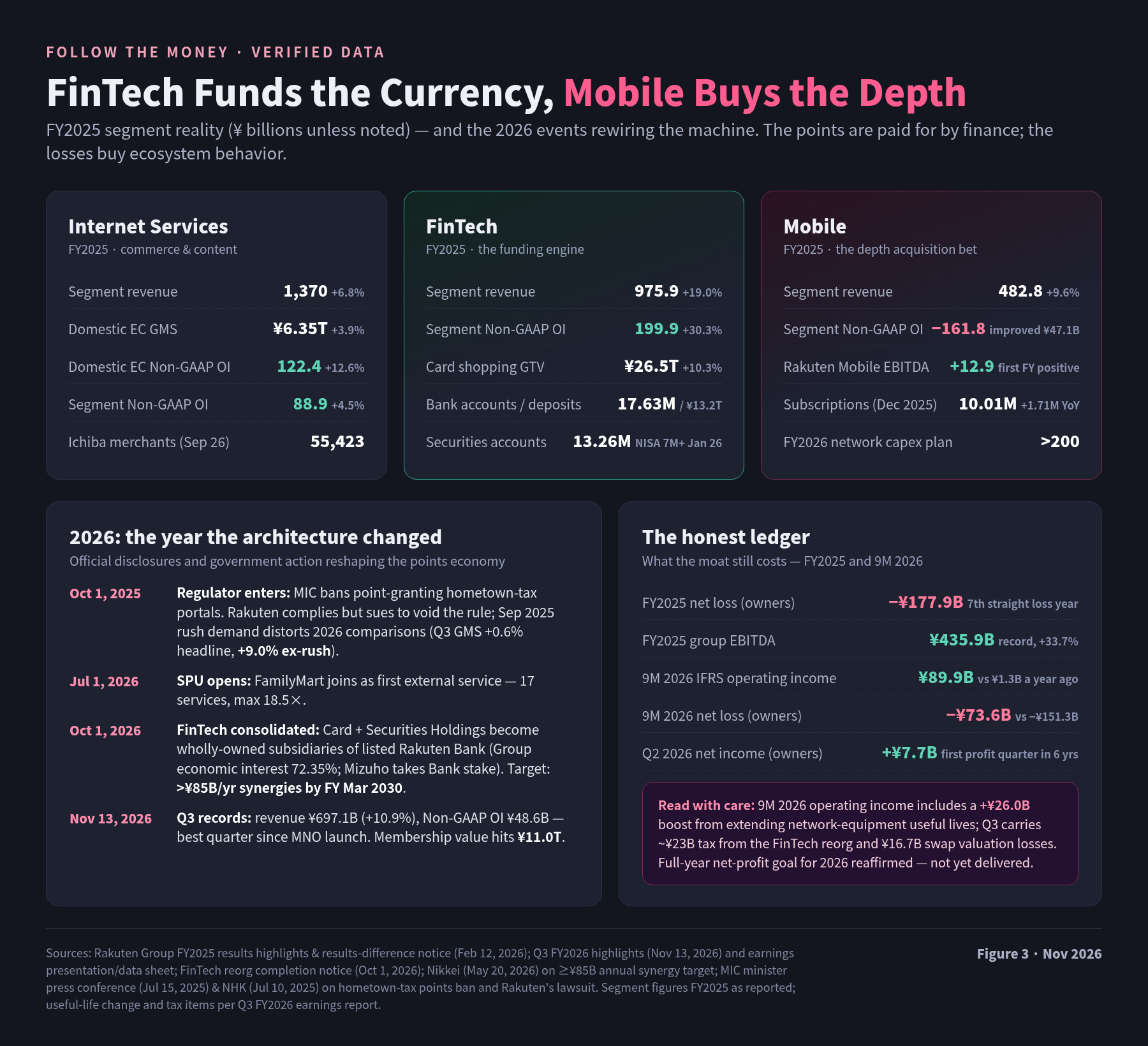
On October 13, 2025, something quietly crossed a threshold in Japan: the cumulative number of Rakuten Points ever issued passed five trillion. One point equals one yen. Do the math and you get roughly ¥5 trillion of spendable value minted by a single company since 2002 — and by September 2026 the counter had already climbed to 5.6 trillion. Japan’s central bank issues the currency. Rakuten, arguably, issues the loyalty layer that sits on top of it.
Here’s the thing most Western marketers get wrong when they look at this: they see a rewards program. A big one, sure, but still a marketing accessory — points as a thank-you for shopping. Rakuten inverted that architecture. The points are the operating system. The 70-plus services — the mall, the credit card, the bank, the brokerage, the mobile carrier, the travel agency — are applications running on it. And once you see the machine that way, the numbers stop looking like loyalty statistics and start looking like monetary aggregates.
This piece walks through how that machine actually works, what the newest disclosures (through Rakuten’s November 13, 2026 quarterly report) reveal, where the moat is genuinely deep, and where it’s starting to crack. If you run a brand, a loyalty program, or a retail media budget, Japan is running the most sophisticated loyalty experiment on earth. You should be taking notes.
The Phenomenon: A Loyalty Program the Size of a Monetary Aggregate
Let’s start with scale, because scale is the argument.
Rakuten’s own investor materials put annual point issuance at roughly 650 billion points — about ¥650 billion of rewards currency minted per year. The company counts more than 10 million online and offline touchpoints where you can earn or burn the balance: convenience stores, drugstores, restaurants, transit top-ups via Suica inside the Rakuten Pay app. In its home market, Rakuten counted 155.5 million registered IDs as of September 2026 — in a country of about 124 million people, which tells you how many of us maintain more than one account.
The behavioral numbers matter more than the raw issuance, though. As of December 2025, 77.3% of users of point-earning services used two or more of them. By September 2026 that figure sat at 76.7%, against a monthly active user base of 46.74 million in Japan, up 4.9% year over year. Read that again: multi-service usage isn’t an aspirational funnel metric. It’s the majority behavior of the user base.
And Rakuten doesn’t just track this — it reports its moat as a KPI. The company’s proprietary “membership value” metric multiplies active users by cross-use by lifetime value minus acquisition cost. It crossed ¥10 trillion for the first time in Q4 2025, and by Q3 2026 it had reached ¥11.0 trillion, up 14.7% year over year. A company that literally puts a trillion-yen number on its loyalty depth in an earnings deck is telling you what it thinks its real asset is. (One honest caveat: membership value is a company-calculated estimate, not an audited financial line. Treat it as a directional compass, not a valuation.)
The Deep Mechanism: Four Layers of Lock-In
Why can’t users just leave? Because leaving isn’t canceling a subscription. It’s demonetizing yourself.
One Currency, Everywhere
The same balance earns and burns across commerce, card, bank, mobile and travel. Abandon any single service and you tax the utility of the whole balance. Every new service you add raises the switching cost of all the others. That’s not a punch card; that’s a compounding exit tax.
The Multiplier Game
Rakuten Ichiba’s Super Point Up program — SPU — turns retention into a progression game. Your earn-rate on every purchase rises with the number of ecosystem services you use. We’ll get to the exact ladder in a moment, but the design principle is what matters: the discount is earned by depth, not by waiting for a sale.
The Financial Flywheel
Who pays for five trillion points? Follow the money and you land in the FinTech segment, which earned ¥199.9 billion in Non-GAAP operating income in FY2025, up 30.3%. Rakuten Card alone processed ¥26.5 trillion in shopping volume that year. Card interchange and banking margins fund point issuance; points drive card usage and mall purchases; those purchases generate more interchange. Amazon is enormous in Japan, but it has no equivalent bank-card-points loop there. That loop is the moat’s funding engine.
The Identity Layer
One Rakuten ID, known everywhere, sitting on purchase data from both online and offline worlds. In an August 2026 interview with trade publication PaymentNavi, Rakuten executives described over three trillion annual interactions across the ecosystem, feeding AI-driven personalization and a retailer analytics product launched in February 2026. The data moat sits underneath the points moat. Each makes the other harder to replicate.
SPU Decoded: Depth Is the Discount
Let’s make the multiplier game concrete, because this is where the behavioral engineering lives.
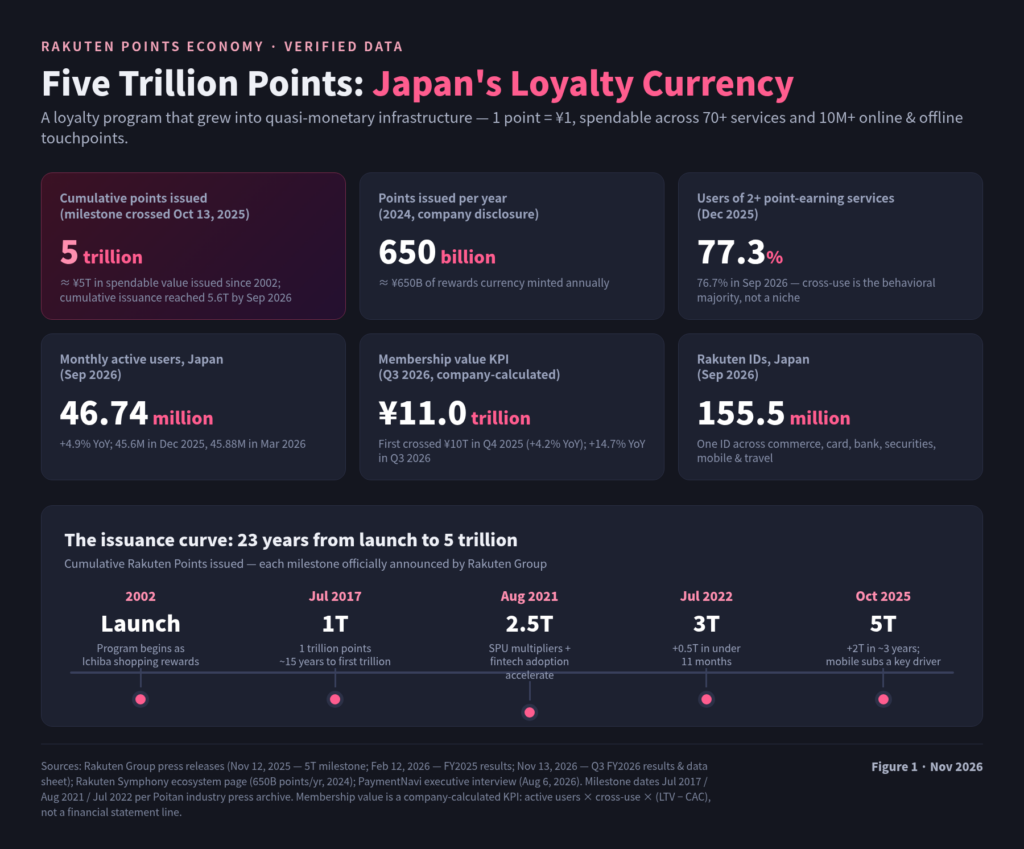
SPU launched in January 2016 with four eligible services and a maximum 7× earn-rate. It celebrated its tenth anniversary in 2026. Along the way it grew to 16 services and an 18× ceiling — and then, on July 1, 2026, something structurally new happened: FamilyMart became the first company outside the Rakuten Group admitted into SPU. Spend ¥3,000 a month (tax included) at the convenience store chain and your Ichiba earn-rate rises by 0.5×, capped at 500 points monthly. The program now spans 17 services with a theoretical 18.5× maximum.
The typical stack looks like this: a base 1× on every Ichiba purchase; +2× for paying with Rakuten Card; +4× for being a Rakuten Mobile subscriber (entry required, capped at 2,000 points per month — roughly ¥50,000 of monthly spend); +2× more for routing ¥2,000+ of Android carrier billing through the mobile account; +1× on dates ending in 5 or 0 when you pay by card. A mobile subscriber paying by card on the right calendar day shops at 8× before touching any of the smaller multipliers from banking, securities, travel or FamilyMart.
Notice what this does psychologically. It converts “which store has the lowest price” into “how do I level up my rate.” Japanese points optimizers genuinely plan purchases around the 5-and-0 calendar and the Shopping Marathon events, where the multiplier climbs with the number of different shops you buy from. The program doesn’t buy transaction spikes the way a coupon does. It buys ecosystem depth, one service adoption at a time.
The Financial Spine: Who Actually Funds the Currency
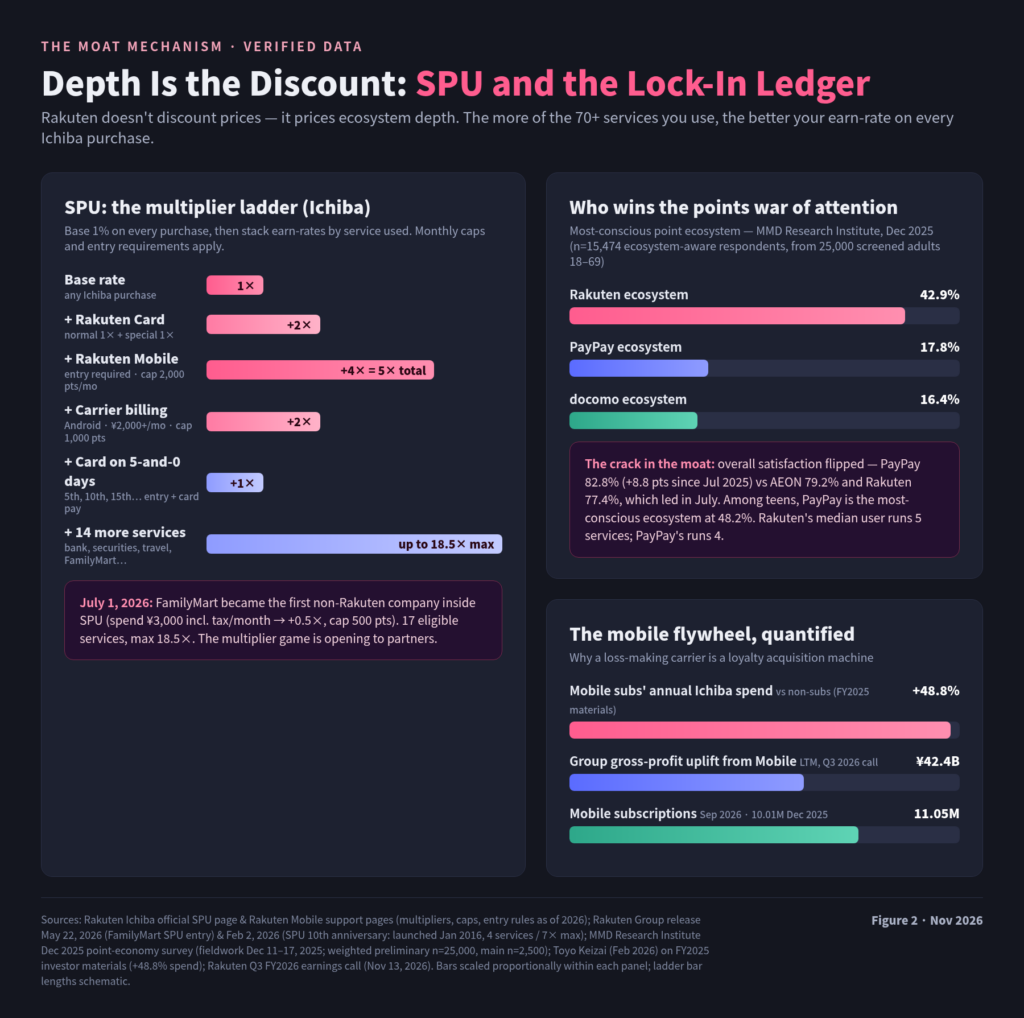
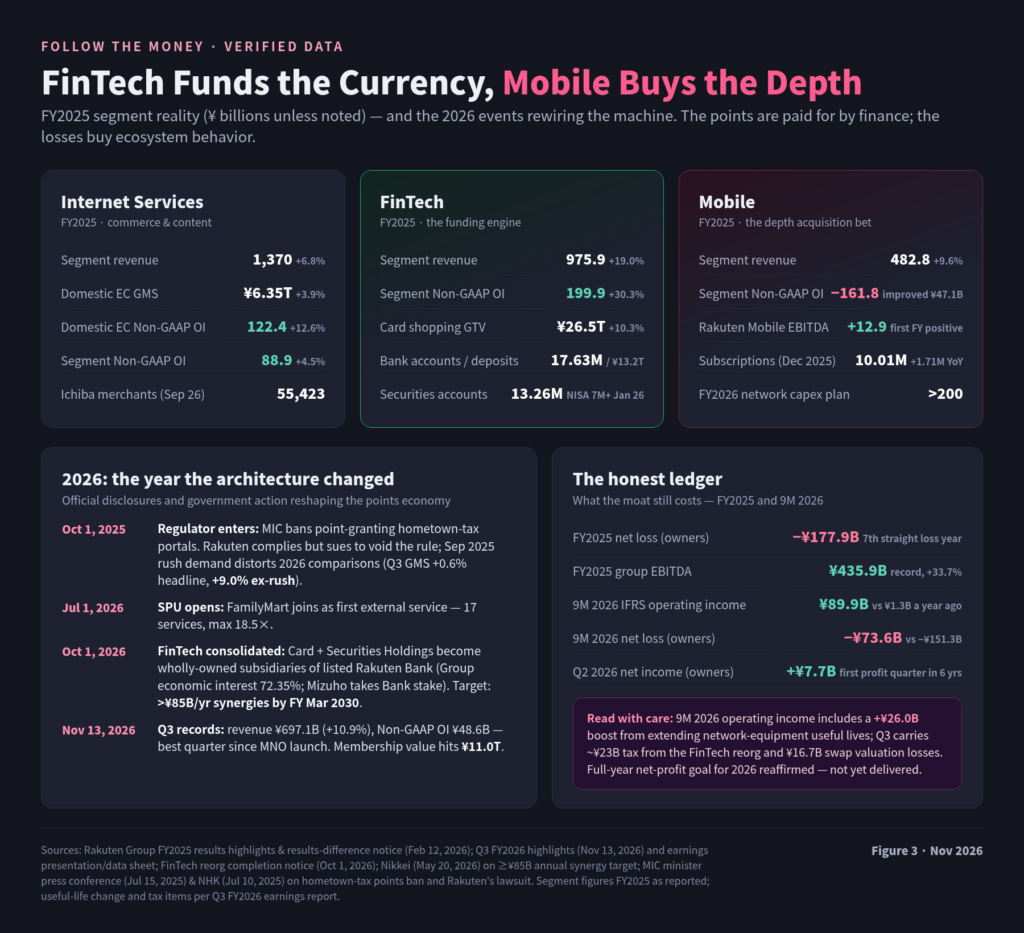
The FY2025 segment picture (Rakuten’s fiscal year matches the calendar year) explains the whole architecture in three columns.
Internet Services — the mall, travel, content — grew revenue 6.8% to ¥1.37 trillion, with domestic e-commerce gross merchandise sales of ¥6.35 trillion, up 3.9% (4.2% adjusted for the prior year’s leap day). Domestic e-commerce operating income rose 12.6% to ¥122.4 billion on a Non-GAAP basis.
FinTech was the profit machine: revenue up 19% to ¥975.9 billion, operating income up 30.3% to ¥199.9 billion. Rakuten Bank ended 2025 with 17.63 million accounts holding ¥13.2 trillion in deposits; Rakuten Securities had 13.26 million general accounts, with tax-free NISA accounts passing 7 million in January 2026. By September 2026 the bank had 18.81 million accounts and the brokerage 14.83 million — crossing 15 million in November.
Mobile was the loss leader in the literal sense: a ¥161.8 billion segment operating loss, though improved by ¥47.1 billion year over year, and Rakuten Mobile itself posted its first full-year positive EBITDA (+¥12.9 billion) since launching the network. Subscriptions hit 10.01 million at the end of 2025 and 11.05 million by September 2026.
Then 2026 rewired the machine. On October 1, Rakuten completed a reorganization placing Rakuten Card and Rakuten Securities Holdings under the listed Rakuten Bank as wholly-owned subsidiaries, with the Group holding a 72.35% economic interest. Nikkei’s reporting on the May announcement put the mid-term synergy target at over ¥85 billion a year in ordinary profit — cheaper internal funding, unified app and data infrastructure, shared customer referrals. The funding engine for the points currency just got consolidated into a single regulated institution. Mizuho, meanwhile, swapped its card stake for a stake in the bank — a signal that Japan’s establishment finance wants exposure to this machine, not distance from it.
The Mobile Paradox: A Loss-Making Carrier That Buys Loyalty
Look at the mobile segment alone and you see a money pit that has tested a decade of patience. Look at it through the ecosystem lens and you see the most effective loyalty acquisition channel Rakuten owns.
The company’s FY2025 investor materials quantify it: Rakuten Mobile subscribers spend 48.8% more per year on Ichiba than otherwise-comparable non-subscribers. On the Q3 2026 earnings call, management put the trailing-twelve-month gross-profit uplift that Mobile contributes to other group services at ¥42.4 billion. The +4× SPU multiplier is the hook; the points earned on the mall can then pay the phone bill itself — a loop that makes the carrier feel free to heavy users.
Segment accounting can’t see any of this. The mobile P&L carries the network costs; the card and commerce P&Ls harvest the behavior. Both things are true at once: the cash burn is real, and the ecosystem logic is real. That’s why the ¥200 billion-plus network capex planned for 2026 is best read not as telecom spending but as loyalty infrastructure spending. It’s also why the demographic detail matters — Toyo Keizai’s reporting on the FY2025 materials notes the share of new mobile subscribers under 30 rose from 23% in 2023 to 29% in 2025. The loss leader is recruiting the next generation of points optimizers.
The Moat Goes External: Uber, FamilyMart and the Toll-Road Turn
For two decades the standard assumption was that a points moat must stay closed. The 2025–2026 moves quietly retired that assumption.
On December 9, 2025, Rakuten and Uber announced a deepened partnership starting with ID linkage: connect your Rakuten ID to the Uber or Uber Eats app and you earn one point per ¥200 spent (before tax) regardless of how you pay. Stack Rakuten Pay on top and the combined earn-rate reaches up to 2%; Rakuten Mobile subscribers got a 20× campaign. In exchange, Uber gains access to Rakuten’s data assets for more tailored recommendations. Let’s be precise about what’s verified here: the official releases describe the mechanics and the data-sharing, but they do not disclose who funds the points issued on Uber’s apps — so treat any claim about the funding split as speculation. What’s undeniable is the direction: an outside platform plugged itself into Japan’s loyalty currency and accepted Rakuten’s ID as the connective tissue.
FamilyMart’s SPU entry pushes the same logic into roughly 16,000 physical stores. And the currency’s convertibility extends further than most outsiders realize: regular Rakuten Points exchange into both ANA and JAL miles at 2 points per mile, with official caps of 20,000 points per month — a partnership JAL and Rakuten formalized back in 2022.
Selective openness, in other words, strengthens the center. Every new place the currency works raises the value of holding it — and the cost of walking away. The moat becomes a toll road: partners route through it, and the toll is paid in data, distribution and dependence.
What Everyone Misunderstands
Three frames worth retiring.
“Points are discounts.” No — SPU is behavioral pricing. A coupon subsidizes a transaction; a multiplier subsidizes a relationship. The economics land differently: Rakuten’s own accounting treats point costs inside marketing costs as retention spending, netted against lifetime value in the membership-value formula. That’s the honest way to book loyalty, and almost nobody outside Japan does it.
“Amazon won Japan.” Amazon Japan is huge, but the market bifurcated by behavioral type rather than by winner. Convenience maximizers default to Amazon; points optimizers live in Rakuten. The 77%-plus cross-use base isn’t shopping there by accident — it’s executing a strategy.
“Mobile is a failure.” See above. It’s a failed standalone telecom bet and a successful ecosystem acquisition channel simultaneously. The consolidated P&L and the ecosystem logic answer different questions.
The Government Enters: When a Points Currency Meets the Regulator
Here’s the storyline most English-language coverage misses entirely — and it may be the most instructive one for anyone building loyalty infrastructure.
Japan’s hometown-tax program lets residents redirect part of their taxes to municipalities in exchange for local products. Portal sites like Rakuten’s competed ferociously on point-back rates, funded by the fees municipalities paid them. The Ministry of Internal Affairs and Communications decided this distorted the program’s purpose, amended its notification in June 2024, and banned point-granting portals effective October 1, 2025.
Rakuten fought back hard: roughly 2.95 million petition signatures delivered to the Prime Minister in March 2025, then an administrative lawsuit on July 10 seeking to void the rule, arguing a cap would suffice where a blanket ban overreaches. The minister publicly confirmed the ban would proceed on schedule. Rakuten complied — it stopped issuing points on hometown-tax donations from October — while keeping the lawsuit alive.
Two lessons. First, when a loyalty currency becomes infrastructure, regulators start treating it as infrastructure; the company’s own framing at its press conference — points have become social infrastructure — cuts both ways. Second, the compliance had a measurable commercial cost: the September 2025 last-chance rush inflated the comparison base so much that Q3 2026 domestic e-commerce GMS grew just 0.6% as reported — but 9.0% excluding the rush. If you model Japan’s e-commerce growth without adjusting for this rule change, your numbers are wrong.
The Crack in the Moat: PayPay’s Simplicity Attack
Now the counterargument, with data instead of vibes.
MMD Research Institute — a Japanese mobile-economy research firm — ran two surveys in December 2025 with a weighted preliminary sample of 25,000 adults and a main sample of 2,500 ecosystem users. Rakuten dominates attention: 42.9% of ecosystem-aware respondents named it their most-conscious points economy, versus 17.8% for PayPay and 16.4% for docomo. Rakuten’s median user runs five services; rivals’ users run four or three.
But satisfaction flipped. PayPay’s ecosystem scored 82.8% overall satisfaction, up 8.8 points since July, ahead of AEON’s 79.2% and Rakuten’s 77.4% — and Rakuten had led that ranking in July at 75.8%. Among teenagers, PayPay is the most-conscious ecosystem at 48.2%. The pattern is consistent across MMD’s survey waves: every age cohort from their twenties up belongs to Rakuten; the youngest cohort belongs to PayPay.
The interpretation writes itself. Rakuten’s depth is its moat and its tax. Seventeen services, entry requirements, monthly caps, points that expire, multipliers that need a spreadsheet — the optimizers love it, and the marginal young user finds it exhausting. PayPay offers a QR code and instant gratification. The core is locked in; the frontier is contested. Complexity compounds loyalty among the committed and repels the uncommitted. Watch which force wins the next five years, because that’s the whole game.
The Honest Ledger: Seven Loss Years and a 2026 Inflection
Let’s not romanticize. Rakuten lost money attributable to owners for seven straight years through FY2025 — ¥177.9 billion in the last of them, wider than the prior year. The moat has been funding a hole, and the hole was mostly mobile.
But the 2026 disclosures genuinely change the trajectory, and they deserve equally honest caveats. Q2 2026 delivered the first quarterly owner-level profit in six years (+¥7.7 billion). Q3 set records for revenue (¥697.1 billion, +10.9%) and Non-GAAP operating income (¥48.6 billion, the best quarter since the mobile network launched). Nine-month operating income reached ¥89.9 billion against ¥1.3 billion a year earlier, and the owner-level loss narrowed to ¥73.6 billion from ¥151.3 billion. The company reaffirmed its goal of full-year net profitability for 2026 — something it hasn’t achieved since 2018.
The caveats: the nine-month operating figure includes a ¥26.0 billion boost from extending the accounting useful lives of network equipment — without that change, nine-month pre-tax income would have been slightly negative. Q3 absorbed roughly ¥23 billion of tax tied to the FinTech reorganization plus ¥16.7 billion of currency-swap valuation losses, which is why a record operating quarter still ended in a ¥62.7 billion owner-level net loss. The operating machine is improving; the bottom line remains a construction site. Both facts belong in any serious analysis.
What It Means for Brands and Marketers
Enough theory. What do you do with this on Monday?
Sell to optimizers, not bargain hunters. Structure offers as point-back rather than price cuts — it protects your reference price and speaks the local language. Time campaigns to the 5-and-0 calendar and Shopping Marathon windows when multipliers peak; a point-up day is when this audience is primed to consolidate purchases.
Run Ichiba like a boutique, not a listing. Rakuten’s B2B2C model — 55,423 merchants as of September 2026 — rewards store personality, newsletters and repeat cultivation. The platform’s own promotion platform and a 15.8% take rate mean you’re effectively buying into a retail media network with CRM attached. Budget accordingly.
Treat ecosystem partnerships as a channel. The Uber and FamilyMart integrations show slots opening for point-funded co-marketing outside the group’s walls. If your brand can plug into the currency, the currency’s holders will find you.
And steal the accounting. Rakuten’s membership-value formula — active users × cross-use × (LTV − CAC), with point costs booked as retention spending — is the cleanest published framework for loyalty economics anywhere. You don’t need a bank to use it. You need the discipline to measure depth instead of redemptions.
Conclusion: Design an Economy, Not a Punch Card
Rakuten turned loyalty from a marketing accessory into something Japan’s consumers treat as infrastructure: 5.6 trillion points of cumulative issuance, three-quarters of users living across multiple services, an ¥11 trillion internal valuation of membership depth, a consolidated financial engine funding the currency, and partners lining up to route through it. The government now regulates it like infrastructure. The youngest consumers are flirting with simpler alternatives. Both of those facts prove the same point — this stopped being a rewards program a long time ago.
For brands, the lesson is structural. The moat isn’t the mall, the app, or any single service. It’s the balance, the multiplier stack, and the identity that make leaving feel like losing money. Design loyalty as an economy — a universal currency, behavioral multipliers, a funded flywheel — and the retention takes care of itself. Japan’s points optimizers are the most sophisticated loyalty audience on earth. They’re already playing the game you’re still trying to design.






