Everyone who watches Asia’s platform wars keeps waiting for Japan to produce its WeChat. It never happened — and after fifteen years, it is safe to say it never will. What Japan produced instead is stranger and, for marketers, more useful: a super-app assembled out of parts that already existed, stitched together by a holding company, a paid membership, a QR wallet, and now an AI agent.
In December 2025, LINE crossed 100 million monthly users inside Japan — roughly eight out of every ten people in the country, counting infants and grandparents. Three months later, the group’s payment arm PayPay listed on Nasdaq, priced at $16 per American depositary share, in the largest Japanese tech listing in years. And in April 2026, LY Corporation — the SoftBank–NAVER-controlled holding company formed from Z Holdings, LINE and Yahoo Japan in October 2023 — unified its two separate AI assistants under a single agent called Agent i.
None of this looks like the Chinese playbook. WeChat accreted services onto chat until the chat app became an operating system. Alipay grew out of checkout into finance, then into daily life. Japan did the opposite: it took two mature, beloved, slightly tired giants and began the slow work of connecting them from behind. This piece walks through how that assembly works, what the verified numbers actually say, where the popular narrative gets Japan wrong, and what the whole structure means if you buy media or run CRM in this market.
Why Japan Never Grew a WeChat
Start with what Japan already had. LINE launched in June 2011, built by NHN Japan in the months after the Tōhoku earthquake, when the phone network failed and people needed a data-based way to reach each other. It won messaging completely. Yahoo Japan, born in 1996 as a SoftBank joint venture, won search, portals and a giant slice of e-commerce. By the time the two ended up under the same holding roof, each was already a daily habit for tens of millions of people.
That is the structural point outsiders miss. Japan never lacked super-app functions. It lacked their integration. Payments, points, chat, search, shopping, news, tickets — all of it existed, operated by competing empires with their own loyal users. Rakuten had its point economy. Docomo had its carrier ecosystem. Convenience stores acted as physical infrastructure for everything from bill payment to concert tickets. The services were abundant; the seams between them were the problem.
Add the cultural blockers and the picture sharpens. Cash held on far longer than in China or Korea. Card networks and point systems were entrenched. The population is old, and older users punish forced interface change. When your grandmother already has a workflow she trusts, merging her apps is not a product upgrade — it is an insult.
So when Z Holdings absorbed LINE and Yahoo Japan into LY Corporation on October 1, 2023, the mission was not to build a new app. The official language was a life platform. The practical agenda was narrower and harder: keep both brands intact, and build connective tissue between them — accounts, data, membership, payment rails — without breaking the habits that made each one valuable.
The Slow Path, Milestone by Milestone
The timeline tells you what kind of strategy this is. Not a blitz. A sequence of deliberate sutures, punctuated by one genuine crisis.
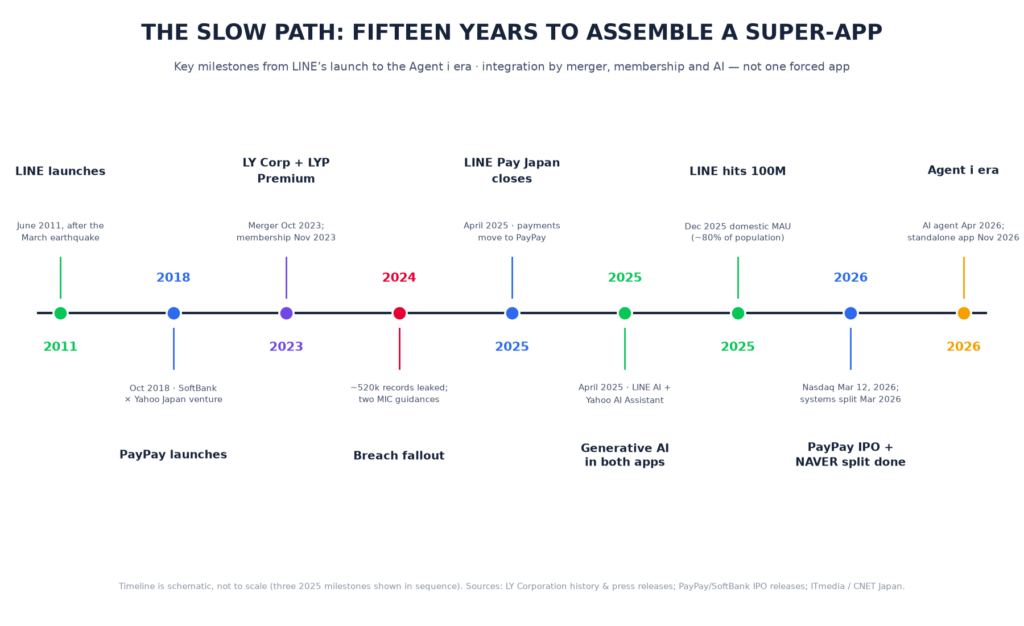
Read the sequence and a pattern emerges. 2023: merge the companies, launch the membership. 2024: absorb the security crisis. 2025: kill the redundant payment app, put generative AI into both flagship apps, cross the 100-million line. 2026: take the payment arm public, finish separating from NAVER’s systems, unify the AI layer. Every step consolidates something that already existed. Nothing asks the user to adopt a new habit cold.
The Three Surfaces and the Thread Between Them
Here is the operating map of the whole ecosystem. LINE owns the relationship surface — the place where people talk to family, friends, and increasingly to businesses and city halls. Yahoo owns the intent surface — search, shopping, news, the moment someone wants something. PayPay owns the transaction surface — the scan at the register, the points that come back. Three apps, three jobs, one audience behind them.
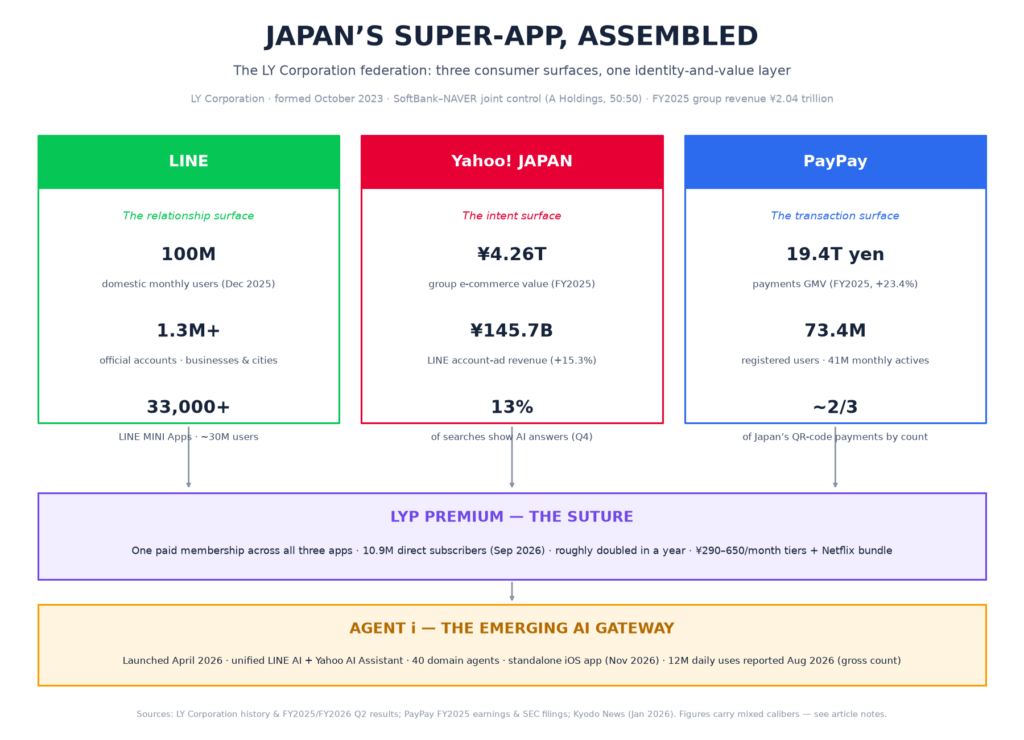
The company is explicit that LINE’s core communication stays free and clean. Management has spent years publicly resisting the temptation to stuff the chat app with commerce clutter, because the chat trust is the asset. Integration happens behind the glass: linked accounts, shared membership benefits, point flows that cross app boundaries. If you keep waiting for Japan’s WeChat — one icon containing everything — you will misread every move this company makes.
LYP Premium: Paying Users to Cross Over
The first and most revealing instrument is LYP Premium, launched November 29, 2023, as an upgrade of the old Yahoo! Premium. The bundle is almost comically Japanese: unlimited access to more than 12 million eligible LINE sticker designs — the emotional currency of the entire messaging culture — plus PayPay point boosts and Yahoo Shopping perks, all under one subscription.
Think about the mechanism. WeChat keeps you inside one app by making everything available there. LY pays you, in stickers and points, to keep using three apps while behaving like one customer. It is the anti-WeChat: federation by incentive rather than consolidation by interface.
And the numbers say it is working. At the end of September 2026, direct paying members reached 10.9 million — roughly double a year earlier, per the company’s Q2 FY2026 results. The composition matters for honesty’s sake: about 7.27 million hold the standard ¥650/month plan (¥508 via the web), while the rest arrived through a ¥290 stickers-focused light plan (migrated from the old LINE Stamps Premium), a LINE MUSIC bundle, and a newer Netflix bundle. Counting everyone who gets LYP benefits bundled free with a SoftBank or Y!mobile phone contract, the total membership base was around 26 million as of mid-2026. Either way you cut it, a membership product that barely existed three years ago now touches roughly a fifth of the population.
PayPay: Payments Lead, Commerce Follows
If the membership is the suture, PayPay is the connective tissue. Launched in October 2018 as a SoftBank–Yahoo joint venture, it burned cash in the famous 10-billion-yen giveaway campaigns, survived the competition, and became the default QR wallet of the country.
The verified scoreboard, from PayPay’s own disclosures around its IPO: consolidated gross merchandise value of ¥19.4 trillion in the fiscal year ended March 2026, up 23.4% (a figure LY later corrected upward in May — the correction itself is a reminder to always re-check headline GMV). Operating revenue of ¥380.7 billion, up 27%. Adjusted EBITDA of ¥111.1 billion, up 89% — the profitability inflection that made the listing possible. Registered users: 73.4 million at March-end, of whom about 41 million transact monthly and more than 40 million have completed identity verification.
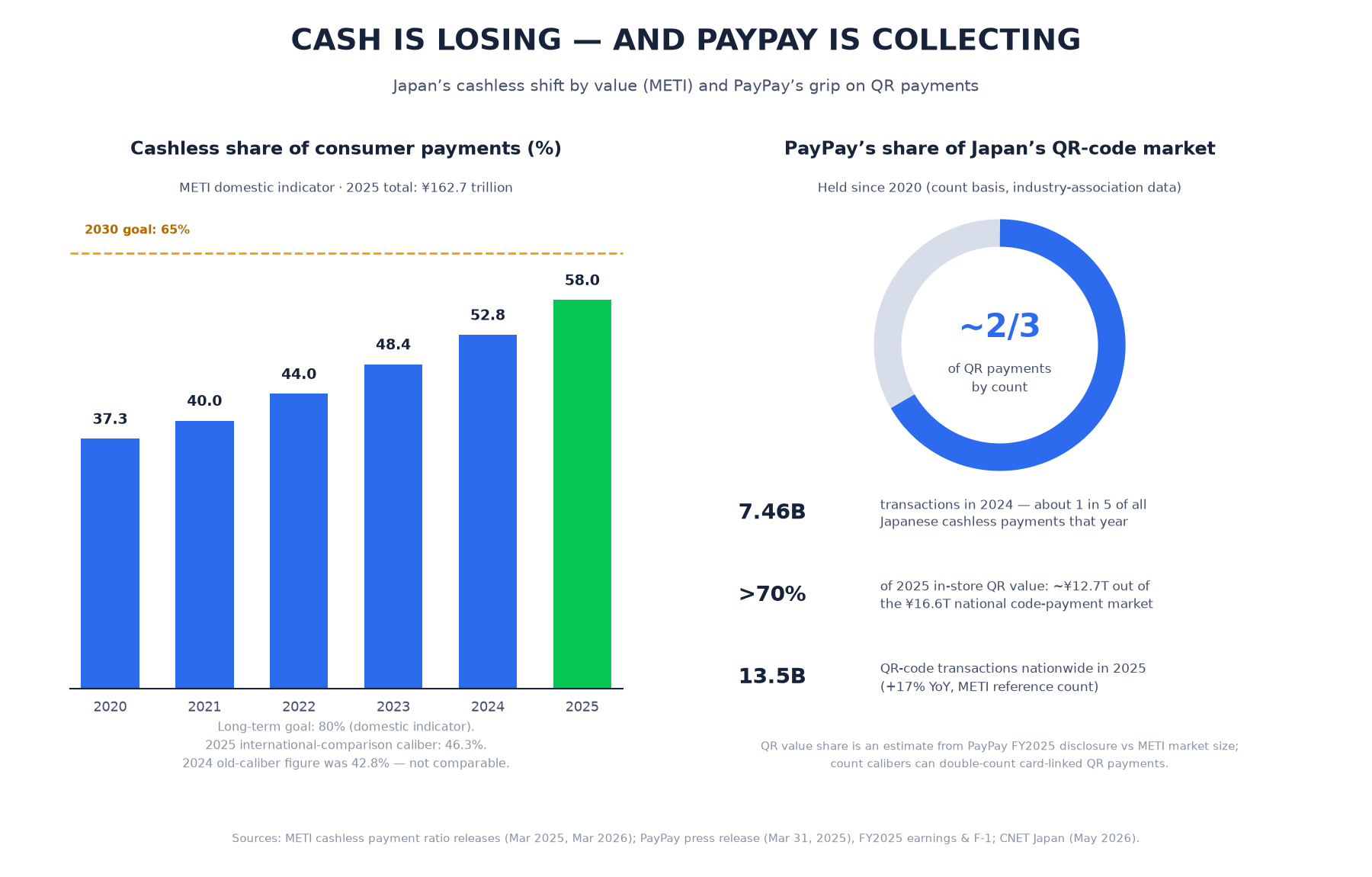
On market structure, one calibration note that most coverage botches. By transaction count, PayPay has held roughly two-thirds of Japan’s QR-code payment market since 2020 — 7.46 billion transactions in calendar 2024, which worked out to about one in five of all cashless payments in the country, cards included. By in-store QR value, its share looks even bigger: roughly ¥12.7 trillion of the ¥16.6 trillion national code-payment market in 2025, or north of 70%, though that ratio is an estimate across two sources with slightly different scopes. Quote the caliber, not just the share.
The March 2026 Nasdaq listing (ticker PAYP, $16 per ADS, about ¥94.6 billion net proceeds to the company) funds the next phase: payment leading commerce, not the reverse. Alipay grew payments out of commerce. PayPay is growing commerce out of payments — securities, banking, credit, mini-apps inside the wallet. The direction of the arrow is the strategic story.
The Cashless Backdrop Finally Turned
For years the standard line was that Japan clings to cash. The government data now complicates that story in an important way — and the complication itself is a trap for anyone quoting old numbers.
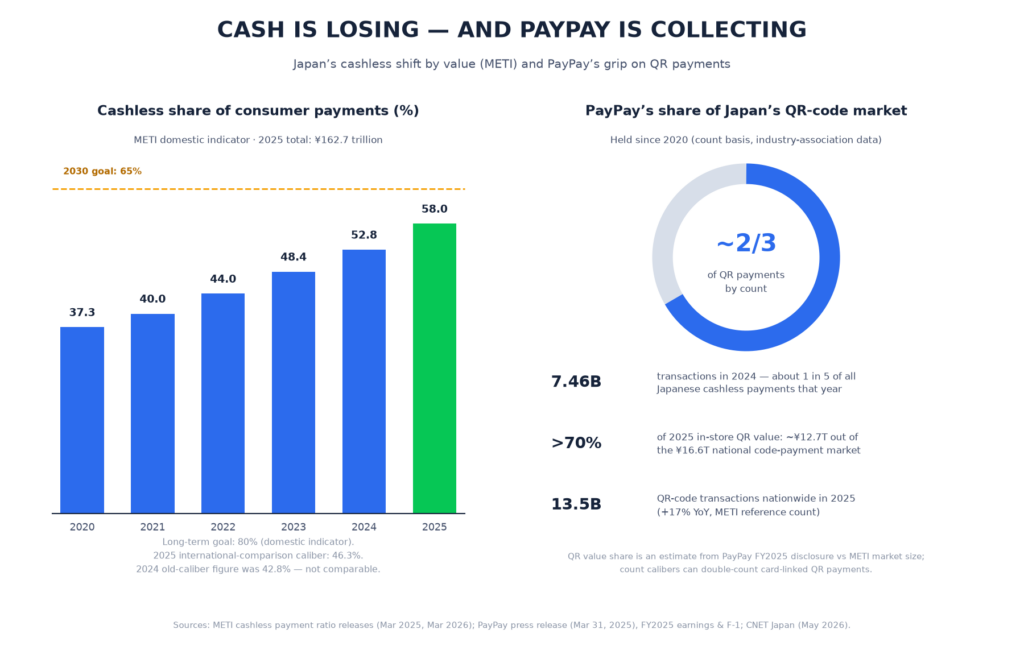
Here is what happened. METI reported that the 2024 cashless ratio reached 42.8% of consumer payment value — beating the government’s 40%-by-2025 target a year early. Then, in December 2025, a government review panel changed the measuring stick: it excluded imputed rent on owner-occupied housing (about ¥57 trillion of denominator that nobody actually pays at a register) from the headline domestic indicator. On that new basis, the 2025 ratio came out at 58.0%, or ¥162.7 trillion, with new targets of 65% by 2030 and 80% long-term. The old international-comparison caliber still exists — on it, 2025 reads 46.3%.
So: is Japan 43% cashless or 58% cashless? Both numbers are official; they answer different questions. If you see a 2026 article citing 42.8% as current, it is quoting a stale figure on a retired basis. Either way, the direction is unambiguous — QR-code transactions grew 17% in 2025 to 13.5 billion nationwide — and the long tail of cash is shrinking faster than the stereotype allows.
The Breach That Bought the Slow Path Its Pace
No honest account skips the crisis. In October 2023 — the same month LY was born — the company disclosed that attackers had exploited a NAVER Cloud-linked authentication path and accessed data touching up to roughly 520,000 records, including user and business-partner information. Japan’s Ministry of Internal Affairs and Communications issued administrative guidance not once but twice, an unusual escalation that put the SoftBank–NAVER governance structure itself under the microscope.
What followed was a multi-year, expensive rebuild: severing shared authentication, separating networks, relocating servers and data to Japan, and unwinding the outsourcing arrangements that had made the cross-border stack efficient in the first place. LY’s own compliance disclosures show the parent-company system separation completed by March 2025, all domestic and overseas subsidiaries separated by the end of March 2026, and residual data on legacy systems deleted by June 2026.
Read that timeline against the integration timeline and you understand the pace. The slow path is partly a design choice — respect user habits, federate gently — and partly a tax. Every engineering quarter spent on separation was a quarter not spent on cross-service synergy. When people ask why LY moves slower than a Chinese super-app, part of the answer is that it was rebuilding its foundation while trying to extend the building.
Agent i: The Agent as the New Front Door
The most interesting bet in the whole structure launched on April 20, 2026. Agent i unified the two assistants the company had shipped a year earlier — LINE AI and Yahoo AI Assistant — into a single agent living inside both apps. Ask it anything; it draws on Yahoo’s search and content graph, LINE’s services, and a growing set of specialized domain agents covering everything from money and health to travel, cooking and fandom life.
By the end of August 2026, the company reported the equivalent of 12 million daily uses and 27 domain agents; in November it shipped a standalone iOS app with widgets and task notifications, and the agent roster reached 40 domains. Two honesty flags: the usage figure is a gross daily count across services, not deduplicated unique users, and the company has not published retention or commerce-conversion metrics for the agent. Treat adoption as promising, not proven.
Strategically, though, the intent is legible. If users start their day by asking an agent rather than opening an app, the agent becomes the cross-service gateway — the super-app’s front door without the super-app’s interface problem. Management has framed 2025 as the year of building AI agents and 2026 as the year of showing results, and has begun monetizing heavier usage. For anyone thinking about search visibility, this is where Japan’s generative-engine story gets concrete.
What Everyone Gets Wrong About This Market
Four corrections, each earned by the data above.
Late means behind. Integration arrived late; the market was never primitive. Japanese point-loyalty behavior is arguably the most sophisticated on earth — consumers optimize point multipliers across services the way traders watch spreads. The gap was architectural, not behavioral.
LY will become one app. It will not, and it should not. Two brands with decades of equity, serving overlapping but distinct emotional jobs, do not merge their interfaces without destroying value. The strategy is federation, and every disclosed product — membership, linkage, agent — respects that.
100 million users means 100 million customers. The milestone is launch-based: open the app once in the month and you count. Messaging frequency is genuinely extreme, but commerce conversion inside LINE remains modest — Japan’s brands treat LINE primarily as CRM and retention rail, not as Thailand-style chat-commerce bazaar. Reach and revenue are different curves.
The breach was a footnote. It was a structural event that reset the governance, the cost base and the schedule. Any synergy model that ignores 2024–2026 separation spending is fiction.
The Marketer’s Operating Map
Enough architecture. What do you actually do on Monday?
Run LINE as the relationship layer. Japan’s official-account ecosystem is mature beyond almost any market: more than 1.3 million business and municipal accounts, of which roughly 450,000 pay for advanced tiers (global count; domestic paid counts run lower and the calibers shift between quarters). Broadcasts, rich menus, sticker campaigns, step-message journeys — this is where retention lives. LINE’s own ad business proves the money follows: account-based advertising revenue grew 15.3% to ¥145.7 billion in FY2025 even as the company’s search-ad revenue fell 10.4%.
Run Yahoo as the intent layer. Search, Shopping, and the PayPay point loop remain the conversion machine for high-intent demand. But note the tremor underneath: in the fiscal fourth quarter, AI-generated answers appeared on 13% of Yahoo searches, cannibalizing the classic ad inventory. The intent surface is being rewritten by the agent — plan your structured data and feeds accordingly.
Design for the point economy, not the discount economy. Japanese consumers respond to point multipliers and cross-service point circulation more reliably than to raw price cuts. PayPay-point campaigns inside Yahoo Shopping, coupon flows inside the wallet — these ride existing behavior rather than fighting it.
Ride the membership suture. LYP Premium’s bundles create co-promotion inventory — sticker campaigns, member-only coupons, PayPay perks. Brands that attach to the cross-service thread get seen in three contexts for one integration effort.
Prepare for agent-mediated discovery. If Agent i becomes the doorway, the brands it can read, cite and transact with win. Agent-readable offers, clean product feeds, structured FAQs — Japan’s GEO frontier is forming now, while adoption metrics are still soft and competition for agent attention is still cheap.
Risks and Honest Caveats
The synergy case is multi-year. Account linkage and cross-use rates improve quarter by quarter, not WeChat-style overnight; model accordingly. Governance remains a live wire — SoftBank and NAVER still share control through A Holdings, regulators still watch, and the breach precedent proved tail risk is real even after the separation completed. The demographic ceiling is arithmetic: 100 million of 124 million people leaves no user-growth story, so everything depends on depth — ARPU, commerce attach, membership conversion. And the cash tail, while shrinking, still bounds the addressable digital economy. A super-app thesis in Japan lives or dies on cross-use, not on headline reach.
The Takeaway
Japan’s super-app was never going to emerge. It was assembled — a messaging empire and a portal empire, joined by a holding company, a paid membership with stickers as bait, a QR wallet with two-thirds of its market, and an AI agent that might become the front door to all of it. The slow path fits the country: habits already exist, loyalty is point-shaped, and users punish forced change.
For marketers, the map is the federation — LINE for relationships, Yahoo for intent, PayPay for transactions, LYP Premium as the thread, Agent i as the emerging doorway. And the lesson travels beyond Japan: a super-app does not require one app. It requires one identity-and-value layer across the apps a nation already loves.