Nvidia reports earnings after the close on November 17 — its first since founder Jensen Huang resigned on November 12, with CFO Colette Kress serving as interim CEO. The governance drama has consumed the headlines. But the more durable question for the stock, and for everyone building on AI infrastructure, sat in four separate announcements that landed on November 16. Taken individually, each is a routine news item. Taken together, they sketch the strongest one-day case yet that the company’s famous software moat is getting shallower.
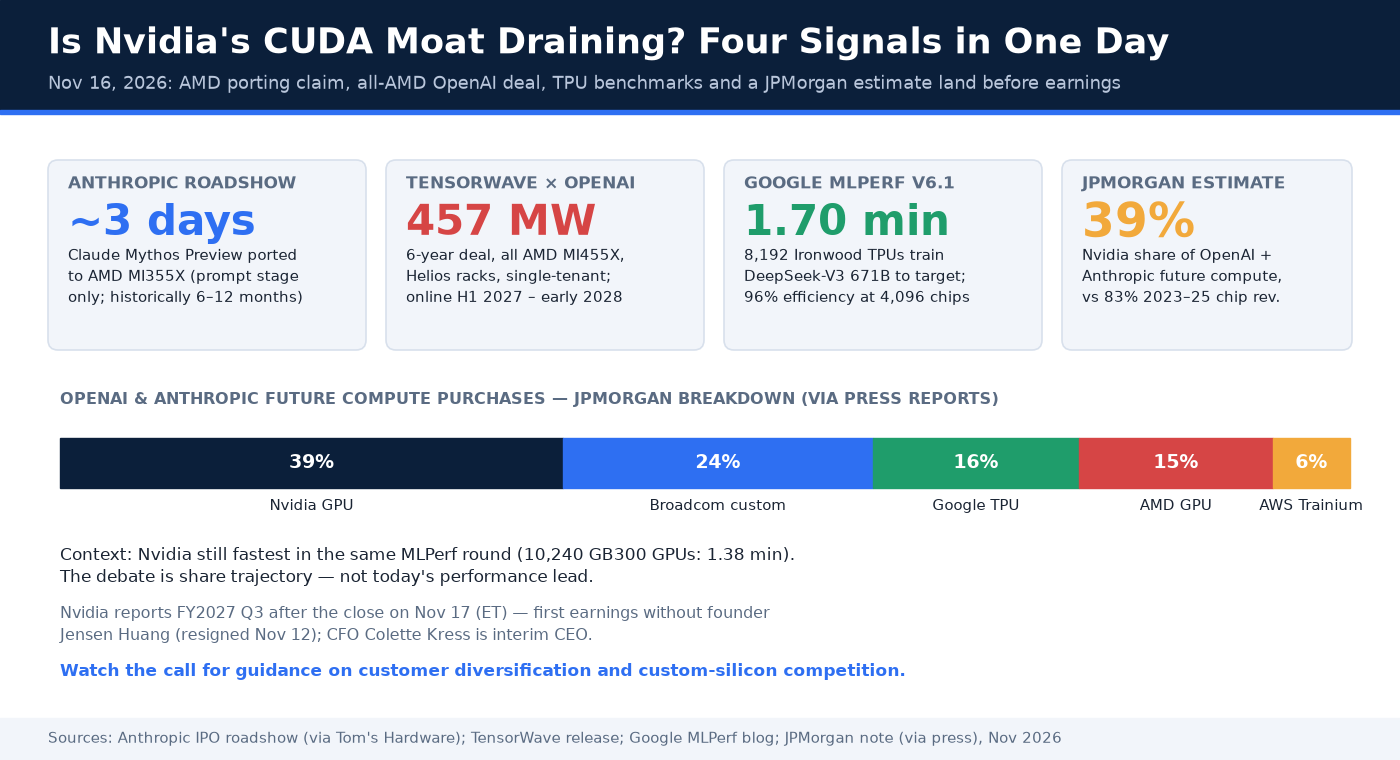
Start with the claim that would have sounded like heresy a year ago. On its IPO roadshow, Anthropic told investors that its Claude Mythos Preview model did the software work needed to run on AMD’s MI355X GPUs in about three days, with almost no human intervention — writing, in the company’s telling, nearly 100% of the required kernel code itself. The comparison point, per Tom Brown, Anthropic’s co-founder and chief compute officer, was six to twelve months of engineering historically. The claim comes with an important asterisk that responsible coverage should keep attached: the three days covered prompt processing for a single model at a useful performance level, not a full production migration. Even so, the direction is unmistakable. CUDA’s deepest defense was never the instruction set; it was the years of human labor required to make anything else work. If frontier models can now perform that labor on themselves, the tax that kept the industry on Nvidia hardware falls dramatically.
Signal two moved from claim to contract. TensorWave, the AMD-focused AI cloud provider, announced a six-year agreement to deliver OpenAI 457 megawatts of dedicated, single-tenant capacity built entirely on AMD Instinct MI455X GPUs and AMD’s Helios rack-scale systems, with first capacity online in the first half of 2027 and full deployment by early 2028. OpenAI’s compute CTO Uday Ruddarraju framed it as an extension of the previously announced AMD partnership. Read that again slowly: one of the two largest buyers of AI compute on earth committed nearly half a gigawatt — a mid-sized city’s worth of power — to a non-Nvidia stack, on purpose, at scale. This is no longer benchmark theater; it is procurement.
Signal three came from Google, which published its seventh-generation Ironwood TPU results in the MLPerf Training v6.1 round. The headline numbers: 8,192 Ironwood chips brought the DeepSeek-V3 671B pretraining benchmark to target quality in 1.70 minutes, with 96% scaling efficiency at 4,096 chips, and 640 chips hit the target accuracy on MLPerf’s first-ever agentic reinforcement learning benchmark in 18.02 minutes — 0.765 against a 0.69 goal, with training chips idle less than 3% of the time. The model identifications come from MLCommons’ supplemental results documentation rather than Google’s blog post, which refers only to target models. Fairness requires the counterweight: Nvidia’s own submission — 10,240 GB300 GPUs finishing the same pretraining benchmark in 1.38 minutes — was the fastest in the round. Nvidia still wins the race. The news is that Google’s custom silicon is now credibly in the same race, on neutral third-party terms, including workloads built around Chinese open-weight models.
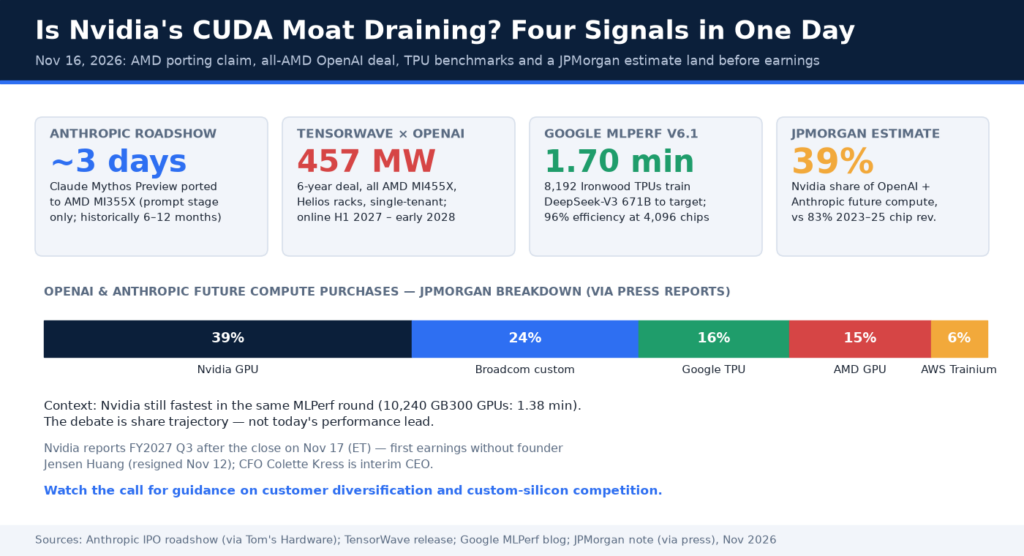
Signal four is the one that ties the others into an investable thesis. A J.P. Morgan Asset Management note by Michael Cembalest, titled “The Icarus Files” and cited in press coverage including Seoul Economic Daily and NDTV Profit, estimates that Nvidia GPUs account for just 39% of the future compute purchases committed by OpenAI and Anthropic — against roughly 83% of total AI chip revenue Nvidia captured across 2023 to 2025. The reported breakdown of the remainder: Broadcom custom silicon at 24%, Google TPUs at 16%, AMD GPUs at 15%, and Amazon’s Trainium at 6%. The figures are a bank’s estimate compiled from commitments, not audited bookings, and deserve that caveat. But they quantize what the other three signals demonstrate qualitatively: the two most important customers in the market are deliberately diversifying away, and the tooling friction that used to prevent diversification is collapsing.
Cembalest’s own summary of the shift, as quoted in the coverage, bridges signals one and four neatly: a year ago it took six to twelve months to get a model running on AMD GPUs; with engineering work done by the latest AI models, a new model can be brought up in three days. The moat, in this telling, is being drained by the very technology it was built to serve — an irony sharp enough to name a research note after Icarus.
Now the honest other side. Nvidia’s lead is not imaginary: it posted the fastest training time in the same MLPerf round, its NVL72-scale systems remain the default for frontier training, and its networking, memory and software stack still sets the integration standard competitors must match piece by piece. Anthropic’s three-day claim covers one stage of one model. TensorWave’s capacity arrives in 2027 and 2028, not next quarter. And demand overall keeps growing fast enough that a shrinking share of a booming market can still mean growing revenue — the bull case is that 39% of a much larger pie beats 83% of a smaller one. Anyone shorting the moat story on a single day’s news is trading narrative, not arithmetic.
But the structural direction now has evidence on four independent axes: a frontier lab saying the porting tax collapsed, a frontier lab signing half a gigawatt of the alternative, a hyperscaler proving the alternative on neutral benchmarks, and a major bank’s estimate putting numbers on the shift. That is what a thesis looks like before it becomes consensus.
Which is why tonight’s call matters beyond the EPS print. The number analysts will parse hardest is not this quarter’s revenue — it is any language about customer concentration, custom-silicon competition, and the durability of the 2028 growth outlook under a diversifying customer base. The CUDA moat made Nvidia the toll booth of the AI economy. Four announcements on November 16 suggest the traffic is learning to build bridges. The toll booth operator’s first earnings without its founder is the moment we find out whether the company sees the bridges too — and what it intends to charge for them.