For two years, generative engine optimization has been the marketing industry’s favorite thought experiment: everyone agrees AI assistants are becoming the place where purchase decisions start, nobody quite knows what to sell against it. A November 16 report from Digiday describes one of the first credible answers — a publisher that has packaged AI visibility into a paid product, run it for real consumer brands, and produced numbers.
Bustle Digital Group, whose titles include Bustle, Nylon, Elite Daily and Scary Mommy, has built a GEO offering internally named ECHO in partnership with Profound, the AI-visibility analytics company that raised a $180 million Series D at a $1.8 billion valuation in September, according to SiliconANGLE. At least three brands have paid for it. The named results involve two very different categories: skincare and diapers.
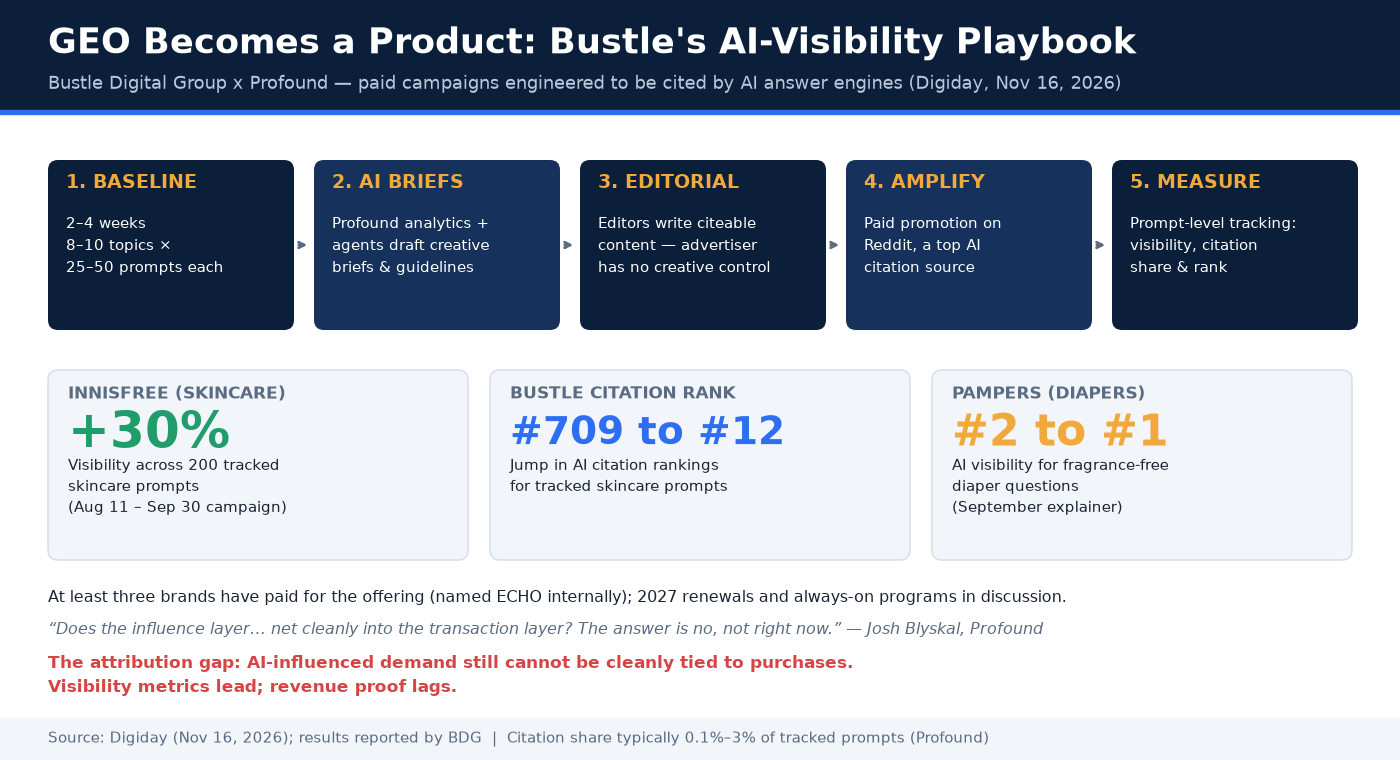
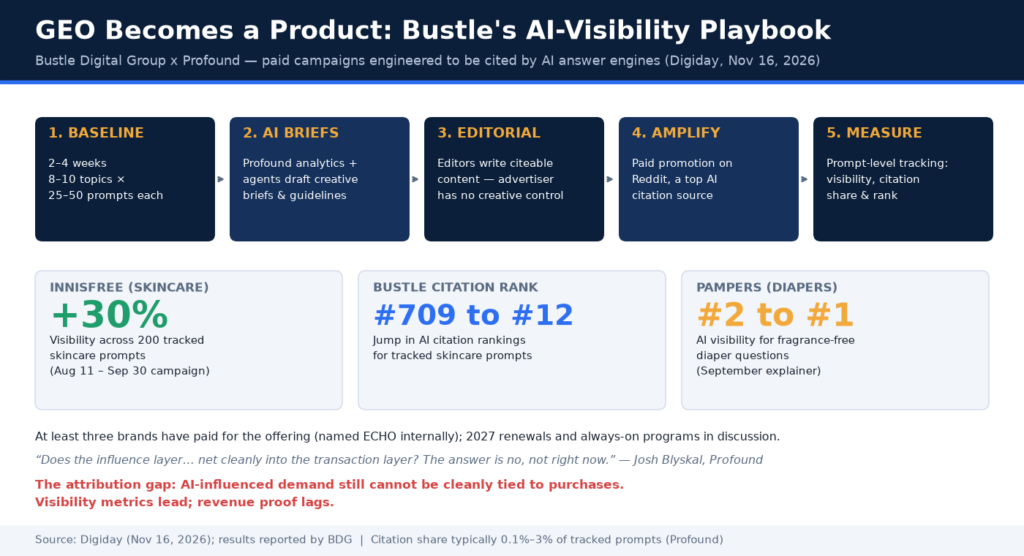
The workflow is the interesting part, because it resists the temptation to turn GEO into glorified advertorial. It runs in five stages. First, a two-to-four-week baseline research phase maps eight to ten topics relevant to the brand, with 25 to 50 tracked prompts per topic — building a measurement universe before any content is written. Second, Profound’s analytics and AI agents trained on BDG’s editorial archive generate creative briefs and guidelines: what AI answer engines currently cite, what they miss, what content shapes earn citations. Third — and this is the load-bearing wall — BDG’s editors write the actual content, with no advertiser involvement in creative. Fourth, the content gets paid amplification on Reddit, which BDG’s research identifies as a significant citation source for answer engines. Fifth, everything is measured at the prompt level: visibility, citation share, citation rank.
Graham Howes, BDG’s SVP of distribution and AI intelligence, was blunt about why the editorial firewall stays intact: “The advertiser has no hand in the actual creative development at all. We leave that entirely up to our editors, partly because we want to make sure that we are following all of the best practices of what gets cited, and something that is very heavy-handed on the advertorial front is very unlikely to do that.” In other words: the machine that decides what to cite can smell a press release, and BDG is betting its product on staying on the right side of that filter.
The results, as reported by BDG to Digiday, are specific enough to evaluate. For Innisfree, the Amorepacific-owned skincare brand, a campaign running August 11 to September 30 lifted the brand’s visibility across 200 tracked skincare prompts by 30%. Over the same tracking universe, Bustle itself climbed from citation rank #709 to #12 — a striking number that reveals the two-sided business model: the campaign sells brand visibility while simultaneously building the publisher’s own standing as a cited source. For Pampers, a September explainer published on Scary Mommy about the brand’s fragrance-free Swaddlers transition moved Pampers from #2 to #1 in AI visibility for fragrance-free diaper questions.
Julien Bouzitat, general manager of Innisfree U.S., offered the marketer’s verdict: “By combining trusted editorial environments, answer engine optimization, and prompt-level measurement, we were able to demonstrate that AI visibility can be measured, optimized, and ultimately transformed into a meaningful competitive advantage.”
Notice what that quote claims and what it does not. Measured, optimized, competitive advantage — yes. Incremental sales — no. That omission is not accidental, and to their credit, both companies say so out loud. Josh Blyskal, Profound’s head of insights, described the industry’s central unsolved problem with unusual candor: “Now the question is, does the influence layer — i.e., ChatGPT, where people find the conviction to decide what to buy — net cleanly into the transaction layer, which is often through Google into the website? And the answer is no, not right now.” A consumer can read an AI recommendation on Monday, search the brand on Google on Wednesday, and buy on Thursday, and no current analytics stack stitches that journey into one attributable line.
Blyskal also supplied the number that should temper every GEO sales deck: citation share is typically between 0.1% and 3% of tracked prompts. AI visibility is a thin, contested layer — hundreds of sources compete for a handful of citation slots per answer. Moving from 0.5% to 1.5% share can be a tripling of presence and still mean the brand appears in a rounding error of conversations. The right response is not dismissal but precision: pick the prompts where purchase intent concentrates, as the Pampers fragrance-free example did, and win those narrowly rather than chasing broad category vanity.
The commercial signals suggest clients are reaching the same conclusion. The offering is already seeing some 2027 renewals, and discussions are underway about always-on, yearlong programs rather than seasonal campaign bursts — a meaningful shift, because citation presence decays as models refresh and new content floods the corpus. GEO, in this telling, is less like a flight of ads and more like maintaining a search ranking: a standing cost of being discoverable.
For marketing teams watching from outside, three lessons transfer immediately. First, measurement precedes content: the 8–10 topics and 25–50 prompts per topic structure is a replicable way to define your own AI visibility baseline this quarter, with or without a vendor. Second, editorial independence is not a nicety but the mechanism — citation engines reward trustworthy content shapes, and heavy-handed brand control defeats the purpose. Third, distribution to citation sources matters as much as the content itself; BDG’s paid Reddit amplification acknowledges that answer engines disproportionately cite community content, a fact any brand can factor into its own distribution strategy.
The honest caveat rides along with everything above: the campaign figures are BDG’s own reporting, the attribution gap remains open, and three paying brands is an early market, not a proven category. But something real happened here. GEO moved from conference-panel speculation to a product with a workflow, a price, named clients, before-and-after numbers, and renewal conversations. The publishers who spent the AI era wringing their hands about traffic loss have, in at least one case, found the thing they can sell instead.
The question for 2027 is no longer whether AI visibility can be bought. It is whether it can be tied to revenue — and whoever closes that loop first will own the category.