Ask your AI assistant for the best running shoes under $100, and watch what happens next. It doesn’t just answer. It shows you products. It shows you prices. And increasingly, it shows you a Buy button.
That button is the most interesting object in consumer technology right now — not because it’s convenient, but because of what it reveals. Every major AI lab, on both sides of the Pacific, is quietly turning its assistant into a storefront. They didn’t coordinate. They didn’t need to. They’re all sliding down the same economic slope.
Most coverage treats this as a product story: agentic commerce, the next UX frontier, shopping meets chat. Follow the money instead, and you’ll see something older and more reliable than any product roadmap — an incentive chain with gravity. Free intelligence costs a fortune to serve. Subscriptions cap out. Ads corrode the trust that makes an assistant useful. Transactions pay at the exact moment value is delivered. The checkout isn’t a feature. It’s the nearest exit from a very expensive room.
Let’s walk the chain, link by link — and then ask the question nobody in the launch announcements wants to answer: when the recommender earns a cut of the recommendation, whose agent is it, really?
The Phenomenon: Every Major Assistant Is Building a Checkout
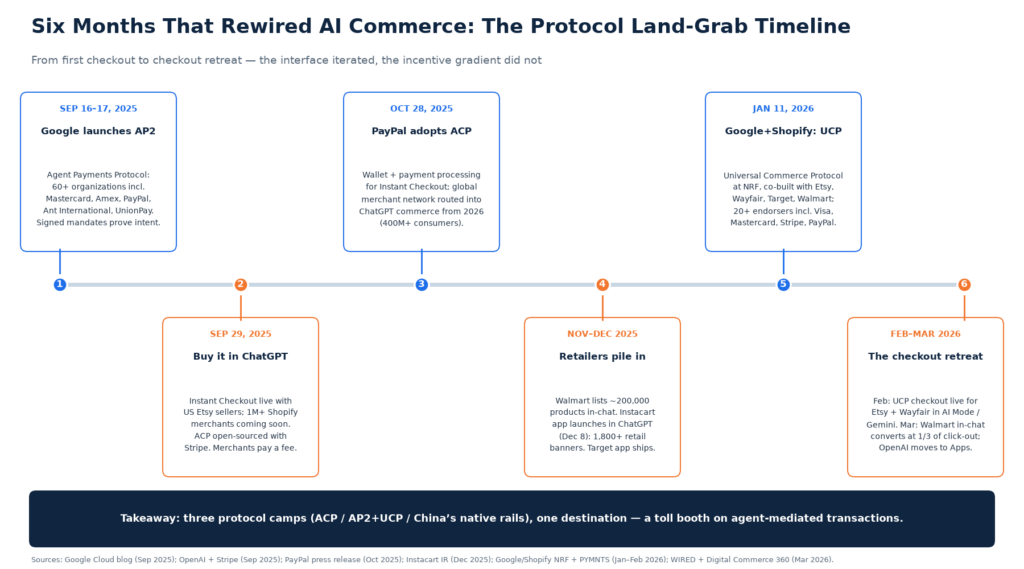
The simultaneity is the tell. In September 2025, Google announced the Agent Payments Protocol (AP2), an open standard for agent-led payments built with more than 60 organizations — Mastercard, American Express, PayPal, Ant International, UnionPay International, Coinbase, Etsy and Salesforce among them. Its core trick is the mandate: a cryptographically signed record proving you actually authorized your agent to spend that money on that thing.
Two weeks later, on September 29, OpenAI shipped Instant Checkout in ChatGPT. US Etsy sellers went live first, with more than a million Shopify merchants — Glossier, SKIMS, Spanx, Vuori — queued up as “coming soon.” Underneath sat the Agentic Commerce Protocol (ACP), co-developed with Stripe and open-sourced so any merchant or developer could build against it. Merchants pay a small fee on completed purchases; users pay nothing. The rate has never been officially disclosed, so treat any precise percentage you see floating around blogs as speculation, not fact.
Then the pile-on. In October 2025, PayPal adopted ACP, bringing its wallet and a merchant network serving more than 400 million consumer accounts into ChatGPT’s commerce layer. In November, Walmart listed roughly 200,000 products for in-chat purchase. In December, Instacart launched the first full app-style checkout experience inside ChatGPT, covering more than 1,800 retail banners. In January 2026, Google and Shopify counter-launched the Universal Commerce Protocol (UCP) at the NRF conference, co-built with Etsy, Wayfair, Target and Walmart, and endorsed by 20-plus organizations including Visa, Mastercard and Stripe.
Five product teams did not independently have the same idea in the same quarter. One economic gradient expressed itself five times.
The Deep Mechanism: Five Links, One Destination
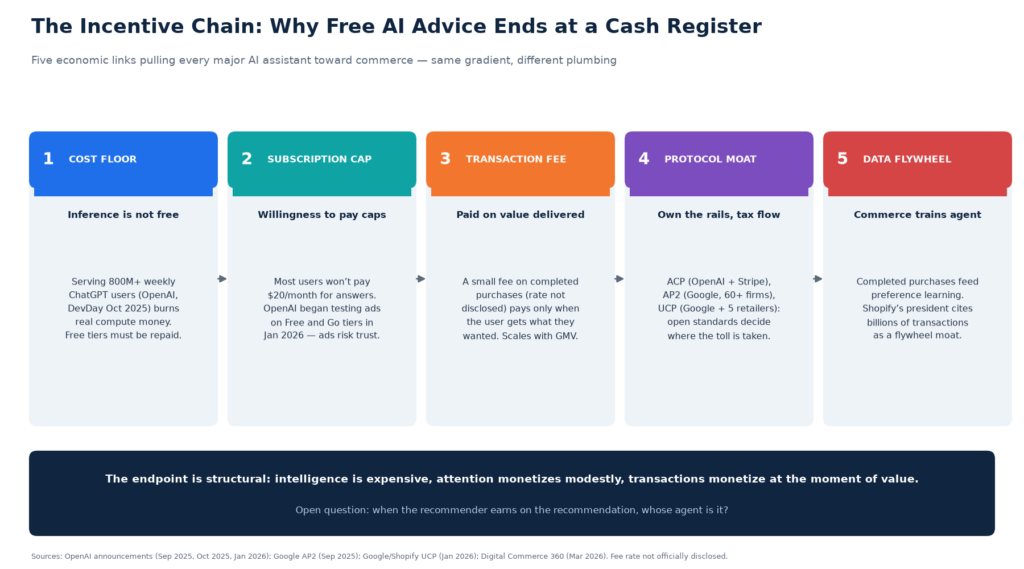
Link 1 — The cost floor: inference isn’t free
At OpenAI’s DevDay in October 2025, Sam Altman said more than 800 million people use ChatGPT every week. The September checkout announcement itself cited 700 million-plus. Every one of those weekly users costs compute money to serve, and the vast majority pay nothing. A free tier at that scale isn’t generosity; it’s acquisition spend. Something downstream has to repay it. That’s not cynicism — it’s arithmetic.
Link 2 — The subscription ceiling
Consumer subscriptions saturate. Most people will not pay $20 a month for answers, no matter how good the answers get. So labs look at ads — and in January 2026, OpenAI officially began testing advertising in ChatGPT for US users on the Free and Go tiers. But ads carry a structural problem inside an assistant: the product’s entire value proposition is “trust my answer.” An assistant that visibly sells its answers corrodes the asset it runs on. Ads can fund part of the bill. They can’t comfortably fund all of it.
Link 3 — Transaction alignment: paid on value delivered
Here’s why the checkout is so attractive. A fee on completed purchases is the cleanest monetization story available: the assistant earns only when you get what you wanted. Revenue aligns with user success, and it scales with commerce volume rather than seat count. Marketplaces have run this model for two decades. The AI labs aren’t inventing a business model; they’re importing the most proven one in digital commerce.
Link 4 — The protocol moat: own the rails, tax the flow
Why open-source ACP and AP2 instead of keeping them proprietary? Because protocols standardize where the fee gets collected. Whoever’s standard mediates agent-merchant transactions sits at a toll booth on the agentic economy — the position card networks occupy on plastic. Open standards grow the traffic; the toll booth monetizes it. Charity and strategy happen to look identical here.
Link 5 — The data flywheel: commerce trains the assistant
Completed purchases are preference labels with money attached. They teach the model what people actually choose, not just what they say they like. Shopify’s president Harley Finkelstein made this logic explicit at a Morgan Stanley conference in March 2026: billions of transactions and trillions of data points make the system smarter over time — a flywheel. Commerce doesn’t just fund the assistant. It trains it.
The Plot Twist Everyone Missed: The Checkout Retreat
If the incentive chain is so strong, why did OpenAI blink? Because in March 2026, it did — sort of.
Walmart ran the experiment at real scale, and the results stung. Daniel Danker, Walmart’s executive vice president overseeing AI and product, told WIRED that purchases completed directly inside ChatGPT converted at roughly one-third the rate of shoppers who clicked out to Walmart.com. He called the experience “unsatisfying.” The core problem was structural: single-item checkout meant five products arrived in five boxes, disconnected from the cart you’d been building on Walmart’s own app.
OpenAI read the same data and pivoted. A spokesperson confirmed to Digital Commerce 360 that “Instant Checkout is moving to Apps,” with ACP surviving as the infrastructure connecting users to merchants. Walmart embedded its own assistant, Sparky, inside ChatGPT — a chatbot within a chatbot — where users log into their Walmart account, sync their cart, and pay through Walmart’s own systems. Google’s UCP simultaneously went live for Etsy and Wayfair checkout inside AI Mode and Gemini in February 2026.
Notice what changed and what didn’t. The interface moved; the toll booth stayed. Discovery happens in the assistant, checkout happens in merchant-controlled environments, and the protocols still mediate the handoff — and the economics. Bet on the gradient, not the current UI. Meanwhile, the demand side keeps validating the direction: Walmart says ChatGPT now brings in new customers at roughly twice the rate of search engines. The shoppers are real. The plumbing is still being negotiated.
What Everyone Misunderstands
“Users demanded shopping in chat.” Some did. But user convenience is the pitch; monetization gravity is the cause. Only one of those explains why every lab moved in the same quarter.
“The results are organic, so there’s no conflict.” Read OpenAI’s own announcement carefully. Product results are organic and unsponsored, yes — but when ranking multiple merchants selling the same product, the listed factors include availability, price, quality, primary-seller status, and whether Instant Checkout is enabled. That’s not pay-to-rank. It’s pay-to-be-rankable-when-tied. A subtle line, and it will be contested — commercially and legally.
“Assistants will replace marketplaces.” The protocols say otherwise. ACP and UCP both keep the merchant as the seller of record, owning payment, fulfillment and the customer relationship. Shopify co-developing UCP is a platform fighting to keep the transaction layer, not surrendering it. The near future is negotiation, not conquest: assistants as demand-side agents, merchants as fulfillment-side principals.
China Walked This Path First — With Better Plumbing
Western coverage treats agentic commerce as an American frontier. The plumbing advantage, though, is Eastern.
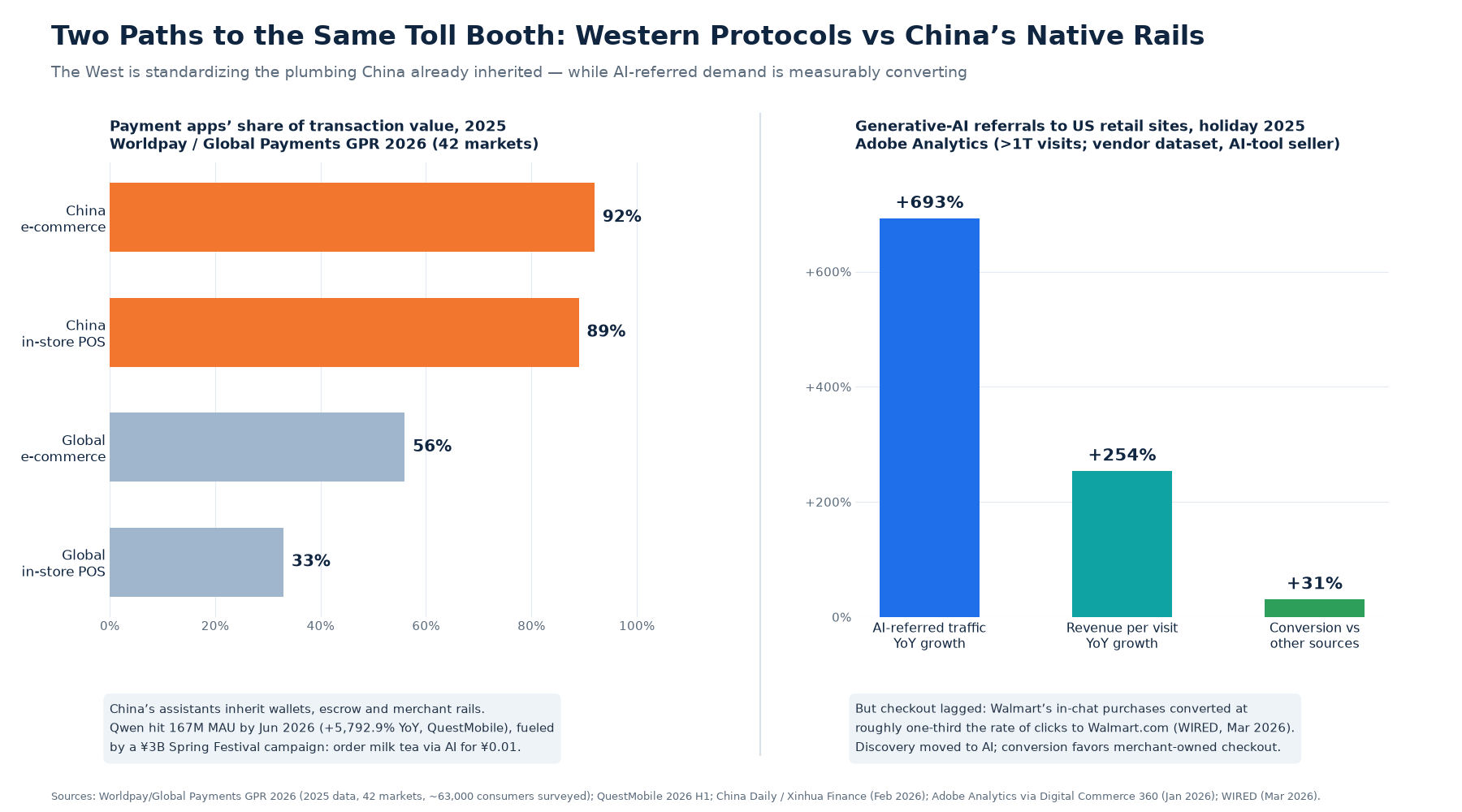
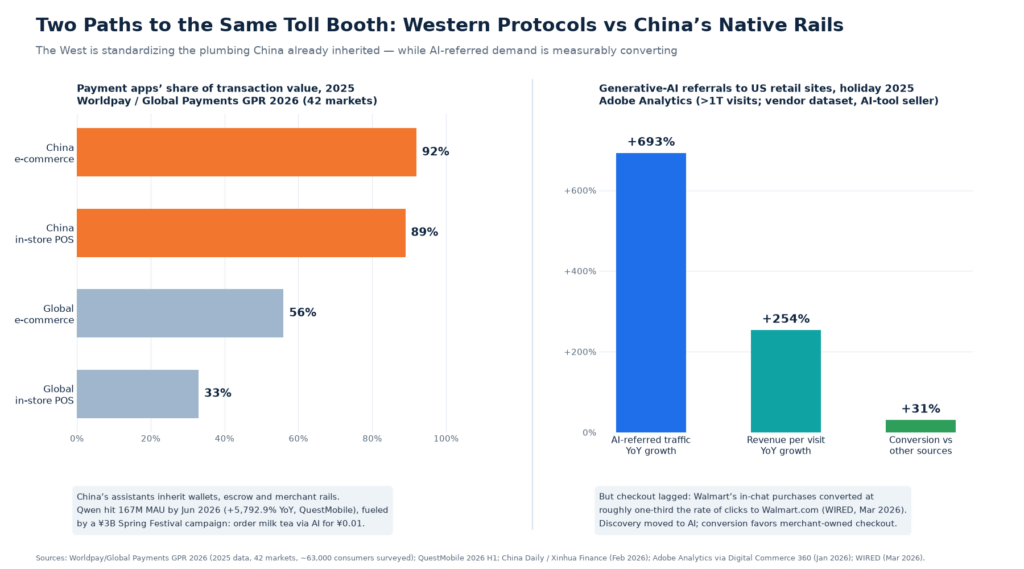
According to the Global Payments Report 2026 from Worldpay (now part of Global Payments) — an industry dataset covering 42 markets and roughly 63,000 surveyed consumers — payment apps carried 92% of China’s e-commerce transaction value in 2025 and 89% of in-store POS value, both world-first figures. Western labs are standardizing wallets and escrow that Chinese assistants simply inherit.
Watch what Alibaba did with that inheritance. In January 2026, the Qwen app plugged directly into Taobao, Alipay, Taobao’s flash-delivery service, Fliggy and Amap, launching more than 400 task-completion features — order takeout, buy products, book flights, all settled in-app through Alipay’s native AI payment capability. Then came the behavioral experiment: a ¥3 billion (about $420 million) Spring Festival campaign in February 2026 offering milk tea for ¥0.01 — but only if you ordered through the AI. Traffic surged so hard the app suffered outages, and Alibaba said it was “urgently adding resources.”
The growth numbers followed. QuestMobile, a Chinese mobile-analytics firm whose panel data is the industry’s standard yardstick, recorded Qwen at 167 million monthly active users by June 2026 — up 5,792.9% year over year, second only to ByteDance’s Doubao at 382 million. A caution worth keeping: growth partly bought with subsidies decays when subsidies end; Qwen’s MAU had eased to around 158 million by September. The habit is being purchased. Whether it sticks is the open question — the same one Western labs face, just with cheaper plumbing.
The Demand Signal Is Real — With an Asterisk
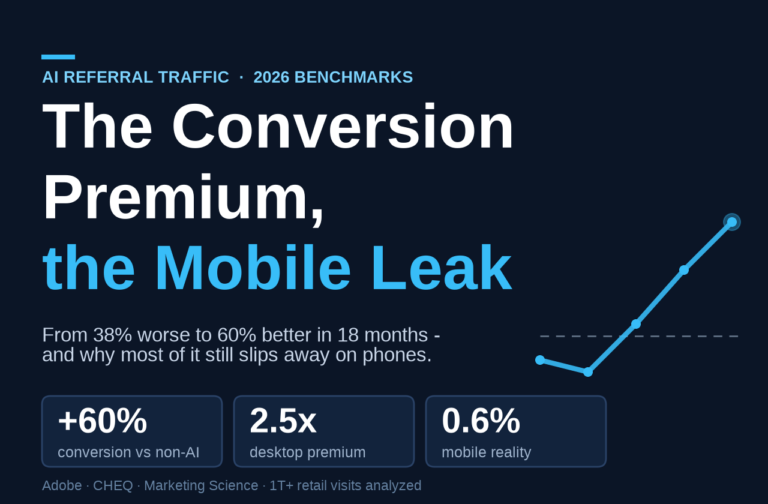
The strongest evidence that AI-mediated shopping isn’t hype comes from the referral data. Adobe Analytics, tracking more than a trillion visits to US retail sites, found that generative-AI referrals to retail websites grew 693% year over year during the 2025 holiday season. Those visitors converted 31% more often than traffic from other sources, and revenue per visit rose 254% year over year. Salesforce, reading activity across its own commerce platform, estimated AI and agents influenced about 20% of global online orders during Cyber Week.
Two honest asterisks. First, both are vendor datasets with commercial interests — Adobe sells AI marketing tooling, Salesforce sells agentic commerce software — and their scopes differ, so don’t add the numbers together. Second, the base remains small: explosive percentage growth on a modest share of traffic. And recall the Walmart result: AI-referred shoppers convert beautifully on merchant sites, but poorly inside the chat itself. The synthesis writes itself — assistants are becoming the front door, not yet the cash register. Which is exactly where the incentive chain wants them next.
The Question Nobody Wants to Answer: Whose Agent Is It?
An assistant that recommends products and earns on the recommendation has a structural commercial tie, however organic the results look. Platforms know trust is the core asset, which is why OpenAI bends over backward to say fees don’t influence rankings. But the tie-break clause exists, and the equilibrium will be fought over.
Regulators have started drawing lines. The EU AI Act’s Article 50 transparency obligations took effect on August 2, 2026, and the European Commission’s final guidelines, published July 20, 2026, explicitly bring AI agents into scope — including agents capable of completing purchases. They must disclose their artificial nature and, notably, on whose behalf they act. Penalties reach €15 million or 3% of global turnover. Read that “on whose behalf” clause again. It’s the legal embryo of the conflict-of-interest question, and it points straight at the checkout.
What Brands and Marketers Should Do Now
Get agent-readable or get skipped. Your catalog, pricing, stock and policies must be exposed through the emerging protocols and structured feeds. This is GEO’s transactional endgame: being recommendable becomes being buyable. The Walmart fiasco proved that stale product data breaks agent commerce faster than it breaks search.
Model the new toll booth. Agent fees stack onto platform take-rates, ad costs and payment processing. Recompute channel economics with the assistant’s cut included — even while the exact rate is undisclosed, model a range. Early integrators often get favorable terms; late ones pay rack rate.
Own the post-transaction relationship. Both ACP and UCP keep you as merchant of record. Use that. The assistant rents you demand; the order data, service relationship and membership are yours to compound. Walmart’s Sparky move is the playbook: meet customers inside the assistant, transact inside your own walls.
Demand ranking transparency. Ask assistant platforms for explicit ranking rules, and avoid schemes that poison recommendation trust. It’s the asset everyone — including you — depends on.
The Counterarguments, and Where They Break
“Subscriptions plus ads could fund AI just fine.” Possible for some labs. But the revealed preference of every major assistant building commerce rails argues the economics point elsewhere at free-tier scale. The honest limit: transaction revenue remains unproven — OpenAI has disclosed no commerce revenue figures. The chain explains direction, not yet magnitude.
“Users will reject shopping in chat.” The Walmart data partly agrees! Early adoption was modest and the first interface failed. But each iteration removes friction while keeping the toll booth. The gradient persists through every UI revision.
“Conflicts of interest will kill trust.” The darkest reading, and the most important one to watch. The counterweight is that platforms understand trust is their moat, and disclosure regulation is now arriving with teeth. The equilibrium will be contested ground: organic-looking recommendations with structural commercial ties. That’s the frontier — now with money attached.
Conclusion: Follow the Gradient, Not the Interface
AI assistants are becoming merchants because the incentive chain has no other comfortable endpoint. Inference costs money. Subscriptions cap out. Ads corrode trust. Transactions pay on value delivered, train the model, and standardize a toll booth. OpenAI’s ACP, Google’s AP2 and UCP, and China’s ecosystem-native ordering are the same gradient running through different plumbing.
For brands, the moves are concrete: become agent-readable, price the new cut, own the relationship after the sale. For everyone else, the defining question of the next commerce decade is already on the table — when the recommendation carries a commission, whose side is the assistant on? The answer will be negotiated in protocols, disclosures and regulation. Watch those negotiations. They matter more than any Buy button.