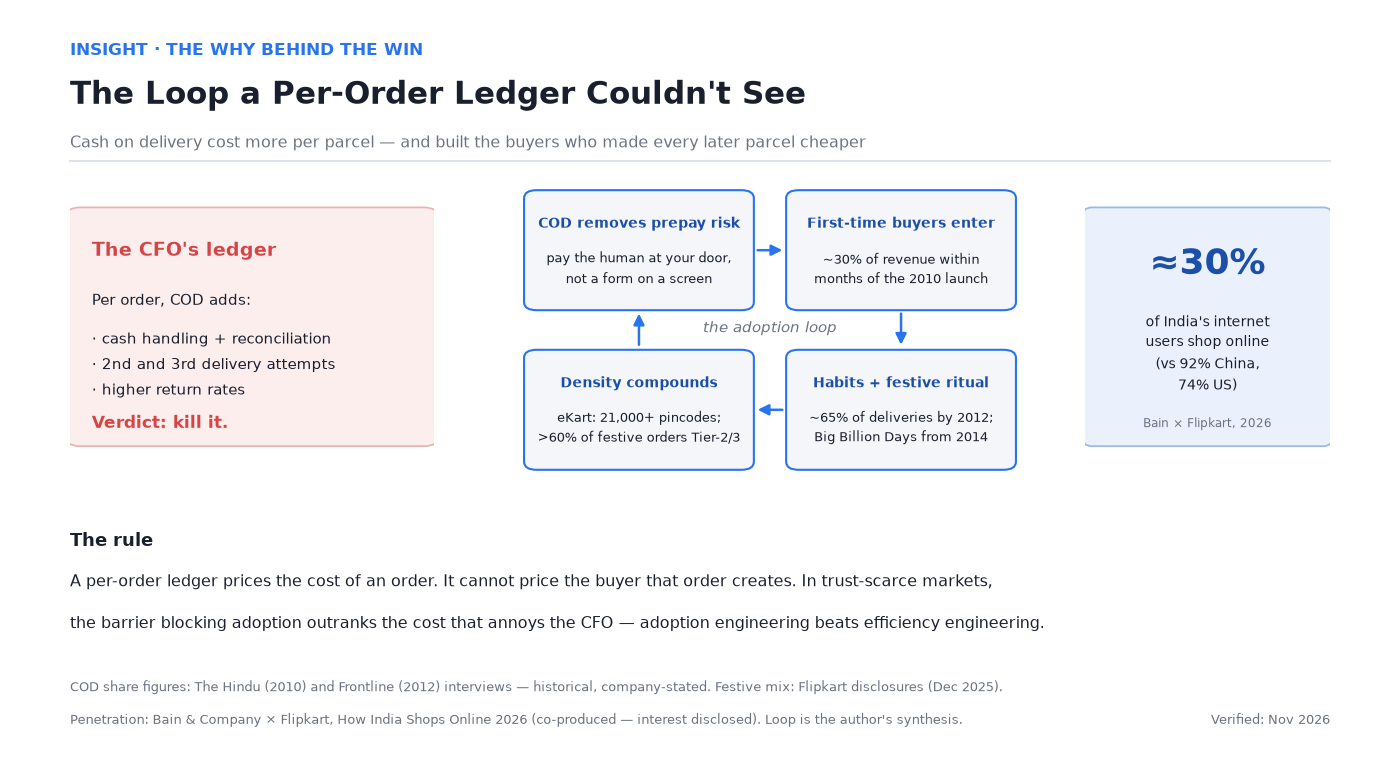
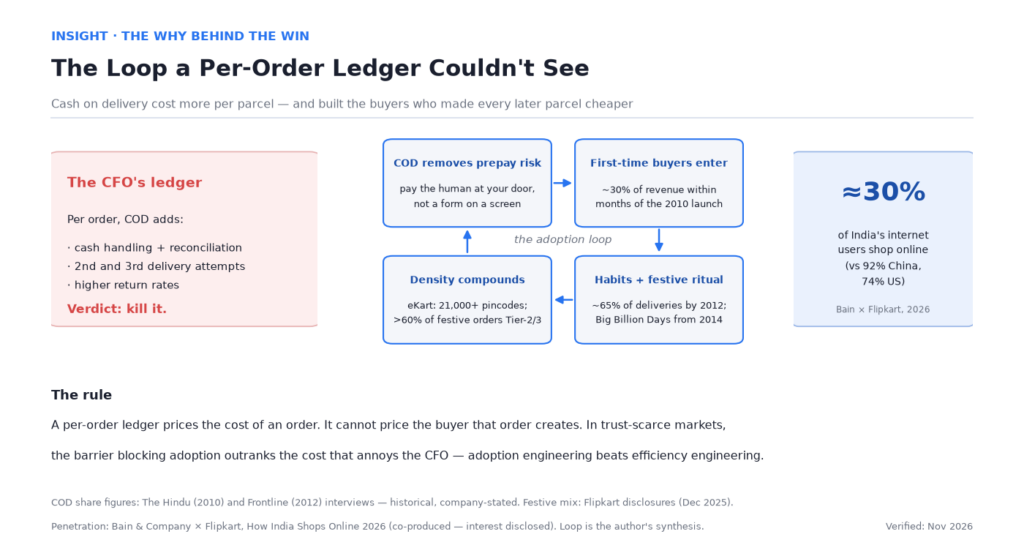
Why did the worst line item in Indian e-commerce — cash on delivery — become its best strategy? In 2010, Flipkart started letting customers pay the delivery agent in cash. Every per-order calculation said no: cash handling, reconciliation, second and third delivery attempts, higher returns. Yet within months, cash on delivery was roughly 30% of Flipkart’s revenue, per The Hindu’s reporting; by 2012, co-founder Sachin Bansal told Frontline about 65% of deliveries were cash. Amazon, arriving in 2013 with a prepaid-first global playbook, had to adapt to the same cash-heavy reality. The head start mattered more than any discount war.
Here’s the mechanism the spreadsheet missed. COD wasn’t a payment method; it was a risk swap. The customer no longer prepaid a stranger’s website — they paid a human at their door, after seeing the box. That single swap converted India’s cash-heavy, low-trust majority from non-consumers into first-time buyers. Flipkart wasn’t stealing Amazon’s customers. It was manufacturing customers neither company had yet.
The Mechanism: A Loop, Not a Line Item
And manufactured customers compound. First-time buyers become repeat buyers; repeat buyers justify delivery density; density lowers cost per parcel and extends reach — Flipkart’s eKart now serves 21,000+ pincodes, and over 60% of 2025 Big Billion Days orders came from Tier-2 and Tier-3 regions, per the company’s festive-season disclosures. The expensive order in 2010 paid for the cheap order in 2025. A per-order ledger can price the cost of an order. It cannot price the buyer that order creates.
Why the Pattern Rhymes Across Markets
This is why the pattern rhymes across markets. China’s escrow payments solved the same prepay-trust barrier before its efficiency race; India’s COD solved it without waiting for banks. Different instrument, identical economics: in trust-scarce markets, adoption engineering beats efficiency engineering, because the binding constraint is buyers who don’t exist yet — not costs that annoy the CFO.
The Objection That Was Outrun, Not Refuted
The uncomfortable corollary for the spreadsheet crowd: the objection was never refuted; it was outrun. As trust settled in and digital payments spread, cash’s share of Indian e-commerce fell from its early dominance, and the CFO’s original math finally looked right. By then the moat was dug. Amazon’s Indian marketplace posted its first operating profit in FY26 — thirteen years after entry — monetizing a buyer pool that trust-first innovation had created. The giant optimized the market. The local built it.