For twenty years, marketing optimized for one scarce input: attention. Then machines made persuasion nearly free. Copy, images, video testimonials — all of it now costs close to nothing at the margin. And something inverted. Attention inflated. Belief didn’t.
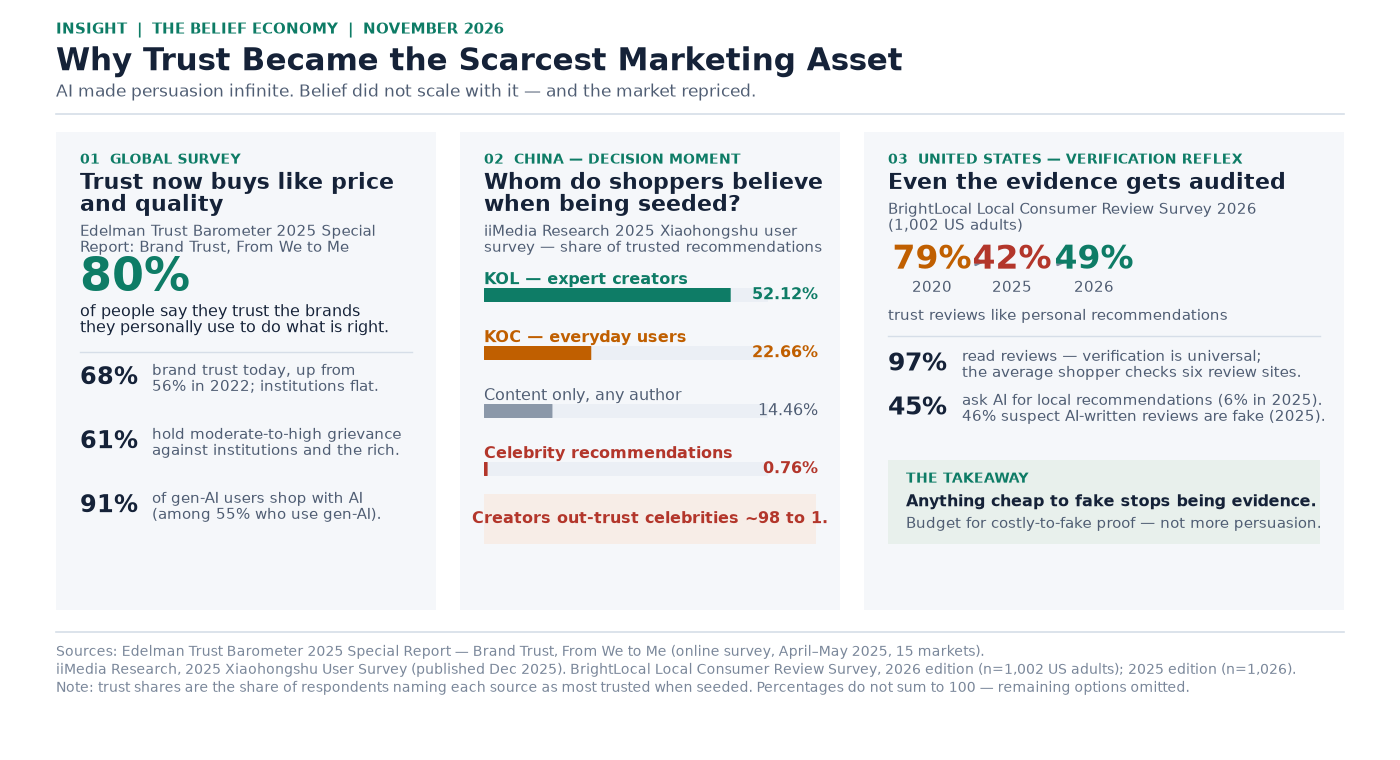
Edelman’s 2025 special report on brand trust, based on online interviews across 15 markets, found that trust now sits beside price and quality as a purchase consideration: 80% of people say they trust the brands they personally use, while trust in institutions stays flat. Meanwhile, 61% of people worldwide carry a moderate or high sense of grievance toward business, government and the wealthy. Audiences pre-discount everything you say before you say it.
Here is the mechanism. Anything cheap to fake stops being evidence. AI collapsed the cost of producing convincing content, so the supply of persuasive artifacts exploded and their signal value crashed. But verification never got cheaper: real usage, real reviews, third-party tests and a kept promise still cost time, money and reputation. That gap — between fakeable signals and costly-to-fake signals — is the trust premium. It is now the binding constraint on the whole marketing stack.
China shows the law behaviorally, at the decision moment. In iiMedia Research’s 2025 survey of Xiaohongshu users, expert creators (KOLs) took 52.12% of trusted recommendations, everyday users (KOCs) 22.66%, and celebrities just 0.76%. Fame — the classic trust proxy — is nearly worthless exactly when someone decides whether to believe and buy. Note the nuance most retellings miss: KOCs don’t beat KOLs here. Professional credibility wins, with everyday users a strong second. What collapses is borrowed stardom.
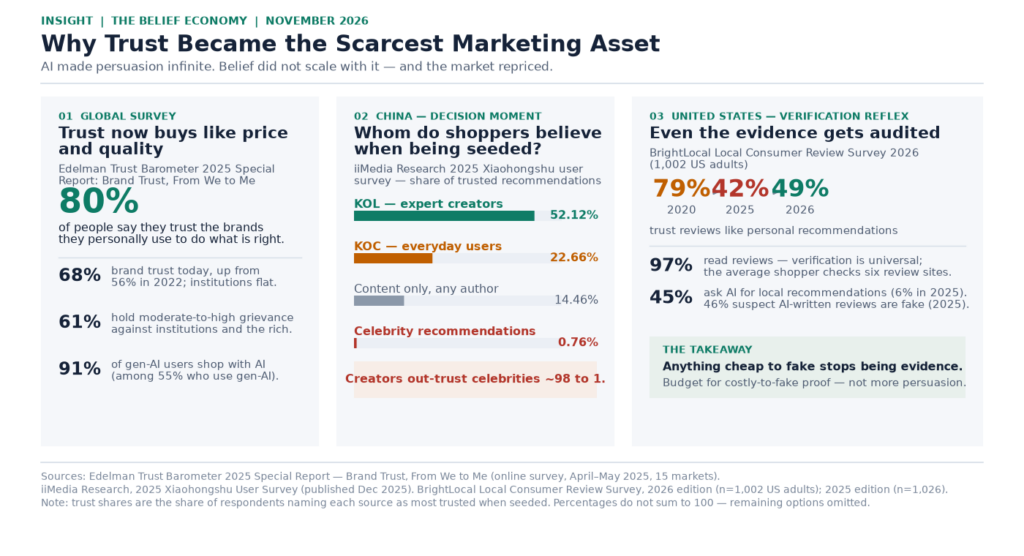
The West is arriving at the same place by a different road. BrightLocal’s review survey tracked trust in reviews as personal recommendations falling from 79% in 2020 to 42% in 2025 — then a partial recovery to 49% in the 2026 edition. Reading, meanwhile, is nearly universal: 97% read reviews, checking six sites on average. People read more and believe less. They audit the evidence. In the same research series, the share asking AI for local recommendations jumped from 6% to 45% in one year — verification itself is being outsourced to machines. In the 2025 edition, 46% said an AI-written-looking review made them suspect a fake. Regulators agree the currency is being counterfeited: the FTC’s fake-review rule, effective October 2024, explicitly covers AI-generated reviews and lets the agency seek civil penalties.
So what do you do with this? Stop budgeting trust like a campaign. It is a balance-sheet item, built from deposits: kept promises, verified-purchase reviews, transparent pricing, consistent facts across the readable web — facts machines can check too, since AI assistants increasingly are the trust intermediary. And be honest about the arms race: a University of Michigan CSCW 2025 ethnography showed KOC authenticity is itself partly industrialized, with paid labor disguised as spontaneous posts. Which is why the strategy is not any one tactic. It is competing on signals your rivals cannot cheaply counterfeit — and raising that bar every year.
Attention was the scarce asset until the machines made persuasion infinite. Brands still buying reach are printing a depreciating currency. Brands accumulating costly-to-fake truth hold the one asset the AI flood cannot dilute.