Everyone explains the Shopee–Lazada gap with adjectives: Shopee was nimbler, Lazada was distracted. Fine. But adjectives don’t compound — costs do. Here’s the mechanism nobody prices in: the two platforms were buying the same thing, attention, at radically different prices.
One Engine Bought Attention Wholesale
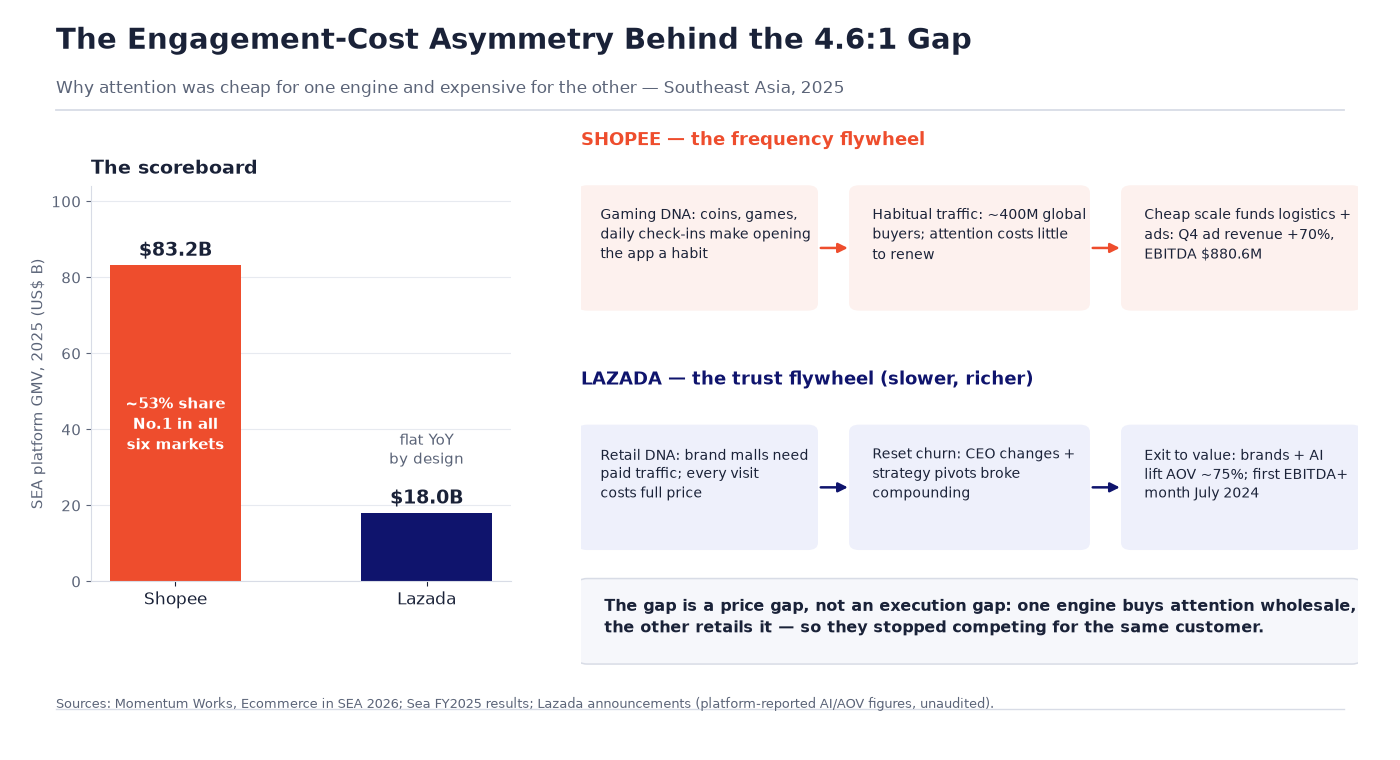
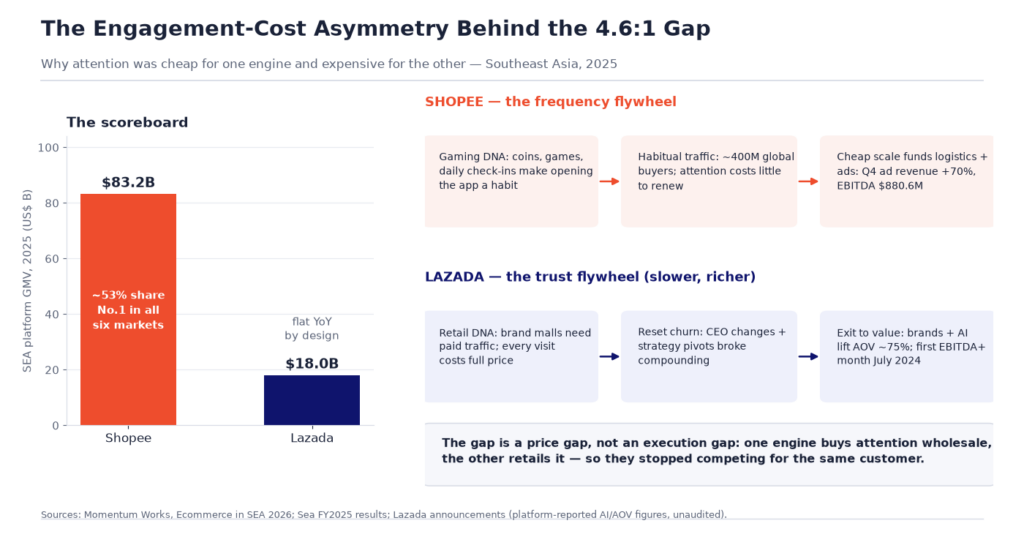
Shopee was born inside Garena, a company whose entire business was manufacturing daily habits. Coins, check-in streaks, mini-games — these aren’t gimmicks bolted onto a store. They’re a free-to-play engagement loop where the next visit costs almost nothing to generate. When your parent’s core competency is making people log in tomorrow, your marketplace inherits traffic that renews itself.
That’s wholesale attention. Roughly 400 million buyers globally, habituated. And cheap attention scales into something Lazada never had: a margin buffer. Sea’s fiscal 2025 shows where it went — Q4 ad revenue up over 70%, e-commerce adjusted EBITDA of $880.6 million, up 5.7x in a year. The flywheel isn’t metaphorical. Habitual traffic funds logistics and ads; better logistics and ads deepen the habit.
The Other Paid Retail Price — Then Kept Renegotiating
Lazada’s DNA was retail: warehouses, inventory, brand malls. Trust-building traffic is purchased traffic — every visit costs full price, because a flagship store can’t gamify its way into your morning routine. That alone raises the cost of competing for the same mass shopper.
Then Alibaba’s integration years added the multiplier: CEO churn, strategy resets, a retailer-to-marketplace conversion happening mid-war. Compounding needs a constant base. Lazada kept changing the base.
Why the Gap Is an Equilibrium, Not a Verdict
Once attention costs diverge permanently, the rational strategies diverge too. Shopee monetizes cheap traffic at mass scale. Lazada — having recorded its first EBITDA-positive month in July 2024 — stopped bidding for bargain hunters and started selling trust: brand-led assortment, AI-guided orders carrying roughly 75% higher values (platform-reported). Flat $18 billion GMV next to $83.2 billion isn’t a scoreboard of effort. It’s two different cost structures finding their own equilibria.
So the next time someone says Lazada “lost,” ask a better question: lost at what price? The volume war was always going to be won by whoever got attention cheapest. The interesting war — the one still undecided — is whether trust can be bought wholesale too. That’s what Lazada’s AI bet is really testing.