Everyone tells the TikTok Shop Southeast Asia story as a platform story. Cheap traffic, viral videos, a Chinese app winning abroad. That framing misses the actual mechanism. What crossed the border was not an app. It was an operating system for turning content into transactions, and the interesting part is which layers survived the trip intact and which had to be rebuilt from scratch.
The doubling, in numbers
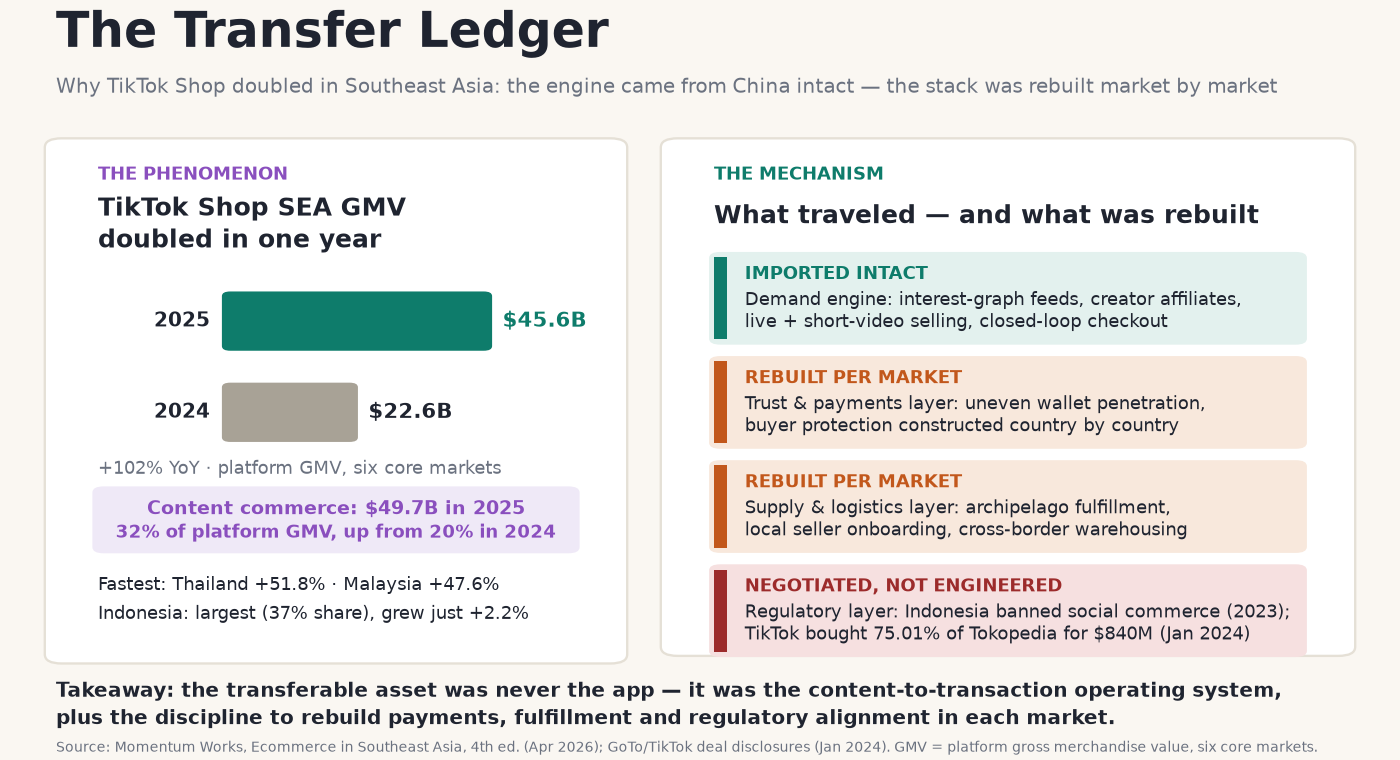
Start with the numbers, because they are genuinely startling. Momentum Works, a Singapore consultancy that tracks the region’s marketplaces, estimates Southeast Asia’s platform e-commerce hit $157.6 billion in 2025, up 22.8 percent, the fastest pace in four years. Inside that total, TikTok Shop doubled: from $22.6 billion in 2024 to $45.6 billion in 2025.
What Shopee’s lead still hides
Counted together with Tokopedia, the Indonesian marketplace it controls, the combined entity reached 65.7 percent of Shopee’s GMV. Shopee still leads with $83.2 billion and the number one spot in all six core markets, but the challenger added more absolute GMV in one year than the leader did.
What actually crossed the border
So what exactly traveled from China? The demand engine, essentially untouched. Interest-graph distribution that sells to people who never searched for anything. Creator-affiliate networks. Live and short-video selling wired straight into checkout. Douyin proved this machine at home; Southeast Asia proved it exports.
The layers that could not be imported
But here is the part clone attempts keep missing. Underneath that engine, almost nothing could be imported. Payments and buyer protection had to be constructed country by country in markets where trust infrastructure is still young. Logistics meant archipelago fulfillment, not China’s uniform next-day network. And the regulatory layer could not be engineered at all, only negotiated: Indonesia banned commerce inside social apps in 2023, and TikTok’s answer was to buy 75.01 percent of Tokopedia for $840 million, closing the deal in January 2024. That is not a product decision. That is a treaty.
Why the incumbent’s copy proves the point
The market structure confirms this is a format shift, not one platform’s feature win. Content commerce, meaning livestream, short video and creator-driven selling, generated an estimated $49.7 billion in 2025, or 32 percent of platform GMV, up from 20 percent a year earlier. Shopee itself is investing to match. When the incumbent copies your format, your format has won.
The caveat and the six-country trap
One caution before you call it destiny: Momentum Works notes much of the region’s affordability still rests on subsidies and vouchers rather than structurally lower costs. And one regional headline hides six countries. Thailand grew 51.8 percent and Malaysia 47.6 percent, while Indonesia, the largest market at 37 percent of regional GMV, grew just 2.2 percent amid restructuring.
The transfer rule
The lesson for anyone exporting a playbook: import the mechanism, rebuild the stack, negotiate the politics. The visible layer is universal. Everything underneath is local.





