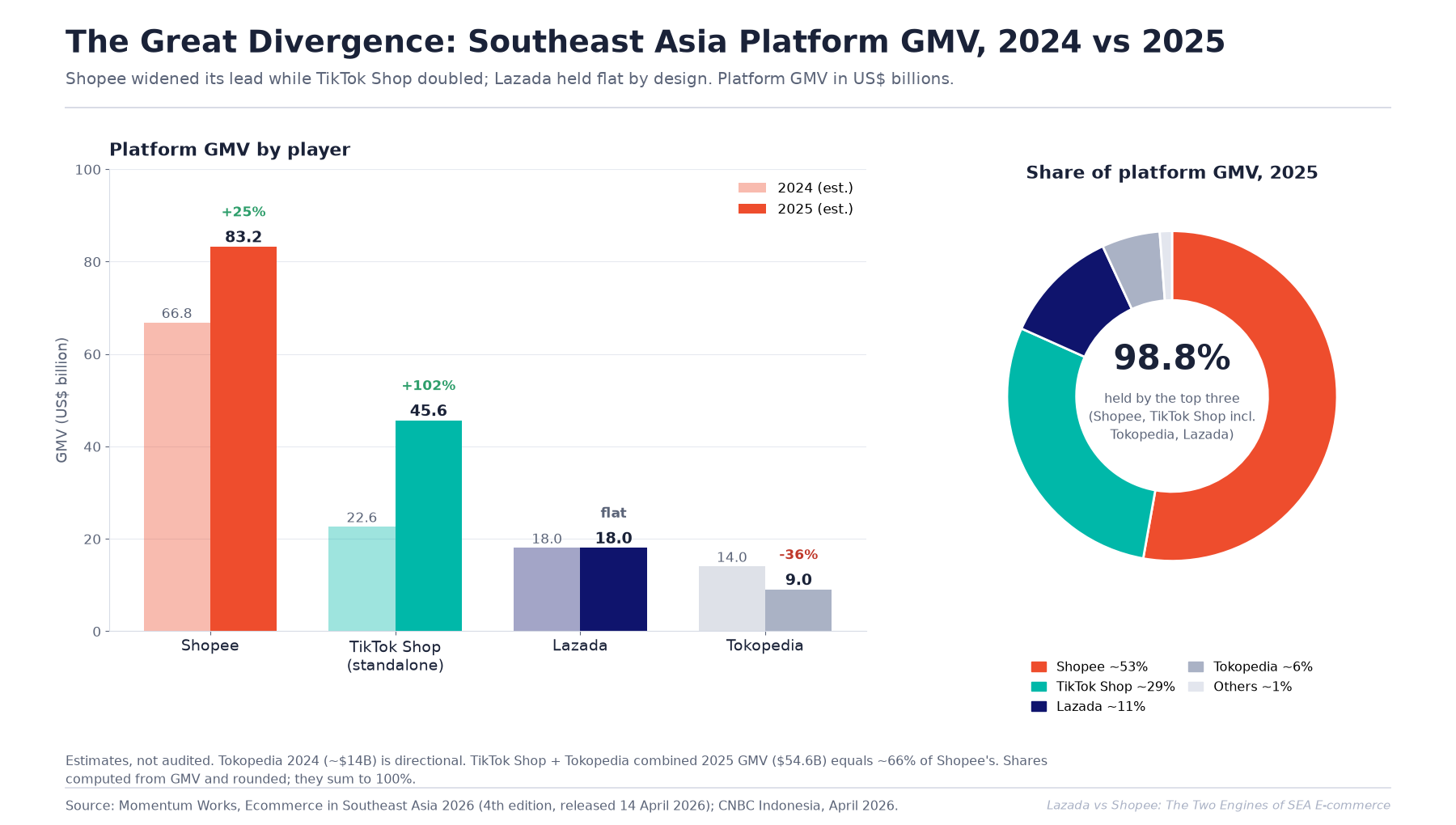
Open the Momentum Works 2026 report and you’ll find a number that stops you mid-scroll: Southeast Asia’s platform e-commerce hit $157.6 billion in GMV in 2025, up 22.8% in a single year. Now look at who owns that growth. Shopee booked $83.2 billion — roughly 53% of the entire market, number one in all six core countries. Lazada, the platform that once was Southeast Asian e-commerce, sat at about $18 billion. Flat. Unchanged from the year before, in a market that grew by nearly a quarter.
Here’s the twist: that flat line isn’t a failure story. It’s a decision. Two platforms that started the 2010s as near-peers now run fundamentally different businesses — a frequency machine and a trust machine — because two parent companies exported two different retail philosophies. If you sell into Southeast Asia, or you’re studying how platform wars actually end, this divergence is the cleanest lesson available. Let’s take the engines apart.
Same Starting Line, Different DNA
Rewind to 2012. Rocket Internet, the German clone factory, launches Lazada in Singapore with an Amazon-style playbook: first-party retail, own warehouses, own delivery fleet. By 2015 it’s the region’s biggest platform. Then Alibaba arrives — $1 billion for control in April 2016, followed by infusion after infusion, roughly $7.7 billion cumulative by mid-2024 according to tallies by TechNode and 21st Century Business Herald. That’s not a bet. That’s a colonization.
Meanwhile, in 2015, a gaming company called Garena — later renamed Sea, with Tencent as a major shareholder — quietly ships Shopee. No warehouses. No inventory. A mobile-only C2C bazaar with coins, mini-games, flash deals and free shipping, run by country teams who could do whatever locals responded to.
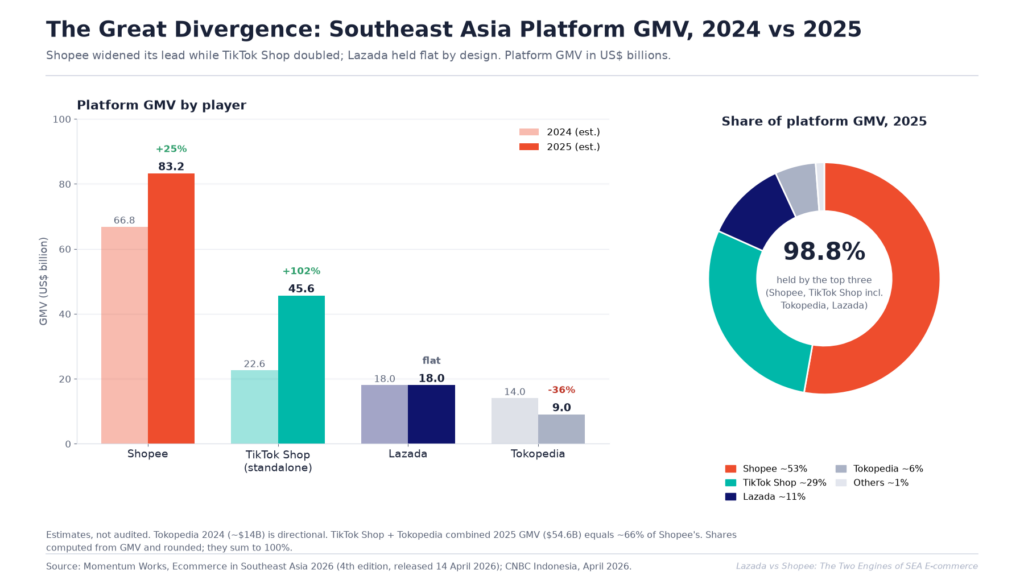
You can probably guess which DNA won the decade. Shopee overtook Lazada regionally around 2019–2020 — its global GMV doubled to $35.4 billion in 2020 — and never gave the lead back. By 2025 the Southeast Asian GMV ratio is roughly 4.6 to 1. But how the gap opened matters more than the gap itself.
The Two Engines, Compared
Strip away the campaigns and the celebrity endorsements, and each platform is a machine with a distinct power source.
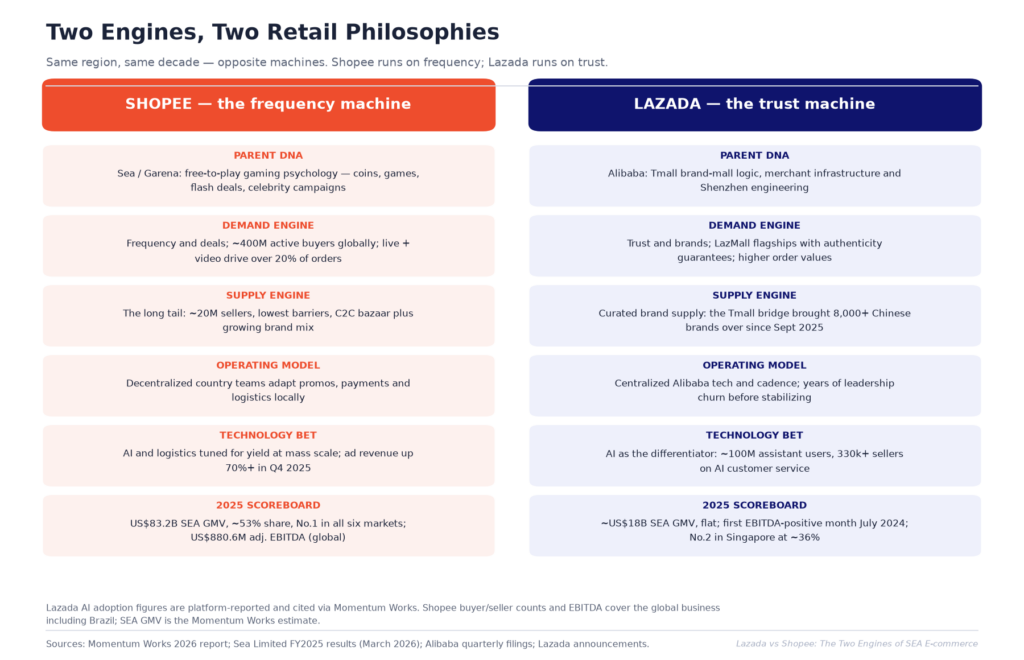
The demand engine. Shopee sells frequency. Gamified engagement loops borrowed from free-to-play gaming — check in daily, earn coins, spin for vouchers — turn shopping into a habit rather than an errand. Roughly 400 million active buyers used Shopee globally in 2025. Lazada sells confidence. LazMall, its brand-flagship zone, leans on authenticity guarantees and verified stores: fewer, bigger, more deliberate purchases.
The supply engine. Shopee runs the long tail — around 20 million sellers globally, the lowest onboarding barriers in the region, a bazaar where anyone can set up a stall. Lazada increasingly curates. Since September 2025, its Tmall bridge — a one-click program letting Chinese Tmall brands cross-list into Southeast Asia — has onboarded more than 8,000 brands, whose startup-period GMV quickly crossed $100 million, per Momentum Works. No rival has that pipeline. It’s a supply-side asset you can’t buy with subsidies.
The operating model. Shopee’s country CEOs adapt promotions, payments and logistics with famous autonomy. Lazada spent years absorbing Alibaba’s centralized tech stack and leadership cadence — including a stretch where it burned through four CEOs in three years, with Alibaba veteran Lucy Peng’s 2018 tenure lasting about eight months. Compounding requires consistency, and Lazada’s reset button got pressed a lot.
The technology bet. This is where the story gets interesting in 2026 — more on that below.
Why the Gap Opened
Three forces did most of the work.
First, timing. Southeast Asia skipped desktop. Shopee launched mobile-first into a mobile-only generation; Lazada carried PC-era retail architecture plus the tax of converting from retailer to marketplace. Second, engagement economics. Sea’s gaming DNA made attention cheap — the same psychology that keeps players logging into Free Fire keeps shoppers opening Shopee. Lazada paid full price for every visit while its strategy kept changing underneath it.
Third — and this is the part most retellings miss — Lazada eventually stopped fighting the same war. In July 2024 it recorded its first-ever EBITDA-positive month, announced by CEO James Dong that August; Thailand had been profitable since 2022. The price of that discipline was volume. Momentum Works notes Lazada deliberately pivoted toward a brand-led, quality-focused assortment, lifting average order value while GMV went flat. The flat line is partly chosen.
But let’s not romanticize it. Alibaba’s own filings tell a sober story underneath. The international commerce group (AIDC) turned its first quarterly adjusted EBITA profit — RMB 162 million — in the July–September 2025 quarter, and Nikkei Asia reported the gain was driven largely by AliExpress efficiency, not Lazada. In the December 2025 quarter, Alibaba explicitly said international retail revenue growth was partly offset by declining Lazada revenue. Translation: the trust machine is healthier per order, but it is still shrinking its topline. Both things are true at once.
Lazada’s Counter-Attack: Brands Plus AI
If you can’t win the volume war, change what winning means. That’s Lazada’s 2025–2026 playbook, and the numbers behind it deserve scrutiny — with the caveat that most AI metrics are platform-reported, relayed through Momentum Works rather than independently audited.
The consumer side: nearly 100 million cumulative users of its AI shopping assistant, over 50% of product detail pages enhanced with AI, and orders guided by the assistant carrying average values about 75% higher than other orders. The merchant side: more than 330,000 sellers running AI customer service — a big deal in chat-heavy markets where a slow reply kills the sale.
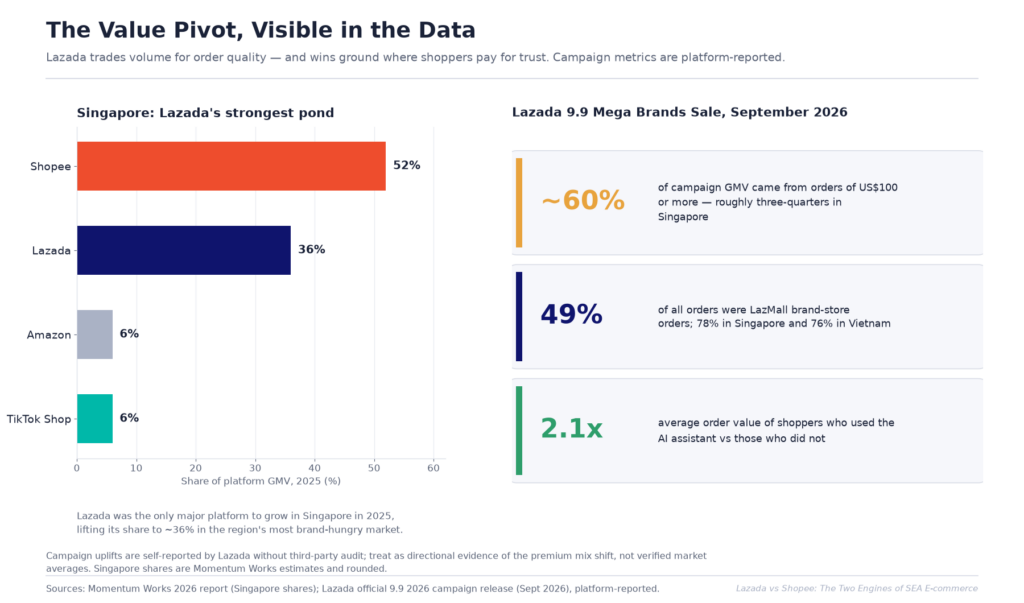
The freshest evidence comes from Lazada’s September 2026 mega-sale, and it reads like a premium department store’s report card: orders of $100 or more generated nearly 60% of campaign GMV (about three-quarters in Singapore); LazMall accounted for 49% of all orders; and shoppers who used the AI assistant spent 2.1 times more per order than those who didn’t. Again — Lazada’s own release, campaign-period data, no third-party audit. Directional, but directionally loud.
Singapore: The Proof of Concept
Every strategy needs one market where it visibly works. For Lazada, that’s Singapore — the region’s richest, most brand-hungry, most authenticity-sensitive pond. In 2025, Lazada was the only major platform to grow there, lifting its share to roughly 36% against Shopee’s 52%, with Amazon and TikTok Shop around 6% each.
Momentum Works flags similar brand-led traction in Thailand and the Philippines, where Lazada holds second place with about 18% and 22% share respectively. Small ponds, higher-value fish. The open question — and it’s a real one — is whether a Singapore-style win can ever generalize to Indonesia, where Lazada’s share has slipped to around 6–7% and price sensitivity rules.
Shopee’s Response: Scale Gets Smarter Too
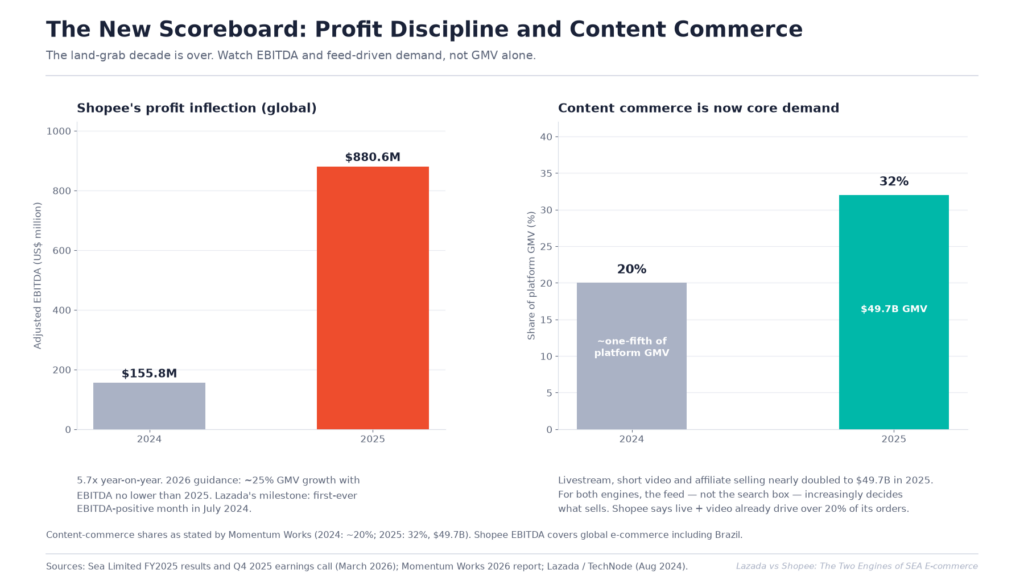
Don’t file Shopee under “dumb volume.” Sea’s fiscal 2025 results, released in March 2026, show the frequency machine learning to print money. Global GMV reached $127 billion, up 27% — note this covers Brazil and other markets beyond Southeast Asia’s $83.2 billion. E-commerce adjusted EBITDA hit $880.6 million, up from $155.8 million — a 5.7x jump in one year.
Look at how. In Q4, ad revenue grew over 70% and the ad take rate rose more than 80 basis points year-on-year. Live and video commerce now drive over 20% of orders. A VIP membership program crossed 7 million subscribers, with members in some markets spending 30–40% more after joining. Management’s 2026 guidance: roughly 25% GMV growth with EBITDA no lower than 2025. The bazaar is becoming a monetization platform — and it’s doing it without abandoning the mass market Lazada conceded.
The Third Engine Nobody Can Ignore
Any honest Lazada-vs-Shopee analysis in 2026 has a third character. TikTok Shop doubled its standalone Southeast Asian GMV to $45.6 billion in 2025, from $22.6 billion. Add Tokopedia — the Indonesian platform it absorbed, rationalized down to about $9 billion — and the combined entity reached $54.6 billion, roughly 66% of Shopee’s scale.
Watch the denominators here, because sloppy coverage doesn’t. “TikTok Shop doubled” refers to the standalone business; figures circulating that put the merged entity at 85.7% of Shopee’s GMV don’t survive division — 54.6 over 83.2 is 65.7%. And content commerce overall — livestream, short video, affiliate selling — generated $49.7 billion, or 32% of platform GMV, up from about 20% a year earlier. The feed, not the search box, increasingly decides what Southeast Asia buys. That trend taxes both engines: Shopee must keep buying engagement it once got cheaply, and Lazada must make premium brands legible to a generation raised on video.
What the Divergence Teaches Brands
So what do you actually do with this on Monday morning?
Run a portfolio, not a channel. Shopee is your velocity engine — launches, price-competitive SKUs, volume testing. LazMall is your equity engine — premium lines, authenticity-sensitive categories, higher AOV. These are different audiences, not redundant shelf space. Treating them as duplicates means either subsidizing bargains on a trust platform or paying brand premiums for bazaar traffic.
Exploit the Tmall bridge if you qualify. Brands already on Tmall can cross-list into six Southeast Asian markets with a fraction of the usual cold-start cost. Eight thousand brands have already taken that shortcut. If you’re a China-based brand eyeing SEA expansion, pilot it before building distribution the hard way.
Treat AI service as conversion infrastructure. In markets where shoppers chat before they buy, response speed is conversion rate. With a third of a million Lazada sellers already on AI customer service, early adopters are banking an advantage that late movers will pay to catch up to.
Never read GMV share as strategy quality. A 53% share and a flat $18 billion can both be winning positions — if the profit pools differ. Match SKU economics to engine identity, and let your margin structure pick your platform, not the leaderboard.
Risks and Honest Caveats
Three caveats keep this analysis honest. One: the 83.2-versus-18 split is Momentum Works’ estimate — reputable and directionally reliable, but neither platform discloses country-level GMV, and nothing here is audited. Two: definitions wander. Google, Temasek and Bain’s e-Conomy SEA 2026 report puts regional e-commerce at $191 billion for 2025 across ten countries — a different denominator than Momentum Works’ $157.6 billion across six. Both are “right”; quoting them interchangeably is wrong. Three: brand-led can become niche-bound. If Lazada’s premium pivot permanently cedes the mass market, today’s elegant positioning becomes tomorrow’s ceiling.
Also note who’s talking: Lazada’s AI uplift figures come from Lazada, a company selling its own turnaround story. The 75% AOV premium and 2.1x campaign multiple are plausible and consistent across releases — but they are marketing disclosures, not measurements.
Trends and Forward Look
Where does this go? The Google–Temasek–Bain report projects regional e-commerce GMV of $226 billion in 2026, with AI woven through the whole journey: 69% of surveyed consumers already use AI to compare purchases, and 75% say they’d let an AI agent find the best price and complete the purchase for them. If delegated buying becomes real, the discovery surface shifts from feeds and search boxes to assistants — which is precisely the bet Lazada’s ~100 million assistant users represent, and precisely why Shopee’s partnership activity with external AI platforms matters.
Meanwhile the cost floor rises for everyone. Vietnam now requires platforms to withhold VAT and personal income tax on individual sellers’ transactions — effective July 2025, with the regime extended since. Indonesia’s 2026 marketplace rules demand fee transparency and labeling of AI-generated content. The subsidy-funded affordability that powered the volume decade is being regulated into something more expensive. Profit discipline isn’t a strategic preference anymore; it’s the entry ticket.
Conclusion: Identity Compounds
Shopee and Lazada are no longer two versions of the same platform. One is a frequency machine that won the volume decade and learned to monetize it; the other is a trust machine choosing the value decade, with a brand pipeline and an AI head start as its collateral. The $83B-versus-$18B gap records history. The brand-and-AI pivot records intent.
For brands, the move is portfolio logic: match your SKUs to the engine, ride the Tmall bridge if you can, and treat AI service as the next conversion battleground. For strategists, the deeper lesson is uncomfortable and useful: in platform competition, identity compounds. A parent company’s DNA, multiplied by a decade of consistent choices, doesn’t just shape a platform — it becomes the market structure itself. Choose your engine knowing what it was built to do.