Everyone files Meesho under the same drawer: social commerce. India’s Pinduoduo. The WhatsApp reseller app that became a group-buying clone. It’s a tidy story, and it’s wrong — not slightly wrong, but mechanically wrong in a way that matters if you’re a marketer trying to reach 284 million Indian shoppers.
The company’s IPO prospectus, filed in late 2025 ahead of its December listing, tells the opposite story. The reseller model wasn’t scaled. It was abandoned. What survived was something far more valuable: years of unglamorous data about what small-town India actually buys, at what price, and with how much anxiety about paying a stranger on the internet. Meesho took that knowledge and built a machine that looks nothing like China’s playbook — because India never had the rails China’s playbook assumes.
Here’s how the machine actually works, what the December 2025 red herring prospectus (RHP) and the latest quarterly filings reveal, and what it means for anyone trying to sell to the mass market in India.
The Origin Story Everyone Knows — and the Ending They Don’t
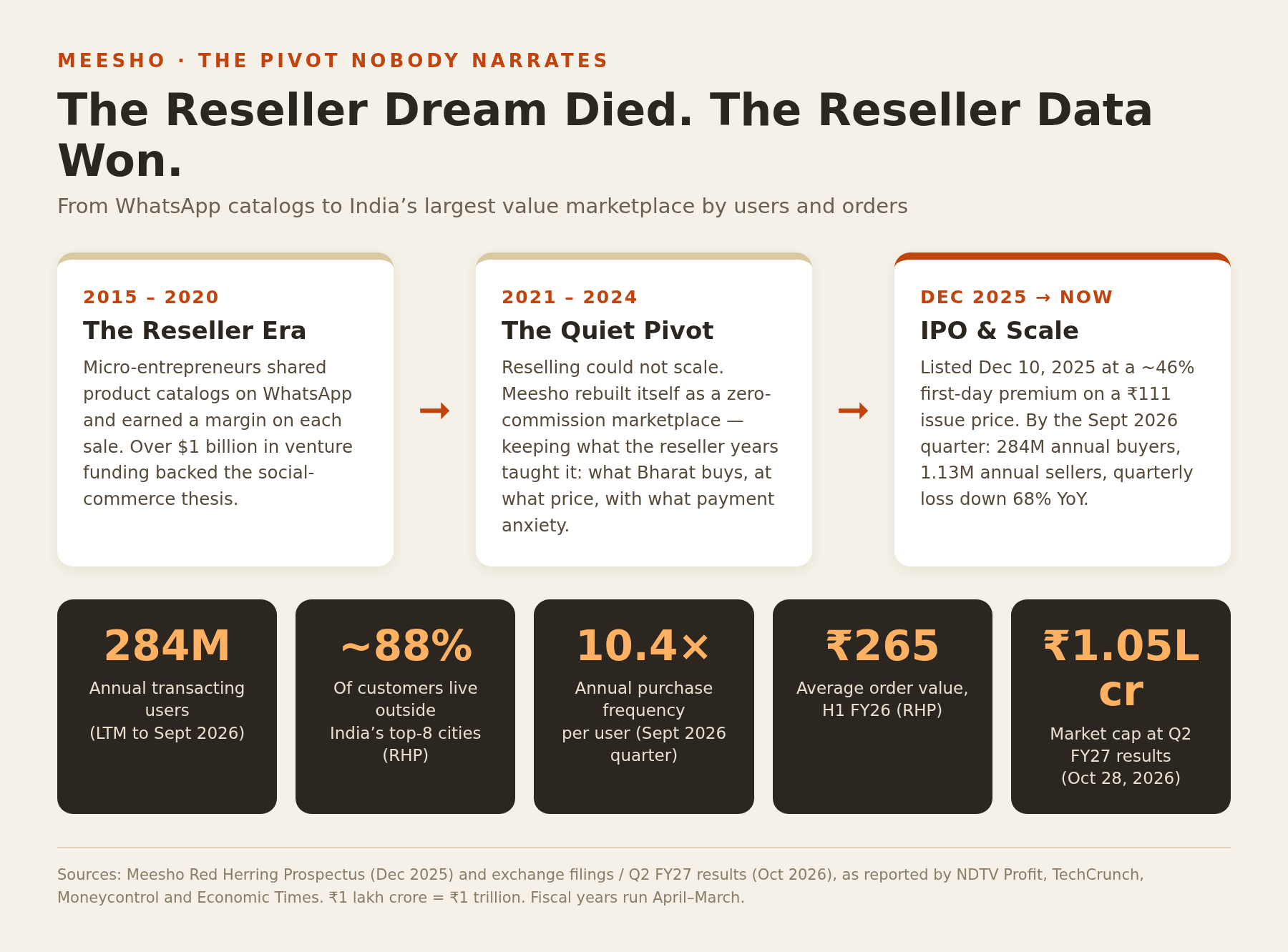
Meesho launched in 2015 with a beautifully simple idea: housewives and micro-entrepreneurs would share product catalogs on WhatsApp, collect orders from their social circles, and keep a margin. Investors loved it. SoftBank, Meta, Prosus and others poured in well over a billion dollars on the social-commerce thesis — TechCrunch reported the cumulative raise crossing $1 billion back in 2021.
Then the model quietly stopped being the model. The RHP describes a zero-commission marketplace, not a reseller network. Why the pivot? India’s peculiarities made reselling unscalable: there’s no unified chat-plus-payment rail like WeChat, reseller margins couldn’t survive price competition, and the human forwarding chain added cost without adding trust.
But here’s the reframe most coverage misses. The reseller era wasn’t a failed business. It was a paid market-research phase. Every WhatsApp forward taught Meesho which saree sells at ₹250 in a tier-3 town, which kitchen gadget converts in Gujarati, and how many buyers flinch at entering a card number. That data became the foundation of everything that followed.
The Numbers Behind India’s Largest Value Marketplace
Let’s anchor the scale before dissecting the mechanics. Per the RHP, in the twelve months ended September 2025, Meesho had 234.20 million annual transacting users and 706,471 annual transacting sellers, placing roughly 2.3 billion orders — which the company, citing research firm Redseer, claims makes it India’s largest e-commerce platform by both users and placed orders. About 88% of those customers live outside India’s top eight cities.
The post-IPO trajectory kept climbing. Fiscal 2026 (ended March 2026) revenue hit ₹12,626 crore, up about 34%, with 264 million annual users. By the September 2026 quarter — Q2 FY27, reported in late October — annual transacting users reached 284 million, sellers crossed 1.13 million, and purchase frequency hit 10.4 orders per user per year. The average order value? Around ₹265 in the first half of FY26. Three dollars. This is a business built on tiny baskets at enormous frequency, and every design choice flows from that fact.
Design Choice One: Zero Commission Buys Supply, Not Virality
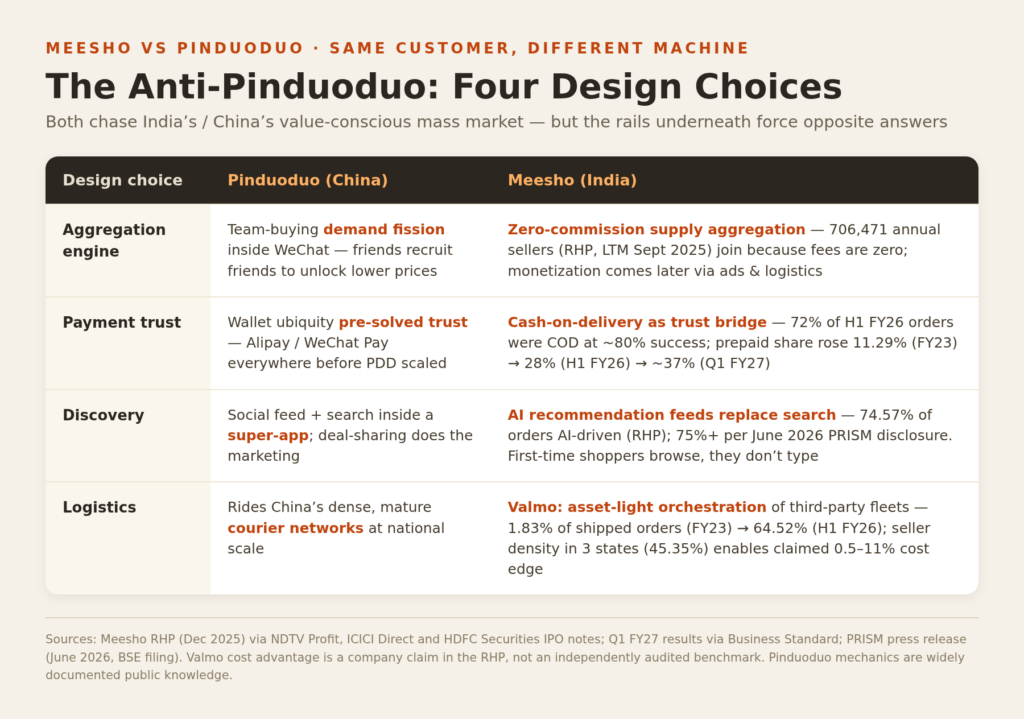
Pinduoduo’s genius was demand-side: team-buying inside WeChat turned every shopper into a recruiter. Meesho had no WeChat to ride. So it flipped the aggregation logic to the supply side.
Zero commission is the lure. Manufacturers, wholesalers and traders of unbranded and regional goods — a segment that, together with regional brands, accounts for over 75% of Indian retail spend according to Redseer’s analysis cited in the prospectus — list on Meesho because listing costs nothing. Branded e-commerce had ignored this ocean of supply; Meesho formalized it with ratings, returns and logistics SLAs.
Is zero percent charity? Obviously not. It’s a loss-leader on the supply side, and the take happens downstream — in shipping, advertising and services. Which brings us to the interesting question: does the downstream take actually work?
The ₹13.55 Answer
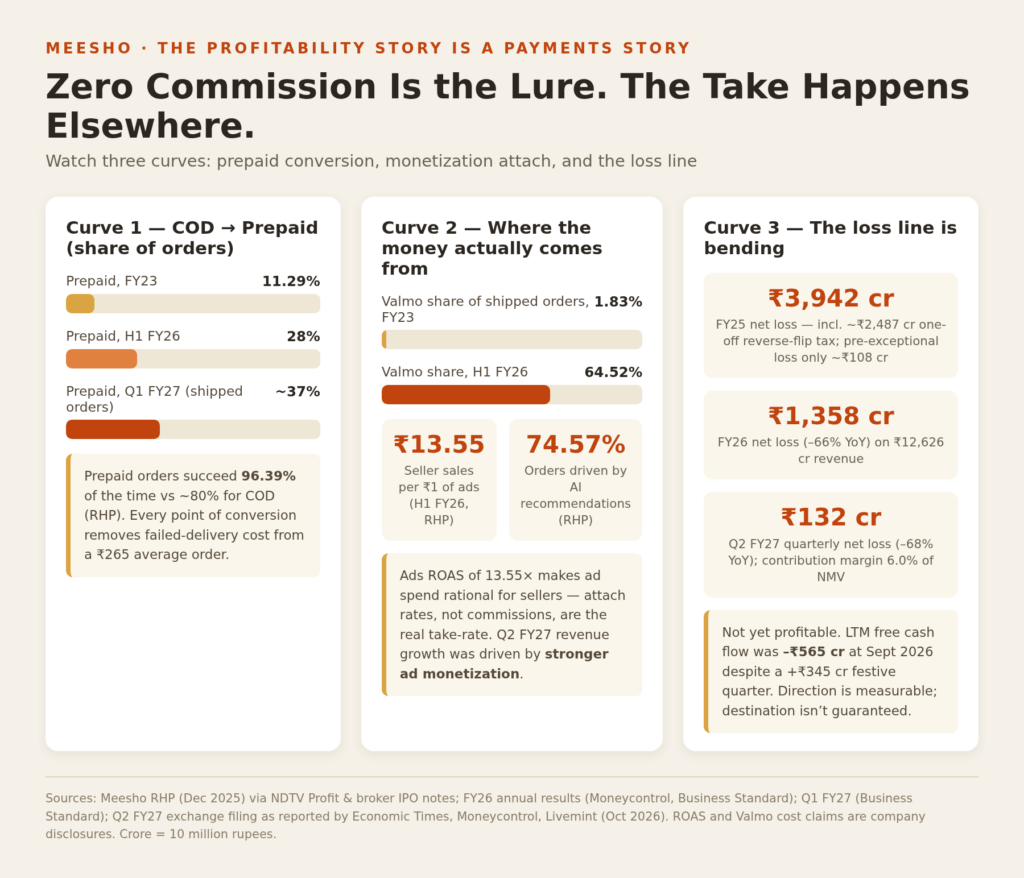
The RHP discloses that in the first half of FY26, every ₹1 a seller spent on Meesho ads generated ₹13.55 in sales. Sit with that number. At a 13.55× return, advertising stops being a tax and starts being a money machine — sellers budget for it voluntarily, and the platform monetizes attention without ever charging commission.
The October 2026 quarterly filing confirms the direction: marketplace revenue grew 34% year-on-year, driven explicitly by stronger advertising monetization. The company’s own logistics arm, Valmo, handled 64.52% of shipped orders in H1 FY26 — up from a rounding-error 1.83% in FY23 — and delivers another revenue line per parcel. Zero commission isn’t the business model. It’s the customer-acquisition strategy for the business model.
Design Choice Two: Cash-on-Delivery as Trust Infrastructure
Western analysts see 72% cash-on-delivery and smell backwardness. That reading gets the causality exactly backwards.
China’s mobile wallets pre-solved payment trust before Pinduoduo scaled. India’s mass market had no such bridge — so Meesho built one out of cash. In H1 FY26, 72% of orders were COD, with an approximate 80% delivery success rate disclosed in the prospectus. Yes, that means roughly one in five COD orders fails and comes back. Meesho absorbed that cost as the price of acquiring customers its rivals spent billions failing to reach.
And crucially, COD was a phase, not a permanent tax. Prepaid orders climbed from 11.29% in FY23 to 28% in H1 FY26 — and to roughly 37% of shipped orders by the June 2026 quarter, per Business Standard’s coverage of Q1 FY27. Prepaid orders succeed 96.39% of the time. Every point of that conversion curve deletes failed-delivery costs from a ₹265 order. As UPI penetrates deeper into small-town India, this curve is the margin story in disguise.
Design Choice Three: The Feed Replaces the Search Box
Here’s the statistic that should reshape how you think about Indian e-commerce: per the RHP, 74.57% of Meesho orders come from AI-driven recommendations, not search. A June 2026 company disclosure puts it above 75% and names the system — PRISM, running on Meesho’s in-house BharatMLStack infrastructure across ten-plus Indian languages.
Why does the feed dominate? Because first-time internet shoppers don’t know what to search for. The search box assumes you can articulate demand in keywords; a browsing feed assumes you recognize what you want when you see it. The recommendation engine is doing the job the WhatsApp reseller used to do — curating a plausible shortlist for someone who trusts people and pictures more than query strings. Meesho didn’t just replace the reseller’s catalog. It automated the reseller’s judgment.
Design Choice Four: Valmo Turns a Risk Factor Into a Moat
The prospectus lists seller geographic concentration as a risk: 45.35% of sellers cluster in just three states — Gujarat, Uttar Pradesh and Delhi. Read it again as a logistics engineer, though, and it’s a gift. Dense pickup clusters mean trucks fill faster, routes shorten, and per-parcel costs fall.
Valmo — think software brain orchestrating other people’s trucks, not a fleet Meesho owns — claims in the RHP a 0.5–11% cost advantage over major rivals thanks to that density. Treat the range as a company claim, not an audited benchmark. But the scale is verifiable: in FY26, Valmo delivered over 1.3 billion orders through roughly 18,000 logistics partners and 120,000 delivery agents. When your average order is ₹265, shaving rupees off fulfillment isn’t optimization. It’s the difference between a viable business and a bonfire.
What Everyone Misunderstands
Three prejudices deserve demolition. First, the Pinduoduo analogy: superficially plausible (cheap goods, value shoppers), mechanically false — no team-buying fission, no super-app wallet, no social graph doing the marketing. Meesho is closer to an algorithmic bazaar with a logistics company attached.
Second, the unbranded-equals-junk assumption. Unbranded isn’t defective; it’s the three-quarters of Indian retail that branded platforms never bothered to organize. Ratings, return policies and delivery SLAs are exactly the formalization layer that turns a bazaar into a market.
Third, the zero-commission skepticism that says sellers will simply skip the paid services. They can — nothing forces a seller to buy ads or use Valmo. But visibility in a recommendation-driven feed rewards participation, and a 13.55× ad return makes participation rational. The moat isn’t lock-in. It’s attach-rate gravity, and attach rates are the KPI worth watching.
The Honest Counterargument: It Still Loses Money
Let’s not write a love letter. FY25’s headline net loss was ₹3,942 crore — but that number is misleading without decomposition. It includes roughly ₹2,487 crore in one-time tax charges from the reverse-flip restructuring that moved the company’s domicile to India; the loss before exceptional items and tax was only about ₹108 crore. FY26’s net loss narrowed to ₹1,358 crore, and the September 2026 quarterly loss fell 68% year-on-year to ₹132 crore, with contribution margin reaching 6.0% of NMV.
Still, two facts temper the optimism. Free cash flow on a trailing-twelve-month basis was negative ₹565 crore as of September 2026 — the celebratory ₹345 crore quarterly inflow owed much to festive-season working capital. And quick-commerce players like Blinkit and Zepto are pushing into smaller cities, contesting the same value-conscious wallet; Bernstein analysts have flagged the overlap even while noting Meesho’s user base dwarfs theirs. The counter-limit: ten-minute delivery economics don’t fit a ₹250 unbranded saree shipped to a tier-3 town. Different basket, different geography — for now. The direction of Meesho’s losses is measurable. The destination isn’t guaranteed.
What This Means for Brands and Marketers
If you sell into India, four practical implications follow. One: Bharat is a different P&L. Low order values, high frequency, COD-tolerant logistics and feed-led discovery mean metro playbooks — search ads, brand stores, premium creative — underperform. Design for the feed and the price point, not the keyword.
Two: zero-commission platforms monetize your attention anyway. Budget ads and services as the real take-rate, and compute fully-loaded channel cost before comparing marketplaces on headline fees.
Three: regional manufacturers can now build repeat equity directly. Ratings plus logistics SLAs create a white-label-to-brand path that never passes through traditional distribution. And four: watch the prepaid curve. As UPI converts Meesho’s base, COD costs fall and margins inflect — the profitability story is a payments story wearing an e-commerce costume. Our companion piece on UPI as a growth channel traces the same rail from the other end.
The Lesson That Travels
Strip away the Indian specifics and one transferable insight remains: mass markets are winnable everywhere, but the machine must be built from the rails that actually exist. China’s playbook assumed wallets, super-apps and dense courier networks — so Pinduoduo aggregated demand socially. India lacked all three, so Meesho aggregated supply with zero fees, bridged trust with cash, replaced search with recommendations, and stitched logistics together with software.
The reseller dream died. The reseller data won. And the companies that understand which of their own assumptions are borrowed — rather than built from local reality — will be the ones still standing when the next hundred million shoppers come online.