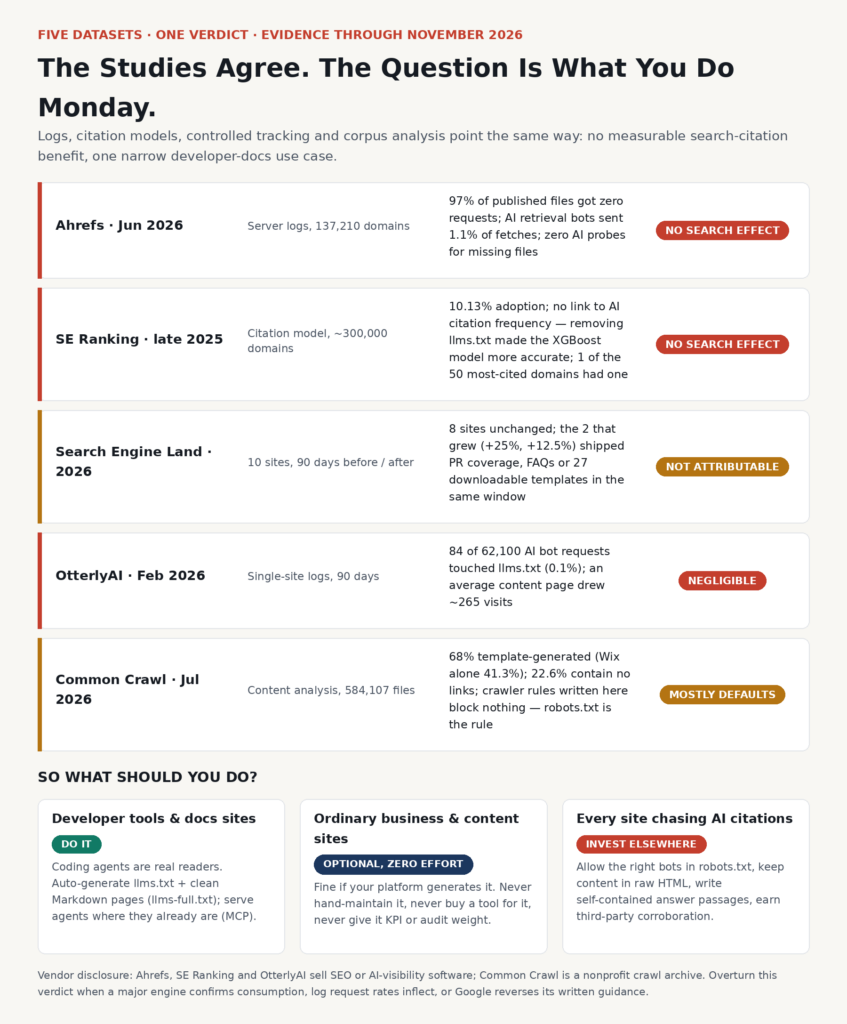
Your audit tool flags it. Your website builder generates it by default. Someone on LinkedIn swears it’s the new robots.txt. And yet, when Ahrefs pulled a month of server logs from 137,210 domains, 97% of published llms.txt files received exactly zero requests. Not low traffic. Zero.
So let’s do what the debate has been missing: put every serious dataset on the table, sort the real use case from the marketing theater, and walk away with a decision you can defend in a sprint planning meeting. The short version: llms.txt does nothing for AI search citations today, it genuinely helps coding agents read developer docs, and for everyone else it’s a zero-cost option — not a strategy.
97%: A File Written for Machines That Machines Don’t Read
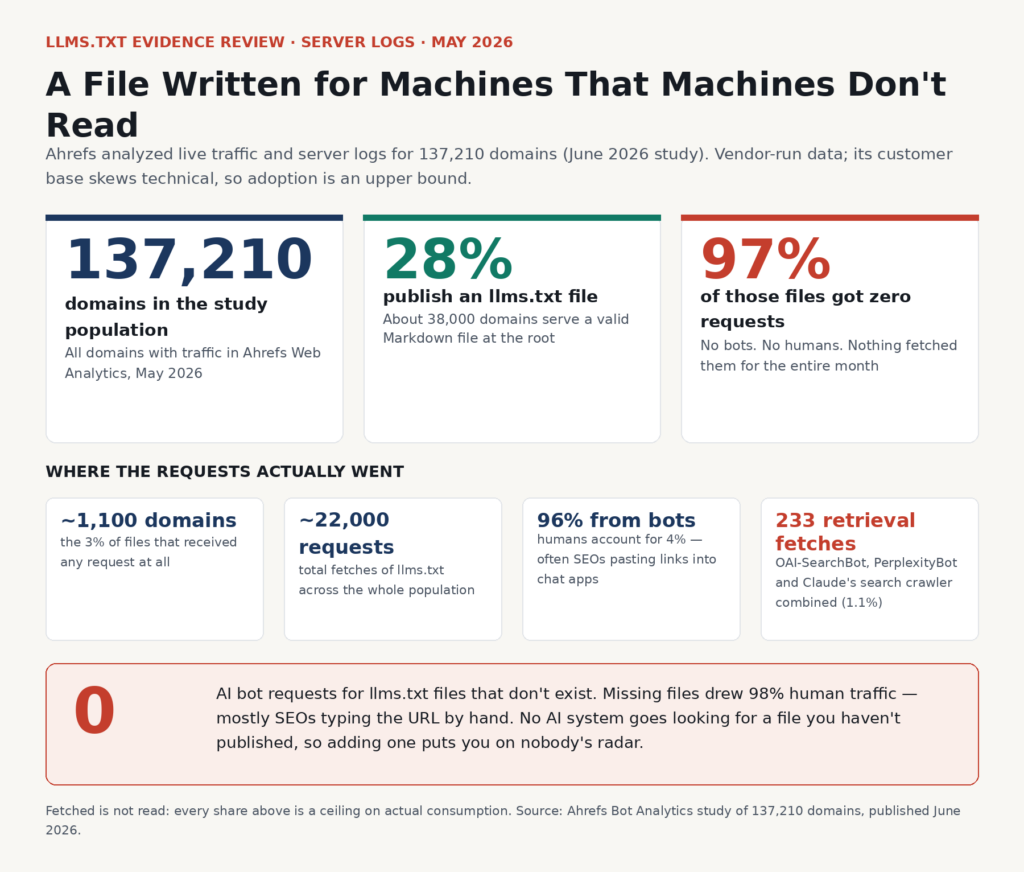
Start with the biggest study we have. In June 2026, Ahrefs analyzed live traffic and server logs for all 137,210 domains in its Web Analytics product that received traffic in May 2026. Two numbers matter, and they have different denominators — keep them straight.
Of the full population, 28% (about 38,000 domains) publish a valid llms.txt file. Of those published files, 97% got no requests at all for the entire month. No bots, no humans, nothing. All the traffic that did exist went to roughly 1,100 domains — about 22,000 requests in total.
One honest caveat before we go further: this is vendor-run data. Ahrefs sells SEO software, and its analytics customers skew technical and SEO-aware, so treat 28% as an upper bound on adoption, not a web-wide average. The zero-readership finding, though, is hard to argue with — you can’t spin a log line that doesn’t exist.
Who Actually Reads It: A Distribution That Should Embarrass the Pitch Decks
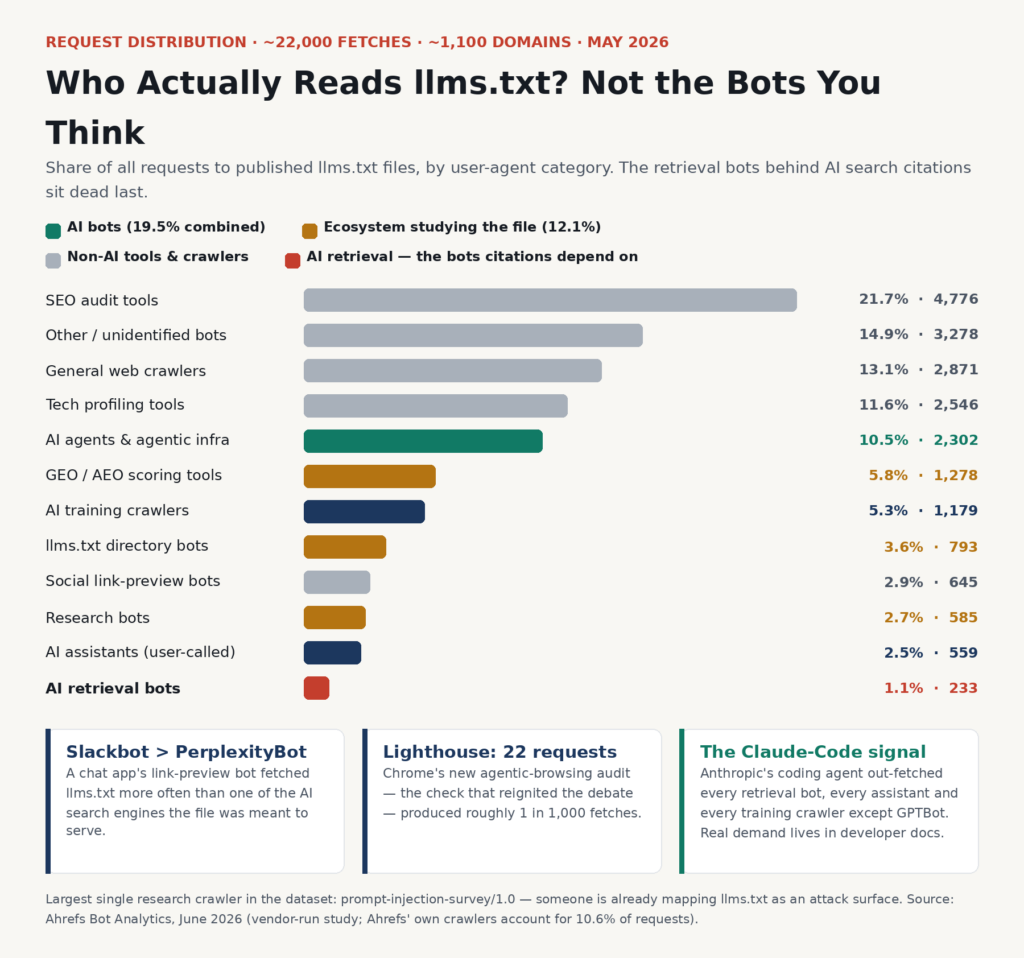
Of the requests that did reach llms.txt files, 96% came from bots. Fine — it’s a file for machines. But which machines?
The single largest reader category is SEO audit tools, at 21.7% of requests. Then unidentified bots (14.9%), general web crawlers (13.1%), and tech-profiling tools like BuiltWith (11.6%). No AI category makes the top four. Combine all four AI categories — agents, training crawlers, assistants, retrieval bots — and you get 19.5% of requests. That’s the ceiling, by the way: a fetch doesn’t prove anything was read or acted on.
Now the part that stings. GEO/AEO scoring tools (5.8%), llms.txt directory bots (3.6%), and research crawlers (2.7%) together account for 12.1% of all requests. The ecosystem studying, scoring, and cataloging llms.txt sends more traffic than AI agents do. As Redocly put it in its one-year retrospective: the tools that nag you to add the file are its main consumers.
And AI retrieval bots — OAI-SearchBot, PerplexityBot, Claude’s search crawler, the ones that actually fetch pages behind AI citations? They sent 233 requests. That’s 1.1% of the total, across thousands of sites. Meanwhile Slackbot, a chat app’s link-preview fetcher, requested llms.txt more often than PerplexityBot did. Let that sink in.
Zero Probing: Publishing Doesn’t Put You on Any Radar
Here’s the cleanest split in the whole dataset. Ahrefs also examined every request to /llms.txt paths that returned a 404 — sites without the file. Those missing files drew 98% human traffic (picture SEOs typing URLs into browsers to check competitors), and the AI bot share was zero.
No AI system goes looking for an llms.txt you haven’t published. Agents fetch it when a link, an index, or a user instruction tells them it exists — never speculatively. So the fear that a missing file means a missed knock at the door is dead on arrival. There is no knock.
Google in Writing: From the Meta Keywords Analogy to “Search Ignores Them”
Google’s position isn’t ambiguous, and it’s been consistent for over a year. In 2025, John Mueller compared llms.txt to the old meta keywords tag — a self-declared claim any system worth its salt ignores in favor of checking the site directly. At Search Central Live in July 2025, Gary Illyes said Google doesn’t support llms.txt and has no plans to.
Then came the documentation. Google’s guide to optimizing for generative AI features, published in May 2026, includes a section literally titled “Mythbusting generative AI search.” It tells site owners they don’t need to create machine-readable files, AI text files, markup, or Markdown to appear in generative AI search, because Google Search itself doesn’t use them. A clarifying note added on June 15, 2026 (the page was last updated July 10) goes further: keeping an llms.txt will “neither harm nor help your site’s visibility or rankings in Google Search, as Google Search ignores them.”
Pressed by Lily Ray in late May 2026 about an apparent contradiction with Chrome tooling, Mueller explained that llms.txt is “not done for search” — it’s a “temporary crutch, perhaps to save some tokens” for AI coding tools parsing developer documentation. Which brings us to the two plot twists.
The 24-Hour Flap and the Lighthouse Plot Twist
In December 2025, an llms.txt file appeared on Google’s own Search Central docs. The industry caught its breath — surely this was adoption. Within roughly 24 hours it was gone. Mueller later confirmed the file came from a sitewide CMS update that content teams didn’t know was happening, not a Search team decision. Files lingered on other Google properties, he noted, for other purposes — not discovery.
Five months later, Chrome’s Lighthouse 13.3 shipped an experimental “Agentic Browsing” audit category that checks for llms.txt. Same company, opposite signals? Not really — two divisions, two jobs. Search reads your real pages and ignores your self-description; a browser agent landing cold might appreciate a map. Note the audit’s own design: a missing file returning 404 is marked “Not Applicable,” because the file is optional. And in Ahrefs’ logs, that headline-grabbing Lighthouse check produced 22 requests — roughly one in a thousand.
The 10-Site, 180-Day Tracker: What Grew Was Content, Not the File
Logs tell you who fetches. Search Engine Land ran the other test: outcomes. A Previsible consultant tracked 10 sites across finance, B2B SaaS, ecommerce, insurance, and pet care for 90 days before and 90 days after implementing llms.txt, measuring AI crawl frequency and traffic from ChatGPT, Claude, Perplexity, and Gemini. (Transparency note: Search Engine Land is owned by Semrush, and this is a consultant’s small-sample study, not a lab experiment.)
Eight sites saw no measurable change. Seven stayed flat — same traffic, same crawl frequency — and one insurance site declined 19.7%, a drop that showed up across all channels and had nothing to do with the file.
The two “successes” dissolve under inspection. A neobank grew AI traffic 25%, but in the same window it earned national press coverage (including Bloomberg) around its banking license, rebuilt product pages with extractable comparison tables, launched 12 FAQ pages, and fixed crawl errors. A B2B SaaS platform grew 12.5% two weeks after implementation — except three weeks earlier it had published 27 downloadable templates, whose Google organic traffic rose 18% and kept climbing.
The pattern writes its own conclusion: sites that launched new, functional content grew; sites that merely cataloged existing content in a markdown file didn’t. llms.txt documented the work. It didn’t do the work.
300,000 Domains, One Citation Model, No Signal
SE Ranking ran the largest correlation study: roughly 300,000 domains, checked for llms.txt and modeled against AI citation frequency (vendor-run data — SE Ranking sells SEO software). Adoption was 10.13%, and there was no significant relationship with citations. The killer detail: removing llms.txt as a feature from their XGBoost prediction model made the model more accurate. A variable that improves predictions when deleted is noise.
Two more nails. Among the 50 most AI-cited domains, only one had an llms.txt. And adoption was flat across traffic tiers — 9.88% for tiny sites, 10.54% for mid-tier, 8.27% for sites with 100,001+ visits. If the file worked, the winners would use it more. They use it less.
A smaller single-site experiment from OtterlyAI (an AI-visibility vendor, February 2026) matches the logs story: over 90 days, 84 of 62,100 AI bot requests touched llms.txt — about 0.1% — while an average content page drew roughly 265 visits.
Most Files Aren’t Even Handwritten: The Common Crawl Reality Check
The strongest source here isn’t a vendor at all. Common Crawl, the nonprofit whose archive underpins much of AI training data, analyzed 584,107 llms.txt files from its July 2026 crawl. The findings, published by its senior research engineer Malte Ostendorff, reframe what “adoption” even means.
About 68% of files are template-generated, with Wix alone accounting for 41.3%. Only 49.9% carry the full proposed structure of title, summary, and link sections — and 22.56% contain no links at all. Adoption counts mostly measure which platforms flipped a switch, not which webmasters made a decision.
It gets messier. Common Crawl found 136,578 robots.txt files served at the llms.txt path — servers hanging the wrong document on the hook. And of 32 files whose text claimed to block Common Crawl’s CCBot, not one of the 31 testable sites actually blocked it in robots.txt. The file grants nothing and blocks nothing. It’s a policy description, not a policy — and descriptions drift out of sync with reality.
Where It Genuinely Works: Coding Agents and Developer Docs
Now the honest flip side, because “useless” is as lazy as “essential.” Jeremy Howard — the Answer.AI and fast.ai co-founder who proposed llms.txt in September 2024 — designed it for inference-time help: a clean markdown map so an agent can skip crawling your navigation, cookie banners, and JavaScript payload. That’s a developer tool idea, and in developer tooling it works.
In the Ahrefs data, AI agents and agentic infrastructure form the largest AI category at 10.5%. Anthropic’s Claude-Code out-fetched every retrieval bot, every assistant, and every training crawler except GPTBot — in the AI ranks it trails only the agentic crawler statespace-indexer and GPTBot. Training crawlers fetch the file nearly five times more than retrieval bots do, which tells you any influence would be upstream in training corpora, not at the moment of citation.
Stripe, Vercel, Cloudflare, and Anthropic all publish llms.txt for their docs, and platforms like Mintlify generate it automatically for the documentation sites they host. Vercel says 10% of its signups come from ChatGPT — the AI channel is real for dev tools. Redocly’s logs add the twist that settles the design question: the clean Markdown copies of pages get read many times more than the index file linking to them, and MCP servers draw far more agent traffic than llms.txt ever did. Even the spec followed its users — the August 2026 v2 revision added HTML link relations pointing agents directly to Markdown versions. The value was never the manifest. It was the Markdown behind it.
The Risk Nobody Puts on the Slide: An Attack Surface Already Being Mapped
The largest single research crawler in the Ahrefs dataset identifies itself as prompt-injection-survey/1.0. Someone is systematically studying llms.txt as a prompt-injection surface — a file agents are designed to ingest and trust.
Keep proportion: Common Crawl’s strict scan found only four genuine injection cases in half a million files, all deliberately planted to make a point, plus a few thousand files with milder guidance like “focus on these pages.” This isn’t an epidemic. But the asymmetry is real — a file nobody reads today could be trusted by agents tomorrow, and a stale or compromised file misleads every agent that touches it. So treat llms.txt like code: version-control it, restrict edit access, alert on unauthorized changes, keep it to plain links and descriptions with nothing instruction-shaped, and actually review whatever your platform auto-generated in your name.
The Decision Table: Three Site Types, Three Honest Answers
Developer tools, APIs, documentation sites: do it. Your readers include coding agents, the demand is measurable, and your docs platform probably generates the file already. Pair it with clean Markdown page copies (llms-full.txt), and put an MCP endpoint on the roadmap — that’s where task-driven agents actually go.
Ordinary business and content sites: optional, zero effort. If your builder ships it, leave it on. Never hand-maintain it, never buy a tool for it, and never let an audit score assign it citation weight or a KPI. If an audit flags a missing llms.txt as an error, ask the vendor to show consumption evidence — then decide whether their red flag deserves your sprint.
Everyone chasing AI citations: spend the hour elsewhere. Which brings us to the list that actually matters.
The Checklist That Beats llms.txt a Hundred Times Over
In order of documented impact:
- Let the right bots in. robots.txt is the rule; llms.txt is a wish. Confirm OAI-SearchBot, PerplexityBot, and their peers are allowed by robots.txt and by any CDN or bot-protection layer — OpenAI’s own crawler docs point here, not to llms.txt.
- Keep content in raw, crawlable HTML. Google’s guide is explicit: indexed, snippet-eligible pages are the entry ticket to AI features. Content locked behind client-side rendering that bots can’t see is invisible no matter what your root directory says.
- Write self-contained answer passages. The neobank’s comparison tables and FAQ pages are the pattern: data an engine can lift directly into an answer, with dates and specifics attached.
- Earn third-party corroboration. Press coverage and independent mentions did more for the two sites that grew than any file. Engines cross-check what the web says about you, not what you say about yourself.
When to Overturn This Verdict
This article is falsifiable on purpose. Update your priors when any of these fire: a major engine officially confirms it consumes third-party llms.txt files for answers; log request rates from retrieval bots show a sustained inflection (check your own logs — filter for llms.txt paths and watch the 404s too); Google reverses its written guidance; or controlled experiments isolate a citation lift with no confounding content launches. Until then, the evidence has a verdict, and it isn’t close.
Summary
The largest log study ever run on llms.txt found 97% of published files unread, retrieval bots at 1.1% of requests, and zero AI probing for missing files. Google says in writing that Search ignores the file. A 300,000-domain model got more accurate when llms.txt was deleted from it. Ten-site tracking credits growth to content and press, not the file. Two-thirds of files are platform defaults, many with no links. The one real audience is coding agents reading developer docs — serve them with clean Markdown and MCP. For everyone else: keep the free file if you have one, treat it like code for safety, and invest in bot access, extractable HTML, answer-ready passages, and third-party proof. That’s not a pessimistic verdict. It’s a budget freed up for work that compounds.