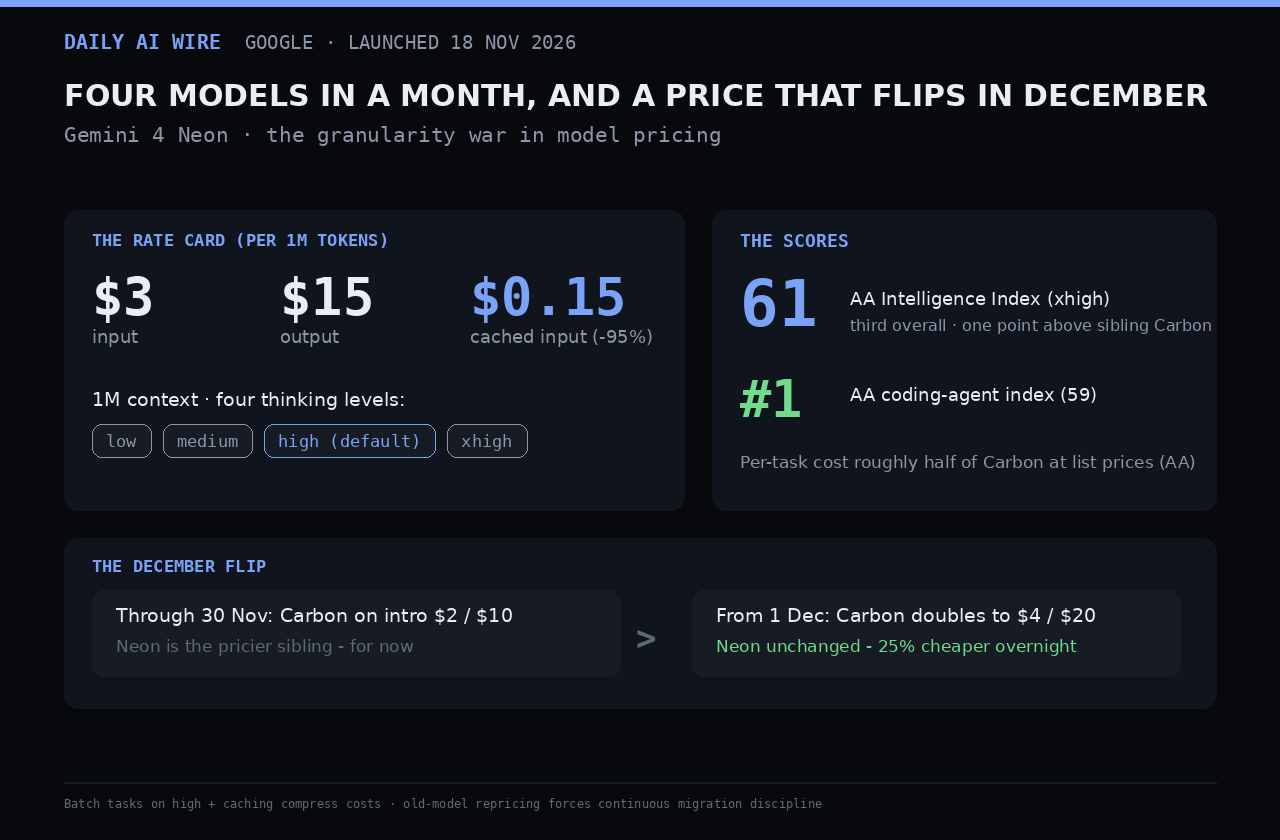
Google launched Gemini 4 Neon on November 18 — its fourth Gemini 4 model in roughly a month, after Argon, Carbon (November 10) and Hydrogen (November 12) — and the interesting part is the rate card’s calendar trick. Neon costs $3 per million input tokens and $15 per million output, cached input at $0.15 (a 95% discount), with a 1M-token context and four thinking levels: low, medium, high (default) and xhigh. At xhigh it scores 61 on the Artificial Analysis Intelligence Index — third overall, one point above its bigger sibling Carbon — and takes first place on AA’s coding-agent index at 59; AA measures its per-task cost at roughly half of Carbon’s at list prices. The flip: until November 30, Carbon sells at an introductory $2/$10, making Neon the pricier sibling; from December 1, Carbon doubles to $4/$20 while Neon holds, becoming 25% cheaper overnight without changing a digit. Model competition has become a pricing-granularity war — batch workloads on high thinking plus caching compress costs hard, and scheduled repricing forces the discipline of continuous migration.