Every January, somewhere in a marketing org, a team writes “publish 20 blog posts” as a key result. Everyone knows it’s a task, not an outcome. It gets approved anyway. Why?
The usual explanation is laziness or vanity. That’s wrong. Look at what each type of goal actually offers the person signing it, and the behavior stops being irrational — it becomes portfolio management.
An output KR is a risk-free asset. Publishing 20 posts is fully within the team’s control, verifiable instantly, and carries zero variance. It’s a guaranteed 1.0. An outcome KR — organic sessions from 12K to 35K — is a risky asset: algorithms shift, sales cycles lag, and honest effort can still miss. Same team, same quarter, wildly different exposure.
Now add the pricing mechanism most companies forget they built: what the scorecard rewards. A missed outcome KR triggers questions, postmortems, sometimes quieter consequences. A hit output KR triggers applause. When the review meeting pays the same price for a guaranteed 1.0 as for real change, buying certainty isn’t cheating. It’s the best trade on the board.
That’s the certainty premium: the gap between what a goal measures and what a goal costs you personally. Teams pay nothing extra for safety and everything for variance — so they load up on safety, and the company quietly pays the difference in flat revenue that never appears on any scorecard.
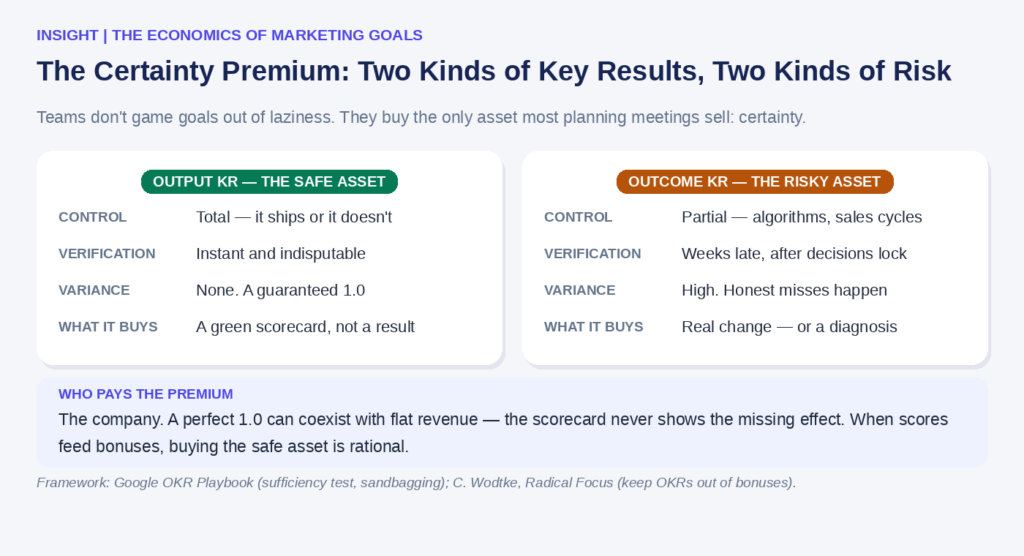
Google’s own OKR playbook documents the symptoms without naming the economics. It lists “playing it safe” — setting goals you know you’ll hit — as a named pitfall, and prescribes the sufficiency test: if every KR can score 1.0 while the objective still isn’t achieved, the KRs are broken. Translated into asset terms: your portfolio can be all green and worth nothing. Christina Wodtke’s rule in Radical Focus attacks the pricing side directly — keep OKR scores out of bonuses, because the moment a number feeds compensation, everyone rationally lowballs the number.
And there’s a compounding twist unique to 2026: the safest-looking asset is now also the least informative. With AI Overviews answering roughly half of tracked queries and only ~17% of cited sources ranking in the organic top 10 (BrightEdge’s twelve-month study), even “rank in the top 3” — a classic lag KR — no longer guarantees visibility. Teams clinging to measurable-but-shallow KRs aren’t just buying certainty; they’re buying certainty about the wrong market.
The fix isn’t exhorting people to be braver. It’s repricing the assets: pair every controllable activity with the outcome it must move, grade aspirational goals at an expected 0.7 without punishment, and make the review meeting ask “what changed?” before “what shipped?” Change the payoff, and the portfolio rebalances itself.
Nobody games a system they aren’t paid to game.