Here’s a question worth sitting with. If naive lifetime-value math overstates customer worth by roughly a third, and contribution-margin accounting has been public knowledge for decades, why does almost every dashboard still ship the inflated version by default? The answer isn’t ignorance. It’s incentives — and they all point the same direction.
Everyone Upstream Gets Paid When You Spend More
Walk the supply chain of your LTV number. The ad platform reports ROAS against revenue, because revenue makes its inventory look productive. The storefront labels lifetime sales as “LTV,” because a bigger number makes its dashboard feel like growth. The attribution vendor claims every converting customer for every channel it touches, because summed credit makes each subscription look essential. Even the agency benchmark that exposes the traps is sold by a firm selling growth services. Nobody in that chain is paid to make your acquisition budget smaller.
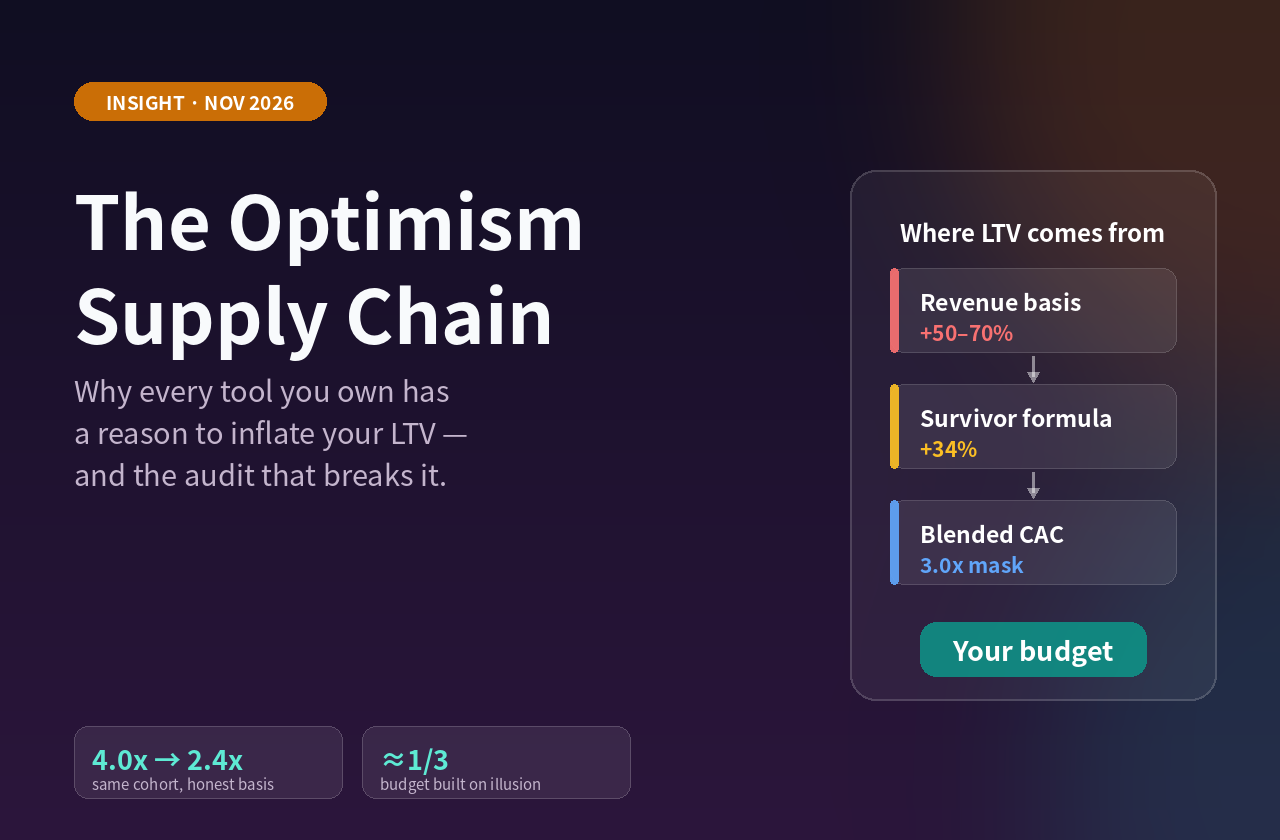
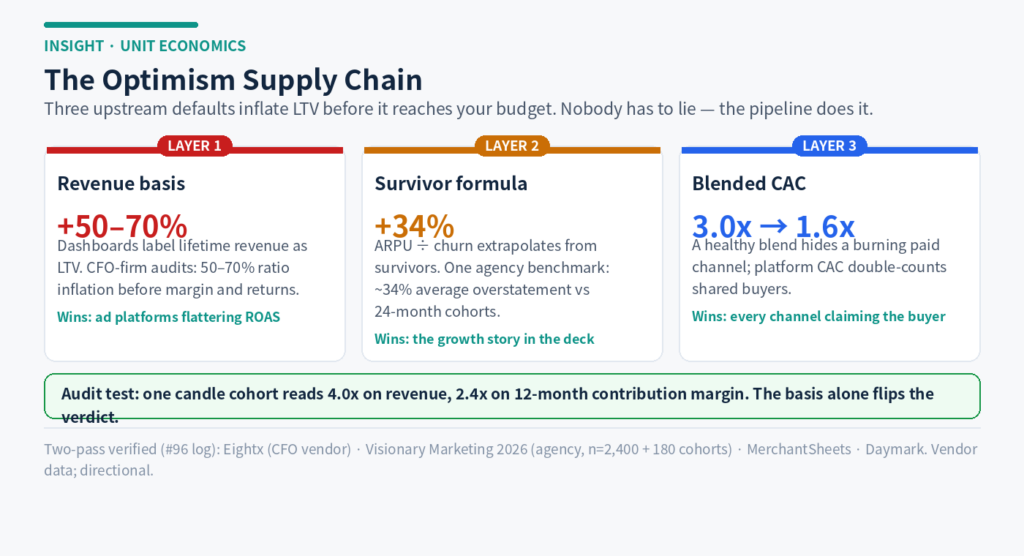
This is what I’d call the optimism supply chain: three upstream layers, each inflating the number before it ever reaches your spreadsheet. CFO-auditors at Eightx put revenue-basis inflation at 50–70%. Visionary Marketing’s disclosed agency dataset puts survivor-formula overstatement near 34% against 24-month cohorts. And blended CAC hides the channel-level insolvency underneath — one illustrative decomposition shows a healthy-looking 3.0× blend concealing paid social at 1.6×. These are vendor datasets, directionally corroborated, not a census — but notice that no layer requires anyone to lie. Each default is individually defensible. The pipeline does the inflating.
The Discount Falls on Exactly One Party
Economists will recognize the structure. It’s a lemons market run in reverse: the sellers of measurement can’t be cheaply audited by the buyer, so optimism is the equilibrium product. The cost of the inflated number lands on one party only — the operator who sets CAC ceilings from it. A third of overspend, compounding quietly, funded by your own credit line while every upstream dashboard congratulates you.
The Cure Costs Editing Time, Not Budget
Here’s the liberating asymmetry: you can’t change anyone’s incentives, but you can refuse their defaults. The audit is embarrassingly cheap. MerchantSheets’ candle example: the same cohort reads 4.0× on revenue and 2.4× on twelve-month contribution margin. Same customers, same month — one basis says scale, the other says repair. Recompute on CM2, cohort-match the CAC, cap the horizon at your data history, and let payback sit beside the ratio.
The brands that survive expensive traffic aren’t the ones with better dashboards. They’re the ones who noticed that every number they receive was manufactured by someone who profits from their spending — and installed one honest checkpoint the supply chain can’t reach.