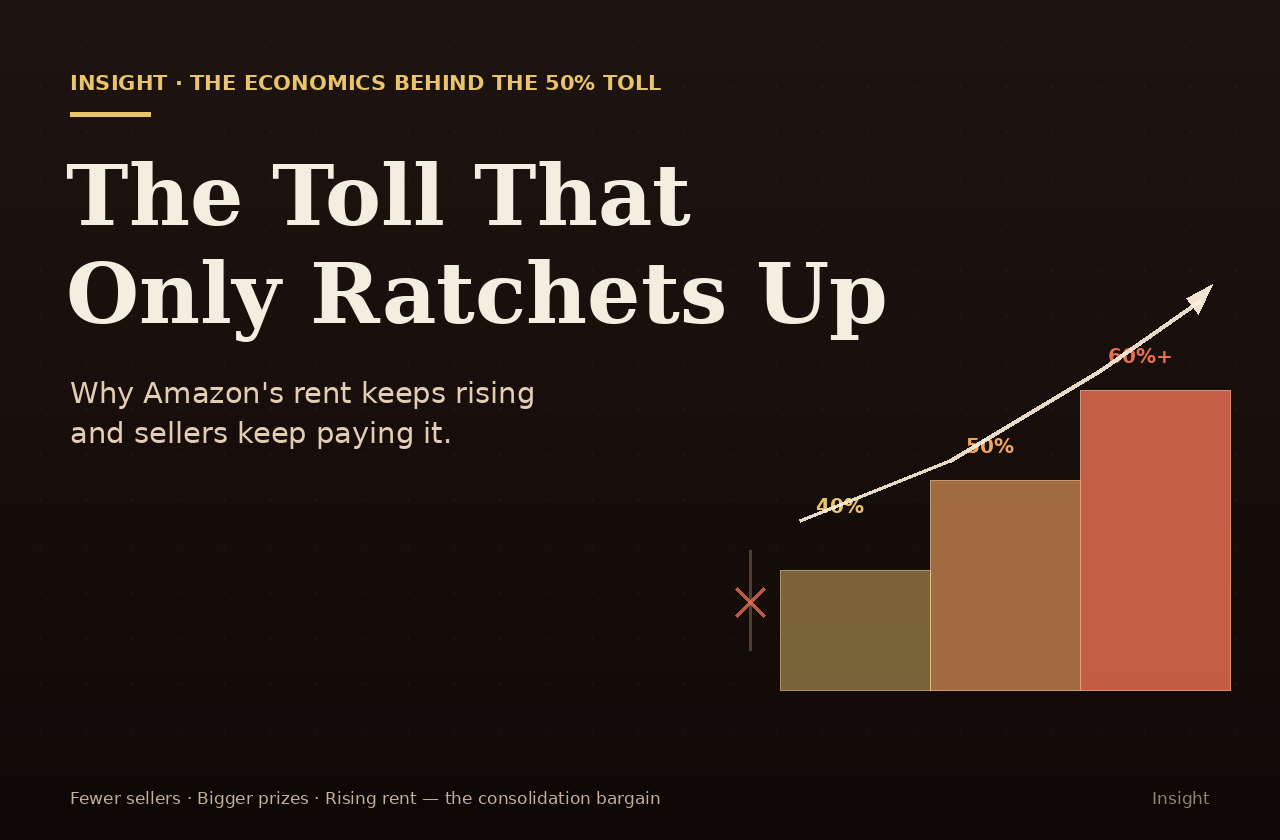
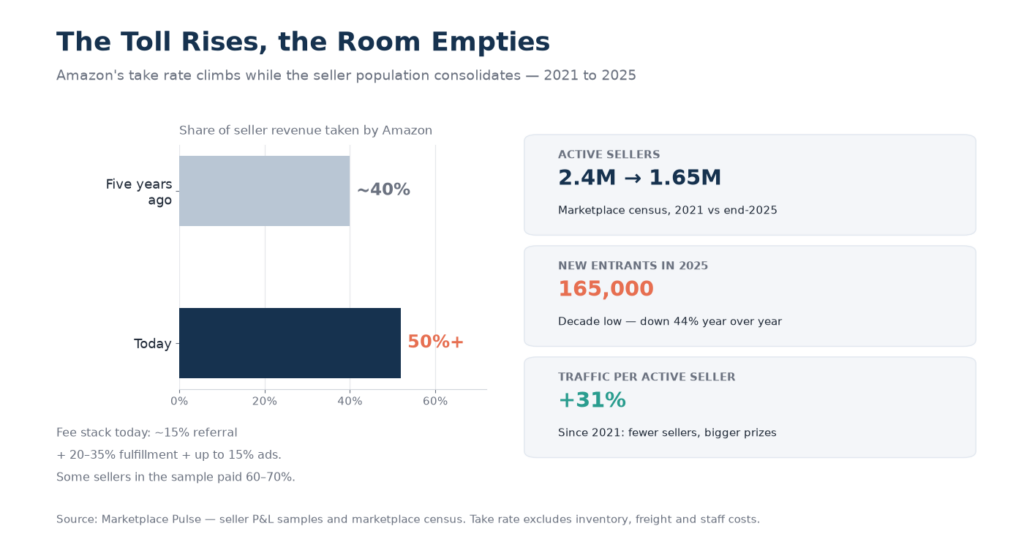
Here is a puzzle that should bother every marketplace seller. According to Marketplace Pulse’s analysis of seller P&Ls, Amazon now takes more than 50% of a typical private-label seller’s revenue — up from roughly 40% five years ago, with some sellers in the sample paying 60% or even 70%. In any normal market, a landlord doubling the rent empties the building. Yet Amazon’s marketplace keeps compounding. Why does the toll only move in one direction, and why do sellers keep paying it?
The answer is not greed. It is mechanism — four interlocking ones.
First, advertising stopped being optional. The fee stack breaks down as roughly 15% referral, 20–35% fulfillment, and up to 15% advertising. That last slice is the ratchet’s engine. Once page-one placement became effectively pay-to-play, ads shifted from a growth boost to a positional tax: you are bidding against your competitors for visibility you used to earn organically. Nobody can unilaterally stop bidding without vanishing from the shelf. The spend is compulsory in everything but name, and the auction guarantees it trends upward.
Second, switching costs swallow the fee delta. A seller integrated into FBA — inventory positioned across Amazon’s warehouses, listings tuned to its algorithm, reviews accumulated on its pages — cannot leave over a two-point fee increase. The cost of exiting exceeds the cost of staying, every single time the fee rises a little. Ratchets work precisely because each individual turn is too small to justify the escape.
Third — and this is the part most sellers miss — the toll is a filter, not an exodus. Marketplace Pulse counted active sellers falling from 2.4 million in 2021 to 1.65 million by end-2025, with only 165,000 new sellers launching their first listing in 2025, a decade low down 44% year over year. But traffic per active seller rose 31% over the same period, and over 60% of the top 10,000 sellers launched before 2019. Fewer players, bigger prizes. The rising rent does not empty the room; it selects who stays in it. The survivors can absorb 50% because each surviving seller sells more. The marginal entrant simply never shows up.
Fourth, follow the landlord’s incentive. Amazon’s retail operations now generate only about 40% of company revenue; the majority comes from services — largely fees paid by sellers. Amazon is not optimizing for seller count. It is optimizing for revenue per surviving seller, and a consolidated base of professional operators is a better tax base than a churn of hobbyists.
Which leaves one disciplined exit the ratchet cannot touch: customers who know your name and can be reached off-platform. An email list does not pay referral fees. That is not a consolation prize — it is the only negotiating position a seller has left. Build it while the toll is still affordable.