Every founder eventually gets asked the same question at a dinner party: do you sell on your own site, or do you get into stores? For a decade, the answer came pre-packaged with ideology. Direct-to-consumer meant independence, margin, and a direct line to your customer. Wholesale meant surrender — handing your brand to a middleman who would mark it up, mark it down, and keep the customer’s email address for themselves.
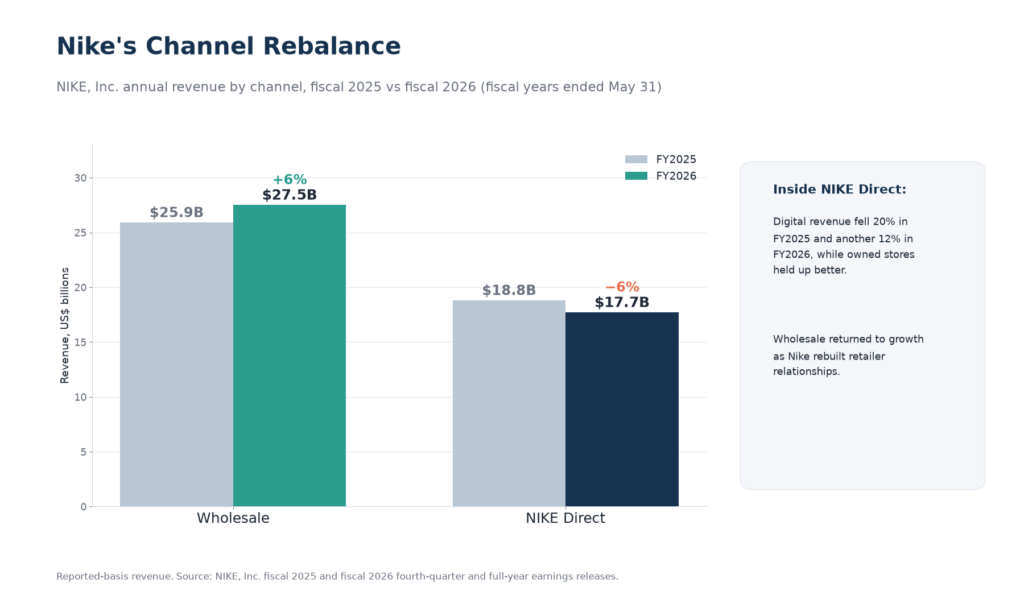
That framing is now obsolete, and the numbers explain why. Nike spent years pushing toward direct sales, watched its digital revenue fall 20% in fiscal 2025 and another 12% in fiscal 2026, then rebuilt its wholesale relationships — wholesale revenue grew 6% to $27.5 billion in fiscal 2026 while NIKE Direct fell 6% to $17.7 billion, according to the company’s earnings releases. Meanwhile Allbirds, the darling of pure DTC, closed every remaining full-price US store by February 2026, pivoted toward wholesale and distributors, and in March 2026 agreed to sell its assets for roughly $39 million — less than 1% of its peak $4 billion valuation. And on the other side of the ledger, Amazon’s marketplace now takes more than 50% of a typical seller’s revenue in fees, up from about 40% five years earlier.
The honest question is not which channel is morally superior. It is: what does each channel keep, what does it surrender, and what can you afford?
The False Binary: This Was Never Either/Or
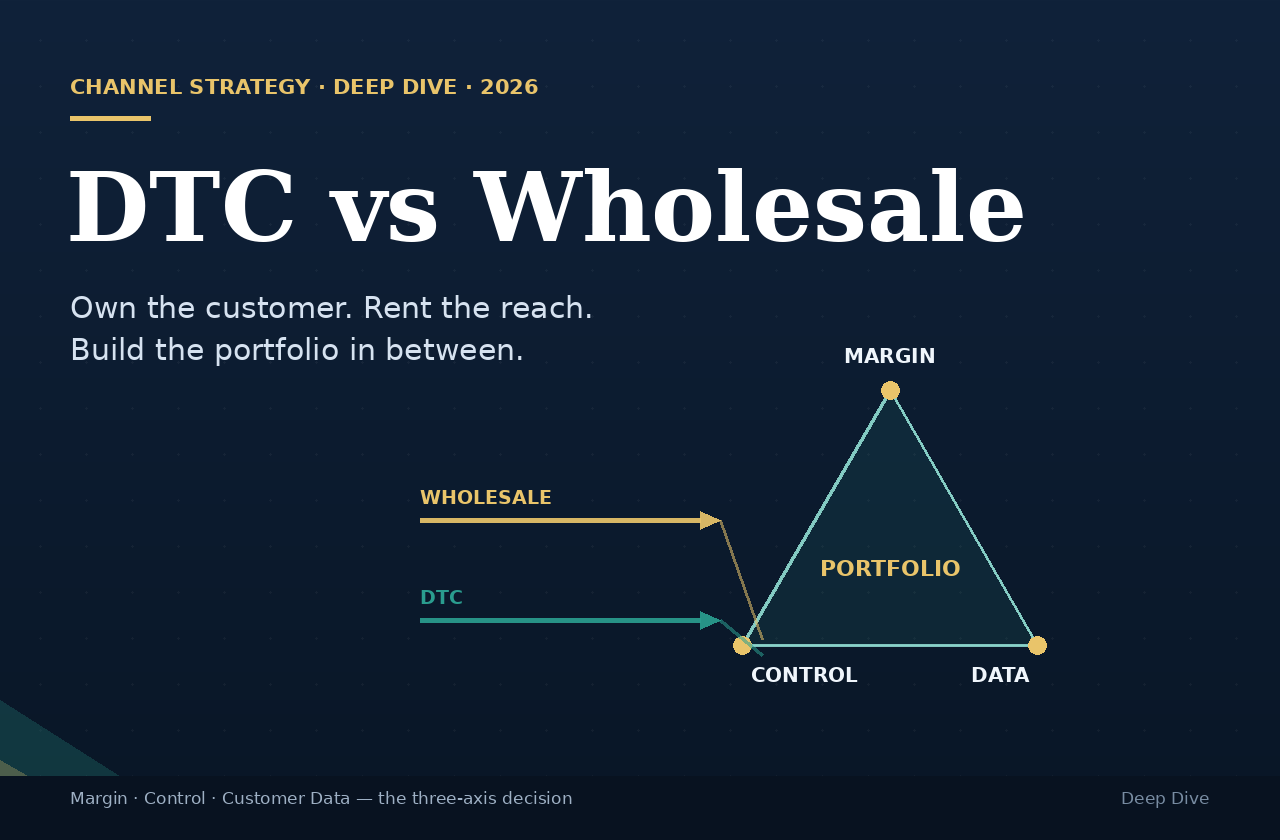
The DTC-versus-wholesale debate treats channels like identities. You are a DTC brand or a wholesale brand, the way you are a cat person or a dog person. But every durable consumer company that survived the last five years treats channels like positions in a portfolio — each holding a different mix of three things: margin, control, and customer data.
Definitions matter here, because sloppy ones cause sloppy strategy. eMarketer defines DTC narrowly: a brand manufacturer selling through its own website, app, or physical stores. Selling through your Amazon storefront does not count as DTC — that is marketplace selling, with marketplace economics. Wholesale means selling inventory to retailers or distributors who resell it under their own roof. Three distinct animals, three distinct contracts with your customer.
Once you separate them, the debate dissolves into arithmetic.
Three Axes: Margin, Control, Customer Data
Here is the trade in one breath. DTC keeps the full retail price, owns the pricing and presentation, and collects the customer’s name, email, and purchase history — but pays for every visitor, every pick-and-pack, every return. Wholesale surrenders roughly half the retail price to the retailer’s markup, loses control of the shelf and the final price, and never meets the customer — but the retailer buys inventory in bulk, generates the demand, and absorbs the store-level operations.
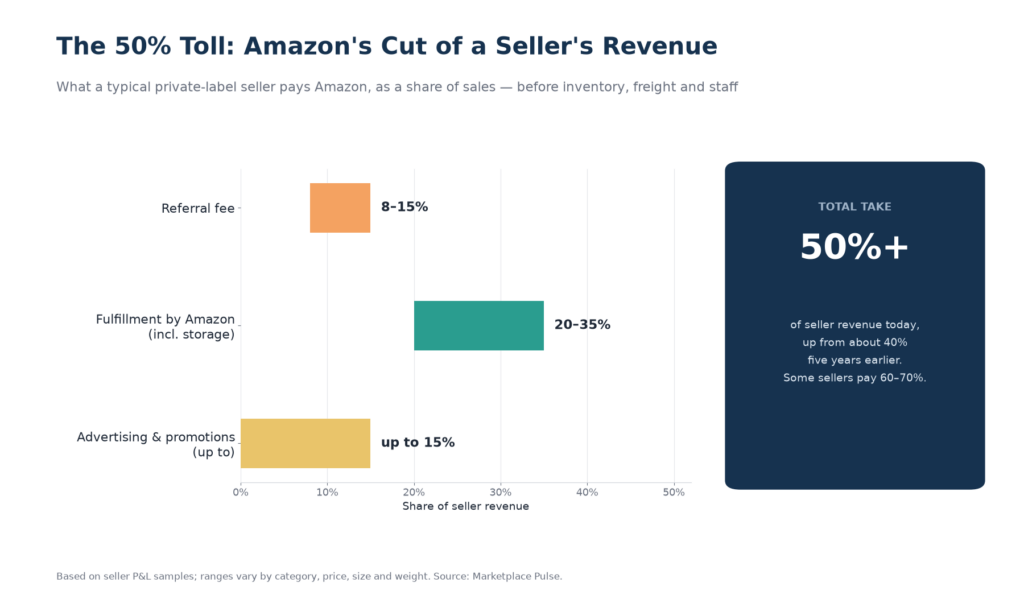
Marketplaces sit awkwardly between the two. You keep more margin than wholesale, but Marketplace Pulse’s analysis of seller P&Ls found a typical Amazon private-label seller now pays a 15% referral fee, 20–35% in fulfillment fees, and up to 15% in advertising — totaling more than 50% of revenue. Some sellers in the sample reported paying 60% or even 70%. That is wholesale-level margin surrender with DTC-level operational work. The worst of both, unless the reach pays for it.
DTC Anatomy: An Asset You Build, a Bill You Pay
The DTC pitch was always compelling. When Bonobos founder Andy Dunn wrote his 2016 manifesto on digitally native vertical brands, he claimed gross margins around 65% versus roughly 30% for conventional ecommerce. Keep the middleman’s cut, own the relationship, compound the brand.
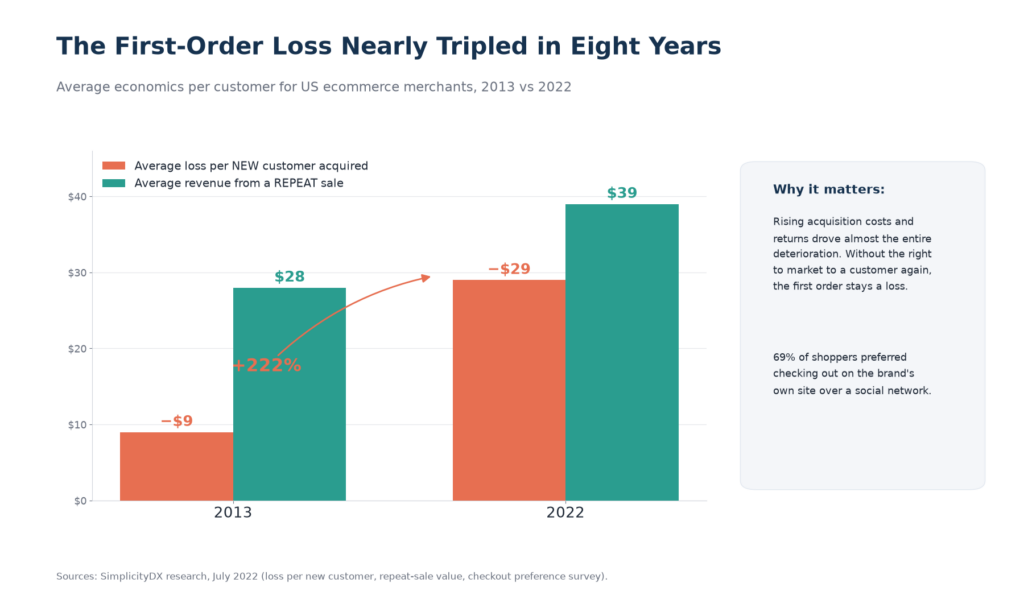
And the asset is real. Your email list cannot be delisted. Your website cannot lose the Buy Box. Your repeat customers cost almost nothing to reach again — research from SimplicityDX found the average repeat sale generated $39 for merchants in 2022, up from $28 in 2013.
But the bill arrived. The same research found merchants lost an average of $29 on every new customer acquired in 2022, versus $9 in 2013 — a 222% deterioration in eight years, driven by acquisition costs and returns. A caveat worth stating: SimplicityDX sells social-commerce optimization software, so read its findings with that commercial interest in mind; the directional trend, however, matches what public companies report. When Apple’s App Tracking Transparency arrived in 2021 and opt-in rates fell to the low teens, Meta’s own CFO estimated on an earnings call that the changes would cost the company on the order of $10 billion in annual ad revenue. Translation: the targeting that made DTC acquisition cheap was switched off, and it is not coming back.
First-party data is DTC’s compensation. You cannot buy your way out of signal loss, but you can collect consent and market to customers you already won. That is the asset the whole framework must protect.
Wholesale Anatomy: Reach You Rent, Cash You Can Bank
Wholesale’s virtues are unfashionable and undeniable. The retailer places one purchase order and you ship one pallet — no thousand individual parcels, no per-order ad spend, no customer-service queue. Cash arrives on purchase-order terms, which finance teams can actually forecast. The retailer’s shelves, foot traffic, and loyalty program do your demand generation for free.
The price of those virtues is the markup. A retailer that buys at half your retail price needs that spread to run stores and still discount. Your product will sit next to competitors, get promoted on someone else’s calendar, and be priced by someone else’s algorithm. On marketplaces, the Buy Box turns this into open warfare: unauthorized sellers undercut, and the algorithm rewards the lowest price regardless of who built the brand.
And the deepest cost: the customer belongs to the retailer. You will never know who bought your product at Target, never email them, never win them back directly. Wholesale revenue is real; wholesale relationships are rented.
The Marketplace Twist: Speed Beats Heritage
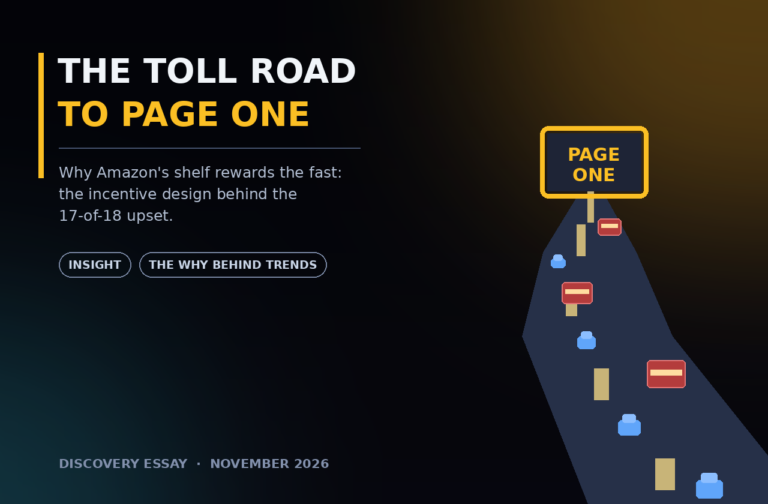
If you assume brand equity protects you on the algorithmic shelf, Kantar Retail IQ has bad news. Analysis published in late 2025 by Agentic Systems for Commerce and Intelligence Node — covering more than 1,000 top Amazon search results across 18 CPG categories — found that third-party sellers appear on page one more often than big CPG brands in 17 of 18 categories. The lone exception: cat food and treats.
The legacy brands had better ratings, deeper reviews, more promotions. They still lost visibility, because challengers update listings, prices, and creative at machine speed while incumbents move through quarterly approvals. Marketplace reach rewards operational agility, not heritage.
Amazon’s own numbers frame the stakes: third-party sellers account for roughly six in ten units sold — 61% of worldwide paid units in Q4 2025, per the company’s earnings release — and Marketplace Pulse calculates that Amazon’s retail operations now generate just 40% of company revenue. The rest is services, largely fees charged to those very sellers. The house always collects.
The marketplace also consolidates brutally. Marketplace Pulse counted only 165,000 new sellers launching their first listing in 2025, the lowest in a decade and down 44% year over year, while active sellers fell from 2.4 million in 2021 to 1.65 million. Yet traffic per active seller rose 31%, and over 60% of the top 10,000 sellers launched before 2019. Fewer players, bigger prizes, a higher bar. Rented reach is available — but the rent keeps rising, and the landlord favors professionals.
Why Pure DTC Got Harder: Costs Up, Signals Down
Stack the pressures and the pure-DTC math of 2015 no longer computes. Acquisition costs up — industry estimates cited alongside the SimplicityDX research put the five-year increase around 60%. Targeting precision down: ATT, cookie deprecation, privacy law. Returns eating contribution margin. Venture subsidies gone — the cheap-capital era that let brands lose money per customer and call it growth ended with the 2022 rate cycle.
Even the category’s ceiling is visible: eMarketer’s May 2025 forecast has DTC plateauing at roughly 19% of US retail ecommerce through 2028. The pandemic surge was a level-shift, not a compounding trend. A market that stops gaining share cannot bail out weak unit economics.
None of this makes DTC bad. It makes DTC-only fragile — one channel absorbing every cost shock with no counterweight.
The Hybrid Synthesis: Wholesale for Cash, DTC for the Asset
Watch what the survivors actually did. Warby Parker — the brand that made DTC eyewear famous — posted its first profitable quarter as a public company in early 2025, opened its 300th store, and launched its first five shop-in-shops inside Target that fall, with 50 more stores planned for 2026. The digitally native pioneer is now, functionally, an omnichannel retailer that happens to own its website.
Nike ran the experiment at $46-billion scale: cut wholesale partners to push customers direct, watched digital shrink two years running, then rebuilt wholesale under new leadership — and wholesale grew 6% in fiscal 2026 while Direct fell 6%. The world’s strongest athletic brand concluded it needed both.
The pattern is consistent: wholesale and marketplaces generate reach and cash flow; the owned site captures margin, data, and brand narrative. Neither channel is the strategy. The allocation is the strategy.
The Insurance Layer: Equity the Platform Cannot Confiscate
Here is the sharpest way to see the difference. Imagine two brands with identical revenue. Brand A sells 70% through a marketplace and 30% through its own site, and holds a 20,000-person consented email list. Brand B sells 100% on the marketplace. This is an illustrative scenario, not market data — but the asymmetry is real. A policy change, a fee hike, or a suspension zeroes out Brand B overnight. Brand A loses reach but keeps a callable customer base.
History prices this risk brutally. Thrasio raised roughly $3.4 billion at a peak valuation near $10 billion buying Amazon-native brands, then filed for Chapter 11 in February 2024, cutting about $495 million in debt — a portfolio of hundreds of marketplace brands proved far less durable than its valuation implied. Allbirds, on the pure-DTC side, went from a $4-billion IPO valuation to a $39-million asset sale in under five years. Platform equity and unprofitable owned equity both failed. What survived across the industry was the boring middle: profitable hybrid operations with off-platform relationships — email, SMS, community, brand search — as the insurance layer.
Build the list even when the marketplace is booming. Especially then.
The Bridge: Making Channels Feed Instead of Cannibalize
The hybrid only works if the channels connect. Three bridges matter in 2026.
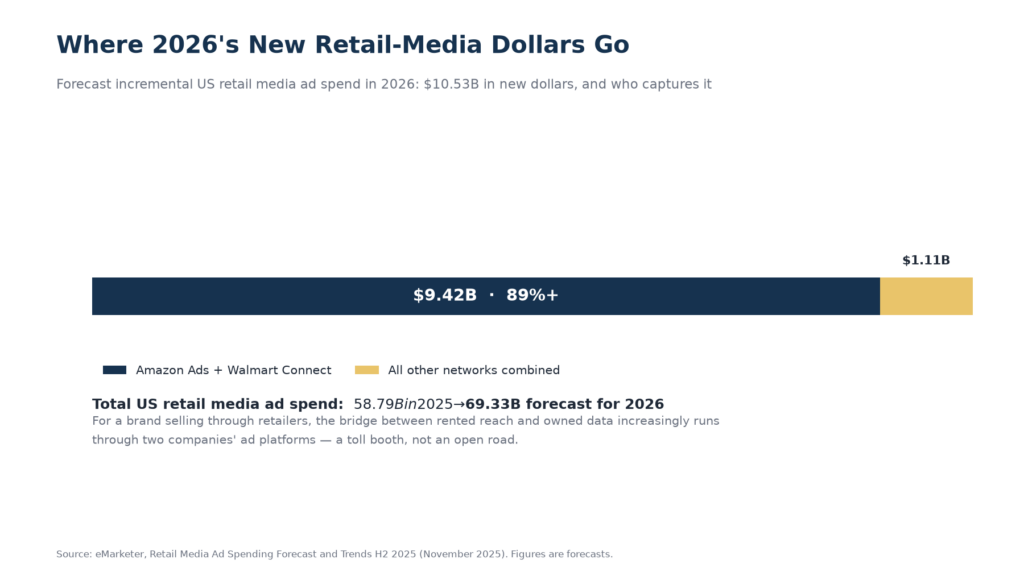
Retail media is the big one — and the most double-edged. US retail media ad spend will reach $69.33 billion in 2026, up from $58.79 billion in 2025, per eMarketer’s H2 2025 forecast. But $9.42 billion of the $10.53 billion in new dollars — over 89% — flows to just Amazon Ads and Walmart Connect. You can buy visibility inside the retailer using the retailer’s purchase data, but you are renting the bridge from the same landlord whose rent keeps rising. Budget it as performance media with incrementality tests, not as a loyalty program.
Packaging and product inserts are the cheap one: every wholesale and marketplace unit that ships is a chance to offer warranty registration, a care guide, or a first-party incentive that converts an anonymous buyer into a consented contact — within each platform’s rules, which for Amazon means never diverting the transaction itself.
Assortment architecture is the structural one: keep hero SKUs everywhere for reach, but hold bundles, exclusives, and new launches on your own site, so the channels sell different baskets instead of fighting over the same one at different prices.
Decision Framework I: Capital Shape
Wholesale and DTC consume different kinds of money. Wholesale needs inventory capital — you finance production months before the retailer pays, and one large order can strain a small balance sheet. DTC needs launch capital — months of ad spend and creative testing before contribution margin turns positive, with that $29 average first-order loss as the industry’s cautionary benchmark.
Ask which shape your balance sheet can survive. A manufacturer with trade-credit lines is built for wholesale. A brand with marketing muscle and patient equity money is built for DTC. Most companies should sequence: use whichever channel funds the other.
Decision Framework II: Control and Data Requirements
Some products cannot survive loss of control. If your brand depends on presentation — premium positioning, education-heavy selling, regulated claims — the retailer’s shelf and the marketplace’s price algorithm will erode it. If your product is a commodity replenishment, control matters less than availability, and rented reach wins.
Data follows the same logic. Subscription and replenishment models need the customer relationship to function; you cannot run a refill cadence through a retailer who will not share buyers. One-off commodity sales can live happily anonymous. Own the channels your business model cannot operate without; rent the rest.
Decision Framework III: Risk and Category Fit
Map your category against two questions. First, is demand trend-driven or replenishable? Trend products need speed — the marketplace’s machine-speed winners proved that — while replenishable products reward the lifetime relationship DTC builds. Second, how catastrophic is channel concentration? If one platform represents most of your revenue, you are one policy change from an existential event, whatever your margin looks like.
The practical rule: no single rented channel should hold a majority of revenue indefinitely, and no owned channel should be starved of investment because rented reach is currently cheap. Both conditions fail quietly, right up until they fail loudly.
Running the Portfolio: Four Metrics, One Cadence
Manage the mix like an allocation, reviewed quarterly. Track four numbers: contribution margin per channel (after ads, fees, fulfillment, and returns — not gross margin); the share of customers you can contact directly (consented email and SMS as a percentage of total buyers); the dependency ratio (your largest channel as a share of revenue); and blended CAC against repeat-adjusted LTV per channel cohort.
The China mirror is instructive: mature Chinese brands run the same triangle — a Tmall flagship for brand-controlled presentation, distributors for reach, Douyin and Pinduoduo for volume — and treat the mix as a managed portfolio rather than an identity. The platforms differ; the arithmetic does not.
Rebalance when a metric crosses a line you set in advance, not when a platform scandal makes the headlines. The goal was never independence or scale. It was durability: margin you keep, customers you can call, reach you can afford to lose.
Conclusion: Own Something They Cannot Take
The 2026 verdict is not that DTC won or wholesale won. Both purist strategies produced headline casualties — Allbirds on one side, Thrasio’s portfolio on the other — while the survivors quietly ran portfolios. Wholesale rents reach and banks cash. DTC builds an asset and pays the acquisition bill. Marketplaces reward speed and charge rising rent. Your job is to allocate across all three by capital shape, control needs, and risk tolerance — and to make sure that somewhere, on a list you own, the customer relationship lives where no platform can confiscate it.
Rent the reach. Own the customer. Build the portfolio in between.