Everyone passes. The store is still slow. That is not a contradiction; it is an accounting decision.
Shopify publishes a speed rule for apps, and it is a good rule. To be listed in the App Store, an app must not reduce a storefront’s Lighthouse performance score by more than ten points. To earn the Built for Shopify badge, it must also keep admin-side Core Web Vitals inside the good band — LCP within 2.5 seconds, INP within 200 milliseconds, CLS at 0.1 or less, measured at the 75th percentile over the last 28 days. Badges are re-reviewed annually, so this is not a rubber stamp.
Read the test procedure closely, though, and you find the seam. Shopify measures the score before and after installing your app, on a weighted blend of home, product and collection pages. And the baseline it specifies is a clean theme “without your app or any other apps installed.” Every app is tested against an empty store. No app is ever tested against the store it will actually join.
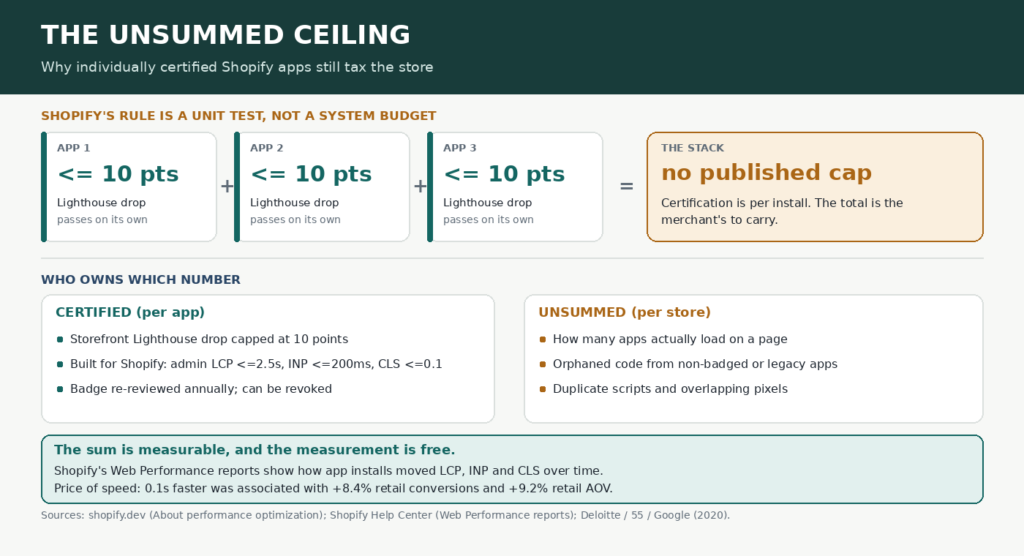
This is a classic unit-test versus system-budget gap. Each vendor optimises what is scored, rationally and well. Nobody owns the total, because the total is not scored anywhere. The merchant inherits a number no dashboard assigns to anyone — and then hears the standard advice, change your theme, which the numbers do not support.
The gap is also asymmetric. Badged apps must use theme app extensions, and Shopify removes their blocks entirely on uninstall. Non-badged and legacy apps can leave orphaned code behind. So the certified half of your stack behaves better on exit than the uncertified half — while both still pay the same admission cost on entry.
Why does this matter commercially? Because speed is priced. In the Google-commissioned field study by Deloitte and 55, covering 37 brands and more than 30 million mobile sessions, a 0.1-second improvement was associated with an 8.4% rise in retail conversions and a 9.2% rise in retail average order value. Those are observed associations, not guarantees. But they explain why an unsummed tax compounds: nobody approved it line by line, yet it shows up in the only report that matters.
The reframe is not anti-app. It is that the platform’s ceiling is a floor for vendors, not a budget for you. And the missing measurement is free: Shopify’s own web performance reports show how app installs moved LCP, INP and CLS over time. Audit the sum before you buy the next component. The badge tells you an app was well built. Only the total tells you what it costs.