Somewhere right now, a marketer is staring at a revenue number that looks wrong. The instinct is to blame the tool. Did GA4 change its attribution model? Did the ads platform drop a conversion? Almost always, the answer is quieter and less glamorous: the tag layer lied. A purchase fired twice because someone refreshed the confirmation page. A cart event carried last week’s SKUs. An analyst typed fb where the spreadsheet said facebook, and suddenly ROAS could not be reconciled with spend.
Here is the uncomfortable part. GA4 is event-based, which means your implementation — not the product — decides what the data means. Google ships the schema; you ship the values. A misconfigured container does not throw an error. It produces a beautiful, plausible, completely fictional report. And because Google Ads bids toward converted revenue, wrong data does not merely mislead a meeting. It quietly reallocates budget toward the wrong clicks.
So why does 2026 make an old problem urgent? Two pressures arrived at once. Consent Mode v2 stopped being optional for anyone measuring users in the EEA and the UK, and browser tracking prevention stopped being a theoretical worry. The fix is not a new tool. It is a change in posture: treat Google Tag Manager as production infrastructure, the way you would treat a payments service, and govern it accordingly.
GTM and GA4 are not the same job, and confusing them costs you
Let us separate the division of labor cleanly. GTM is the deployment layer: it decides what code runs, when it runs, and with which values. GA4 is the collection and analysis layer: it receives events, models behavior, and renders reports. One is plumbing. The other is the water quality report.
You can, technically, hard-code gtag() calls directly into templates. Plenty of teams still do. It works right up until the moment you need to change eleven event definitions across three environments, or pause a vendor tag during an incident without a deploy. Direct-code tracking couples measurement to release cycles, which is a polite way of saying measurement stops being anyone’s priority. In 2026, with consent state, server-side routing, and multiple ad platforms all needing the same event, that coupling is fragile. A container gives you one place to change behavior without shipping application code.
That does not make GTM magic. It makes it a lever with a long handle: small edits scale instantly across the whole site. Long handles amplify both good and bad decisions, which is exactly why the governance sections below matter more than any individual tag.
The container is a product, not a snippet
A GTM implementation has four moving parts, and worth knowing them by name. Tags are what fires and where it goes. Triggers are when it fires. Variables carry context — a click text, a product ID, a consent state. The dataLayer is the structured bridge between your application and all of the above. Around that core sit the controls that turn a snippet into infrastructure: workspaces so two people can edit without collision, environments so staging and production load different container versions, and versions themselves, which give you a rollback button when something goes sideways.
One container per domain is the sane default. Multiple containers on one page create duplicate tags and phantom pageviews that are miserable to untangle. The <noscript> fallback exists, but treat it as a safety net for a tiny slice of traffic rather than a measurement strategy. And use environments the way engineering uses them: a preview build carrying gtm_auth and gtm_preview parameters lets you validate a container against production data before a single real user sees it.
Ask yourself a simple question the next time an audit feels heavy: if this container broke at 9 a.m., could you revert to yesterday’s version in under five minutes? If the answer is no, you do not have infrastructure yet. You have a very confident script tag.
The dataLayer is where discipline lives or dies
The dataLayer is an array of objects, but you should think of it as an API contract between developers and marketers. That framing changes the behavior. APIs get documented. They get versioned. They do not get improvised twenty minutes before a campaign launch.
A documented dictionary is the single highest-return artifact in this whole playbook. For every event, write down the event name, every parameter, its type, who owns it, and what “valid” looks like. value is a number, never a string with a dollar sign. item_id matches the product feed, full stop. quantity reflects what was actually added, not a hard-coded 1 that hides a three-unit click. Once the contract is written, build the item object in one function and call it from every event; most ecommerce errors are really inconsistent item construction wearing a disguise.
Timing matters as much as shape. Push before render, not after. If your tag reads the dataLayer before the application has written the product data, you get an event with an empty cart and no error message. A useful mental model: the dataLayer is a stage, and the push is the cue. Miss the cue and the actor walks out to an empty set.
Triggers should describe intent, not CSS accidents
This is a subtle one, and it is where GA4 quietly removed a guardrail. Universal Analytics let you mark an event as non-interaction, so passive events did not distort engagement. GA4 dropped that flag. Events that fire on scroll depth, element visibility, or a timer now count toward engagement unless you deliberately design around them. A container full of auto-firing visibility triggers can manufacture an engaged audience out of people who bounced in four seconds.
So write triggers that reflect user intent rather than technical convenience. A click on “Add to cart” is intent. “Any click whose element class contains btn” is a coincidence waiting for a redesign. Element visibility is fine for measuring exposure, but label it honestly and keep it out of the conversion path. Custom-event triggers driven by clean dataLayer.push({event: '...'}) calls are the most stable option, because they are coupled to your application’s logic instead of the DOM’s mood.
Rhetorical question worth keeping on the wall: if a front-end developer renames a class tomorrow, should your revenue reporting change? If the answer is yes, the trigger is wrong.
GA4 ecommerce in full: ten events and one reset nobody remembers
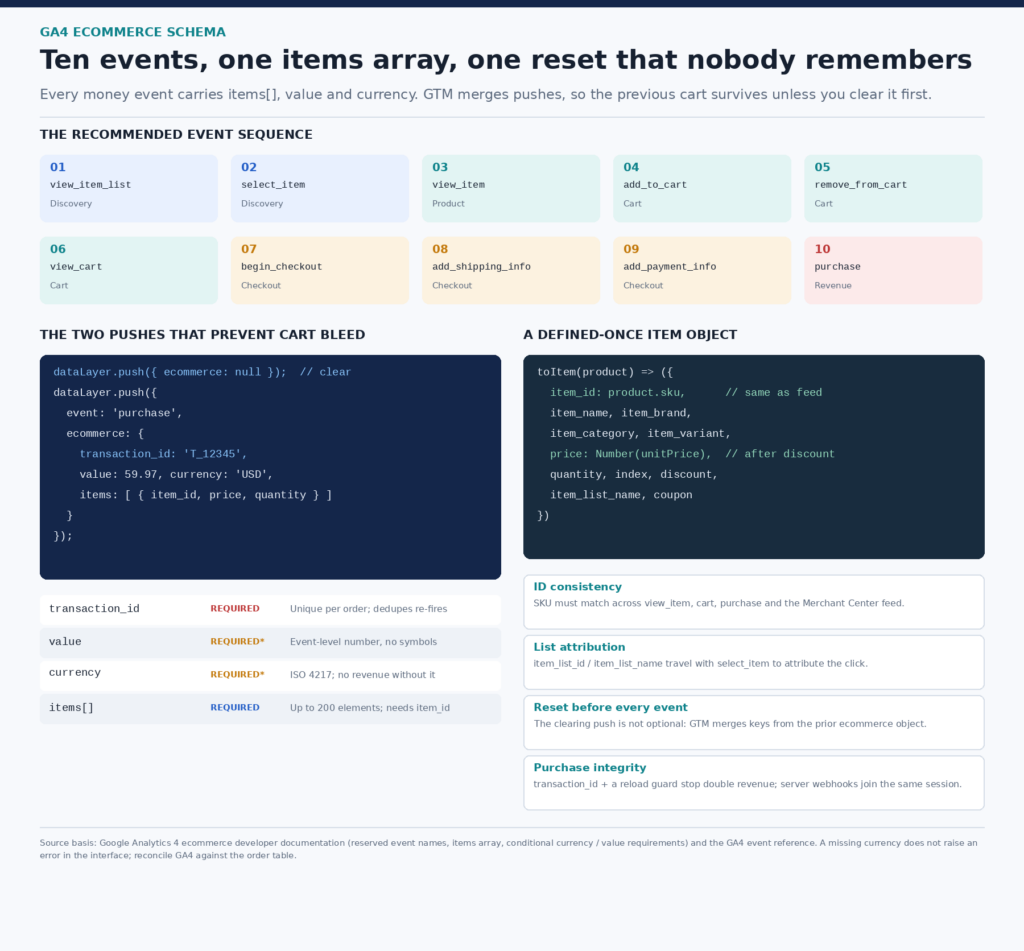
Google’s recommended ecommerce sequence is a funnel, not a menu. In order: view_item_list, select_item, view_item, add_to_cart, remove_from_cart, view_cart, begin_checkout, add_shipping_info, add_payment_info, purchase, with refund for returns and login / sign_up alongside it. Each event carries an items array built the same way, with item_id or item_name required and up to 200 elements allowed.
The details that make the schema useful are the ones teams skip. view_item_list and select_item carry item_list_id and item_list_name, which is how you attribute a sale back to the shelf that produced it. add_shipping_info carries shipping_tier. Every event that involves money needs value and currency at the event level; Google marks both as required with an asterisk that essentially means “conditional but you really want them,” and a missing currency does not raise an error — it just leaves revenue metrics wrong while event counts look perfect. Reconcile against the order table. That is the only reliable alarm.
Then there is the reset. GTM merges pushes into its own model of the dataLayer, which means keys from the previous ecommerce object survive into the next event unless you clear them. Google’s own examples push { ecommerce: null } before each ecommerce event. Skip it and an add_to_cart can arrive with the SKUs from a prior view_item. It is one line. It is also the line most likely to be missing in a container built under deadline.
Purchase integrity is the difference between reporting and bidding
A purchase tag firing on the order confirmation page is fine. A purchase tag firing again when the customer reloads that page is not. Duplicate purchases are the most common audited ecommerce error, and they inflate ROAS in a way that feels like a win right up until finance compares the two numbers.
transaction_id is the non-negotiable defense. It must be unique per order, and Google uses it to deduplicate across hits, refunds, and re-fires. Pair it with a client-side guard so the tag cannot fire twice within one session, and remember the schema detail teams forget: refund does not require an items array, so a partial refund and a full refund look identical unless you send items deliberately.
For traffic where the browser is fully blocked, server-side webhooks are the fallback worth building. Capture client_id and session_id at the browser edge, then send the purchase from your server so it joins the same GA4 session. Enhanced Conversions for web does a related job on the ads side: Google documents SHA-256 hashing of first-party customer data such as email or phone, matched against signed-in Google accounts, with a 24-hour window for API-based sends and transaction_id again as the join key. One note for 2026: Google merged Enhanced Conversions for web and for leads into a single unified setting in April 2026, so you no longer choose separate implementation methods for the two.
Notice the pattern. Every integrity mechanism is an identifier plus a rule about when it can appear twice. You are not configuring a tag. You are defining the identity of a transaction.
Consent Mode v2: the seven signals are not what most decks say
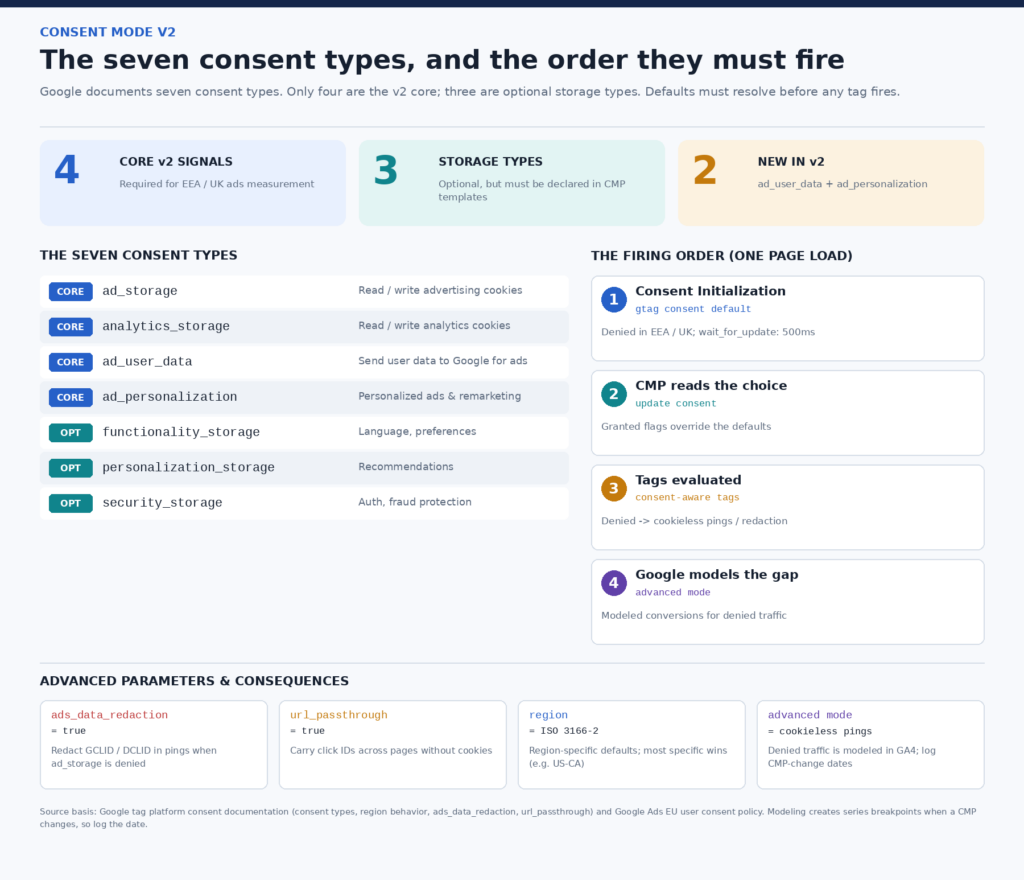
Let us correct a widely repeated claim, because it changes how you audit. Google’s consent documentation lists seven consent types in total: ad_storage, analytics_storage, ad_user_data, ad_personalization, functionality_storage, personalization_storage, and security_storage. Consent Mode v2 did not add seven signals. It added two — ad_user_data and ad_personalization — on top of the original storage pair. Those four are the core required for EEA and UK ads measurement under Google’s EU user consent policy. The remaining three are optional storage types that a CMP template can still declare. If a vendor says “seven v2 signals,” ask them to name the policy that made security_storage mandatory. There is not one.
The order is the part that breaks silently. Defaults must be set in the Consent Initialization phase, before any Google tag is evaluated. For regulated regions the default is denied, with wait_for_update — commonly 500 milliseconds — holding the pings long enough for a returning visitor’s stored choice to arrive. The CMP then calls consent update with granted values, and only then are consent-aware tags evaluated. A banner that collects a choice but never forwards it to Google is decorative. Tag Assistant will happily confirm the tag fired; it will not confirm the signal followed.
Beyond the four flags, the advanced parameters do real work. ads_data_redaction strips GCLID and DCLID from network requests when ad_storage is denied. url_passthrough carries click identifiers across pages without cookies. region accepts ISO 3166-2 codes, and the most specific region wins — a US-CA default overrides a US default. In advanced mode, tags load in a restricted state and send cookieless pings that Google uses to model conversions for denied traffic. Which brings a practical warning: consent modeling changes the shape of your series. When you change CMP, log the date, or a legitimate methodology change will look like a demand shock in every chart you own.
Server-side GTM: worth it, but do not believe the Safari fairy tale
Server-side tagging moves the container to a first-party subdomain you control. Three benefits are real. The script, sgtm.js, loads from your own host, so blockers that filter on known Google hostnames see an unknown one. You gain a governance point where PII can be hashed or stripped before anything leaves your infrastructure. And server webhooks let purchases survive a browser that blocks everything client-side.
Now the part the sales pages soften. Apple’s WebKit documentation is explicit: since March 2020, ITP caps cookies created through JavaScript — and all script-writeable storage including LocalStorage and IndexedDB — at seven days of no user interaction. Separately, Safari 14 capped cookies set in third-party CNAME-cloaked HTTP responses at seven days, specifically to close the workaround where a subdomain resolves to a third-party tracker. A server Set-Cookie header can outlive the script cap, but only when the serving path is genuinely first-party; WebKit’s own table distinguishes matching-cloaking cases from third-party ones. So “move to sGTM and Safari attribution is fixed” is not a fact you can assert. Open Safari, inspect the actual cookie expiry, and verify. Chrome plays by different rules entirely, with its own 400-day maximum on cookie expiry — another reminder that one browser’s fix is not another’s.
Server-side also has an ops bill: a container to host, a domain and TLS to maintain, monitoring, and a team that understands the request path. It is worth paying when you need data control and blocked-browser resilience. It is an expensive way to avoid writing a transaction_id.
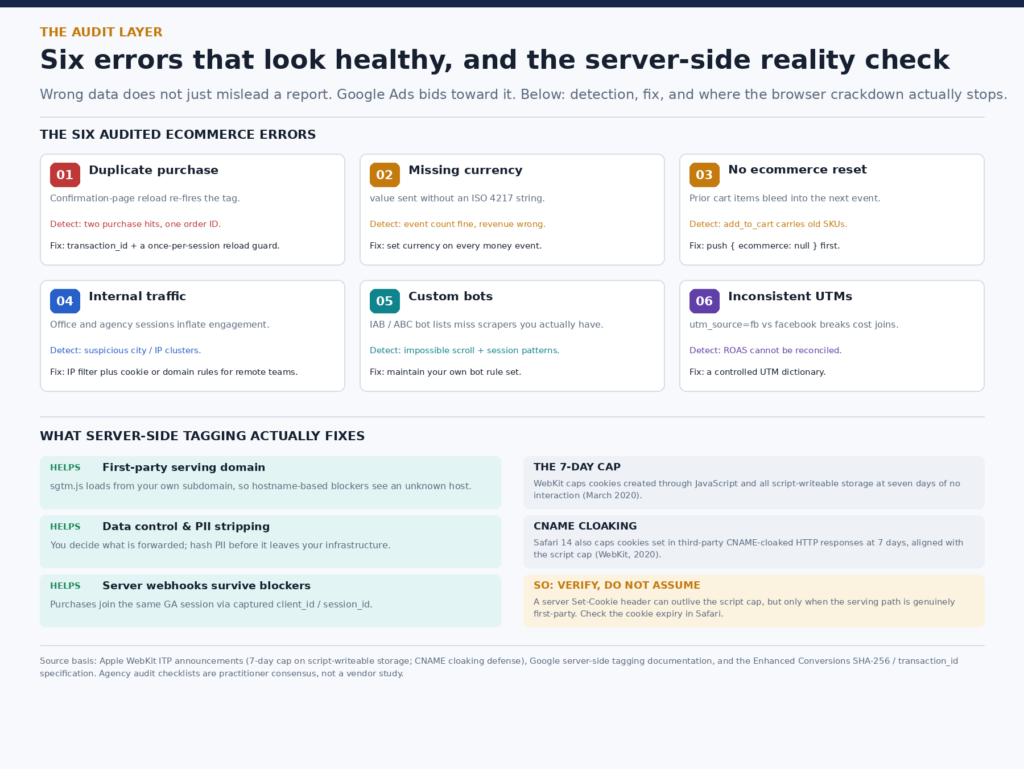
Six errors that look healthy until they cost money
Think of this as a worked checklist, because each of these failures presents as a green dashboard.
Duplicate purchase. Two hits, one order ID. Detect by comparing conversion count to the order table; fix with transaction_id plus a once-per-session reload guard. This is the big one.
Missing currency. Event counts fine, revenue wrong. Google’s troubleshooting path is a checklist you run against your own code, because the interface offers no alert. Fix by setting currency on every money event and keeping value a number with no symbols.
No ecommerce reset. Prior SKUs appear in add_to_cart. Detect in DebugView by inspecting the items array of the second event. Fix with { ecommerce: null } before every push.
Internal traffic unfiltered. Office and agency sessions inflate engagement. An IP rule handles a fixed office, but remote teams need a cookie- or domain-based rule instead. Detect with implausible city or IP clusters.
Custom bots unfiltered. The IAB and ABC bot lists will not know the scraper that hits your pricing pages every night. Detect with impossible scroll-plus-session combinations and maintain your own exclusion rules.
Inconsistent UTMs. utm_source=fb and utm_source=facebook split the same campaign, so cost data will not join to revenue and ROAS stops reconciling. Fix with a controlled UTM dictionary and, ideally, a build-step validator.
The common thread is that none of these announce themselves. A container that “appears to work while generating misleading data” is more dangerous than a container that is visibly broken, because nobody opens an incident for a chart that looks reasonable.
The ads-side integrity loop
Google Ads and Meta do not consume your data out of politeness; they optimize toward it. Enhanced Conversions supplies hashed first-party data to recover conversions that cookie-less paths lose. Meta’s Conversions API needs deduplication against the browser pixel using a shared event ID, or you simply buy the same conversion twice in two channels. Conversion value rules and value-based bidding amplify whatever number you send. So a schema error propagates: bad value becomes bad revenue becomes a bad bid becomes real spend. This is the cleanest argument you will ever make for a QA ritual, because it converts an engineering concern into a budget line.
The QA and release ritual, in order
Before any publish, walk the chain. GTM Preview mode shows which tags fired and in what order, including consent status. GA4 DebugView shows the event and its parameters for your test session within seconds. Realtime confirms aggregate arrival across visitors. Then run a test conversion in the ad platform itself, because a GA4 event and an accepted conversion are not the same object. Between steps, run one full test order from category page through refund — the only way to confirm sequence, not just presence. Reload the confirmation page and confirm no second purchase appears. Refund the test order and confirm refund carries the same transaction_id.
Publish with a change log that states a hypothesis, not just a diff: “we expect purchase count to drop 3 percent because duplicate reload hits are removed.” That sentence turns an anomaly into a diagnosis instead of a panic. Then monitor for 24 to 48 hours, since GA4’s monetization reports can lag. And keep a duplicate-container check in the routine — two GTM plugins, or a plugin plus a hard-coded snippet, is a classic source of doubled events that no single tag review will catch.
Governance at scale: the documentation is the deliverable
At some point the container outgrows the person who built it. Naming conventions stop being pedantry when there are 180 tags. Assign an owner to each tag, run a quarterly container audit, and treat the dataLayer dictionary as a shipped artifact rather than a wiki page nobody links. Version rollback should be a drill, not a hope. If you operate in China, the mirror is worth noting: Baidu Tongji and GrowingIO SDK event-governance problems are structurally the same — naming, timing, dictionary, deduplication — just with a different vendor surface and a different compliance regime.
Here is the shift in one line. You are not maintaining a tag manager. You are maintaining the contract that every downstream number is written against.
The short version
GTM is the layer where every analytics argument actually begins. GA4 gives you an event schema; your container decides whether the values are true. In 2026, consent signaling is mandatory in the EEA and UK, browser prevention is real, and both pressures reward the same boring habits: one container per domain, a documented dataLayer, intent-based triggers, ecommerce: null before every push, transaction_id on every purchase, consent defaults before any tag, verified — not assumed — server-side behavior, and a release ritual that ends with a hypothesis and a monitor. Wrong data does not sit quietly in a report. It teaches your bidding systems the wrong lesson. Treat the container like production code, because that is exactly what it is.