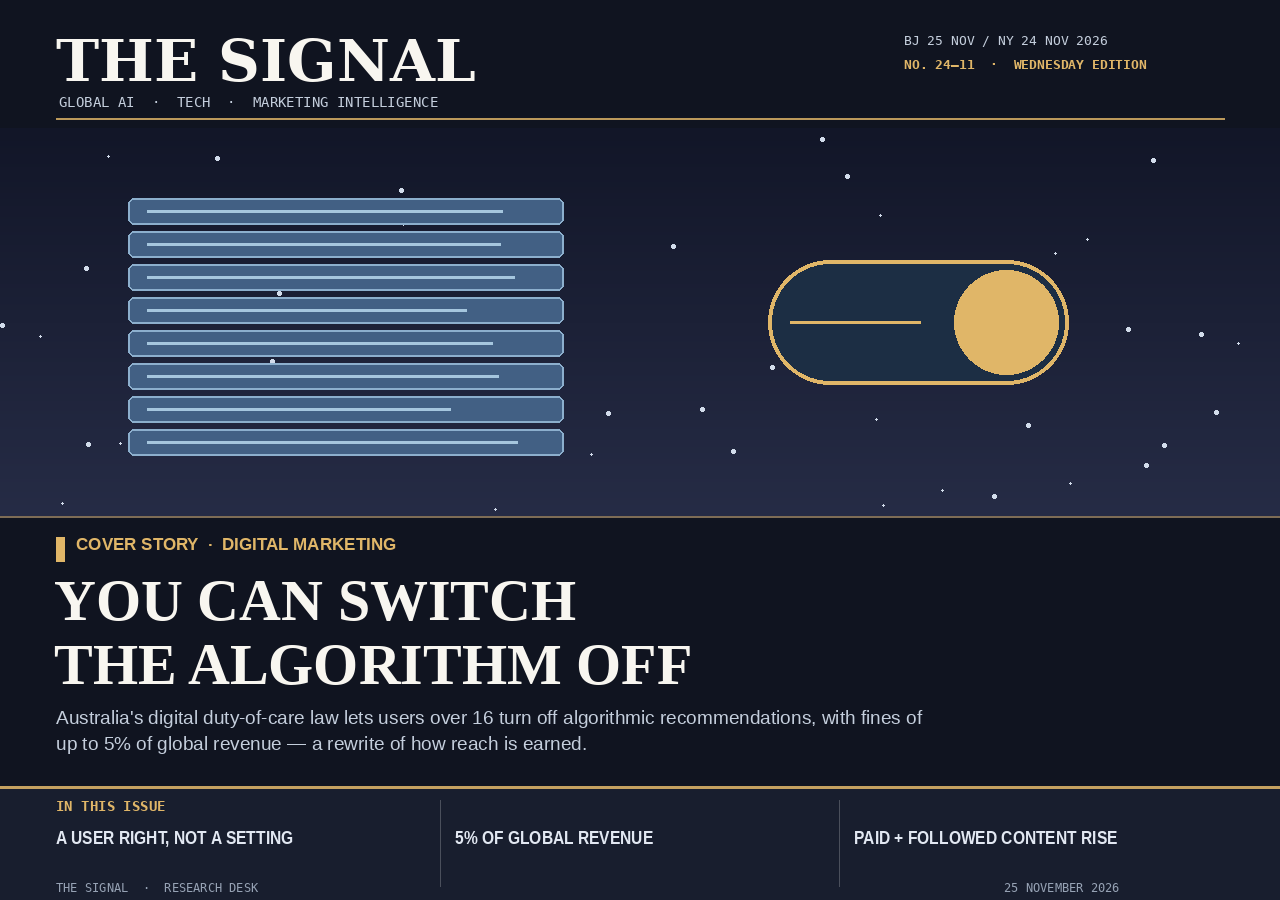
A digital duty-of-care deal between Labor and the Greens clears the way for fines up to 5% of global revenue — and a user right that rewrites how organic reach works.
Australia’s government secured a political deal on Tuesday to pass online safety legislation, following an agreement between the ruling Labor Party and the Greens. Under the Digital Duty of Care framework, platforms including Google, TikTok and Meta could face penalties of up to 5% of global revenue for breaching their obligations — a sharp rise from the original proposal of a maximum A$109.2 million (about US$72.3 million) per breach, reported by the Sydney Morning Herald.
The provision that matters most for marketing is the simplest one: users aged 16 and over will be able to switch off algorithmic recommendations and see only accounts they have chosen to follow. The package also adds a private right of action, an independent commissioner, and a requirement that platforms reassess “addictive” design patterns such as infinite scroll, autoplay and gamification. A similar current is visible elsewhere: ByteDance’s Hongguo short-drama app this week added a “time lock” letting users cap viewing sessions, though that item comes from a single Chinese tech outlet and should be read as a signal rather than a confirmed regulatory trend.
Three consequences follow for anyone planning reach in 2027. First, recommendation-driven organic distribution becomes optional — a portion of the audience can simply opt out of it. Second, that shifts value toward two things: paid distribution, and the “followed” graph, i.e. the audience a brand has earned directly. Third, a penalty measured as a share of global revenue turns compliance from a line-item fine into a proportional business risk; for the largest platforms the theoretical exposure reaches into the tens of billions.
This is the first jurisdiction to write “turn the algorithm off” into law as a user right, which makes it a test case rather than a finished settlement. Platforms must now decide how to implement a chronological or followed-only feed without gutting engagement, and how much of their addictive-design inventory they are willing to retire. US political pressure has already been reported around the law, so the friction is not purely domestic. Expect UK, Canadian and EU lawmakers to cite it, and expect brand planners to start asking what percentage of a campaign’s reach currently comes from recommendations they cannot assume will stay on.