Prosecutors called him a flight risk with ties to a foreign government. Magistrate Judge Alex G. Tse disagreed, and set a January trial date.
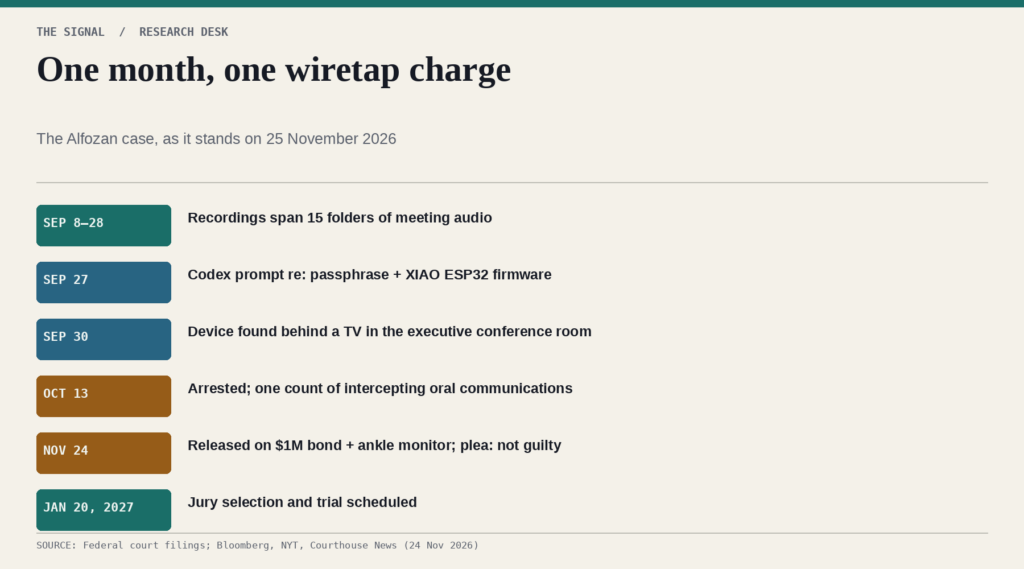
A federal magistrate judge on Tuesday ordered Abdulrahman Alfozan released on a $1 million bond with an ankle monitor, ending roughly 46 days in custody. Alfozan, 35, a Saudi national and former OpenAI engineer, has pleaded not guilty to a single count of using a device to intercept oral communications. Jury selection and trial are set for January 20, 2027.
The government had fought the release. In a filing submitted Monday, prosecutors argued the investigation was still running and that Alfozan might leave the country, pointing to what they described as ties to the Saudi government. They also laid out what they found: hundreds of audio files, dozens of recorded meetings, customer conversations, material protected by attorney-client privilege, and a photograph of a document marked confidential. The defense argued the evidence so far supports only the one wiretapping charge. After the hearing, attorney David Rizk said the court “made the right decision” and that the government’s concerns “will prove to be illusory” — adding that he intends to push back the January trial date.
The detail that makes this more than an office espionage story is in the setup. Court filings say records obtained from OpenAI show Alfozan used Codex, the company’s own productivity agent, in September to help configure the recording device and move audio into Dropbox. One September 27 prompt concerned a passphrase and firmware for a XIAO ESP32 board — the same kind of device OpenAI says it found three days later hidden behind a television in the executive conference room, wrapped in toilet paper. The recordings span 15 folders dated September 8 to 28, including one named for a sovereign bilateral briefing.
An AI company’s own agent, used to build the instrument aimed at its own boardroom, is the kind of detail that changes security reviews. Expect labs to start asking harder questions about internal tool-call logs, physical sweeps of meeting rooms, and who can point a general-purpose coding agent at a microcontroller. The case itself is narrow — one interception count, no trade-secret charge filed — but the compliance shadow is wider than the indictment.
OpenAI has said Alfozan is no longer employed there and will not attend meetings in the executive conference room. He declined an earlier offer from the Saudi Consulate to fund his bail; the bond is backed by college friends, with $500,000 secured by his own funds.