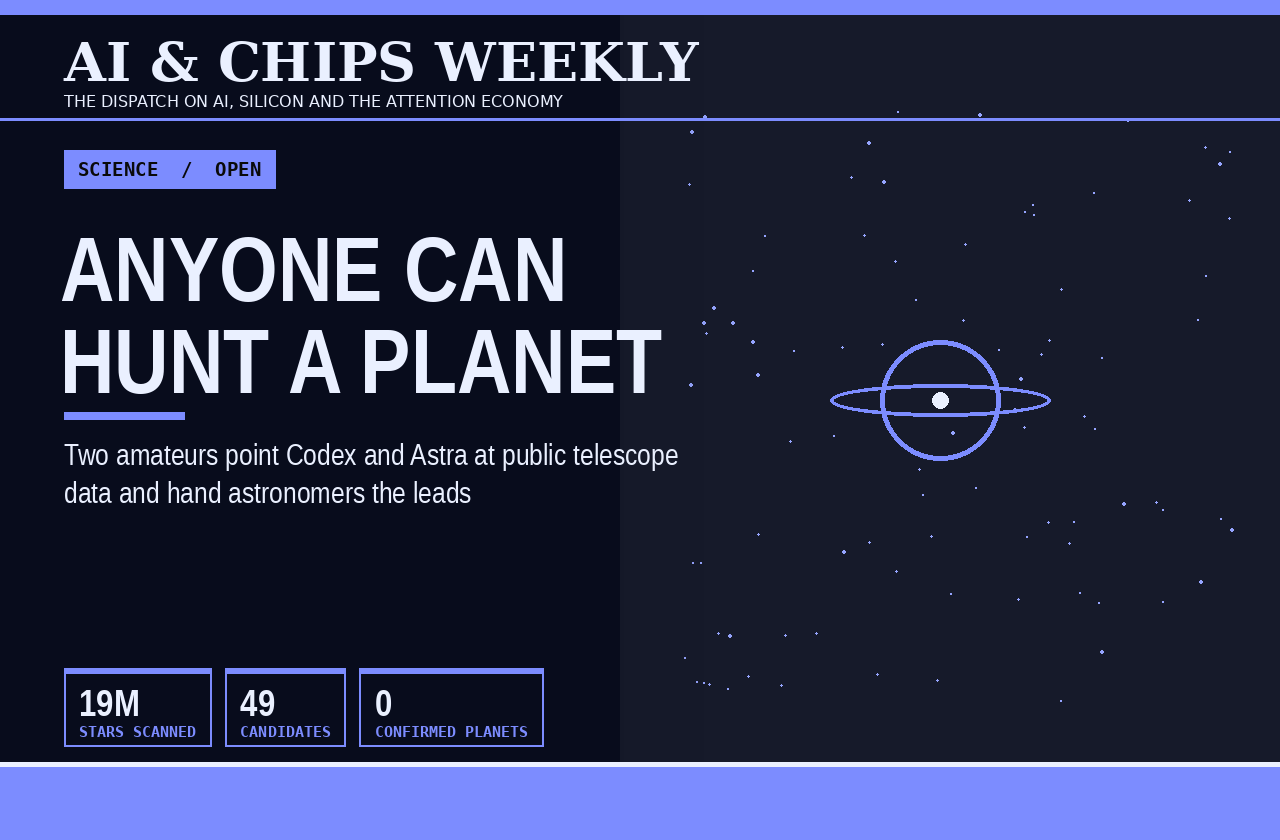
OpenAI published a story on Monday about two amateur astronomers who used its tools to sift public telescope data for the tiny repeating dips in starlight that may mean an orbiting planet. Kevin Bond, an OpenAI engineer, used Codex to stitch published transit methods into a search program and ran it over roughly one hundred thousand Kepler stars, flagging more than two hundred signals including ten already confirmed planets, a useful sanity check. Two candidates stood out, one with a 13.8 day dip consistent with a world about 2.4 times Earth’s diameter, and a SETI Institute astronomer independently found both in the same data. Ethan Byrd, founder of email startup Primitive, used Astra across about nineteen million stars and produced forty nine candidates, sending the strongest to the TESS team. Neither has confirmed a planet. OpenAI says eclipsing binaries and telescope temperature drift can mimic a transit, and confirmation could take months or years, radial velocity measurements and peer review. These are leads, not discoveries.