A preprint posted November 24 claims the model family produced novel protein structures without calling a specialist tool. Wet-lab tests found binders for all five targets — with a few caveats the company itself notes.
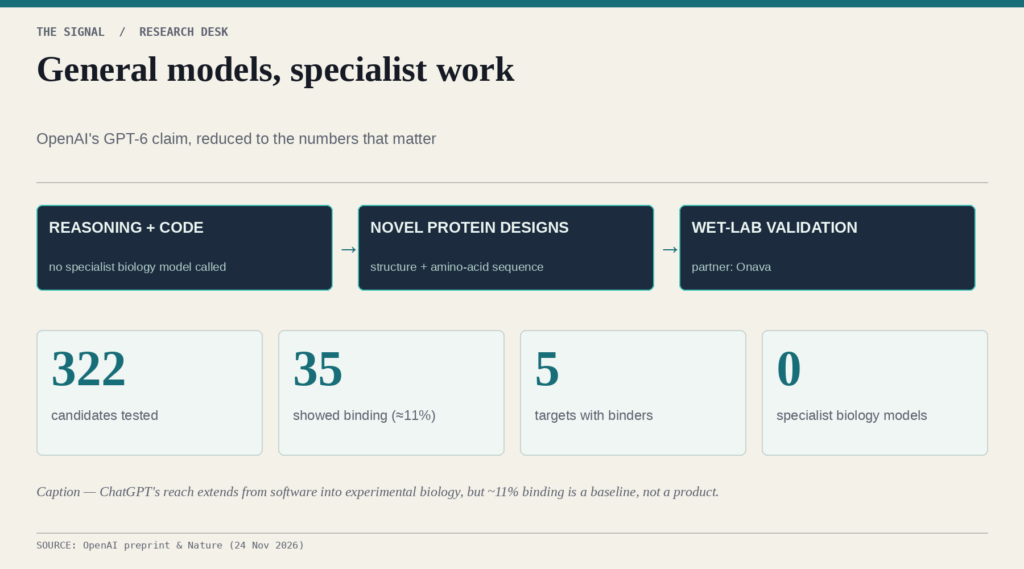
OpenAI said on November 24 that its GPT-6 family can design new protein shapes and the amino-acid sequences behind them using only reasoning and general-purpose code. No AlphaFold, no protein language model, no purpose-built biology engine in the loop. The claim arrived as a preprint and a short post on the company’s X account, and was picked up by Nature the same day.
The wet-lab work ran with Onava, a research partner. Of 322 proteins tested, 35 showed evidence of binding their intended target — roughly 11% — and the set produced binders for all five targets chosen for the experiment. Redesigned antibodies kept their ability to bind. OpenAI framed this as evidence of “intrinsic” protein-design capability: the design work came from the model itself, not from a specialist system tuned for the job.
One detail is worth keeping straight. Accounts of the work, including Nature’s, say that after the language models generated the designs, a specialist tool was used to work out a corresponding genetic sequence, and that specialized models helped prepare or select candidates in parts of the pipeline. “Without a specialized biology model” describes where the designs came from, not every step between a design and a test tube. OpenAI’s own framing is careful about this. Most headlines about it have been less so.
Protein design has been the cleanest example of a job that belongs to specialist models. AlphaFold, ESM and their relatives were built for exactly this. A general model landing in the same territory, even at a modest hit rate, changes the question from “which model is best” to “how much of the specialist stack will still be necessary in two years.” An 11% binding rate is a baseline, not a drug pipeline; nobody here is claiming a therapeutic candidate.
It also extends a run of OpenAI work pointed at physical and scientific tasks — earlier this month the company published research on GPT-6 Astra designing a hardware device end-to-end. Independent replication is the obvious next step. Expect comparisons against AlphaFold-based pipelines, and a fair amount of argument about what “intrinsic” ought to mean, within days.