Let’s start with the question every CMO is quietly asking: do we actually need to do something about AI search, or is this another metaverse-shaped distraction? Fair question. You have read two dozen articles about GEO, AEO, llms.txt and answer engines, and you still don’t know what to do on Monday morning. This article is the operating system that turns all that reading into a sequence: four layers, ninety days, three budget bands, and one KPI stack that finally retires the ranking report.
But first, the evidence. Three shifts are real and irreversible. One popular panic is not.
The Situation on One Page: Three Irreversible Shifts and One Overhyped Panic
Shift one: the entry point moved. In March 2026, G2 surveyed 1,076 B2B software buyers and decision-makers for its Answer Economy report. Fifty-one percent now start their research with an AI chatbot more often than with Google, up from 29% just a year earlier. Seventy-one percent use chatbots somewhere in the journey. And here is the number that should keep vendor marketers awake: 69% chose a different vendor than they originally planned because of chatbot guidance, and about one in three bought from a vendor they had never heard of. The shortlist now forms inside an answer you can’t see, before your sales team knows a deal exists. One caveat before you quote this at your board: G2 sells review listings, so it has a commercial interest in this narrative. The sample is real and the direction matches other surveys, but treat the exact percentages as one vendor’s measurement, not gospel.
Shift two: the click economy restructured — clicks shrank, value rose. SparkToro’s June 2026 analysis of Similarweb clickstream data found that 68% of US Google searches ended without any click in early 2026, up from about 60% in 2024. Different panels were used across those years, so read the direction as the point, not the decimal. Meanwhile, Adobe Analytics, tracking more than one trillion visits to US retail sites, found that visitors arriving from AI assistants converted 31% better than other traffic during the 2025 holiday season, with the premium hitting 54% on Thanksgiving and 38% on Black Friday. They bounced 33% less, spent 45% longer on site, and viewed 13% more pages. Fewer visits, better visits. Note the conflict: Adobe sells an LLM Optimizer product and completed its $1.9 billion acquisition of Semrush in late 2025, so it profits from your urgency. The transaction data is still the largest dataset of its kind.
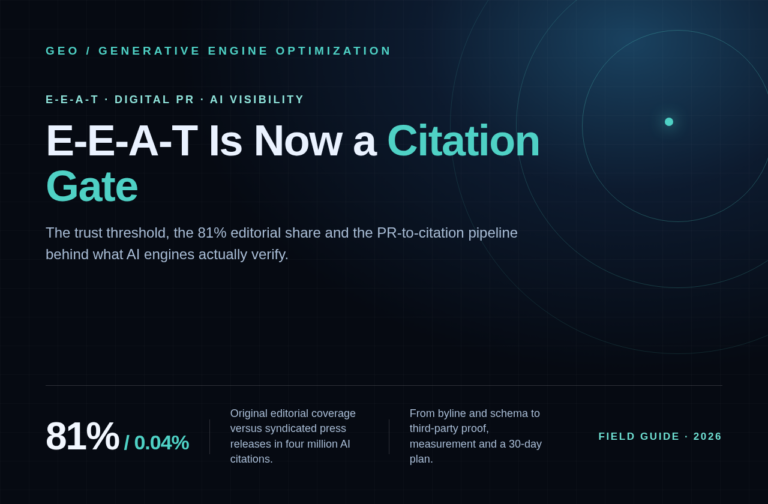
Shift three: citations concentrate. Meltwater’s GenAI Lens analysis of more than five million citations across major LLMs found that 48% point to news media. Earned coverage, the thing PR teams have fought for since forever, quietly became an AI-visibility asset. On the technical side, when audit firm Stradiji crawled more than 100 websites across seven countries through September 2026, nearly nine in ten had at least one of three visibility doors closed: the engine couldn’t reach them, didn’t recognize them as an entity, or didn’t trust what it found. Both firms sell products in this space, so treat their numbers as practitioner samples, not a census of the web.
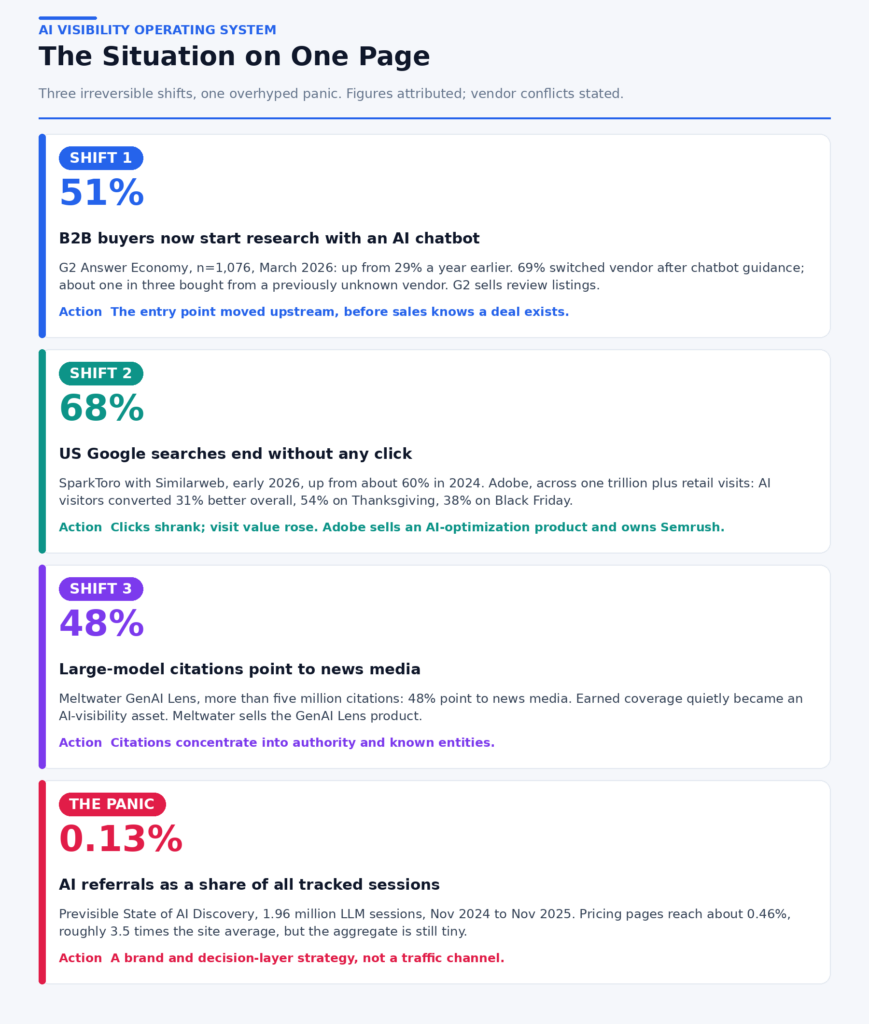
The overhyped panic: “AI is eating all our traffic.” Not yet. Previsible’s December 2025 State of AI Discovery report tracked 1.96 million LLM-driven sessions across twelve months of GA4 data. In aggregate, AI referrals were 0.13% of total sessions. Individual page types do better: industry pages hit 1.14% and tools pages 0.95%, while pricing pages reached about 0.46%, roughly 3.5 times the site average. Those are page-type penetration rates, not whole-site numbers, and nobody’s traffic pie has been devoured. Scale context: OpenAI said at its September 2026 DevDay that 1.2 billion people use ChatGPT weekly, and Google announced at I/O 2026 that AI Mode passed one billion monthly users. Both are self-reported vendor figures. Enormous attention, tiny referral trickles. That combination tells you exactly what this is: a brand-and-decision-layer strategy, not your next big traffic channel. Budget it like brand building with a performance floor and you will make good decisions. Budget it like paid search and you will fire the program in month four.
The Four-Layer Funnel: Reach → Recognize → Believe → Convert
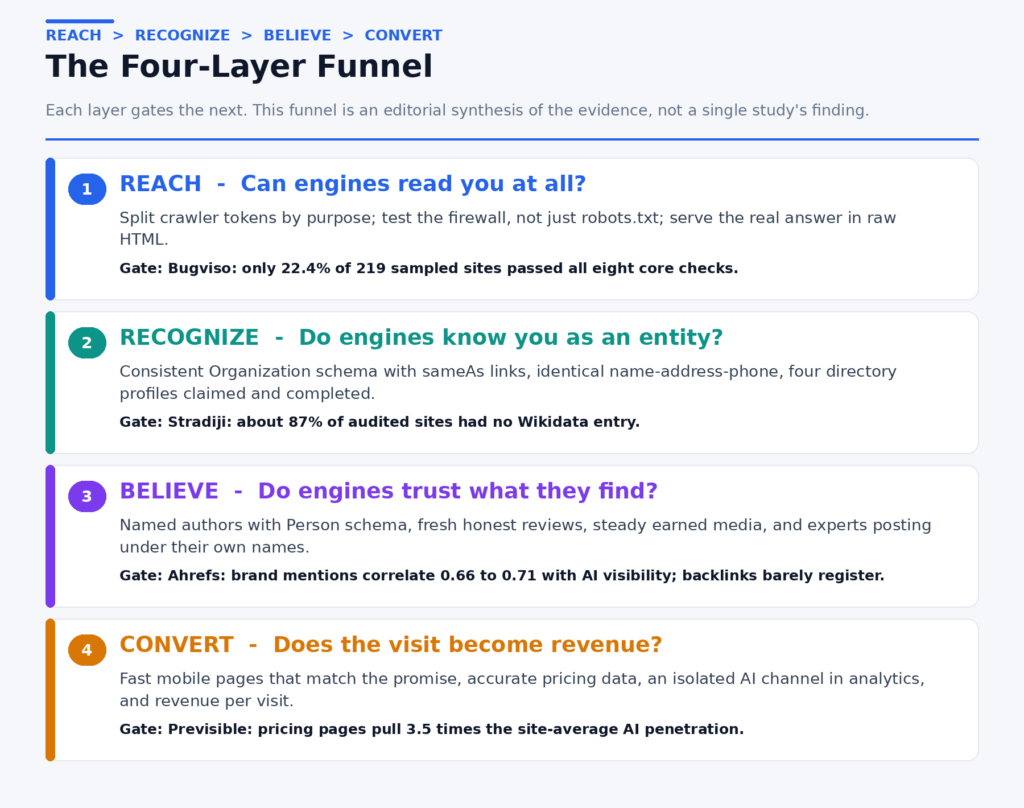
Here is the skeleton of the whole system. AI visibility isn’t one problem; it’s four, stacked in dependency order. A brand the engine can’t reach can never be recognized. A brand it doesn’t recognize can’t be believed. A brand it doesn’t believe won’t get recommended, and a recommendation your site fumbles converts nothing. Semrush’s 2026 AI Visibility Index, built on 126 million US prompts, independently arrived at a similar layered framing across discoverability, clarity, authority and trust, which is reassuring convergence. The funnel below, the 90-day plan, the budget bands and the KPI stack are this article’s editorial synthesis: a way to organize the evidence, not a single study’s finding.
Reach: The Minimum Action List
Can AI engines get in and read you? This layer fails more quietly than any other. Bugviso tested 219 randomly sampled homepages from the Tranco top-sites list in October 2026: only 22.4% passed all eight core checks, covering page reachability, crawler access, and content and key tags present in raw HTML. The surprises matter. Firewalls blocked more sites (15.1%) than robots.txt did (6.4%). About one site in four (26.9%) failed the check that at least half its rendered text appears in raw HTML, because client-side rendering hides substance from crawlers that don’t execute JavaScript. JSON-LD was missing on 67.6% of sites. So your Monday checklist:
- Separate the bots. OAI-SearchBot and ChatGPT-User get you into ChatGPT answers; GPTBot is for training. You can block training and still appear in AI search. One blanket “block AI bots” rule cuts off both, and since Cloudflare’s September 2026 default changes, mixed-purpose crawler like Googlebot can get caught in training blocks too.
- Test the firewall, not just robots.txt. Fetch your homepage as a plain HTTP client with an AI crawler user-agent. If your CDN challenges it, your robots.txt politeness is irrelevant.
- Serve answers in raw HTML. One H1, the core answer in the first sentences below it, no JavaScript dependency for substance. ChatGPT’s retrieval often keeps only the title, URL and roughly the first 200 characters of body text, so don’t spend that budget on breadcrumbs.
Recognize: The Minimum Action List
Does the engine know you as an entity: a company with a name, a location, a category, rather than a string of words? Stradiji found about 87% of audited sites had no Wikidata entry, so machines had no clean way to resolve who they were. Minimum actions: publish consistent Organization markup with sameAs links to your official profiles; make your name, address and phone identical everywhere; claim and complete your Google Business, Apple Business Connect, Yelp and Bing Places profiles, which is free, same-day work. If you are genuinely notable, a Wikidata item helps machines resolve you. If you’re not, don’t force it. Recognition is plumbing, not glory — but broken plumbing floods everything downstream.
Believe: The Minimum Action List
Does the engine trust what it says about you? This is where the correlation evidence is strongest. Ahrefs studied 75,000 brands in December 2025: branded web mentions correlated with AI visibility at 0.709 on AI Mode, 0.664 on AI Overviews and 0.656 on ChatGPT, while backlink counts barely registered at about 0.2. The single strongest signal was YouTube mentions at roughly 0.74. Correlation isn’t causation — Ahrefs says so explicitly, and it sells the Brand Radar tool that produced the data — but the pattern is consistent: AI systems recommend brands the web talks about. Minimum actions: named authors with real bios and Person schema; a steady flow of fresh, honest reviews on your category’s platforms; earned media, week after week; and expert humans posting on LinkedIn. A Meltwater analysis of 9.5 million citations found 75% of LinkedIn citations came from personal posts, not company pages. Your five smartest employees are a distribution channel.
Convert: The Minimum Action List
When the AI-referred visitor lands, does the visit turn into revenue? Previsible’s data shows pricing pages pull 3.5 times the site-average AI penetration: these visitors arrive late-funnel, comparison-ready. Minimum actions: fast mobile pages that match what the AI promised; accurate, consistent pricing and product data, because an AI quoting your old price is a support-ticket factory; a GA4 custom channel group that isolates AI referrers; and revenue-per-visit reporting instead of raw session counts. Small numbers, high intent: measure them like pipeline, not like pageviews.
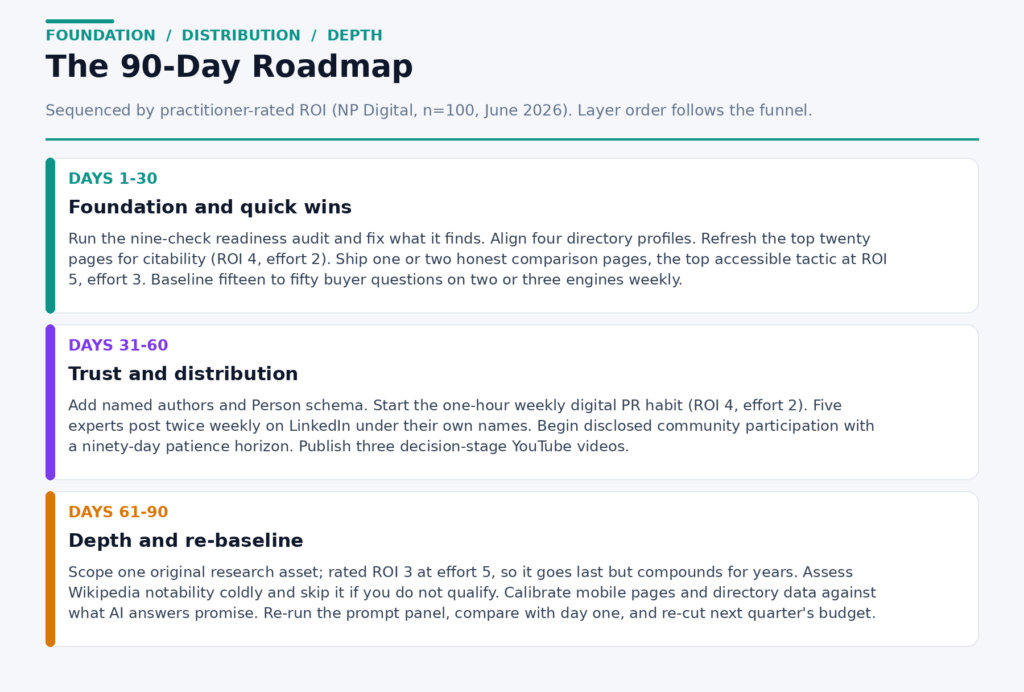
Days 1–30: Foundation and Quick Wins
The sequencing logic comes from NP Digital’s June 2026 ROI–effort matrix, a survey of 100 GEO-focused marketers rating tactics from 1 to 5. It’s an agency survey of practitioners, small-n and self-reported, but it is the closest thing we have to a consensus priority list, and its shape matches the independent evidence above.
Month one is plumbing plus the two highest-leverage content moves. Run the nine-check readiness audit and fix what it finds (Reach). Claim and align the four directory profiles (Recognize). Then the quick wins: restructure your top 20 existing pages for citability, with clear headers, direct answers and fresh numbers, which practitioners rated ROI 4 at effort 2. Ship one or two honest comparison pages, the matrix’s top accessible tactic at ROI 5, effort 3. Honest means real trade-offs, real alternatives and real criteria; a comparison page that reads like a press release earns neither citations nor trust. Finally, establish your baseline: 15 to 50 real buyer questions, run weekly on two or three engines. You can’t manage what you never measured.
Days 31–60: Trust and Distribution
Month two builds the Believe layer. Add author identity across your key pages. Start the one-hour-per-week digital PR habit, pitching data, expert commentary and useful assets to publications your category’s AI answers already cite, rated ROI 4 at effort 2 in the matrix, and remember that 48% of citations are news media. Activate five internal experts to post twice weekly on LinkedIn under their own names. Begin transparent community participation where your buyers actually ask questions, with disclosed affiliation, genuinely useful answers, and a ninety-day patience horizon, because communities punish drive-by marketing. Publish three decision-stage YouTube videos: comparisons, setup walkthroughs, honest limitation reviews. NP Digital’s panel rated YouTube low-ROI at early maturity, 2 out of 5 at effort 5, while Ahrefs found YouTube mentions the strongest visibility correlate. The resolution is sequencing, not contradiction: don’t build a video studio in month one, but do plant the flag while your quick wins compound.
Days 61–90: Depth and Re-Baseline
Month three is for compounding bets and honest re-measurement. Scope one original research asset: the matrix rates it ROI 3 at effort 5, so it goes last, but it is the asset that keeps earning citations for years. Assess Wikipedia eligibility coldly, and if you don’t meet notability standards, skip it and spend the energy elsewhere. Calibrate mobile landing pages and directory data against what AI answers actually promise. Then re-run the full prompt panel, compare against your day-one baseline, and re-cut the budget for the next quarter based on what moved, not by extrapolating this quarter’s curve in a straight line. Ninety days doesn’t make you visible everywhere. It makes you operational, which is more than most competitors will manage this year.
Three Budget Bands: Under $500, $500–3,000, and $3,000+
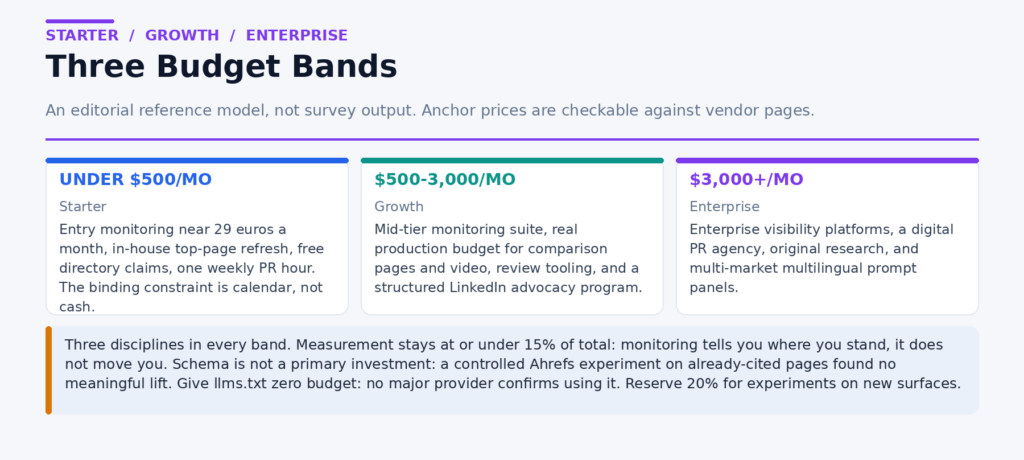
These bands are an editorial reference model, not survey output. Anchor prices are checkable: Otterly’s public pricing starts at €29 per month for its Lite tier with 16 tracked prompts, while enterprise platforms like Profound quote custom pricing.
Starter (under $500/month): entry-level monitoring, in-house time for the top-20 content refresh, free directory claims, and one weekly hour of PR outreach. The binding constraint is calendar, not cash.
Growth ($500–3,000/month): a mid-tier monitoring suite, real production budget for comparison pages and video, review-operations tooling, and a structured LinkedIn advocacy program.
Enterprise ($3,000+/month): enterprise visibility platforms, a digital PR agency, original research, and multi-market prompt panels, because a brand visible in US ChatGPT can be invisible in German AI Mode.
Three Budget Disciplines
First, measurement takes no more than 15% of the total. Monitoring tells you where you stand; it doesn’t move you. Second, schema is not a primary investment. Practitioners rated it ROI of about 1, and Ahrefs’ May 2026 difference-in-differences experiment, covering 1,885 pages that added JSON-LD against roughly 4,000 matched controls, found no meaningful citation lift on ChatGPT at +2.2% or AI Mode at +2.4%, with a small unexplained decline on AI Overviews of −4.6%. Keep schema for rich results and entity clarity, but don’t fund it as a GEO strategy. The caveat matters: the study covered pages already heavily cited, so schema may still help undiscovered pages. Third, llms.txt gets zero budget; no major AI provider has said it uses the file. Every band reserves 20% for experiments on new surfaces: AI Mode ads, agentic checkout, whatever ships next quarter.
The KPI Stack: Four Layers That Replace Rankings
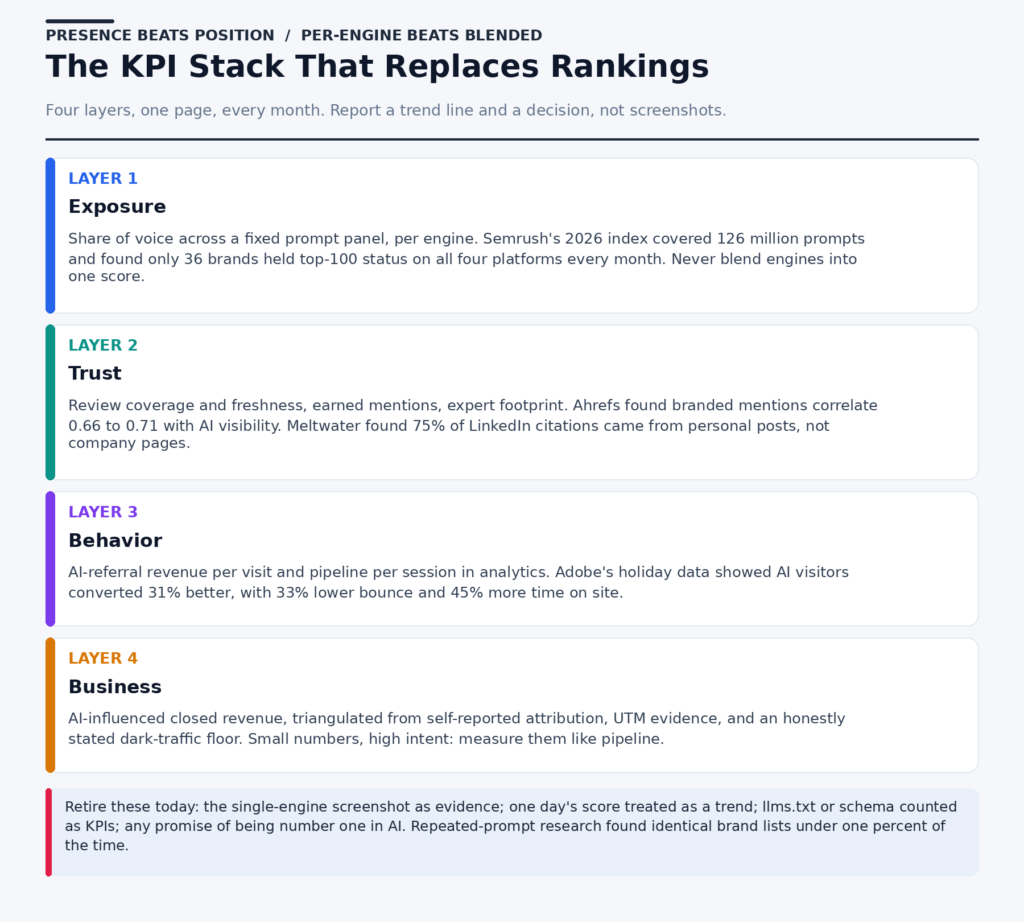
Why must rankings die? Because they don’t exist. SparkToro and Gumshoe.ai ran 2,961 prompt executions with roughly 600 volunteers in late 2025: ChatGPT and Google’s AI returned the identical brand list less than 1% of the time, at 0.74% and 0.81% respectively, and the same list in the same order under 0.1% of the time. Anyone selling you “position number one in ChatGPT” is selling noise. Gumshoe sells tracking tools and the study isn’t peer-reviewed, but its raw data is public and the finding matches everyone else’s. What is stable is how often your brand appears across many runs: presence, not position.
So measure four layers. Exposure: share of voice across a fixed prompt panel, per engine. Semrush’s index found only 36 of 1,200-plus brands stayed in the top 100 on all four platforms every month, so never blend engines into one score. Trust: review coverage and freshness, earned mentions, expert footprint. Behavior: AI-referral revenue per visit and pipeline per session in GA4. Business: AI-influenced closed revenue, triangulated from self-reported attribution on forms, UTM evidence, and an honestly stated dark-traffic floor. Report it as a one-page monthly “AI visibility P&L”: share-of-voice change by category and engine, referral revenue, trust assets added, and next quarter’s experiments. Your CEO doesn’t need a screenshot. They need a trend line and a decision.
Anti-Patterns and Who Owns Which Layer
Retire these today: the single-engine screenshot as evidence; one day’s score treated as a trend; llms.txt or schema counted as KPIs; any promise of being “number one in AI.” Ownership follows the funnel: engineering owns Reach, content and brand own Recognize, PR and customer teams own Believe, growth owns Convert. No new department required, just four names in a spreadsheet and one monthly meeting where the P&L gets read aloud. Programs die when everyone owns visibility, which is another way of saying nobody does.
The Bottom Line
AI visibility in 2026 is a real strategic shift wearing an unhelpful hype costume. The entry point moved: 51% of B2B buyers start with AI. The click economy restructured: 68% zero-click, yet a 31% AI conversion premium. Citations concentrated into news media and known entities, while actual AI referral traffic remains a rounding error for most sites. The winning response is boring and operational: open the four doors in order, sequence the work by ROI, spend within a band you can defend, measure presence instead of position, and re-baseline every quarter. Monday morning, you now know exactly what to do: run the audit, claim the profiles, and write down your fifty buyer questions. The operating system is installed. Boot it.