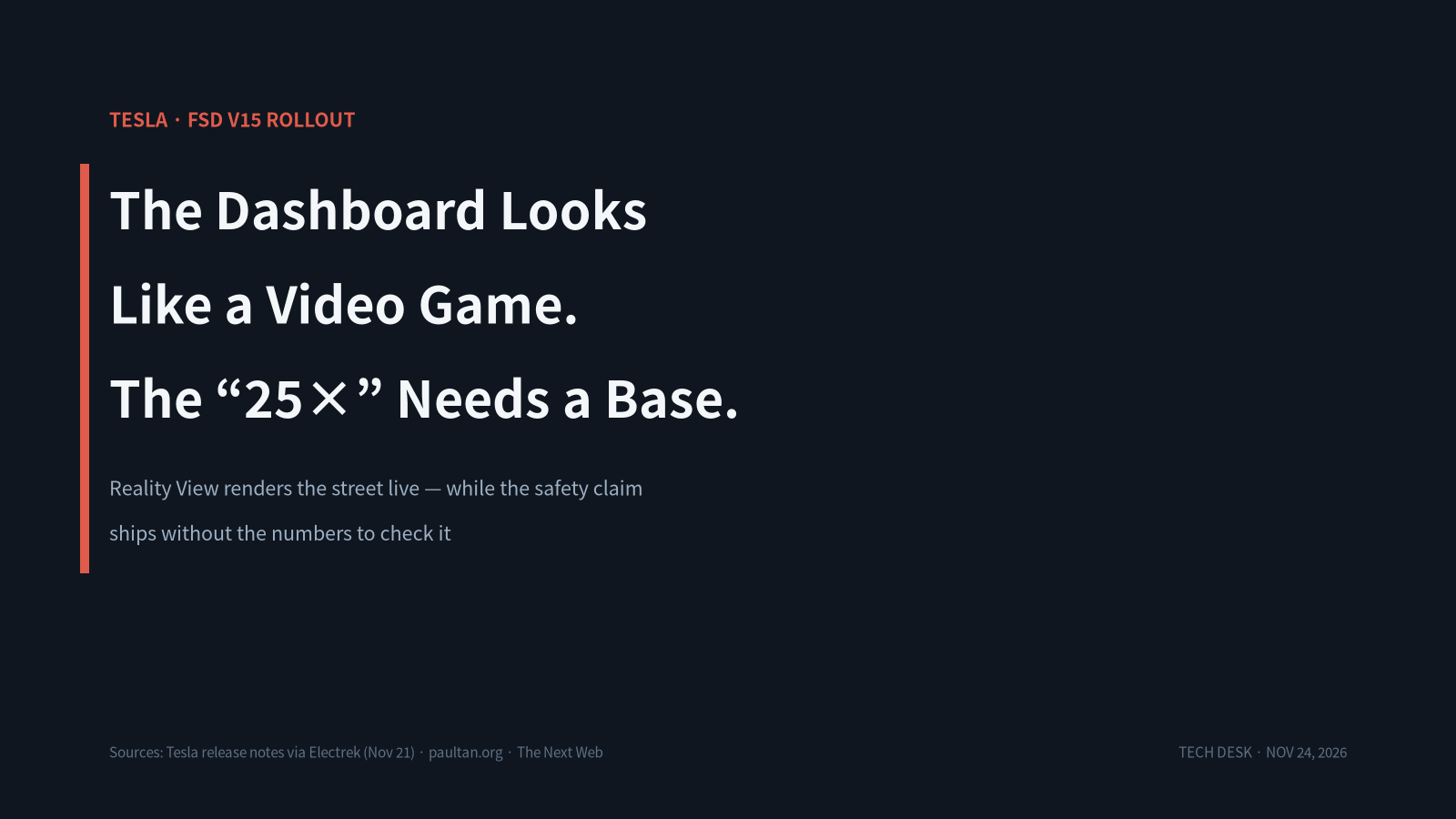
Tesla started rolling out FSD (Supervised) v15 in the US on November 21, and the internet immediately fixated on the screen: Reality View renders the street around your car as a live, AI-generated video — glowing arrows for planned turns, pins for where it intends to park. Owners compared it to GTA VI, which had launched days earlier. Musk leaned in.
The rendering trick is genuinely interesting engineering. Per Tesla’s release notes and Ashok Elluswamy’s posts, the same end-to-end network that drives the car also generates the view from a virtual camera above it — no separate visualization models, and, Tesla claims, less total compute than the old wireframe display. Musk says it runs on “half of one AI4 TRIP accelerator,” with no game engine involved. TechRadar reports the view lags reality by about a second; Musk says a 35% latency cut is coming. If seeing the car’s intent makes supervision easier, that’s a real human-factors gain — a display that shows you the plan, not just the detections.
But the headline number deserves the scrutiny the visuals are distracting from. Tesla claims the new vision encoder — shared across FSD, Robotaxi, and Optimus, trained on millions of internet videos — improves the critical intervention rate by 25×. Three things to hold onto. First, that is Tesla’s own claim about a specific metric: interventions, not crashes, not “safety.” Second, Tesla published no baseline miles-per-intervention figure, no definition of “critical,” and no measurement conditions — a multiplier without a base cannot be independently checked. Third, when self-driving lead Phil Duan posted that v15 is “25x safer than v14 across the fleet,” that was a personal statement on X going beyond the release notes’ wording. Tesla’s broader “9× safer than a human” figure comes from its own unaudited safety report, which counts a crash against FSD if the system was active in the five seconds before impact.
Read the release notes as a confession list and they’re actually encouraging: sign detection, potholes, standing water, school-zone speed handling — precisely the areas where independent testing has caught FSD failing. A Brussels nonprofit’s September test found FSD exceeded the limit in 55% of the 30 km/h zones it drove, averaging 44 km/h while displaying 50. NHTSA has an open investigation into red-light running and an engineering analysis covering ~3.2 million cars over low-visibility crashes. v15 targeting these weaknesses is the right roadmap. Whether it fixes them is exactly what the missing baseline would tell us.
Two details cut the other way. Driver monitoring gets less strict in higher-speed profiles — while Europe tightens monitoring at regulators’ request. And FSD now slows for speed cameras, with a memory: cancel the slowdown twice at one camera and it stops slowing there. Compliance keyed to enforcement hardware is not the same as compliance.
Rollout reality check: fleet trackers have so far logged v15.0.1 mainly on AI4/HW4 Model Ys in the US; HW3 cars remain on a v14 Lite branch with no announced path to v15. Musk promises wide release next month with the Holiday Update. Until then, treat v15 as what it legally remains: a supervised system where the driver owns every mile — and treat “25×” as a vendor claim awaiting its denominator.