YouTube has quietly become one of the most important citation sources in AI search — and the rules for getting cited look nothing like the rules for going viral. In OtterlyAI’s YouTube Citation Study 2026, which analyzed more than 100 million AI citation instances across six platforms over a 30-day window, 40.83% of cited videos had fewer than 1,000 views, and subscriber count showed essentially zero correlation with citation frequency (r = −0.03). What did correlate: description length (r = 0.31) and chapter structure. Roughly 94% of YouTube citations went to long-form video, not Shorts, and chapter-level citations appeared exclusively on Google’s AI surfaces. For content teams, the implication is liberating and demanding at once: you don’t need an audience to earn AI citations — you need a machine-readable text layer. This article breaks down the evidence, the engine-by-engine mechanics, a production playbook, and the honest limits every marketer should build into their expectations.
Why YouTube Became a First-Class Citation Source
Let’s start with the uncomfortable context. AI answers are absorbing the clicks your content used to earn. When an AI Overview or a Perplexity answer resolves the question on the spot, being inside the answer as a cited source matters more than ranking beneath it. And video is no longer a side channel in that contest.
Two independent datasets tell the same story from different angles. Ahrefs’ March 2026 analysis of 863,000 keyword SERPs and 4 million AI Overview URLs found that YouTube is the most-cited domain in Google AI Overviews, with citation share growing 34% over six months. Among cited pages that don’t rank in Google’s top 100 organic results for the same query, 18.2% are YouTube URLs. Read that again: video gets cited even when it has no traditional search visibility at all.
Across all six AI platforms in OtterlyAI’s dataset, social and video domains supplied 5.54% of citations — about 5.5 million instances. Within that subset, Reddit led at 46.4% and YouTube took 31.8%, together accounting for 78.2% of social citations. So who’s “number one” depends on the lens: YouTube leads inside Google’s AI Overviews; Reddit still leads the blended social pool. Both can be true, and any vendor who tells you otherwise is selling a denominator.
One caveat worth keeping: YouTube’s share of all citations is modest — brand domains supply 52.2% and news media 20.3% in the same dataset. YouTube isn’t replacing your website. It’s opening a second door your website can’t open alone.
40.83% and r = −0.03: Why Views and Subscribers Barely Count
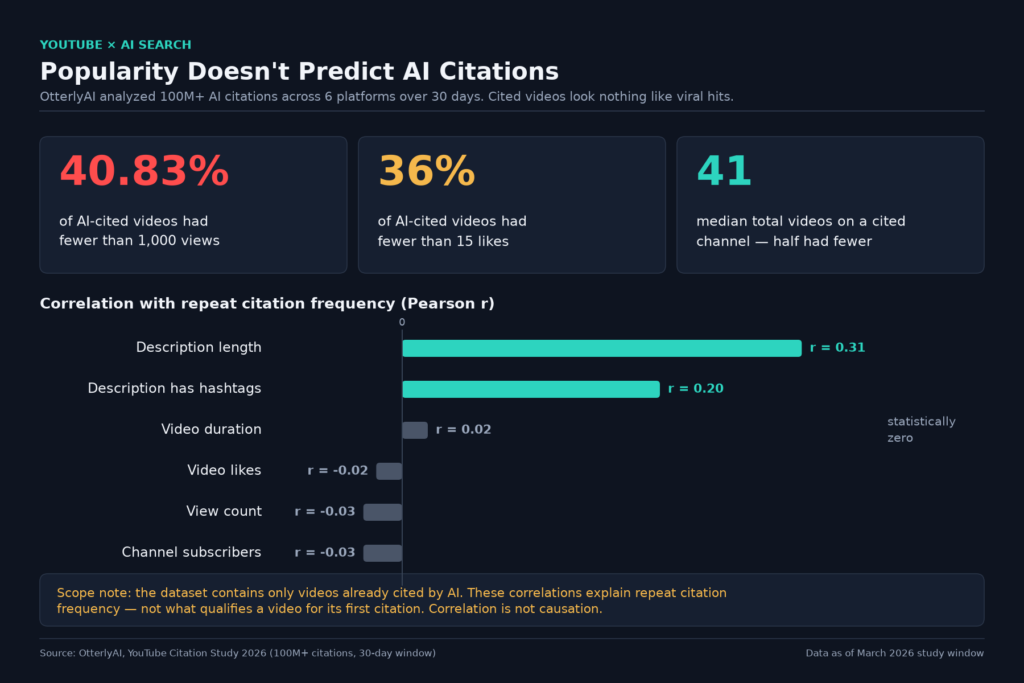
Here’s the finding that should reorganize your video budget. Of the YouTube videos AI engines actually cited:
- 40.83% had fewer than 1,000 views at the time of analysis
- 36% had fewer than 15 likes
- The median cited channel had 41 total videos — half had fewer
- 35% of cited channels had under 10,000 subscribers
And when OtterlyAI computed Pearson correlations between video features and how often a cited video gets cited again, the popularity signals flatlined: view count r = −0.03, likes r = −0.02, channel subscribers r = −0.03. Statistically, that’s zero. The only metadata features with meaningful (still modest) positive correlations were description length (r = 0.31) and hashtag presence in the description (r = 0.20). Recency showed a weak positive relationship too (r ≈ 0.3).
Think about what this means operationally. A brand-new channel can publish one well-structured, 12-minute explainer today and be cited by Perplexity or an AI Overview next week — no subscribers, no promotion budget, no algorithmic lottery ticket. AI citation behaves like reference selection, not recommendation. A librarian doesn’t cite the most popular book; they cite the one that answers the question.
Two honesty flags before you run with this. First, correlation is not causation — these are associations, not levers with guaranteed returns. Second, and more subtle: the study only examined videos that were already cited. The correlations explain repeat citation frequency, not what qualifies a video for its first citation. The door is open to small players, but the data describes who keeps walking through it, not everyone who tries.
The Text Layer: Models Don’t Watch Your Video
Why would a 200-view video beat a 500,000-view one? Because the machines never pressed play. Retrieval systems read the text that surrounds your footage: the title, the transcript, the captions, the chapter list, the description, the pinned comment. Peec AI’s research documents answer engines pulling directly from video descriptions and auto-generated transcripts — including cases where Google AI Mode built an answer straight from a description.
A video, in other words, is a document wearing a costume. Your production quality serves humans; your text layer serves the retriever. A modest-looking video with a clean, structured text layer beats a cinematic one that’s opaque to a crawler. That inversion is the single most useful mental model in this whole article.
The Transcript Is the Real Body Copy
If the transcript is what gets read, then your spoken words are your on-page SEO. Script the key answers before you record. Say them as complete, liftable sentences — “The three steps to configure SSO are…” extracts cleanly; a charming ramble across three tangents does not. Say the important entities out loud: the product name, the category, the comparison brands. If a term only appears on a slide, the retriever may never see it.
Auto-captions are the weakest link. They mishear product names, drop punctuation, and slice sentences in the wrong places — and that messy text is exactly what the model reads. Manually correcting captions in YouTube Studio is the cheapest fix on this list, and practitioners report it matters most for domain-specific terms.
Chapters Are Your Video’s H2 Headings — and 69% of Rivals Skip Them
Only 31% of cited videos in the OtterlyAI dataset carried chapter or timestamp structure. Among the timestamped videos Google cited, 78% were cited more than once — typically across two to five different chapters. One structured video becomes several citable sources, each answering a different sub-query.
That’s the closest thing to a free lunch in this dataset: 69% of the videos already winning citations haven’t done the basic structural work. YouTube’s own formatting rules are simple — first timestamp at 00:00, at least three timestamps in ascending order, each chapter at least 10 seconds. Title each chapter as the sub-question it answers (“How to measure AI share of voice”), not as “Part 2.” Practitioner guidance suggests five or more chapters of two to five minutes each; treat that as a rule of thumb, not a research finding.
Writing the Description Like an Article
The average cited video’s description ran 334 words. Description length was the strongest positive correlate in the study (r = 0.31) — weak-to-moderate, but directionally consistent with everything we know about retrieval: the model needs extractable text, and a 15-word description gives it nothing.
A workable template, drawn from practitioner playbooks rather than the study itself:
- A ~100-word summary that restates the video’s answer in plain text, with the conclusion up front
- The timestamped chapter list
- Section-by-section detail with the key claims written out — the model gets a second, cleaner copy of your answer
- Supporting links, including the companion article on your own site
- Three to five relevant hashtags (hashtag presence correlated at r = 0.20)
Practitioners commonly target 300–1,000 words and front-load substance because crawlers prioritize the opening of the description. Don’t treat 334 words as a magic number — OtterlyAI explicitly warns against that reading. Treat the description as machine-readable metadata: summary, entities, structure, links.
Engine Routing: Perplexity 38.7%, Google 56.2%, ChatGPT 4.4%
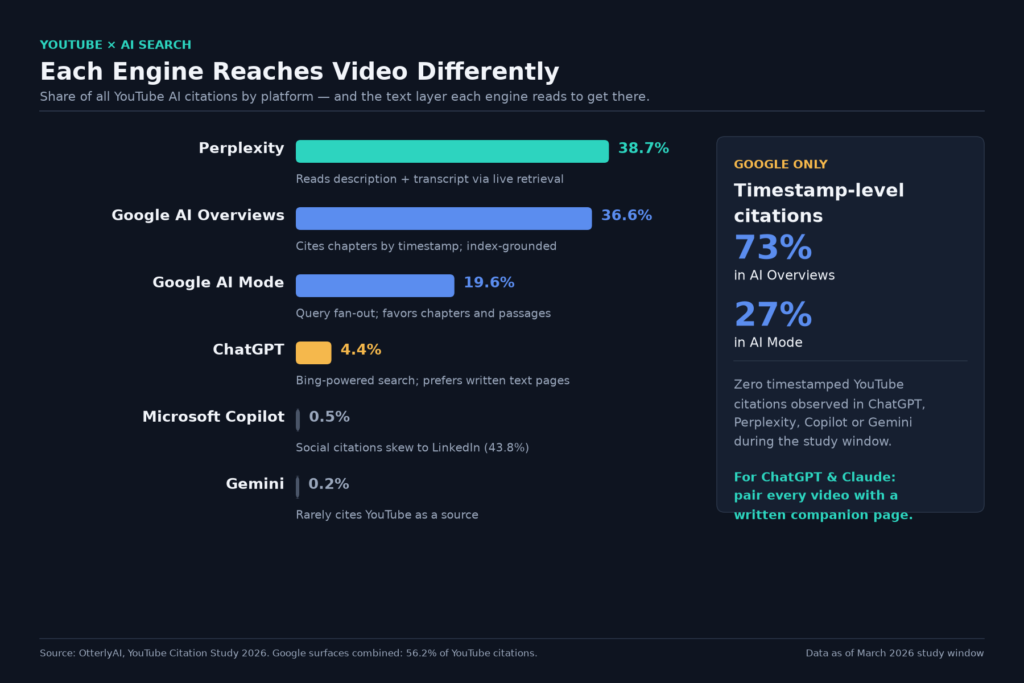
“AI search” is not one channel. In OtterlyAI’s data, YouTube citations distributed across platforms like this: Perplexity 38.7%, Google AI Overviews 36.6%, Google AI Mode 19.6%, ChatGPT 4.4%, Microsoft Copilot 0.5%, Gemini 0.2%. Google’s two surfaces combined took 56.2%.
The mechanics behind the split explain the strategy:
- Perplexity runs live retrieval on every query and reads descriptions plus transcripts, ranking your video alongside any web page. It’s the fastest surface to reward a new, well-structured upload.
- Google AI Overviews and AI Mode parse structure. Every timestamped citation in the dataset landed on Google — 73% in AI Overviews, 27% in AI Mode. Chapters function like subheadings the system can cite individually.
- ChatGPT search grew up on Bing-powered retrieval and still prefers text passages from written pages; YouTube made up just 4.4% of its citation volume. (Worth noting: a September 2026 investigation by Peec AI, echoed by Search Engine Watch, reports that ChatGPT now runs its own index family — including a dedicated YouTube vertical — alongside external providers, though OpenAI hasn’t confirmed the details. Treat the old Bing-only picture as history, not a permanent law.)
- Copilot skews its social citations to LinkedIn (43.8%) — consistent with Microsoft’s ecosystem. Gemini, despite sharing Google’s infrastructure, rarely cited YouTube in this window (0.2%). Same company, different retrieval behavior; never assume family resemblance.
Claude wasn’t separately measured in the study, but adjacent evidence points the same way as ChatGPT: its web search is powered by Brave Search and it cites conservatively. For both, the video alone is rarely the cited asset.
The ChatGPT Workaround: A Written Companion Page
If text-heavy engines won’t reach your video, give them a text page that carries the same answer. Publish a companion article for every important video — on your blog, a watch page, or a Medium post — summarizing the claims, embedding the video, and linking both ways. TwoSetAI’s founder-visibility audits found ChatGPT reaching their guests through third-party written posts even when it named the video episode itself. One recording, two retrieval doors. Your future self, syndication budget intact, says thanks.
One setting quietly guarantees zero, and it deserves its own warning: the visibility dropdown. In OtterlyAI’s follow-up experiment with German finance publisher onvista — 610 videos tracked across seven engines over 107 days — 118 unlisted videos collected exactly zero citations. In a matched comparison of 33 public versus 33 unlisted clips from the same production line and topic pool, 42.4% of the public clips earned citations; the unlisted group stayed at 0.0%. The same experiment found videos took a median of 23 days to earn their first citation, versus two days for articles — so publish public, keep the catalogue tidy with playlists instead of unlisting, and give new uploads a month before judging them. Your gated demo library is invisible; ungated, question-titled demos are the asset.
The Real Job of Shorts: Discovery, Not Citations
Roughly 94% of YouTube AI citations went to long-form video; Shorts took 5.7%, and playlists, channels and livestreams split the remaining 0.3%. The largest cited duration cluster was 10–20 minutes (32.1%), followed by 5–10 minutes (26.1%) and 20-plus minutes (17.6%). One nuance keeps this honest: half of all cited videos ran under eight minutes, and duration itself correlated at just r = 0.02. Length isn’t the lever — answer completeness is. Let the procedure set the runtime; don’t pad toward a band. And the small Shorts slice sat almost entirely inside Google’s AI surfaces — ChatGPT, Perplexity, Copilot and Gemini effectively didn’t cite Shorts at all.
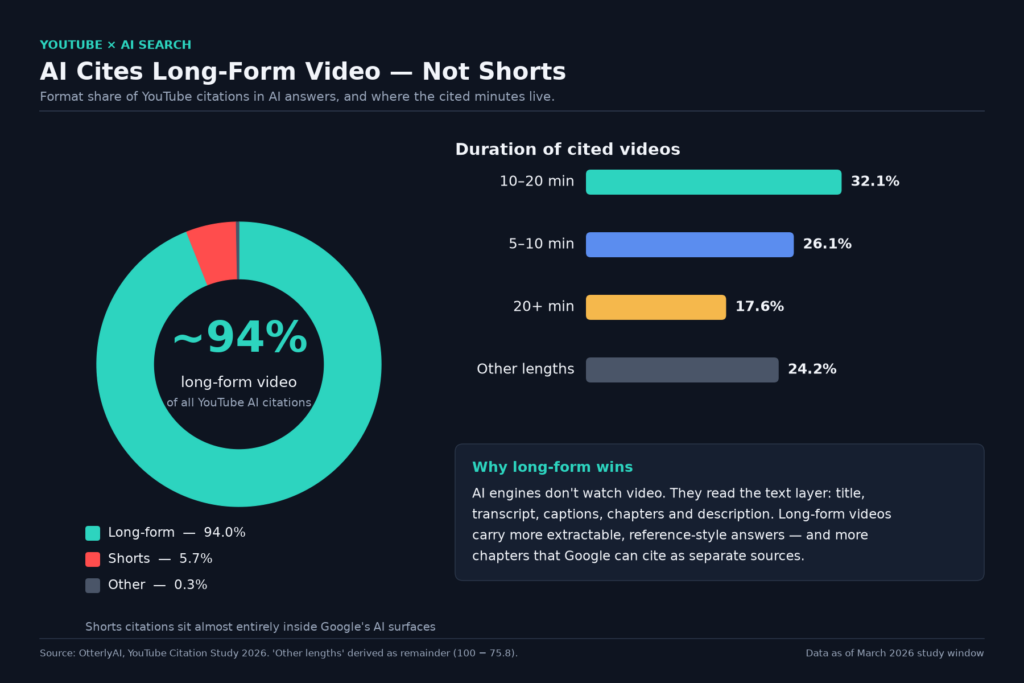
Does that make Shorts worthless? No — it makes them a different job. Shorts compete for social discovery and top-of-funnel reach; long-form builds the reference library AI engines quote. A sensible production split used by practitioners: 60–70% of production hours on long-form, 20–30% on Shorts clipped from it, the remainder on community engagement. One structured long-form video repurposed into three to five Shorts is a sane unit of work. Just never budget Shorts for citations — the data says that money is misplaced.
The Four Video Types AI Loves to Cite
Across the datasets, the cited content clusters into four reference-style formats:
- How-to and instructional videos — the strongest category; “how do I…” queries resolve naturally to demonstrations
- Visual demonstrations and walkthroughs — software tours, setup guides, anything where seeing the process beats reading about it
- Reviews and comparisons — evaluative queries (“is X worth it”, “X vs Y”) where a hands-on verdict is the answer
- Expert explainers — a credible person explaining a concept with specifics and original analysis
Notice the common thread: each format answers a question completely. AI engines cite video that demonstrates, explains and proves — not video that talks around a topic. If your content calendar is mostly brand films and trend-chasing, you’re producing for the feed, not the reference shelf.
A Low Bar and Wild Volatility Can Both Be True
Here’s the paradox at the heart of video GEO. The entry bar can be absurdly low: practitioner field notes from September 2026 document an eight-day-old video with under 100 views serving as the first cited source in a Google AI Overview for “best email marketing software.” One observation, not a promise — but consistent with the 40.83% finding.
Now the cold shower. SparkToro and Gumshoe ran 12 recommendation prompts 2,961 times across ChatGPT, Claude and Google’s AI with roughly 600 volunteers. The chance of getting the same brand list twice was under 1 in 100; the same list in the same order, under 0.1%. Your screenshot of a citation is a snowflake.
But the same study offers the fix: while individual lists churn, appearance rates are stable. Across 994 responses to wildly varied human prompts about headphones, the top brands showed up 55–77% of the time. So measure presence across many runs of many prompts, on a fixed panel, over weeks — and treat any single result as noise. Build for the mechanism; audit the trend, not the screenshot. And re-test quarterly: platform behavior shifts fast enough that yesterday’s citation share is a historical artifact — a history lesson, not a forecast.
Schema Won’t Save You: The 1,885-Page Reality Check
The most commercially popular “shortcut” in this space is structured data. The best controlled test we have says don’t bother — at least not for citations. Ahrefs tracked 1,885 pages that added JSON-LD schema against roughly 4,000 matched control pages, using difference-in-differences over 30-day windows. Result: AI Overviews citations fell 4.6% (small but statistically significant), AI Mode moved +2.4% and ChatGPT +2.2% — both indistinguishable from zero. A separate searchVIU experiment found that five major AI systems ignored JSON-LD entirely when fetching pages in real time.
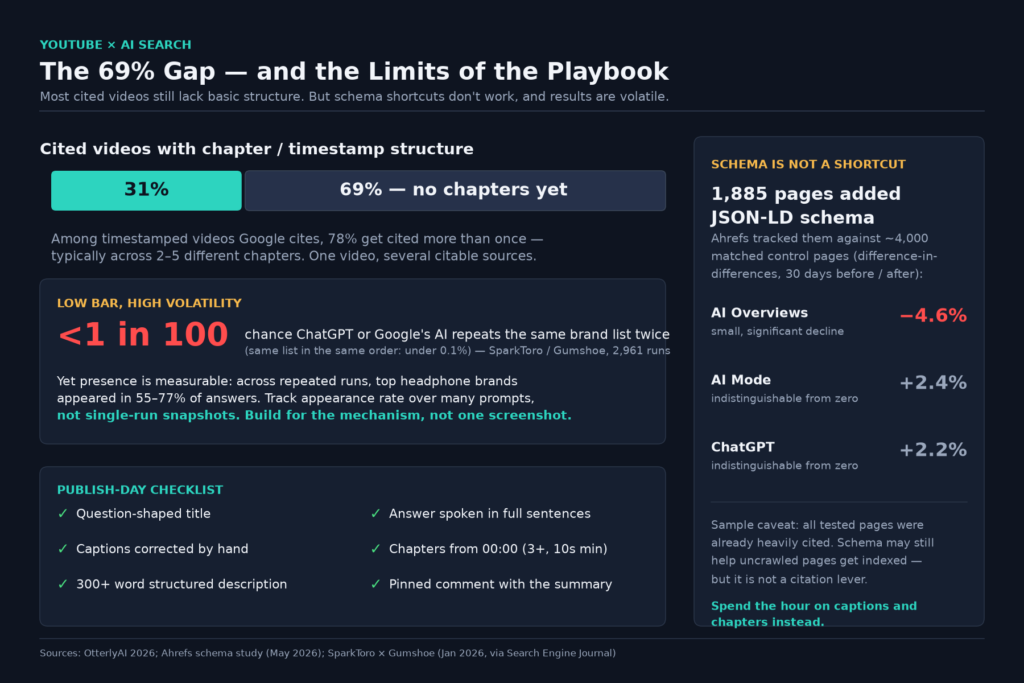
Two fair caveats: every tested page was already heavily cited, so schema might still help invisible pages get crawled and indexed; and the fetch experiment doesn’t speak to how Google’s index uses markup internally. Keep VideoObject schema as hygiene for rich results. Just don’t buy it as a citation lever — spend that hour correcting captions instead.
Sponsored Videos: Price the Attribution Problem In
Creator sponsorships are where budgets go to avoid measurement. Mega-tier YouTube channels (1M+ subscribers) commonly charge $20,000–$50,000+ per sponsored integration, per Influencer Marketing Hub’s rate benchmarks; practitioner field notes quote $20–40K per video with no reliable way to prove the return.
And nothing in the citation research separates sponsored uploads from organic ones — sponsored videos with thin descriptions and disclosure-heavy framing may behave differently from the structured explainers the data describes. So discipline the spend: require the structural package in the contract (question-shaped title, chapters, corrected captions, 300+ word description, pinned summary), ship a companion article on a domain you control, add UTM-tagged links, and track the creator’s video on your fixed prompt panel. If a creator won’t do the text layer, you’re buying reach, not citations — price it accordingly.
The Publish-Day Checklist and a 90-Day Cold Start
Before any video goes live, run seven checks:
- Title is question- or task-shaped and matches a real query
- Key answers are spoken as complete, structured sentences
- Captions corrected by hand — product names spelled right
- Chapters added from 00:00, at least three, each titled by sub-question
- Description restates the answer in 300+ structured words
- Pinned comment carries the summary and links
- Important entities are spoken and written
For a channel starting from zero, a workable 90-day arc: Days 1–30, fix the text layer on every existing video (highest ratio of impact to effort), then publish four to six long-form reference videos targeting your core question cluster, each with a companion article. Days 31–60, expand to adjacent sub-questions, clip three to five Shorts per long-form for discovery, and start a fixed prompt panel — 15–25 buyer questions checked weekly across Perplexity, AI Overviews and ChatGPT. Days 61–90, refresh what’s earning appearances, kill what isn’t, and re-run the panel quarterly. You’re building a reference library, not chasing an upload streak.
Summary
The 100-million-citation evidence rewires three assumptions. Popularity doesn’t predict AI citations — structure does, and 40.83% of cited videos had under 1,000 views. Long-form reference video owns roughly 94% of citations while Shorts do a different job. And engines route differently: Perplexity and Google reward the text layer directly, ChatGPT and Claude need a written companion. The bar is low, the volatility is high, and schema is no shortcut. Write the transcript like body copy, chapter the video like an article, describe it like an abstract — then measure presence over time, not screenshots. The small channel that structures its answers beats the big channel that doesn’t. That’s the whole game.