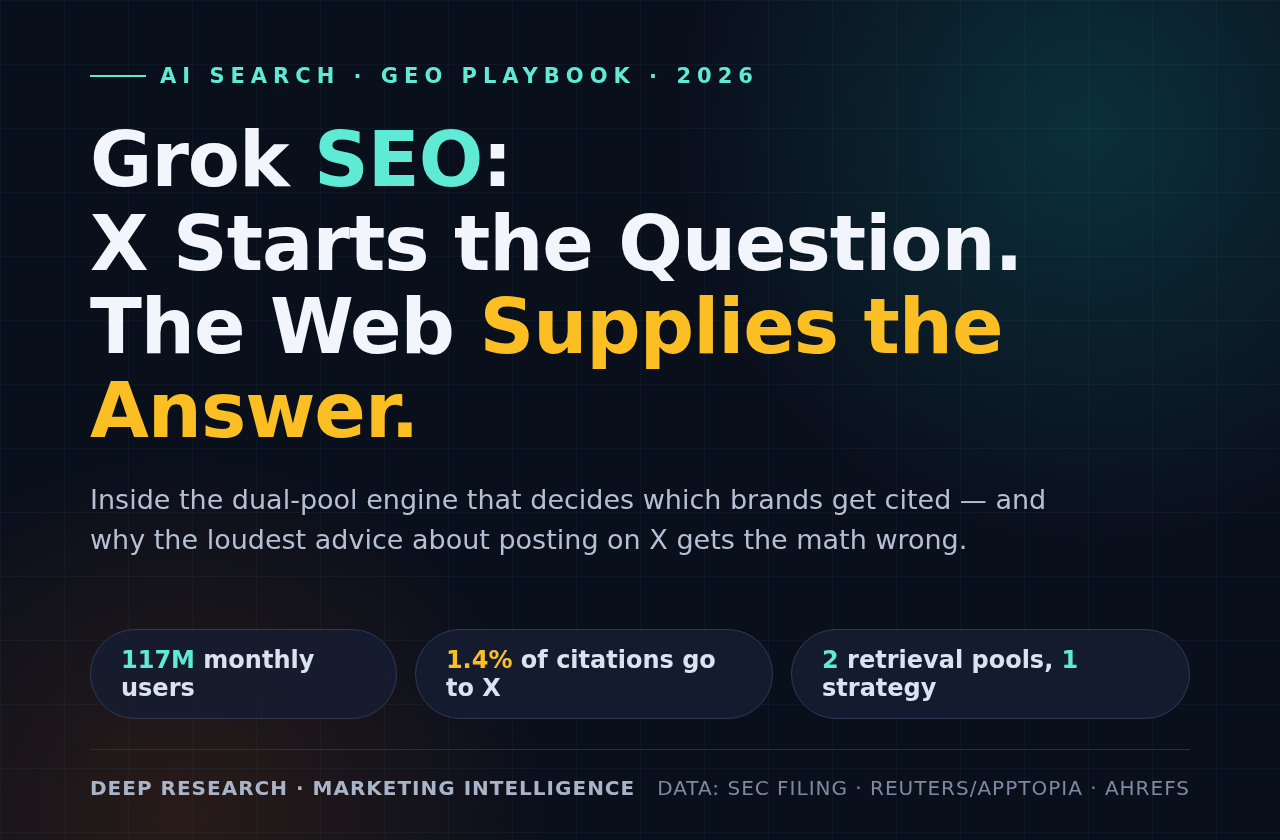
Grok is no longer a rounding error: SpaceX’s SEC prospectus discloses roughly 117 million monthly users of Grok features as of March 2026, and Apptopia data put its US chatbot share at 17.8% in January 2026 — third behind ChatGPT and Gemini. Yet the platform it lives inside, X, accounts for just 1.4% of citation mention share among Grok’s top 50 cited sources, while Reddit, YouTube and Facebook together capture about 45%. Grok runs two documented retrieval tools — X Search and Web Search — and they play different roles: X triggers what Grok investigates; the open web supplies the evidence it quotes. The winning strategy feeds both pools, treats vendor statistics with suspicion, and re-tests quarterly because Grok’s source mix drifts faster than any other major engine.
From 1.9% to 17.8%: The Third Pole You Can No Longer Ignore
A year ago, skipping Grok cost you almost nothing. That math has changed.
According to Apptopia data reported by Reuters in February 2026, Grok’s share of US chatbot usage climbed from 1.9% in January 2025 to 14% that December, then to 17.8% in January 2026 — behind only ChatGPT (52.9%) and Gemini (29.4%). An Emarketer analyst credited the surge mainly to cross-promotion inside X, not model quality. Distribution, it turns out, beats benchmarks.
The harder numbers arrived with SpaceX’s IPO paperwork. After xAI merged into SpaceX in February 2026 — a deal valuing SpaceX near $1 trillion and xAI at $250 billion — the company’s SEC prospectus disclosed about 117 million monthly active users of Grok’s AI features as of March 31, 2026, up from roughly 89 million at the end of 2025. That is a 31.5% quarterly jump inside a combined Grok-plus-X base of about 550 million monthly users. Roughly one in five people in that ecosystem now touches Grok each month.
One caution before you screenshot these numbers: later third-party trackers show the curve flattening (an October 2026 cross-surface estimate sat near 118 million, up less than 1% month over month), and different panels report wildly different “market shares” because they count different things — app daily users, website visits, or feature invocations. When someone quotes you a Grok statistic, ask what the denominator is. That habit will matter again in a moment.
Two Search Engines Living Inside One Chatbot
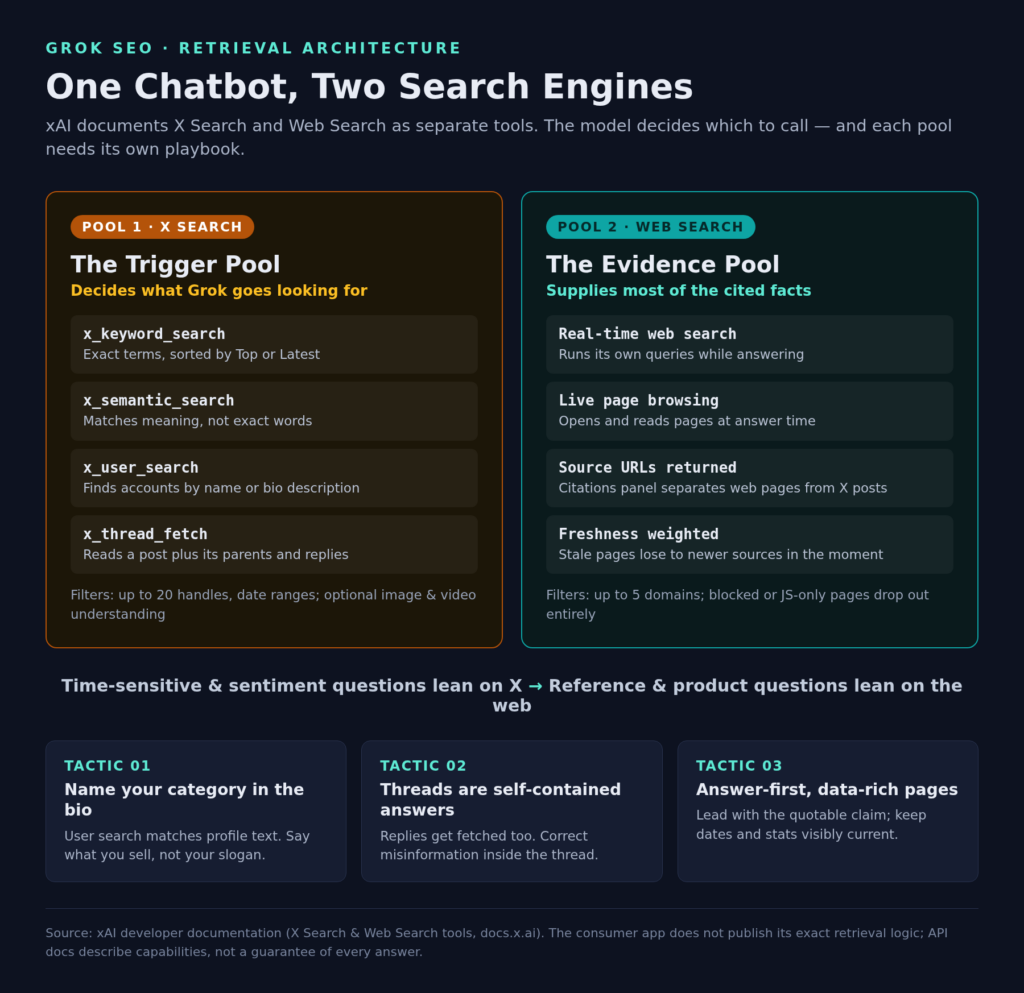
Here is the structural fact that separates Grok from every other assistant you optimize for. xAI’s developer documentation describes not one search function but two separate tools, and the model decides which to call.
The X Search tool gives Grok four ways into the platform: keyword search (sorted by Top or Latest), semantic search that matches meaning rather than exact words, user search that finds accounts by name or profile description, and thread fetch, which pulls a post together with its parent posts and replies. Developers can filter by up to 20 handles and a date range; image and video understanding are optional add-ons.
The Web Search tool does something more familiar: it searches the open internet in real time and browses pages while composing an answer, returning source URLs for what it uses. It can be scoped to five domains. The citation panel keeps the two pools visibly separate — web pages on one side, X posts with author handles and timestamps on the other.
The mix shifts with the question. Ask what people think of a product launch this week, and the X pool does the heavy lifting. Ask how two payroll tools compare, and Grok leans on the web. One honest caveat: these are API capabilities. xAI does not publish the consumer app’s exact retrieval logic, so treat the docs as the clearest description of the machinery, not a contract for every answer.
Think of it this way: X is the assignment desk deciding what story to chase. The web is the library where the facts get checked. You need to be in both buildings — but you should know which one publishes the article.
The Data That Breaks the X-First Myth
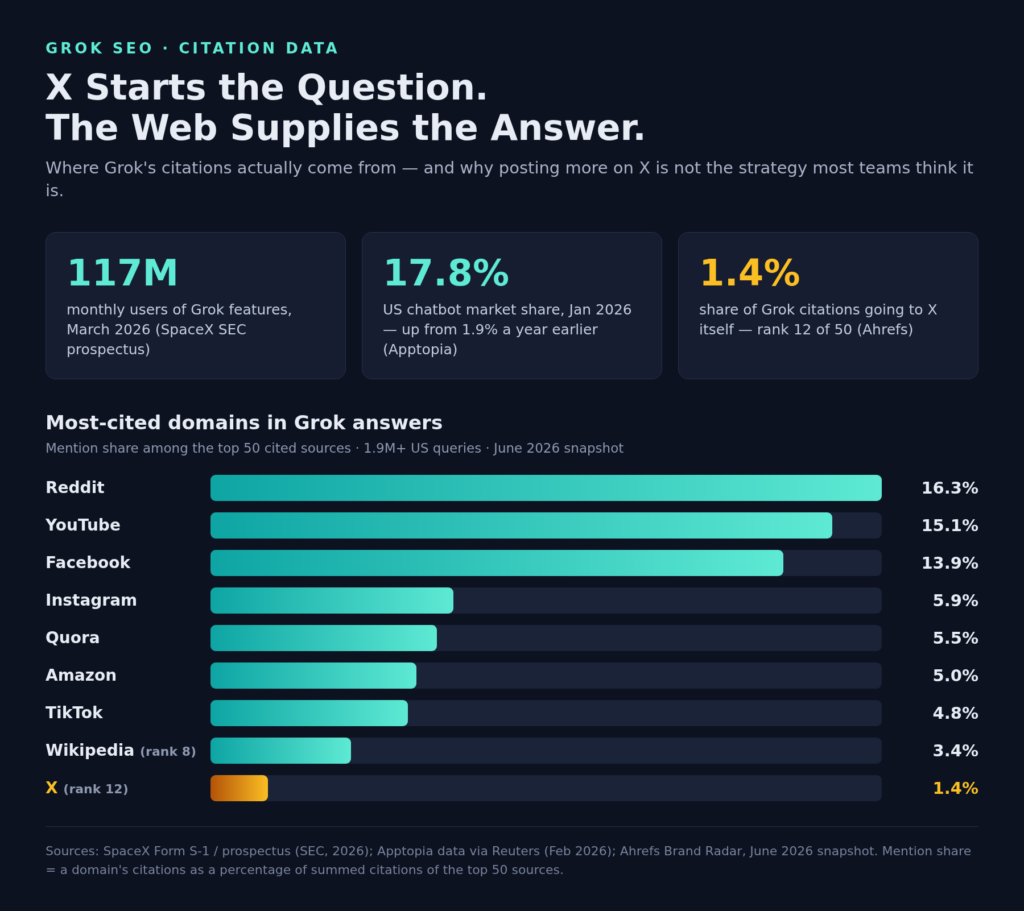
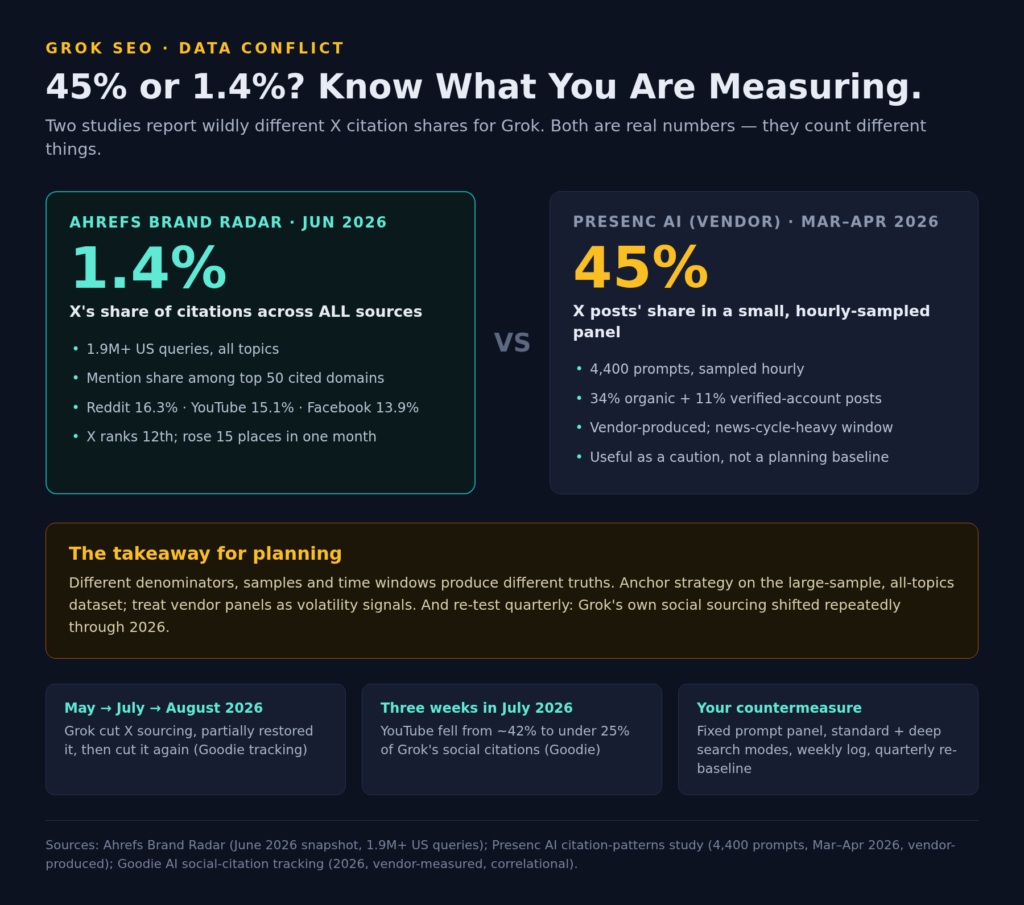
Now the number that should reorder your roadmap. Ahrefs’ Brand Radar tracked every domain Grok cited across more than 1.9 million US queries. In the June 2026 snapshot, the leaderboard looked like this: Reddit first at 16.3% mention share, YouTube second at 15.1%, Facebook third at 13.9%. Instagram (5.9%), Quora (5.5%), Amazon (5.0%) and TikTok (4.8%) followed. Wikipedia sat eighth at 3.4%.
And X — the platform Grok is built into, the one every “Grok SEO” thread tells you to post more on — ranked twelfth. At 1.4%.
Read that again. The three community platforms supply roughly 45% of citation attention among the top 50 sources. X supplies barely more than Pinterest. (Methodology note, because it matters: “mention share” here is each domain’s slice of the summed citations of the top 50 sources, not of all citations ever. And X did climb 15 places in a single month — the pool is small but moving.)
Goodie AI’s engine-by-engine scoring points the same direction. In its AEO Periodic Table V4, Grok scores 95 on social and community citations — the highest of six engines — and just 68 on classic search rank, the lowest. In Goodie’s tracked prompts, third-party pages account for about three-quarters of what Grok cites; brands’ own sites, under 1%. Your Google rankings buy you less here than anywhere else. What other people say about you buys you almost everything.
45% vs 1.4%: How to Read Vendor Numbers Without Getting Burned
If you have read other Grok guides, you have seen a very different claim: that X posts supply 45% of Grok’s citations. That figure is real — it comes from Presenc AI, an AI-visibility vendor, based on 4,400 prompts sampled hourly during March and April 2026. In that panel, X posts (34% organic plus 11% from verified accounts) dwarfed news sites at 22% and brand sites at 9%.
So which is it: 1.4% or 45%? Both, and neither. The studies use different denominators (top-50 web domains versus all classified citations including individual posts), different samples (1.9 million search-backed queries versus 4,400 monitored prompts), and different windows. A small hourly panel during a news-heavy stretch will over-weight whatever is trending on X. A broad all-topics query set will not.
This is not a reason to distrust all vendor research; it is a reason to read methodology sections before rearranging your budget. Anchor your strategy on the large-sample dataset, and treat vendor panels as volatility signals rather than planning baselines. The same discipline applies to Presenc’s engagement multipliers — claims that posts with 5,000-plus likes are 4.6 times more likely to be cited. Interesting, unreplicated, and not a license to buy engagement.
X Tactic One: Your Bio Is a Search Field, Not a Billboard
Because user search matches accounts by name and profile description, your bio is literally a retrieval surface. If it says “Making work better,” Grok has nothing to match when someone asks about payroll software. If it says “Payroll software for small businesses,” you are findable by category.
Write the bio the way a customer would phrase the question. Keep the same brand name, handle and category terms across X, your website and your other profiles, so the entity resolves cleanly. This takes twenty minutes and most brands still have not done it.
X Tactic Two: Threads Are Answers, and the Replies Are Part of the Text
Thread fetch pulls a post together with its parents and its replies. Sit with that for a second: the argument happening under your post is part of what Grok reads.
Two consequences follow. First, structure threads as self-contained answers — open with a clear claim, state facts in the first line using the words a buyer would type, and resolve questions inside the thread. Second, the reply section is not someone else’s problem. A misleading reply left unchallenged is misinformation with your brand attached; a calm, factual correction in-thread is optimization. Keyword search can also sort by Latest, so a steady weekly posting cadence keeps fresh material in the pool for time-sensitive questions.
X Tactic Three: Let Other Handles Do the Talking
Your own posts are one voice. Grok’s social-citation weighting rewards the conversation around you — customers, partners, analysts, creators mentioning your brand in their own threads. Share original data worth quoting, join relevant threads with substance, and work with credible category voices. There is no public evidence that a paid verification checkmark raises citations; xAI’s documented filters cover handles and dates, not badges. Spend the effort on being worth mentioning, not on looking official.
The strategic frame for all three tactics: X is where you influence what Grok decides to investigate. It is the trigger, not the source of record.
The Web Pool Playbook: Answer First, Original Data, Real Refreshes
The web side is where most citations live, and the playbook overlaps with solid GEO fundamentals — with a freshness premium.
Lead every page with a direct, self-contained answer to the question it targets. Goodie’s Periodic Table V4 found answer placement gives a measurable lift, while wholesale “rewrite for AI” projects do not. Publish original data before adding more schema: across engines, Originality and Information Gain averaged 86.7 on Goodie’s scale versus 75.8 for Structured Data. Markup helps machines parse a page; it does not give them a reason to quote it.
Then keep the page honestly current — updated statistics, swapped examples, a visible last-updated date. Grok browses live at answer time, so your page is judged against fresher alternatives in the moment. Its freshness score of 85 trails only Perplexity among the six engines. Access is pass-or-fail: blocked, login-walled or JavaScript-only pages simply drop out. Load your key pages with JavaScript off; if the copy vanishes, so does your candidacy.
And show up where Grok already reads: answer real questions in relevant subreddits, publish explainer videos with clear titles and descriptions on YouTube, keep your Facebook page current, and pitch the third-party publications in your category. PR is now a retrieval channel.
The Crawler Question Nobody Can Answer Officially
Here is a trap worth flagging because several popular guides walk straight into it. You will see advice to “allow GrokBot, xAI-Grok and Grok-DeepSearch in robots.txt.” The problem: xAI has never officially published a crawler user-agent, IP range or robots.txt policy for Grok’s web fetches. Those tokens circulate in third-party bot directories, unconfirmed. (A separate, documented product called Grok Bot — a computer-use agent launched in August 2026 — is not the crawler, despite the confusing name.)
The practical stance: make pages public, fast and readable in plain HTML, which helps regardless of who is fetching. Do not treat a robots.txt line as either a guarantee of inclusion or a reliable block. If you need real access control, enforce it at the server or firewall level.
Seventeen Points in Three Weeks: Drift Is the Feature
Grok’s source mix moves faster than any dashboard you check monthly. Goodie’s September 2026 social-citation study logged 16 sourcing shifts across engines in seven months, five of them reversals. Grok itself cut X sourcing in May 2026, partially restored it in July, then cut it again in August — and reduced YouTube from about 42% of its social citations to under 25% across three weeks in July. These are vendor-measured, correlational observations, not official changelogs — which is exactly the point. Nobody announces these changes. You either measure them or you get surprised by them.
The countermeasure is a quarterly re-baseline of your source map, with weekly spot-checks between. Which domains and handles does Grok cite for your ten most valuable prompts this month? If the answer changed, your content mix should change with it.
The Grokipedia Warning: The Encyclopedia You Cannot Correct
In October 2025, xAI launched Grokipedia, an AI-written encyclopedia pitched as an upgrade to Wikipedia. For a few months it worked its way into citation graphs — one analysis found it cited roughly 356,000 times across AI answer engines, and it drew 6.7 million visits in June 2026.
Then it quietly froze. An August 2026 Lawfare analysis by researchers Renée DiResta and Ronald Robertson found no article edits after April 24, 2026, and no approval or rejection decisions after April 25, across 34,519 pages carrying 225,496 edit suggestions. More than 13,000 corrections sit stuck “in review.” The site’s own SpaceX entry still described the company as private after its June 2026 IPO.
The lesson is not “avoid Grokipedia” — you cannot opt in or out. It is that an AI-generated reference work with no functioning correction channel can feed stale facts about your brand into other engines, indefinitely. Your hedge is to make the correctable records excellent: accurate Wikipedia-eligible facts, a clean Wikidata entry, an official site whose key claims are dated and consistent. When the frozen source and the living sources disagree, give the engines every reason to prefer the living ones.
Measurement Without a Console: The Two-Mode Prompt Audit
Grok has no Search Console, no official webmaster guidance, and — per xAI’s own documentation — no guarantee it will attach citations to every answer even when it reads your page. So you build the instrument yourself.
Fix a panel of 30 to 50 buyer questions, split between brand-direct queries and unbranded category queries. Run each through Grok weekly in both standard mode and its deeper search mode, because they can draw on different source mixes. Log four things: whether your brand appears, whether it is recommended or merely mentioned, which domains and handles get cited, and whether the description of your brand is accurate. Compare against two named competitors so the numbers have context.
That last column matters more than teams expect. In July 2025, a code update made the @grok reply bot produce antisemitic posts for roughly 16 hours before xAI pulled it and apologized — a reminder that a live-reading system’s output can change overnight. Independent testing by Artificial Analysis shows Grok 4.7’s hallucination rate fell to 29% from 34% on general-knowledge questions, with accuracy near 47% — improving, but that test says nothing about answers built from live posts. SpaceX’s own prospectus lists misinformation among the risks tied to X and Grok. Being cited wrongly is a brand-safety event; your audit should catch it in days, not quarters.
The Bottom Line
Grok rewards a different allocation than its branding suggests. The name says X; the citations say Reddit, YouTube, Facebook and the open web. Treat X as your trigger layer — a findable bio, self-contained threads, corrected replies, third-party voices — and the web as your evidence layer, built on answer-first pages, original data and honest freshness. Distrust single-number claims until you have seen the denominator, including the ones in vendor decks. And because the engine rewires its own sourcing without notice, measure weekly and re-baseline quarterly. The brands that win Grok are not the loudest on X. They are the easiest to verify everywhere else.