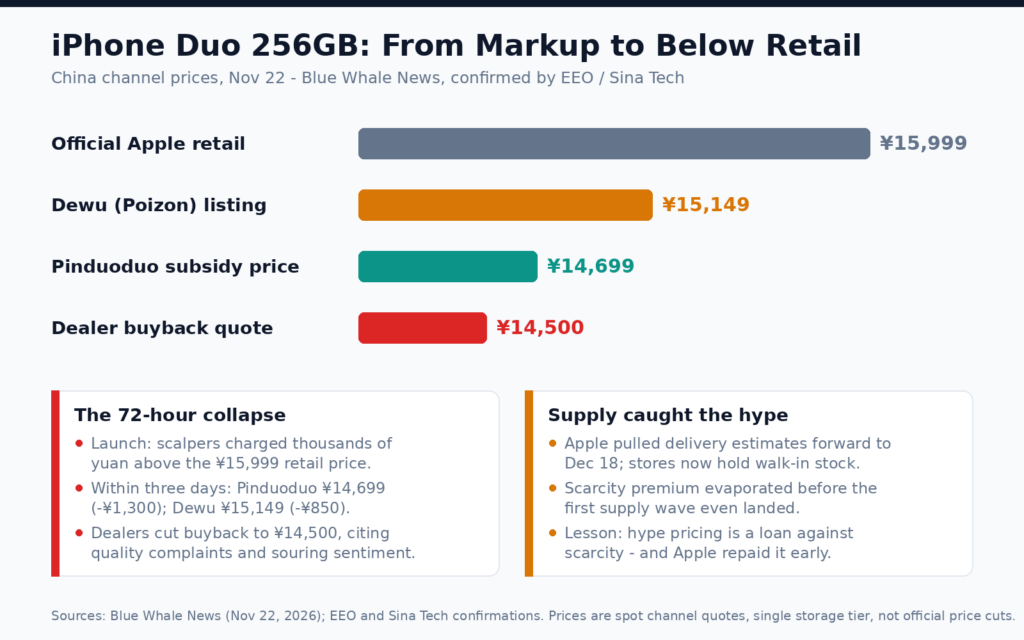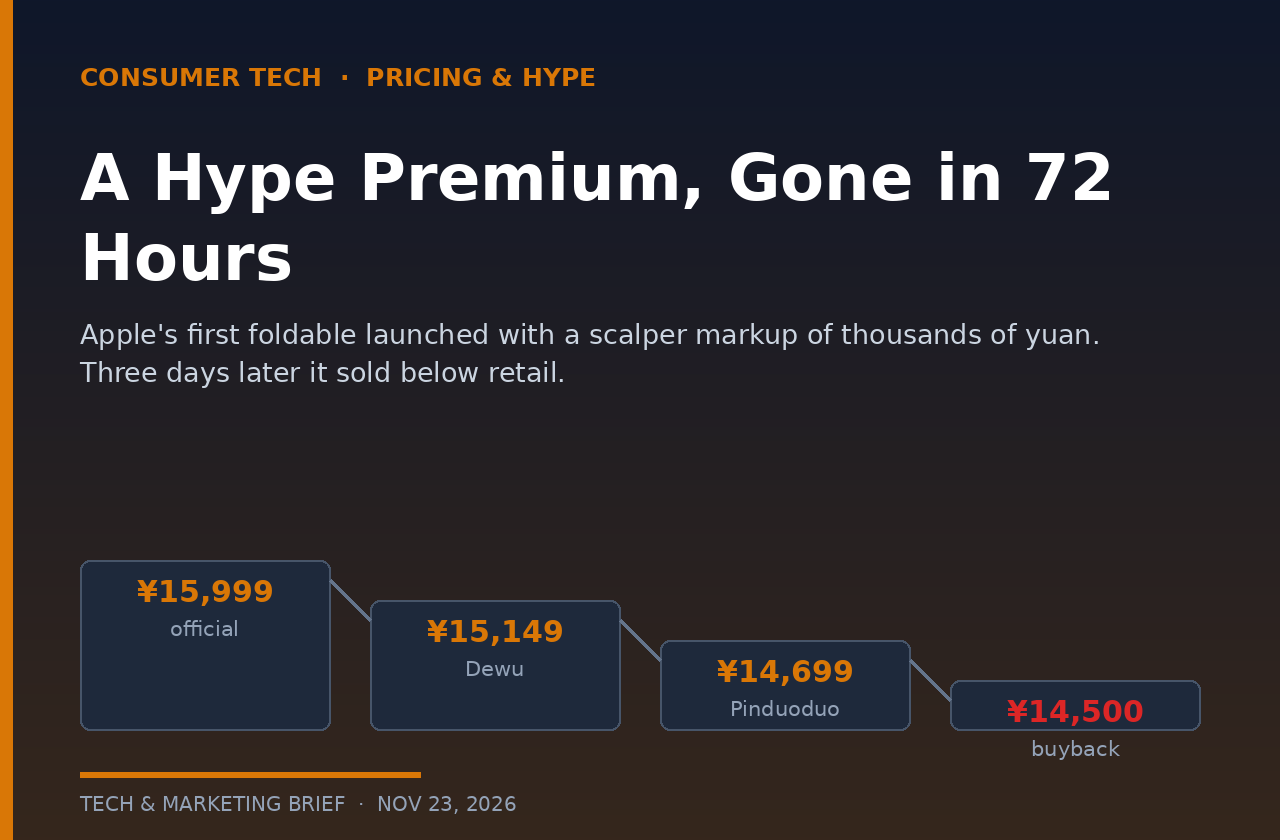
Apple’s first foldable launched like a flagship and repriced like a commodity. The iPhone Duo — Apple’s debut folding iPhone, which reached stores in September at a starting price of $1,999 — is now trading below that sticker in parts of China’s gray market less than three months after release, and within roughly 72 hours of the latest channel restock, according to trader quotes aggregated by Chinese tech media over the weekend. For a product category Apple positioned as ultra-premium, that is a remarkably fast unwind of launch scarcity.
The mechanics matter more than the headline. Gray-market channel prices in Shenzhen’s Huaqiangbei ecosystem are a real-time sentiment gauge for iPhone demand in China: when supply is tight and enthusiasm high, channel dealers charge above MSRP for weeks; when inventory outruns demand, quotes slip below official pricing almost immediately. The reported pattern for the Duo — early premiums evaporating, then sub-MSRP quotes within about three days of a restock wave — describes a product whose launch allocation met its eager buyers faster than expected, leaving dealers marking down to move units.
None of this means the Duo is a failed product, and the article should not be read that way. First-generation foldables from every manufacturer have shipped into a narrow enthusiast market, and Apple’s $1,999 entry price — roughly double a standard flagship — narrowed it further. A launch sellout followed by channel softness is consistent with a scenario where initial supply was calibrated to a niche, pent-up demand cleared quickly, and mainstream buyers are waiting: for a second generation, for carrier subsidies, or for the price to settle. Official Apple pricing has not changed; what moved is the dealer-to-dealer market, which is a leading indicator, not a verdict.
But the signal is worth reading precisely because it is early. Chinese channel pricing has historically front-run official demand narratives — it flagged weak standard-iPhone cycles before earnings did, and strong Pro cycles before Apple raised mix guidance. Sub-MSRP foldable quotes 72 hours after restock suggest that, at least in the world’s most competitive smartphone market, the first foldable iPhone is being priced as a gadget rather than a must-have. That has implications for the holiday quarter’s average selling prices and for how aggressively Apple’s channel partners will discount during year-end promotions.
For marketers and product strategists, the lesson generalizes beyond Apple: launch scarcity is a manufactured asset with a half-life. Premium pricing survives only if perceived value refreshes faster than supply catches up — through software features, ecosystem lock-in, or genuine differentiation. A folding screen alone, at twice the price of a very good phone, appears to buy about three months of scarcity in China. The next data point to watch is not another leak; it is whether December promotions defend the sticker or quietly abandon it.