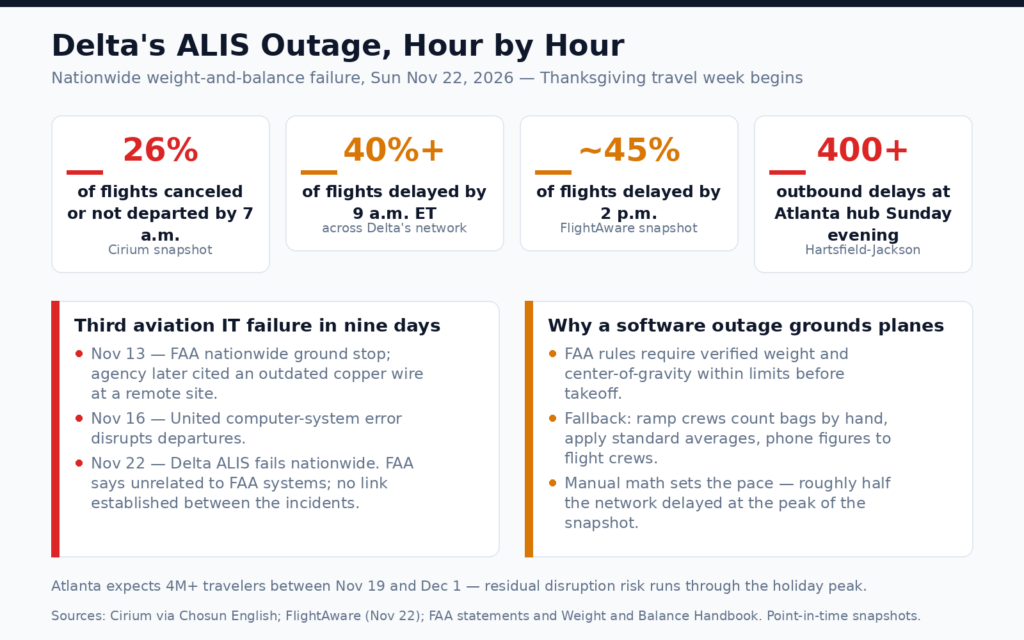
On the Sunday that kicks off America’s busiest travel week, Delta Air Lines rediscovered pen, paper and arithmetic. The carrier’s Automated Load Instruction System (ALIS) — the software that calculates weight and balance for every departure — suffered a nationwide outage on November 22. With it went the airline’s automated ability to tell pilots where the aircraft’s center of gravity sits. Ramp crews went manual: counting checked bags by hand, weighing cargo mentally against standard averages, and phoning the numbers in to flight crews.
The numbers cascaded fast. By 7 a.m. Sunday, roughly 26% of Delta flights were canceled or had not departed, per Cirium data cited by Chosun’s English service. By 9 a.m. ET more than 40% were delayed; FlightAware showed about 45% delayed by 2 p.m. Sunday evening, outbound delays at Delta’s Atlanta hub topped 400 at Hartsfield-Jackson — the world’s busiest airport, which expects more than four million travelers between November 19 and December 1.
Why does a software failure ground airplanes? Because weight and balance is not paperwork; it is physics. The FAA’s weight-and-balance handbook makes clear that exceeding weight limits or loading outside the center-of-gravity envelope compromises structural integrity and controllability at takeoff. Pilots need verified load figures before departure. When the system that produces those figures dies, the legal fallback is slower human computation — and every minute of it is a delay.
This is the third aviation IT failure in nine days. On November 13 an FAA system outage triggered a nationwide ground stop; the agency later said the disruption likely stemmed from an outdated copper wire at a remote location. On November 16 United Airlines suffered a computer-system error that disrupted departures. The FAA has said explicitly that Sunday’s Delta delays were unrelated to FAA systems. There is no evidence connecting the three incidents — but their clustering, at the exact moment the holiday surge begins, has turned “aviation IT resilience” from an infrastructure footnote into a board-level question.
Delta’s incident also lands in a year of uncomfortable precedents for the industry: the July 2024 CrowdStrike meltdown, after which Delta publicly clashed with its vendors over recovery costs, showed how a single software dependency can strand an airline for days. The industry’s automation stack — load planning, crew scheduling, dispatch, bag tracking — is deep and brittle, and redundancy usually means humans with radio phones, not mirrored systems.
For travelers this week, the practical advice is mundane: build buffer into connections, watch airline apps rather than airport boards, and know that a “systems issue” delay can outlast its fix while crews and aircraft reposition. For airlines and regulators, the question is sharper: if manual weight-and-balance is the certified fallback, how many flights per hour can it actually carry? Sunday’s answer, at roughly half a network delayed, was: not enough. The holiday peak will keep testing that answer through December 1.