OpenAI spent the weekend arguing about a number most people outside machine learning have never heard of. In an essay titled “Perplexity and Intelligence,” published on the company’s blog, the lab proposes that the cleanest way to track progress toward machine intelligence is not another benchmark scoreboard, but an old language-modeling metric: log perplexity, a measure of how “surprised” a model is by the next token of real text.
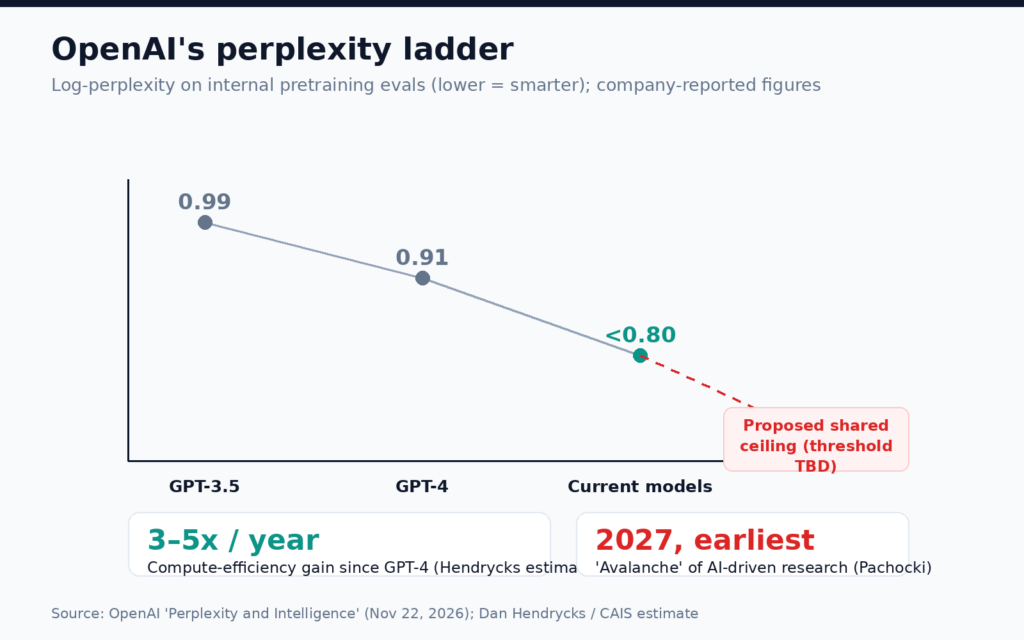
The argument is deceptively simple. As models get better at predicting text, their log perplexity falls along a fairly predictable curve — and the essay maps specific levels on that curve to qualitative capability thresholds. The official text flags landmarks around 0.99 and 0.91, and treats the region below 0.8 as the point where genuinely new capabilities begin to appear. Coverage of the ensuing discussion by Chinese tech outlet IT Home pegs the solving of open research problems near 0.76, with the near-term frontier expected to land in a band of roughly 0.68 to 0.7.
The essay did not travel alone. Sam Altman, Mark Chen and Mustafa Suleyman publicly backed the framing, which matters because it signals alignment across OpenAI’s leadership and its closest partner ecosystem. Dan Hendrycks, who has studied capability trends for years, offered a complementary estimate: capability-per-unit-efficiency has been improving roughly three- to fivefold a year. Put the two claims together and you get a testable proposition — not “AGI is coming someday,” but “here is the number, here is the slope, watch it.”
Why should anyone outside the labs care? Because measurement is governance. Benchmarks like MMLU and GPQA have become marketing instruments: saturated, gamed, and increasingly detached from what users experience. A single continuous metric would give enterprises, regulators and buyers one dial to watch instead of a leaderboard of dozens. It would also give AI vendors a new axis to compete on — and a new one to game. Goodhart’s law does not take a holiday: once perplexity becomes the target, expect training data curation optimized for exactly that number.
For marketing and product teams, the practical read is narrower. If OpenAI’s framing catches on, model release notes and vendor pitches will start quoting perplexity deltas the way they once quoted benchmark points. Treat those claims the way you treat any vendor metric: ask what data it was measured on, whether the trend holds on your own traffic, and what capability threshold — if any — the number actually unlocks for your use case.
The red line is a useful idea precisely because it is falsifiable. If models cross 0.8 and the promised capabilities do not show up, the essay will age badly in public. That is more accountability than most AGI forecasts have ever offered.