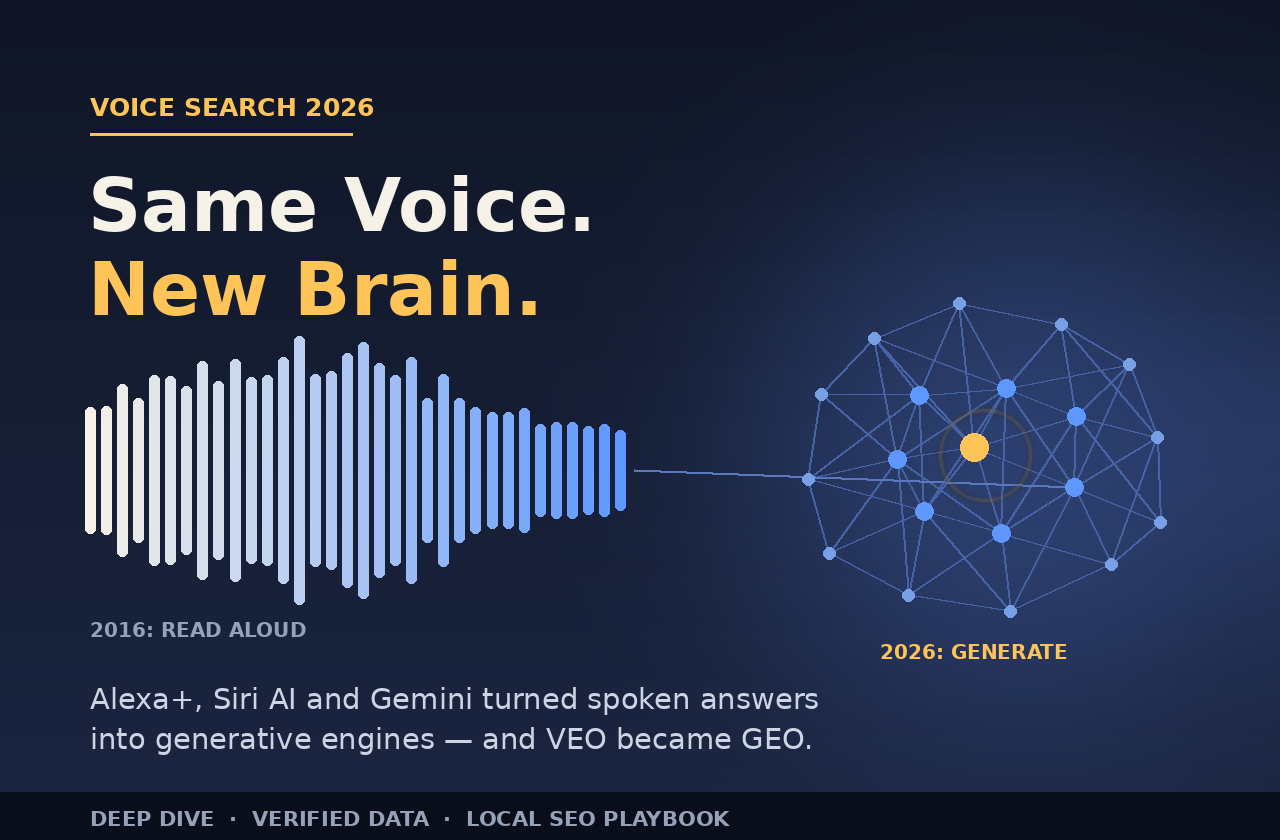
Twice already, the industry promised you a voice revolution. Around 2016, smart speakers were going to replace the search box. Around 2019, an analyst prediction — half of all searches would be voice by 2020 — got stapled onto every SEO pitch deck. Neither happened. Voice usage settled into a habit, not a takeover, and “voice SEO” became the punchline of conference hallway jokes.
So why write about it again in 2026? Because this time something actually changed, and it wasn’t the microphone. It was the brain behind it. Every major voice assistant now runs on the same large language models that power text AI search. The interface you talk to stayed the same. The machine answering you did not. And that quietly turns voice optimization from a separate discipline into a free side effect of work you should already be doing.
Let’s walk through what changed, which numbers you can trust, and the one genuinely new constraint voice adds.
The Three Brain Transplants
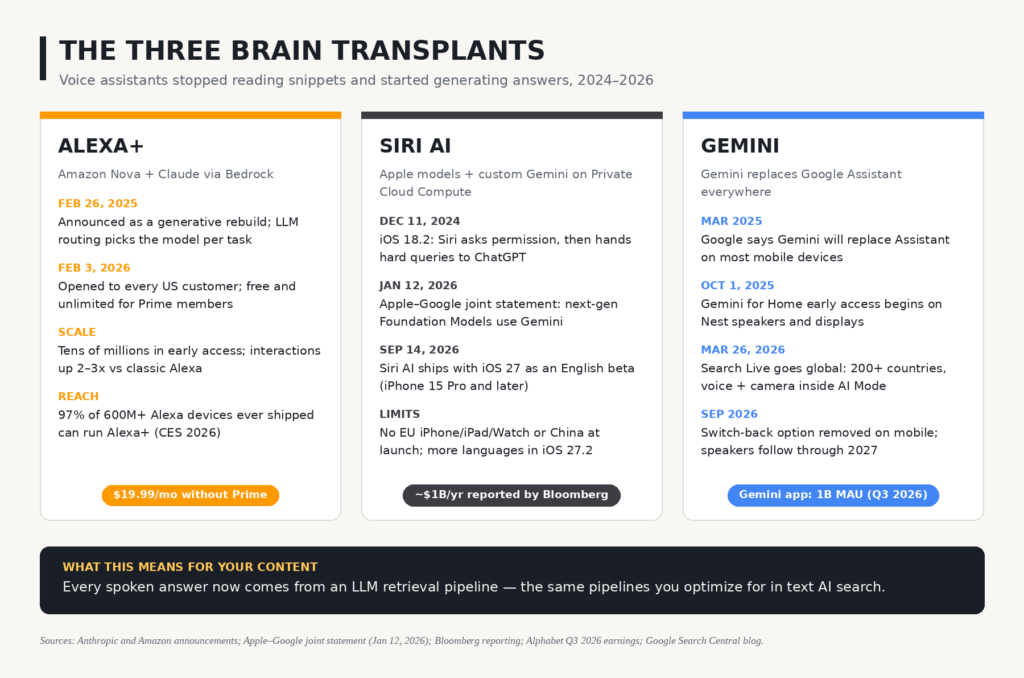
Start with Amazon. On February 26, 2025, Amazon unveiled Alexa+ — not a feature update but a rebuild. Anthropic confirmed the same day that its Claude models help power the new assistant through Amazon Bedrock, alongside Amazon’s own Nova models, with a routing system that picks the best model for each request. The old Alexa matched your words to pre-written commands. Alexa+ generates answers, holds multi-turn conversations, and books things on your behalf.
The distribution move mattered more than the demo. On February 3, 2026, Amazon opened Alexa+ to every US customer, free and unlimited for Prime members. Tens of millions had already joined during early access, and Amazon says those users interact more than twice as often as they did with classic Alexa. At CES 2026, Amazon’s devices VP Daniel Rausch put a number on the runway: 97% of the more than 600 million Alexa devices ever shipped can run the new assistant. This wasn’t a beta for enthusiasts. It was a brain transplant for an installed base the size of a continent.
Google moved next, messier but just as decisively. In March 2025 it announced Gemini would replace Google Assistant on most mobile devices. The deadline slipped — Google quietly pushed the transition into 2026 — but by September 2026 the switch-back option was gone from mobile. Gemini for Home began reaching Nest speakers and displays in early access from October 2025, with the classic Assistant on home devices scheduled to retire in 2027. And in March 2026, Google expanded Search Live — voice-plus-camera conversation inside AI Mode — to more than 200 countries and territories, powered by its Gemini 3.1 Flash Live audio model. Talking to Google Search is no longer a Labs experiment. It’s a global default.
Apple took the strangest road of all. Since iOS 18.2 in December 2024, Siri has offered to hand questions it can’t answer to ChatGPT — but only after asking your permission, with your IP address obscured and OpenAI promising not to store the request. Then, on January 12, 2026, Apple and Google announced a multi-year collaboration: the next generation of Apple Foundation Models will be based on Gemini models and cloud technology. Bloomberg reported the price at roughly $1 billion a year for a custom model of about 1.2 trillion parameters — a figure Apple has never confirmed. The rebuilt assistant, Siri AI, missed its expected spring debut, skipped two updates, and finally shipped with iOS 27 on September 14, 2026, as an English-language beta on iPhone 15 Pro and newer. Notably absent at launch: the EU on iPhone, iPad and Watch, and China. More languages arrived with iOS 27.2 in October.
Three companies, three strategies, one destination. The voice assistant is now a generative engine with a microphone attached.
The Hand-Off Chain Is the Strategy
Here’s the part most coverage misses. When Siri hands a hard question to ChatGPT, your content isn’t competing in some special “Siri index.” It’s competing in ChatGPT’s retrieval pipeline — the same one you’re already trying to influence for text answers. Court filings from OpenAI in late 2026 revealed the integration underperformed expectations, and Siri AI now handles far more on its own. But the architectural point stands: the assistants upstream are the LLMs. There is no separate voice corpus to optimize.
That’s why the old advice to build a standalone “voice search strategy” collapses. If your pages already win citations in ChatGPT, Gemini and AI Mode, you’re most of the way to winning the spoken answer too. Voice doesn’t need its own workstream. It needs your GEO workstream, plus one extra constraint we’ll get to.
The Old Model Is Dead — Mostly
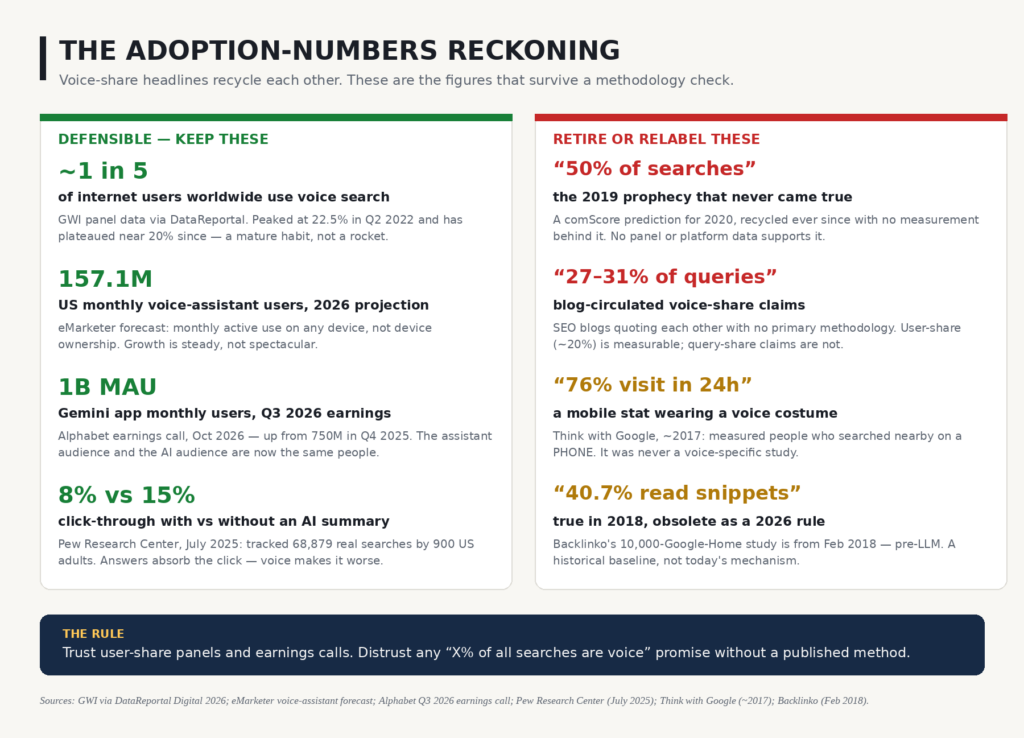
From roughly 2016 to 2022, voice answers worked like this: the assistant found a featured snippet — the boxed answer at the top of Google — and read it aloud. Backlinko’s study of 10,000 Google Home results, published in February 2018, found 40.7% of voice answers came straight from featured snippets, averaging about 29 words. That was real, once. It is now a historical baseline, not a description of 2026.
Today’s assistants retrieve, synthesize and generate. They may cite several sources, one, or none. But — and this is where the honest picture gets layered — simple lookup queries still ride the old rails. Ask about business hours and you’ll get an answer driven by structured local data, not an essay. Ask for a unit conversion and a deterministic system answers it. The generative pipeline takes the research questions; the structured pipeline keeps the lookups. Which means the featured-snippet game isn’t dead for definition-style queries, but it’s no longer the main event, and any 2026 article quoting that 40.7% figure as current is selling you a 2018 map of a 2026 city.
The Adoption Numbers Deserve a Reckoning
Now, the numbers fight. You’ve seen the headlines: 27% of searches are voice. Thirty percent. Half. Where do these come from?
Trace them and most dissolve. The “50% by 2020” line descends from a comScore prediction made in the late 2010s that simply never came true — it survives as zombie marketing copy. The “27–31% of all queries” claims circulating in 2026 blog roundups cite each other, not any published measurement. And two of the most-repeated “voice” statistics aren’t even about voice: the famous “76% visit a business within 24 hours” figure comes from a Think with Google study around 2017 about people searching nearby on their phones — mobile local search, not voice — and the “answers agree across devices only 22% of the time” line traces to a 2019 survey. We left all of them out of this article’s argument, and you should leave them out of your decks.
What survives a methodology check? GWI panel data, published through DataReportal, puts voice search usage at roughly one in five internet users worldwide — a share that peaked at 22.5% in Q2 2022 and has plateaued near 20% since. That’s a mature habit, not a moonshot. eMarketer projects 157.1 million monthly voice-assistant users in the US for 2026, counting active use on any device. And the audience that matters is merging with AI: on Alphabet’s October 2026 earnings call, Sundar Pichai said the Gemini app reached 1 billion monthly active users, up from 750 million two quarters earlier, while AI Mode passed a billion monthly users and AI Overviews reach more than 2 billion. The “voice audience” and the “AI assistant audience” are increasingly the same people holding the same phones.
One more sober number, from Pew Research Center’s July 2025 study tracking 68,879 real searches by 900 US adults: when an AI summary appeared, people clicked a traditional result 8% of the time, versus 15% without it. The answer absorbs the click. Voice, where there’s often no screen at all, pushes that logic to its endpoint. Optimize to be the answer, because being the tenth blue link is worth less every quarter.
The One New Constraint: Compression
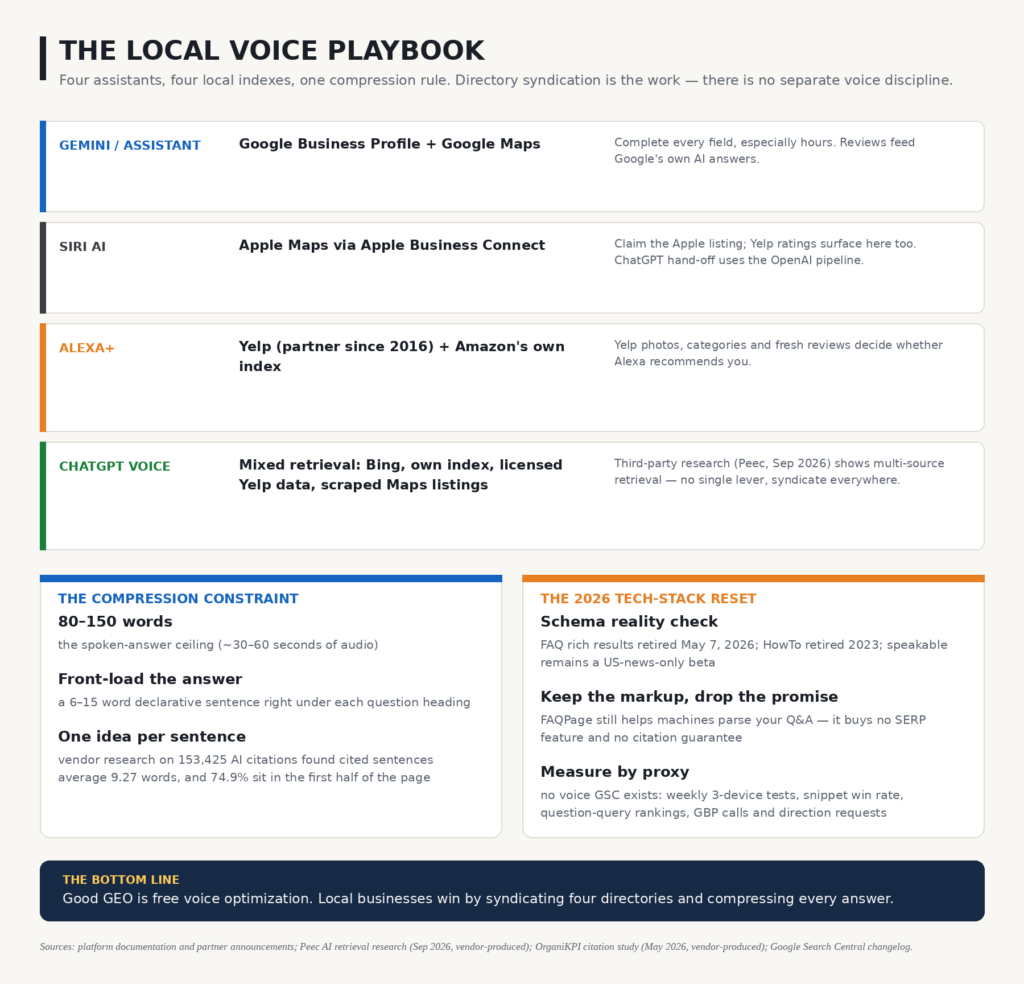
Here is what voice genuinely adds to GEO. A spoken answer has a ceiling — practitioners estimate roughly 80 to 150 words, about 30 to 60 seconds of audio, before listeners tune out. Text AI answers can sprawl; voice answers cannot. Your content has to survive compression.
What survives? Short, declarative, front-loaded sentences. A May 2026 study by the SEO agency OrganiKPI — vendor-produced research, not peer-reviewed, so treat it as directional — analyzed 153,425 AI citations and found the average cited sentence ran just 9.27 words, with 74.9% of cited sentences sitting in the first half of the source document. Voice and text citation behavior look like the same animal. The machine lifts the sentence that states the answer cleanly, near the top, without needing its neighbors to make sense.
So the writing discipline is simple to say and hard to do: put a 6-to-15-word direct answer immediately under each question-shaped heading. One idea per sentence. Numbers with units — a price range, a real duration — not vague gestures. Then elaborate below for the humans who click through. Journalists call it the inverted pyramid. The military calls it BLUF — bottom line up front. The machines, it turns out, call it lunch.
The Tech Stack Got Quietly Demolished
If your voice checklist still says “add FAQ schema and speakable markup,” it’s time for a demolition notice. Google retired FAQ rich results entirely on May 7, 2026 — the expandable question-and-answer boxes are gone from search for every site, with Search Console reporting removed in June and API support in August. HowTo rich results died back in 2023. Speakable markup, the one actually designed for text-to-speech, remains a beta confined to English-language news content read by Google Assistant for US users — a news feature, not a business-ranking lever, and invisible to ChatGPT, Claude and Perplexity, which read your rendered text rather than your JSON-LD wish list.
Does that mean ripping out your schema? No. FAQPage remains valid markup that helps machines parse your question-and-answer structure, and Google has said unused structured data doesn’t hurt you. Keep it if it’s there; stop selling it as a voice shortcut. What actually carries weight now: LocalBusiness markup with accurate opening hours for local entities, clean question-shaped headings with self-contained answers, fast pages, and the entity clarity that lets an assistant resolve who you are. The schema layer describes your content. The content itself wins the citation.
Local Is Where Voice Pays the Rent
For local businesses, this is not abstract. Voice queries skew heavily toward immediate local intent — is it open, where is it, can someone come fix this today — and each assistant consults a different address book. Gemini and Google’s surfaces lean on your Google Business Profile and Maps data. Siri’s local answers come from Apple Maps, fed by Apple Business Connect, with Yelp ratings surfacing alongside. Alexa has partnered with Yelp since 2016, and its local recommendations draw on that listing plus Amazon’s own index. ChatGPT is the messy one: third-party research from the vendor Peec AI in September 2026 found its retrieval blends Bing, its own index, licensed Yelp and TripAdvisor data, and scraped Google Maps listings. No single lever — which is precisely why the strategy is syndication.
Practically, that means four directories maintained like one: Google Business Profile, Apple Business Connect, Yelp, and Bing Places, with consistent name, address and phone across all of them. Hours that are actually right — especially evenings, weekends and holidays, because “open now” is a filter, and a wrong hour silently deletes you from the answer. Fresh reviews that mention specific services, because both the ranking systems and the summarizing models read them. BrightLocal’s 2026 survey of 1,002 US adults found 45% now use AI tools for local business recommendations, up from 6% a year earlier, while reliance on Google reviews slipped from 83% to 71%. The discovery layer is fragmenting exactly as the assistants did.
And because voice users are usually in motion — driving, walking, cooking — the handoff must be one tap. A click-to-call number that works. A directions link that resolves. If you run multiple locations, each needs its own genuinely local page; template pages with the city name swapped perform poorly, and an assistant synthesizing an answer has no patience for them.
There Is No Voice Search Console
Measurement is where voice keeps its humility. No platform gives you a voice-analytics dashboard; GA4 can’t cleanly separate spoken queries from typed ones. So you measure by proxy, honestly labeled as proxy. Filter Search Console for question-shaped queries — how do I, what is the best, where can I — which over-index on voice. Track featured-snippet ownership for your lookup queries. Watch Google Business Profile calls, direction requests and site clicks. And run the ritual that costs nothing but discipline: once a week, speak your twenty most valuable queries into an Android phone, an iPhone and a smart speaker, and log what each says and whom it names. That three-device log is the closest thing to a voice rank tracker that exists, and it will teach you more than any recycled percentage.
The B2B Verdict: Don’t Start a Voice Project
If you sell enterprise software, nobody is asking their kitchen speaker to shortlist CRM vendors. The honest priority ranking: local businesses first, consumer brands second — mostly entity clarity, so “order more of my brand” resolves to you — and B2B a distant third. But the B2B move is not to ignore voice. It’s to notice that the atomic-answer, front-loaded structure that wins voice compression is the same structure that wins AI citations, featured snippets and AI Overviews. One discipline, many surfaces. Build the GEO workstream; collect voice as a dividend. Anyone selling you a separate VEO retainer in 2026 is selling you a second coat of the same paint.
The Takeaway
Voice search didn’t die and it didn’t conquer. It got absorbed. The assistants swapped their snippet-readers for generative brains, the audience merged with the AI-assistant audience, and the optimization surface collapsed into one: be the clearest, shortest, most front-loaded answer in your niche, syndicated everywhere the machines look. The 2019 playbook asked you to write like people talk. The 2026 playbook asks you to write like an answer — because that is literally what gets lifted, compressed, and read aloud in someone’s kitchen. Same voice. New brain. Same work you should already be doing, with one extra constraint: make it fit in thirty seconds.