Ask an SEO team which AI assistant they optimize for and you will hear the same answer: ChatGPT. Maybe Gemini. Almost never Copilot. And almost never Bing — the engine most dashboards relegate to a rounding error. That instinct is understandable. It is also, in 2026, expensive. Because while everyone debates Google AI Overviews, Microsoft quietly built the most transparent AI-citation channel on the market, running on the index most teams stopped checking years ago. This piece is about that blind spot: what Microsoft officially says about how Copilot picks its sources, what its own data reveals, and the two-week fix that costs roughly nothing.
The 5% Illusion: A Small Share Feeding a Billion-User Ecosystem
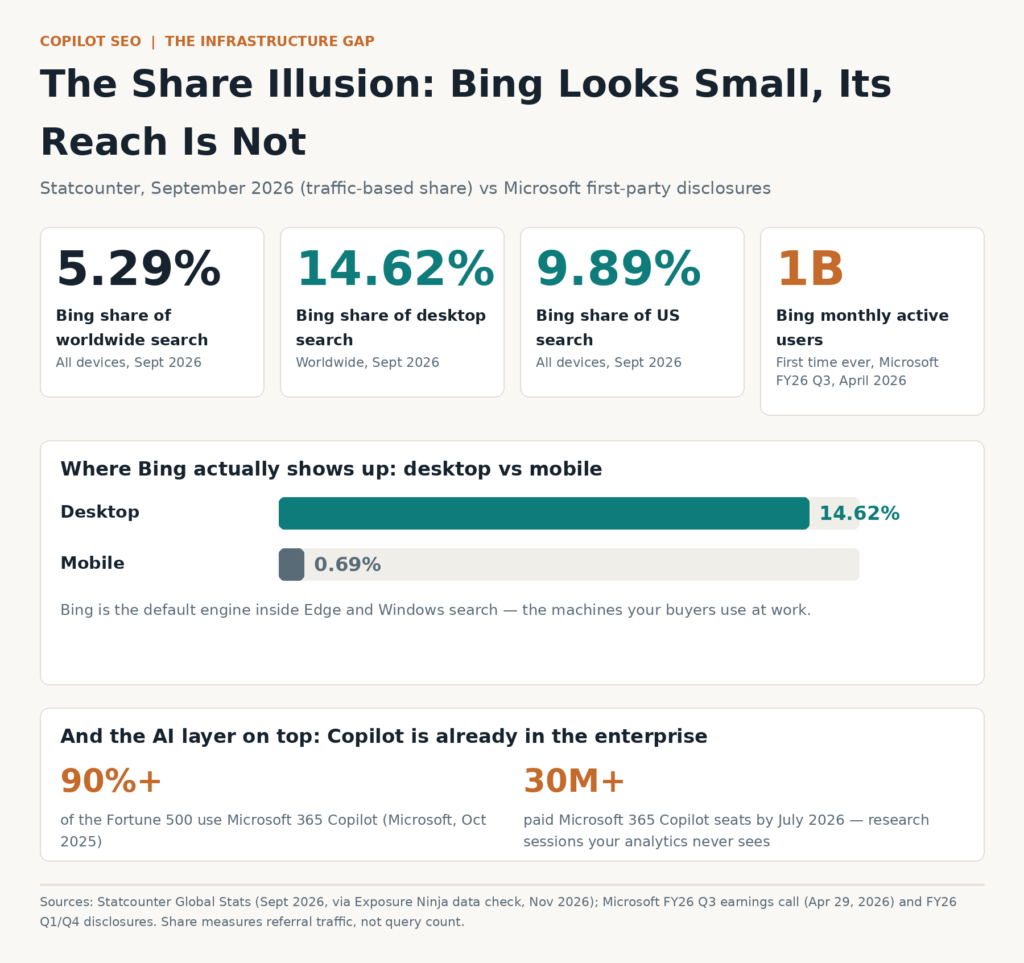
Here is the number that keeps Bing ignored: 5.29%. That was Bing’s share of worldwide search in September 2026, according to Statcounter data checked by Exposure Ninja in November 2026. Against Google’s roughly 90%, it looks like a footnote.
But averages hide the audience you actually want. On desktop — the machine people use at work, where B2B purchase research happens — Bing’s worldwide share was 14.62%. In the United States, across all devices, it was 9.89%. On mobile it collapses to 0.69%, which tells you exactly where the headline number comes from: phones. Bing is a desktop, workplace, default-browser phenomenon. Edge is the default browser on managed Windows machines, and Microsoft said on its April 29, 2026 earnings call that Edge has gained share for twenty consecutive quarters.
On that same call, Satya Nadella announced that Bing reached one billion monthly active users for the first time. One caveat worth keeping straight: that billion is Bing’s ecosystem — search, Edge, Windows surfaces, Copilot — not a standalone Copilot user count. Microsoft’s last published Copilot-family figure was 150 million monthly active users in October 2025, and by July 2026 it reported more than 30 million paid Microsoft 365 Copilot seats, with over 90% of the Fortune 500 using the product. The buyer researching your category inside Outlook or Teams is a session your analytics will never see.
One more methodological honesty note: Statcounter measures referral traffic — visits search engines send to websites — not raw query counts. The share is real, but it is a traffic lens, not a usage census.
How Copilot Builds an Answer: Retrieval, Evidence, Citation
When someone asks Copilot a question that needs current knowledge, the system does not improvise from memory. It generates internal search phrases — Microsoft calls them grounding queries — runs them against the Bing index, pulls candidate pages, selects the evidence it trusts, and composes an answer with citations.
Two mechanics matter for you. First, the grounding query is not what the user typed. Copilot decomposes a conversational question into several keyword-dense searches; one chat can fan out into multiple retrievals. You are not optimizing for one prompt — you are optimizing for a cluster of machine-generated variations nobody typed. Second, eligibility comes before selection. If your page is not in Bing’s index, it cannot be retrieved, cannot be weighed as evidence, and cannot be cited. No amount of Google ranking changes that. Bing indexing is the entrance exam; everything else is the interview.
Microsoft’s New Philosophy: From Relevance to Strength of Evidence
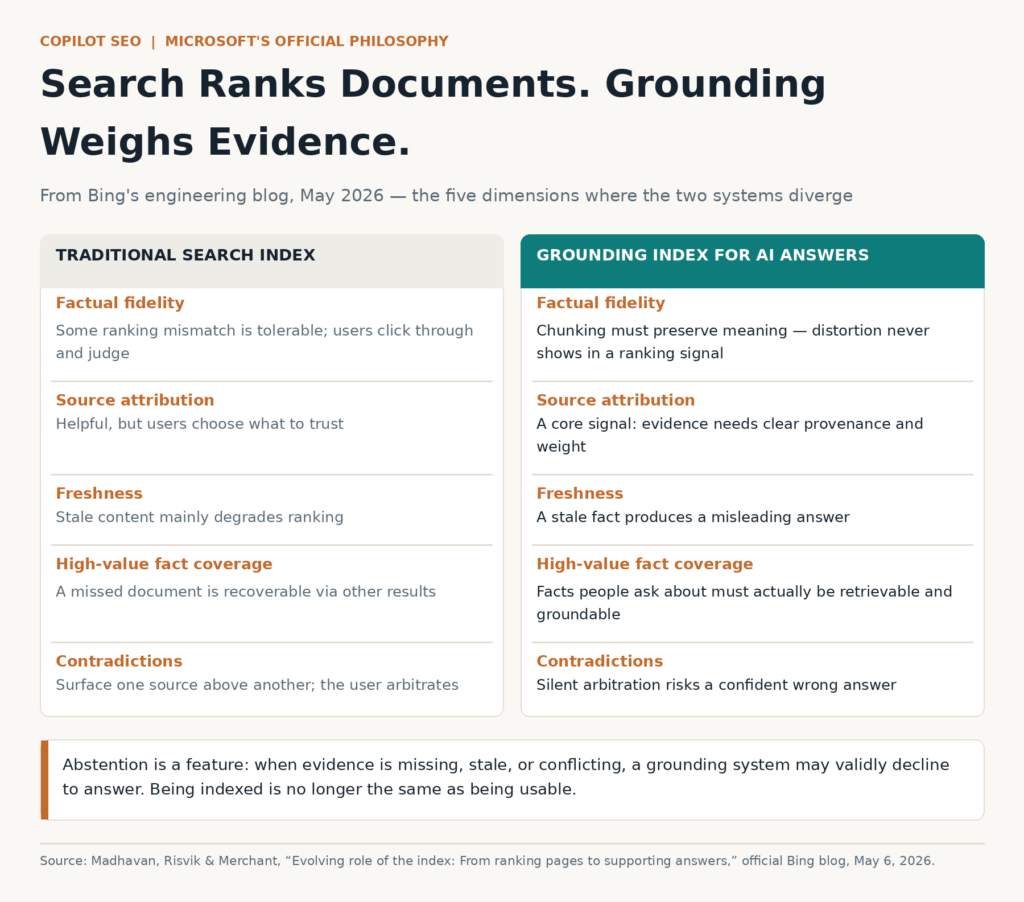
In May 2026, three Microsoft AI product leaders — Krishna Madhavan, Knut Risvik and Meenaz Merchant — published an engineering post on the official Bing blog that deserves to be read by every content strategist. Its core line: “Search optimizes for likelihood of relevance. Grounding must measure strength of evidence.”
Read that twice. Traditional search asks which pages a human should visit; the human scans, skips and self-corrects. A grounding system asks what information an AI can responsibly use to construct an answer — and then commits to that answer on the user’s behalf. The unit of value shifts from the document to the discrete, supportable fact with clear provenance.
The post lays out five dimensions where the two systems diverge: factual fidelity (chunking must not distort meaning), source attribution (a core signal, not a nicety), freshness (“a stale fact produces a misleading response”), coverage of high-value facts, and handling of contradictions. And it introduces a concept marketers rarely consider: abstention. When evidence is missing, stale or conflicting, declining to answer is a valid outcome. Your page can be indexed and still be passed over — not as a penalty, but as a judgment about evidence quality.
The 2026 Webmaster Guidelines, Decoded
In late February 2026, Microsoft rewrote the Bing Webmaster Guidelines — confirmed by Search Engine Journal and Search Engine Roundtable on February 26–27 — extending them explicitly to Copilot and grounding API results. For the first time, Generative Engine Optimization (GEO) is a named concept in official policy: eligibility for grounding and citation, with no guarantees, exactly as SEO never guaranteed rankings.
The practical guidance is refreshingly concrete. State facts directly rather than implying them, because AI systems need claims they can verify independently. Keep entity names consistent — your product is one name, everywhere, not three variants across five pages. Give each URL a single topic; single-topic pages are more likely to be selected for grounding. Put essential information near the top. The abuse sections were rebuilt too: keyword stuffing now covers “artificially engineered language” aimed at triggering AI citations, and a full section addresses prompt injection and AI manipulation. Meanwhile the stance on machine-written content softened from blanket hostility to a quality test: large-scale content without oversight or editorial review may be excluded. The message is consistent — write pages that work as evidence, not as bait.
Three Directives That Can Silently Switch You Off
The rewrite also spells out, directive by directive, how legacy meta tags affect AI answers — and this is where teams accidentally sabotage themselves. NOARCHIVE prevents content from being used in Copilot responses and grounding results. NOCACHE limits Copilot to your URL, title and snippet. NOSNIPPET and data-nosnippet can limit citation quality by restricting what text is quotable. These tags were often added years ago for unrelated reasons — paywall experiments, caching policies, an old agency’s template. Audit them. A robots meta tag copied from a 2019 staging environment can quietly remove you from a billion-user channel while your Google rankings look perfectly healthy.
Measure First: Reading the AI Performance Report
Here is what makes this channel unique: Microsoft shows you the data. On February 10, 2026, Bing Webmaster Tools launched AI Performance in public preview — the first first-party citation report from any major AI assistant. It shows total citations, average cited pages per day, a sample of grounding queries, page-level citation counts and a timeline across Microsoft Copilot, AI-generated summaries in Bing and select partner integrations. Microsoft expanded it in March 2026 with query-to-page mapping, and in June 2026 added intent labels, topic clusters, Citation Share (your portion of citations for a given grounding query) and period comparison. As of November 2026 it remains a preview.
Read it with three caveats. The grounding-query data is a sample, not a census. Citations are not clicks, rankings or authority — Microsoft says so explicitly. And it covers Microsoft surfaces only; ChatGPT and Gemini citations will never appear here.
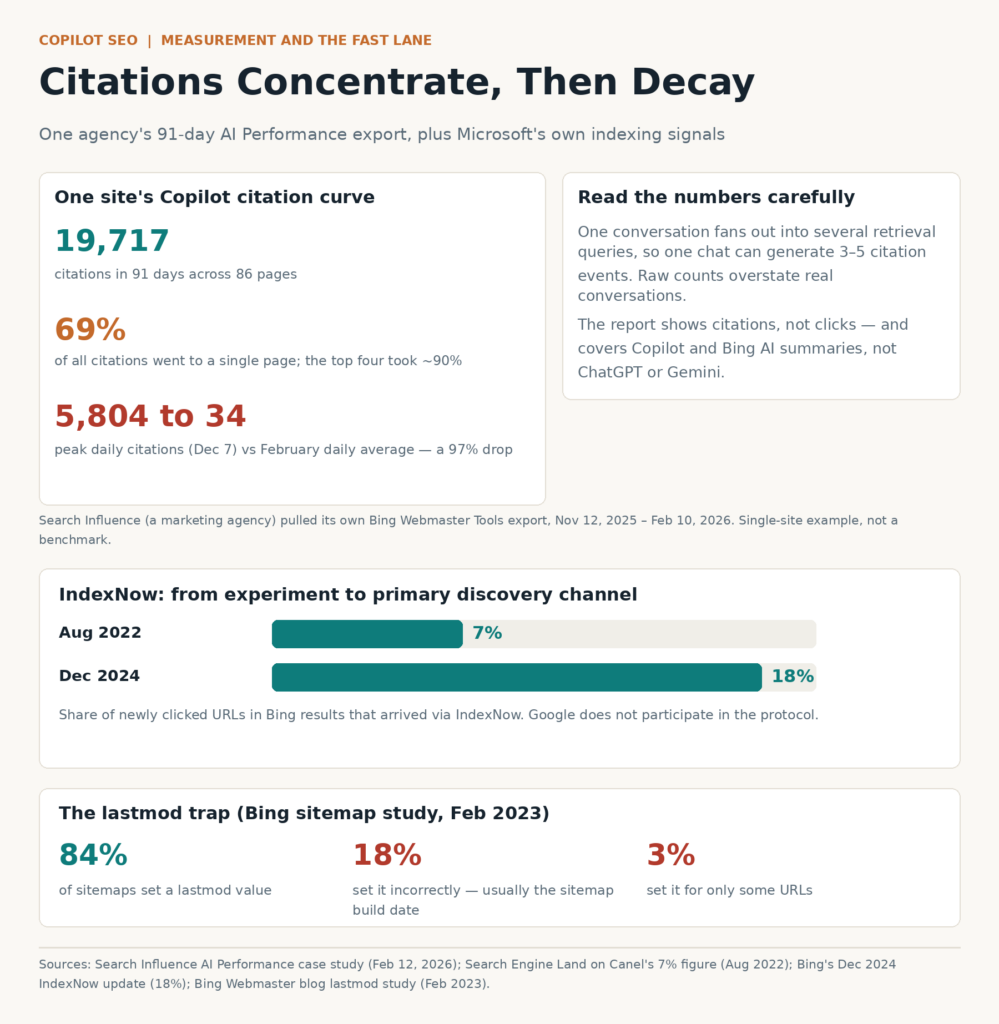
What does real data look like? Search Influence, a marketing agency, published its own export in February 2026: 91 days, 19,717 citations, 86 cited pages. One page captured 69% of all citations; the top four took roughly 90%. Then the decay: a peak of 5,804 citations on December 7 fell to a February daily average of 34 — a 97% drop in two months, likely freshness decay as competing content entered the index. The agency also estimates one conversation generates three to five citation events through fan-out, so raw counts overstate real chats. Treat this as a single-site example, not a benchmark — but the pattern is the lesson. AI citations concentrate brutally and evaporate quietly. Depth on your strongest topics beats thin coverage everywhere, and refreshes are not optional maintenance; they are the strategy.
IndexNow + lastmod: The Officially Endorsed Fast Lane
Microsoft’s answer to “how do I get into the grounding pipeline faster” is boringly practical: an XML sitemap, honest lastmod timestamps, and IndexNow. In its 2025 webmaster post on keeping content discoverable in AI-powered search, Bing recommended exactly this trio. Asked by Search Engine Roundtable whether normal SEO works for AI search, then-Bing product lead Fabrice Canel replied in July 2025: “Optimize for AI Search by following SEO guidelines.” (Canel, the public face of IndexNow, retired from Microsoft on July 1, 2026 — his statements remain official policy, but attribute them to his tenure.)
IndexNow, launched by Bing and Yandex in October 2021, flips crawling from pull to push: your site hosts a key file and pings participating engines the moment a URL is added, updated or removed. One ping reaches Bing, Yandex, Naver, Seznam and Yep. Google does not participate — it tested the protocol and never joined, so your Google workflow stays sitemap-and-crawl. The adoption numbers show this is no side experiment: Canel reported in August 2022 that 7% of newly clicked URLs in Bing results arrived via IndexNow; by December 2024 Bing’s own update put that at 18%, with more than 3.5 billion URLs submitted daily. On WordPress, Wix or Cloudflare it is a toggle, not a project. Bing fetches your sitemap immediately on submission and revisits at least daily; IndexNow collapses the remaining lag to minutes.
The lastmod Trap: Fake Freshness Gets Ignored
A warning with data attached. Bing’s February 2023 sitemap study found 84% of sitemaps set a lastmod value — but 18% set it incorrectly and another 3% only partially. The classic error: stamping every URL with the sitemap’s generation time instead of the page’s actual modification time. Bing said plainly that if it observes dates consistently set to the current date, it will suspect their validity and may disregard them. You cannot fake freshness at scale; you can only lose the signal. Update lastmod when content substantively changes, use full ISO 8601 timestamps, and ignore changefreq and priority — Bing disregards both. Freshness in grounding is not a ranking nicety; a stale fact produces a wrong answer, and the system would rather abstain than repeat yours.
Copilot Is Not ChatGPT: The 8.1% Overlap and the Labrador Variable
Do not run this playbook on an outdated map. The lazy 2024 assumption — “ChatGPT runs on Bing, so one fix covers both” — no longer holds cleanly. Ahrefs’ study of 15,000 long-tail prompts (data collected July 2025, published August 2025; note Ahrefs sells the Brand Radar tool used, so this is vendor research) found only 8.1% of ChatGPT’s cited URLs appeared in Bing’s top ten for the same prompt. Copilot showed the highest Bing overlap at 16.6%, as you would expect from a Microsoft product — but even that is a reminder that retrieval is not ranking: query fan-out, merging and re-selection mean top-ten placement is one input, not a verdict.
Then the ground shifted. Through mid-to-late 2026, independent reverse-engineering — RESONEO’s retrieval-stack analysis reported by Search Engine Land, and Peec AI’s index mapping (both vendors selling AI-visibility services, so weigh accordingly) — documented ChatGPT leaning heavily on its own internal index, nicknamed Labrador by researchers, not officially confirmed by OpenAI. In these samples, free instant-mode answers drew almost entirely from the internal index for stable questions, while paid thinking-mode leaned on scraped Google results roughly three-quarters of the time. Bing, once the documented backbone, appears as a minor path rather than the default. The strategic conclusion is clean: Bing indexing is the necessary entrance ticket for Copilot, and a helpful-but-insufficient signal for ChatGPT. Optimize each index like the separate channel it is.
Why B2B Should Move on This Channel First
Stack the facts. Your buyers sit at desktops where Bing holds nearly 15% of search. Over 90% of the Fortune 500 already run Microsoft 365 Copilot — the assistant is inside the tools where vendor research happens, invisibly. The channel is the only major one with a free first-party citation report. And the entire technical setup — verification, sitemap, IndexNow, meta-tag audit — takes an afternoon, with zero license fees. For a team with solid Google SEO, the marginal cost of covering the Bing-to-Copilot pipeline approaches zero, while the marginal benefit is eligibility in an ecosystem of a billion monthly users. No other AI channel offers that ratio.
Your Two-Week Rollout Checklist
Week one: verify your site in Bing Webmaster Tools (import from Google Search Console if you have it); submit your XML sitemap and confirm Bing reads it; audit robots meta tags for stray NOARCHIVE, NOCACHE and NOSNIPPET on pages you want cited; enable IndexNow via your CMS, plugin or CDN and confirm submissions in the IndexNow report. Week two: fix lastmod so it reflects real content changes; rewrite your three highest-value pages to guidelines spec — facts stated directly up top, one topic per URL, consistent entity names; open AI Performance, export the CSVs, and record your citation baseline, top cited pages and grounding-query themes. Then set a monthly ritual: export, compare, refresh the decaying winners. This is not a project. It is hygiene.
The Bottom Line
Bing’s 5% headline share is the most misleading number in search marketing. Underneath it sits a billion-user ecosystem, a desktop-heavy B2B audience, an official evidence-first philosophy, a free citation dashboard no competitor matches, and a push protocol that turns publishing into near-instant retrievability. Microsoft has told you exactly what it wants: indexed pages, honest freshness, direct facts, consistent entities, quotable structure. The teams that win Copilot citations will not be the ones with clever tricks. They will be the ones who treated the ignored index as infrastructure — and fed it, honestly, on schedule.