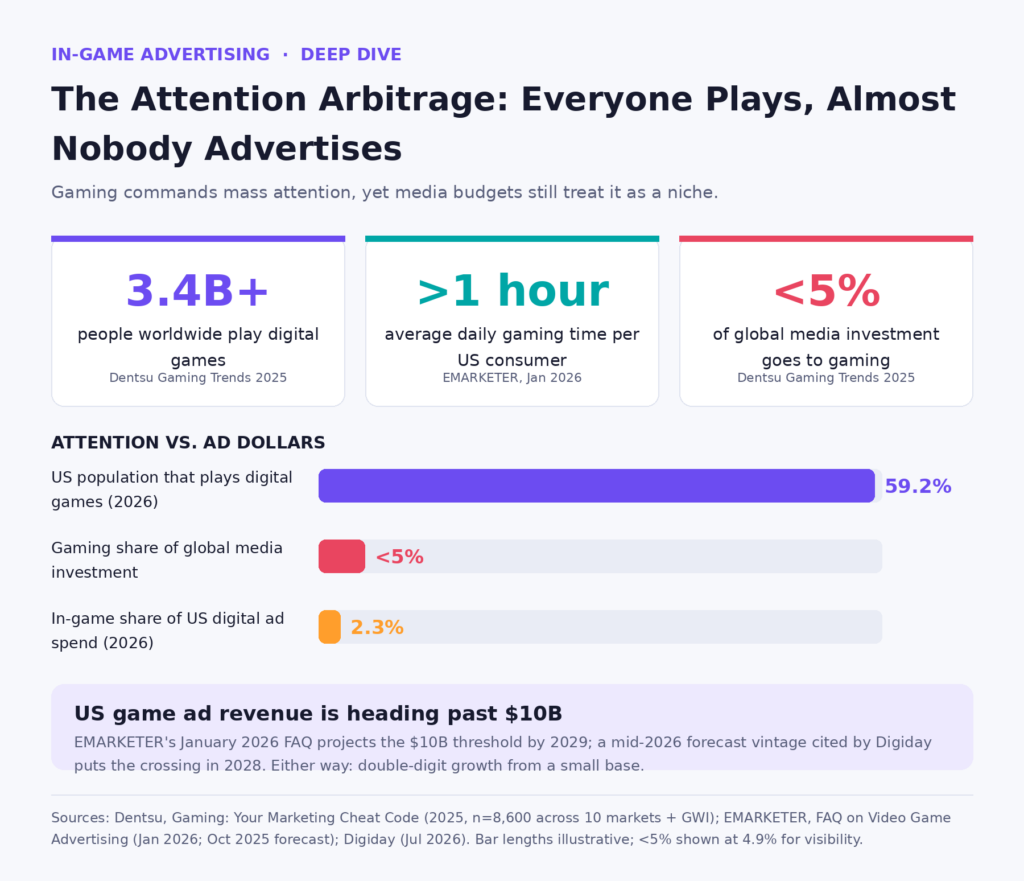
Here is a number that should keep media planners awake at night: more than 3.4 billion people play digital games, yet gaming attracts less than 5% of global media investment. That gap comes from Dentsu’s 2025 Gaming Trends Report, built on a survey of 8,600 consumers across ten markets plus GWI data — and it describes the clearest attention arbitrage left in media.
Think about what that means. Roughly six in ten Americans will play digital games in 2026, according to EMARKETER’s October 2025 forecast, and the average US consumer spends over an hour a day gaming. Time spent in games keeps climbing — up 6% year over year, per Dentsu. Meanwhile, in-game advertising accounts for just 2.3% of US digital ad spend. If any other medium commanded that much daily attention with that little competition for it, buyers would be fighting over the inventory.
So why aren’t they? The short answer: measurement anxiety, format confusion, and one very public cautionary tale. The longer answer is more interesting — and more actionable. Because the data now shows that gamers don’t hate advertising. They hate interruption. And the formats built around that distinction are quietly becoming some of the highest-performing units in digital.
The Money Is Coming — Slowly, Then All at Once
EMARKETER’s January 2026 gaming FAQ projects US game ad revenues will surpass $10 billion by 2029. Worth noting: forecast vintages move. A mid-2026 EMARKETER breakdown cited by Digiday has the line crossing $10.2 billion in 2028. Either way, the direction is unambiguous — double-digit growth from a small base, while the channel stays structurally underpriced relative to attention.
Global sizing depends on whose lens you use, and it’s worth keeping the lenses separate. Technavio’s 2026–2030 report forecasts incremental growth of about $85 billion at an 11.2% CAGR, driven by intrinsic formats, rewarded video, and programmatic buying. Mordor Intelligence, using a broader market definition, values the sector at $119.3 billion in 2025 rising to $217.2 billion by 2031 — a 10.63% CAGR. These are commercial research forecasts, not audited market data, and their scopes differ; don’t average them into a single number. What both agree on: rewarded and playable units are the fastest-growing formats, expanding at 11.58% annually in Mordor’s model, while static placements — still 44.23% of 2025 revenue — plateau as players demand value in return for attention.
The Four Formats, Finally Named
For years, buying gaming ads felt like ordering from a menu with no dish names. That changed in June 2025, when the IAB released its Gaming Measurement Framework, giving the industry a common vocabulary. As EMARKETER summarizes it, four primary formats anchor the taxonomy — with sponsorship, playables, audio, and custom integrations covered alongside.
Intrinsic in-game ads
Virtual billboards, stadium signage, product placements that live inside the game world. Think the boards around a football pitch in EA Sports FC — advertising that adds authenticity rather than stealing attention. Done well, players barely register it as advertising at all. That’s the point.
Rewarded ads
The player chooses to watch an ad and gets something concrete back: currency, an extra life, a cosmetic item. It’s opt-in by design, and it’s the format with the strongest reception data — 62% of players call rewards-based ads the most engaging in-game format, per Attest data cited in EMARKETER’s 2026 FAQ.
Interstitial ads
Full-screen units between levels or during natural breaks. Tolerated when skippable and placed at genuine pause points; resented everywhere else. The placement decision matters more than the creative.
Adjacent ads
Banners and companion displays near — but not inside — gameplay. The least immersive option, and the easiest entry point for teams testing the channel with standard display assets.
Beyond the core four, playables (try-a-mechanic mini-ads) drive high-intent performance outcomes, while custom integrations and branded worlds command premium CPMs for deeper storytelling.
What Players Actually Think: The Sentiment Is Mixed, Not Hostile
Let’s kill the myth that gamers are unreachable. Attest surveyed 1,363 US adults in January 2025 — 1,000 of whom play at least a few times a month — and found that 71.3% of gamers notice in-game ads. Only 14.6% feel positively about them. Read those two numbers together and you get the real picture: ads register, but goodwill has to be earned.
What earns it? Skippability tops the list at 46.8%, followed by rewards at 41.4%. EMARKETER’s FAQ, citing the same Attest research program, adds relevance to interests (26.5%) and blending with the game’s theme (24.5%). Category fit helps too: 48% of respondents said tech and gaming products belong in games naturally — nobody had to explain why a graphics card billboard fits a racing title.
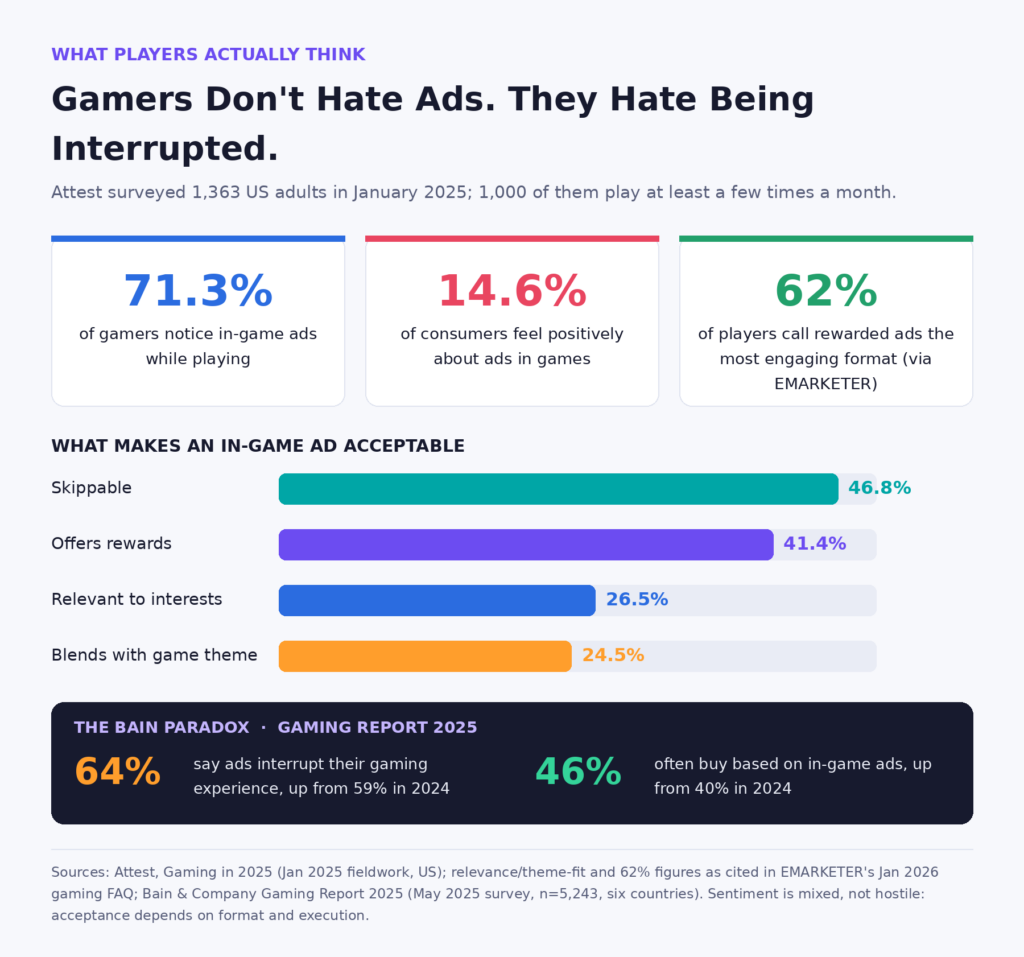
And now the paradox that should reshape your media plan. Bain & Company’s Gaming Report 2025 — a May 2025 survey of 5,243 players aged 13+ across six countries — found that 64% say ads interrupt their gaming experience, up from 59% a year earlier. In the same survey, 46% said they often make purchases based on in-game ads, up from 40%. Both lines are going up. Gamers are simultaneously more annoyed and more influenced than they were a year ago. The variable that separates the two outcomes isn’t the audience. It’s the format.
Why the Value Exchange Works
Rewarded advertising flips the psychology of interruption. Instead of taking something (time, attention, flow), the ad offers a trade: thirty seconds of your attention for something you actually want. The player initiates. The player benefits. The ad stops feeling like a tax and starts feeling like a side quest.
Marketers are noticing. In an EMARKETER × Discord survey of 160 US marketing professionals conducted in July 2025, 65% agreed users prefer rewarded ads to non-rewarded formats, and roughly 46% said rewarded units make users feel more in control of their ad experience. More than 60% rated rewarded ads effective across upper, middle, and lower funnel stages — this is not just a mobile user-acquisition trick anymore. And 52.9% of brand marketers said they plan to use rewarded formats in upcoming campaigns. One disclosure worth making: Discord sells rewarded-ad inventory, so it has commercial interest in these findings; the sample is also modest. Treat the direction as signal, the decimals as noise.
The format is also escaping gaming. In the same survey, 74% of marketers saw social media as a promising environment for rewarded ads, 56% named streaming platforms, and 45% pointed to messaging and community apps. The value exchange, it turns out, is portable. Gaming just proved it first.
Gaming Is a Behaviour, Not a Demographic
If your mental image of a gamer is a teenage boy in a headset, update it. At the IAB’s 2025 PlayFronts, experience-center VP Zoe Soon put the average gamer age at 37 — and noted that 90–95% of Gen Z and Gen Alpha identify as gamers. Gaming isn’t a youth vertical; it’s a horizontal layer across every cohort. EMARKETER’s age splits make the same point: penetration runs 76% among 18–24s, but still 62.9% among 35–44s and 43.6% among over-65s.
The audience also spills beyond the game itself. Bain found that gamers devote 27% of their social media time and 25% of their streaming time to gaming-related content. Which means an in-game campaign can — and probably should — travel with creator partnerships on Twitch, YouTube, and TikTok. The game is the anchor, not the whole territory.
The Plumbing Got Good While Nobody Was Watching
The technology objection is a decade out of date. Modern engines swap billboard textures and stadium signage server-side, so placements match a player’s location and time of day without client patches. Unity and Unreal expose APIs that route bid responses straight into live scenes.
The buying rails are maturing just as fast. At CES 2026, Roblox expanded programmatic access — adding Amazon DSP and Liftoff on the buy side, Magnite, Index Exchange, and PubMatic on the sell side — alongside a Homepage Feature unit and rewarded video. When a platform with Roblox’s scale opens its doors to the major DSPs, that’s a confidence signal for the whole category. On the open web side of gaming, The Trade Desk’s OpenPath integration with Overwolf delivered roughly 15% revenue growth for the gaming platform, per Adweek’s April 2025 reporting — with cross-screen frequency capping included. (Overwolf benefits commercially from the integration; the figure comes from trade press, not an audited disclosure.) The specialist vendor layer — Anzu, Bidstack, Frameplay, AdInMo, Gadsme on the intrinsic side; AppLovin, Unity, and Playwire on mobile rewarded — is deep enough to run competitive tenders.
The Real Bottleneck: Measurement Adoption, Not Measurement Science
Here’s the uncomfortable truth about those muted CPMs: the standards already exist. The Intrinsic In-Game Measurement Guidelines 2.0 — finalized by the IAB, IAB Tech Lab, and the MRC in August 2022 — define a viewable in-game impression with real precision: the ad must cover at least 1.5% of the screen, show at least 50% of its pixels, sit within a 55-degree viewing angle, and stay in view for one continuous second (two for video). The old ten-second cumulative window, which let five scattered glances count as an impression, was deleted.
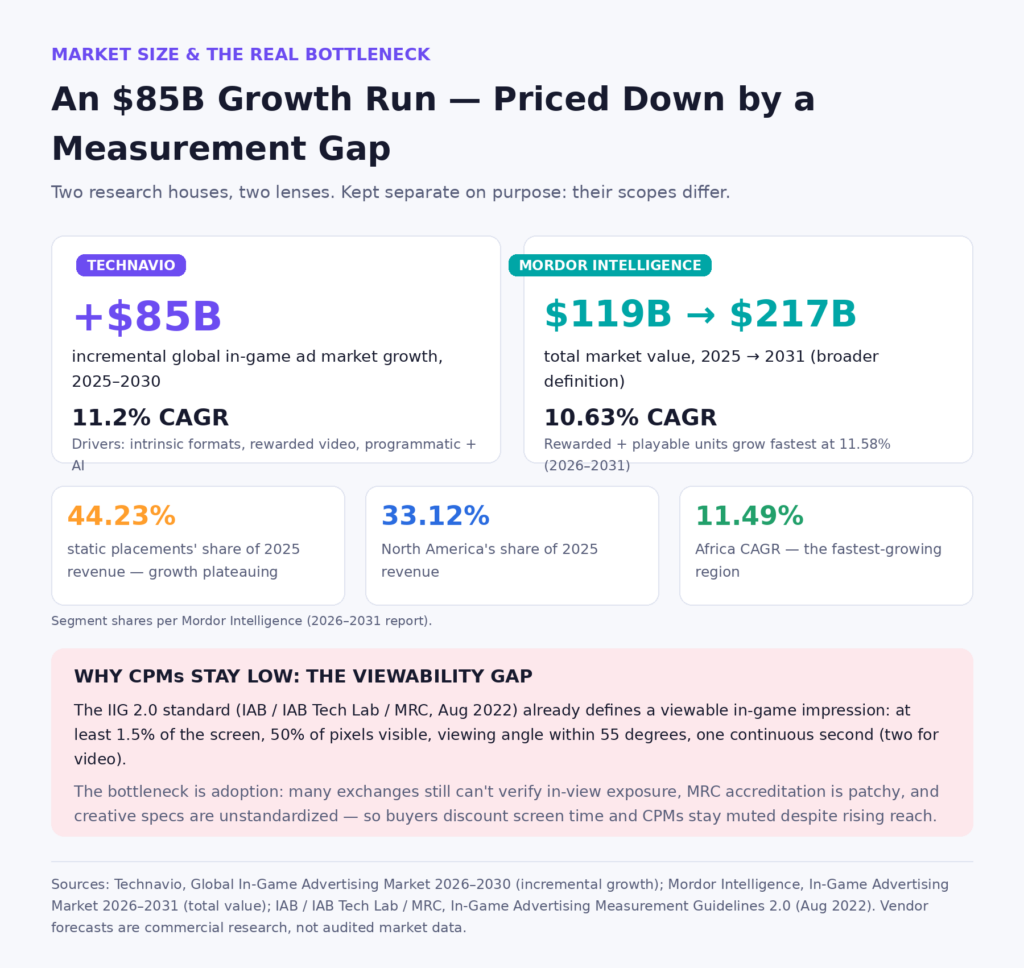
The problem is adoption. Many exchanges still can’t verify that an ad stayed in the player’s field of view; MRC accreditation across in-game measurement vendors remains patchy; and creative specs are unstandardized, forcing brands to produce multiple asset variants per engine. OpenRTB 2.6 added a rewarded-video flag to its Video object — useful plumbing — but a protocol field doesn’t accredit a measurement vendor. Until verification becomes table stakes, buyers discount gaming screen time, and CPMs stay low despite rising reach. For buyers, that discount is the arbitrage. For the channel, closing the gap is the single biggest unlock. The practical move: put viewability, invalid-traffic filtration, brand-safety verification, and attention metrics in your insertion order — and ask which measurement vendor is MRC-accredited for in-game specifically.
The Cautionary Tale: EA Already Ran This Experiment
In September 2020, EA switched on full-screen ads inside UFC 4 — a $60 premium title — about a month after launch, once the reviews were in. Replays were interrupted by promos for Amazon’s The Boys. A Reddit thread hit roughly 100,000 upvotes. Within days, EA apologized, removed the ads, and promised they wouldn’t return to the replay experience. The lesson wasn’t that gamers reject advertising — the same franchise had long carried menu tiles and Octagon logos without complaint. The lesson was that forced interruption inside a paid premium experience breaks an implicit contract.
The industry keeps re-learning it. In May 2024, EA CEO Andrew Wilson told analysts that internal teams were exploring “thoughtful” dynamic ad implementations in AAA games; players responded with mockery and boycott hashtags before a single ad shipped. Meanwhile, the stadium boards in EA Sports FC sail on, unbothered — because they belong there. Consent-driven, world-native formats win. Forced units in premium console titles trigger revolt. Plan accordingly: mobile and rewarded first, intrinsic in premium, never forced full-screen in a paid game.
Privacy and Child Safety Are Design Constraints, Not Footnotes
Gaming audiences skew young on the platforms where advertising is growing fastest, which puts COPPA’s parental-consent rules, the EU’s Digital Services Act protections for minors, and GDPR consent requirements directly in your campaign path. The practical consequence: contextual targeting by genre and title, first-party identity where consent exists, and data minimisation by default. Newer privacy laws in markets like India and Thailand narrow behavioural targeting further while pushing the ecosystem toward gaming-native first-party solutions. Age-appropriate creative and clear ad disclosure aren’t compliance overhead — on UGC platforms especially, they’re the price of admission.
A Buyer’s Framework You Can Use Monday Morning
If you need Gen Z and Gen Alpha at scale
Buy rewarded and intrinsic units in mobile and UGC environments — Roblox’s programmatic opening makes this routable through your existing DSP. Lead with the value exchange, not the impression count.
If you’re building a premium brand
Intrinsic placements and sponsorships in console and PC titles, where the ad can live inside the world. Require in-game-specific viewability verification in writing. Never force interruption in a paid title — EA proved what that costs.
If you’re chasing performance
Rewarded video plus playables, measured on completion, redemption, and incrementality — not last-click installs alone. Run a holdout; the format’s opt-in nature makes clean experiments easier than in most channels.
Whatever you buy
Game-native creative (your repurposed display banner will underperform), verification and attention metrics in the contract, and regional tailoring — North America still holds 33.12% of market revenue in Mordor’s model, but Africa is the fastest-growing region at an 11.49% CAGR, and mobile-first markets are where rewarded formats scale first.
The Bottom Line
Gaming is the last mass medium priced like a niche: 3.4 billion players, an hour-plus of daily attention, less than 5% of spend. Players notice ads (71.3%) but warm to them only when the format respects them — skippable, rewarded, relevant, native to the world. The purchase influence is real and rising (46%, per Bain), even as annoyance rises with it. The bottleneck isn’t the audience or the technology; it’s measurement adoption, which suppresses CPMs and creates the buying window. Buy the value exchange, demand verification, respect consent and kids, and never force a full-screen ad into a $60 game. The arbitrage won’t stay open forever — Roblox opening its gates to every major DSP is the sound of it starting to close.