Signal spent a decade making sure nobody could read your messages in transit. Now it’s fighting a reader that lives inside your own phone.
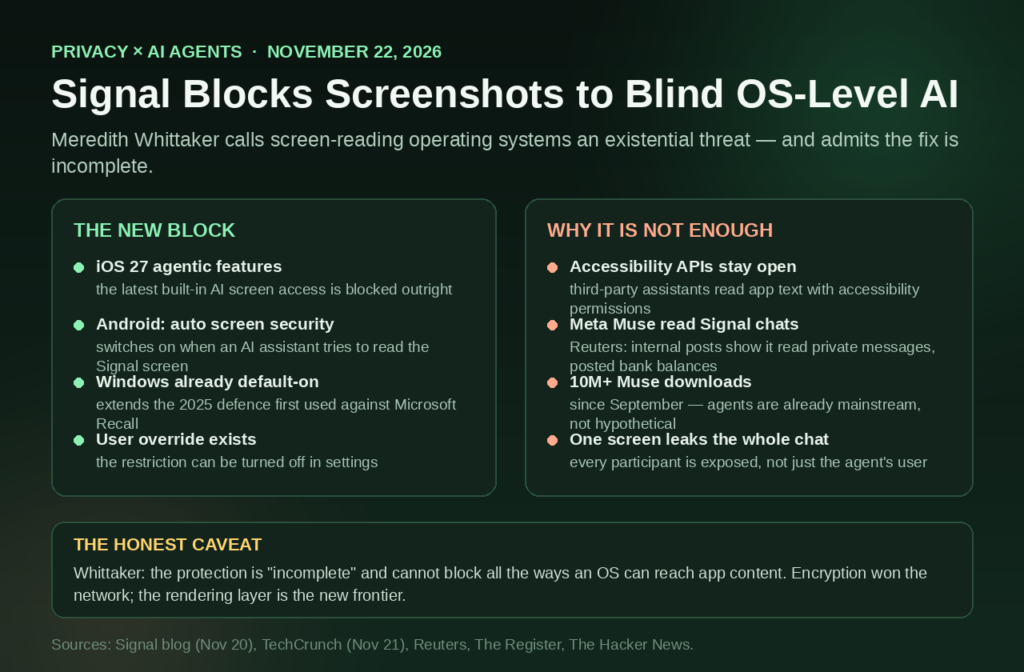
The encrypted messenger announced on November 20 that it is blocking screenshot access from OS-level AI assistants across its apps, with TechCrunch detailing the rollout the next day. On iOS, Signal blocks the agentic screen-reading features introduced in iOS 27 outright. On Android, its screen-security protection switches on automatically when an AI assistant attempts to read the Signal screen. On Windows, the same defense has been on by default since 2025, when Signal first deployed it against Microsoft’s Recall feature. Users can override the restriction in settings — but the default has flipped.
Why Signal is doing this
Signal president Meredith Whittaker’s framing is blunt: operating systems that let AI agents read whatever is on screen are an existential threat to private communication. Her core argument is about externalities. When one person in a group chat runs an AI assistant that can see their screen, every other participant’s messages get read too — people who never consented, never installed the agent, and may not know it exists. End-to-end encryption protects the pipe. It does nothing about a camera pointed at the window.
This is not a hypothetical worry. Reuters reported that Meta’s Muse assistant — which has passed 10 million downloads since September — read private Signal conversations through internal screen-access pathways, with internal posts showing it surfacing content including bank balances. The agent era arrived through the front door of the operating system, and messengers had no say in the matter.
The honest caveat
Whittaker herself calls the protection “incomplete.” Screenshot blocking closes one channel, not all of them. Accessibility APIs remain open: a third-party assistant granted accessibility permissions can still read app text directly from the view hierarchy, no screenshot required. Notifications, backups and clipboard paths are other routes an OS-level agent can take. Signal is buying friction, not immunity — and it says so publicly, which is more honesty than most of the industry has offered on this topic.
What this means beyond Signal
The episode marks the opening of a new front in the privacy wars. For fifteen years, the fight was over encryption backdoors and network interception. That fight was largely won. The new battlefield is the rendering layer: the moment decrypted content appears on a screen controlled by an OS vendor whose business increasingly depends on feeding that screen to a model.
Expect two consequences. First, other privacy-positioned apps — WhatsApp’s locked chats, Telegram’s secret chats, enterprise messengers — will face pressure to ship equivalent blocks. Second, “our user consented” is no longer a complete privacy argument for any product that displays other people’s words. If your app shows group content, the consent of the person holding the phone does not cover the people who wrote the messages.
For now, the practical advice is unglamorous: if a conversation matters, have it on a device where you control which assistants can see the screen — and check that setting today, because the default on your OS is probably not the one Signal would choose.