Nobody opens Discord hoping to see your ad. They open it because a friend just went live, because the raid starts in ten minutes, because the group chat is where their people are. Anything that interrupts that ritual gets muted, blocked or roasted — sometimes all three before lunch.
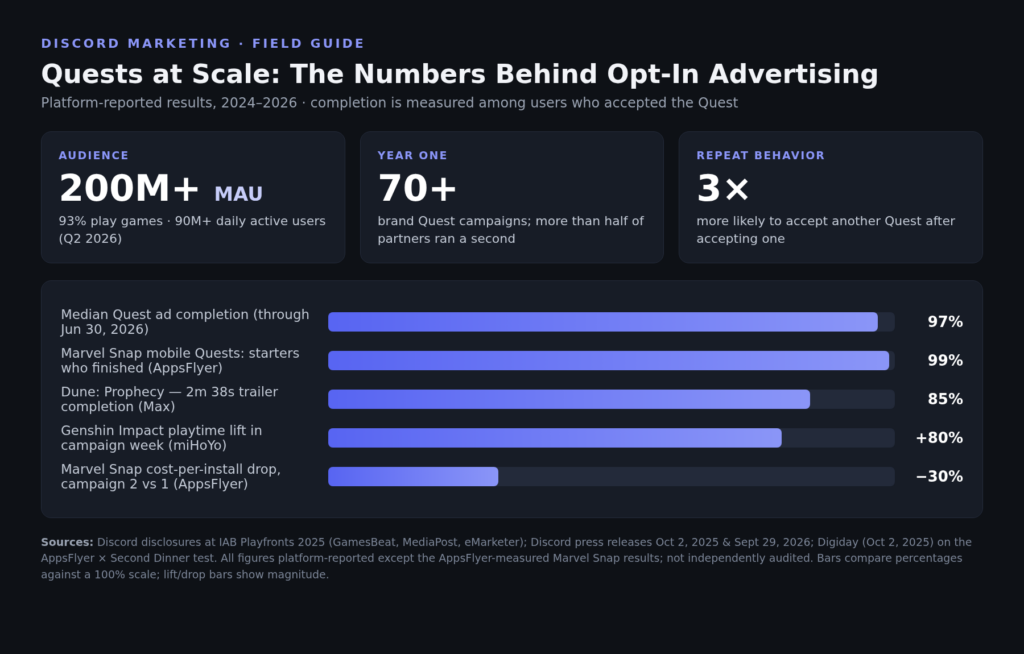
And yet. In the first year of Quests, Discord’s rewarded ad format, more than 70 brand campaigns ran on a platform that had spent its first nine years completely ad-free. Over half of those partners came back for a second campaign. A Genshin Impact Quest lifted gameplay hours by 80% during its campaign week. A two-minute-and-38-second trailer for Max’s Dune: Prophecy held an 85% completion rate among the users who engaged with it.
How do you advertise to people who hate advertising? You stop interrupting and start rewarding. That’s the whole trick — and the whole discipline. This field guide walks you through building a brand server people keep unmuted, buying Quests without burning community trust, and measuring the results honestly. One caveat before we start: nearly every performance figure below is Discord’s own disclosure or a partner-run test, not an independent audit. I’ll flag who measured what as we go, and you should treat the numbers as directional rather than guaranteed.
The Short Version
- Discord is a semi-private gaming community, not a feed. Broadcast advertising gets muted; opt-in rewarded Quests get played.
- Run three surfaces with three different jobs: an owned server for retention, Quests for awareness and reactivation, Ads Manager for scaled buying.
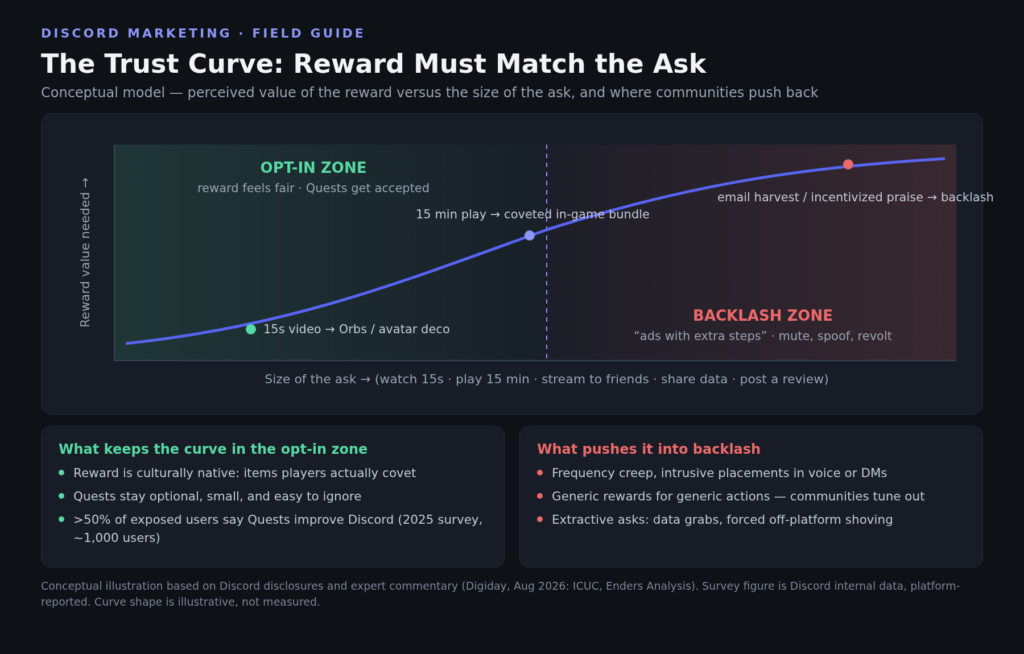
- The reward must match the ask. Cheap rewards for big asks read as “ads with extra steps,” and communities punish that.
- Measure completion, playtime lift and sentiment — not last-click ROAS, which Quests were never built to deliver.
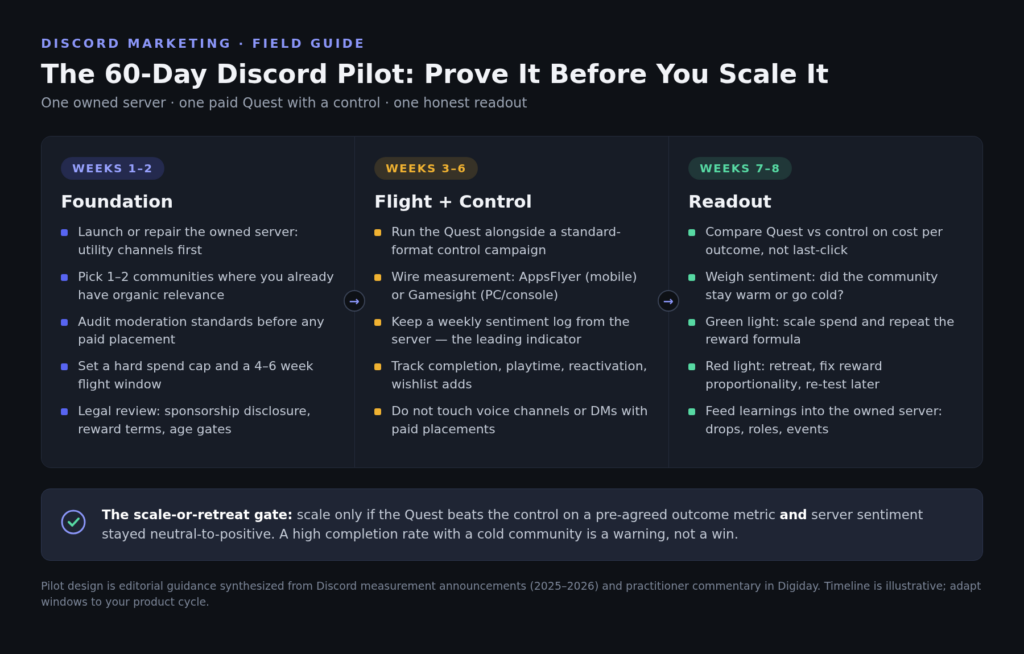
- Prove it in a capped 60-day pilot before you scale a dollar.
A Gaming Community, Not a Feed
Start with the scale, because it explains why marketers keep circling this platform. Discord reports more than 200 million monthly active users and, in its Q2 2026 reporting, more than 90 million daily actives. According to product chief Peter Sellis, speaking at the IAB’s Playfronts event in 2025, 93% of those users play games, and they log a combined 1.5 billion gameplay hours every month across more than 8,000 titles — on PC alone. Roughly half talk live with friends on Discord every week. This is not an audience you scroll past. It’s an audience you hang out with.
And gaming is no longer a vertical you can ignore. IAB experience chief Zoe Soon put it bluntly at the same event: 90 to 95% of Gen Z and Gen Alpha identify as gamers, and the average gamer is now 37. Discord’s advertising head Adam Bauer made the same argument on the Next in Media podcast in October 2026 — treat gaming as a consumer behavior, not a niche column on a media plan.
But here’s the catch that trips up most brands: the space is semi-private. Servers, DMs and voice channels are rituals, not inventory. Users defend them the way you’d defend your living room from a door-to-door salesman.
Three Surfaces, Three Jobs
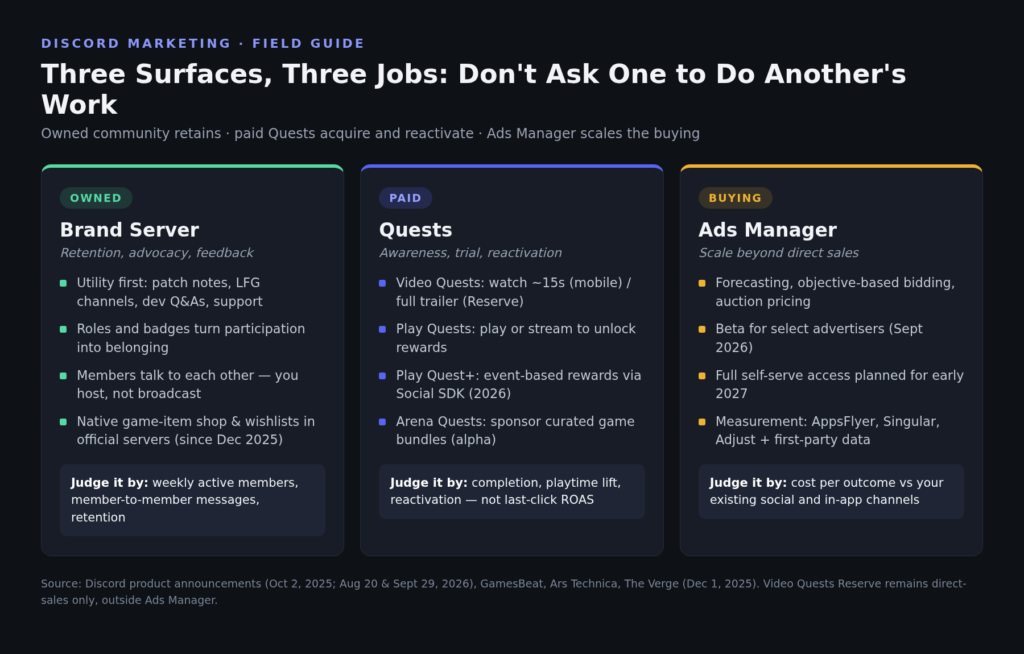
Discord gives you three distinct marketing surfaces, and the fastest way to fail is asking one to do another’s work. Your owned brand server is a retention and advocacy engine. Quests are paid, opt-in placements for awareness, trial and reactivation. And the new Ads Manager — announced in September 2026, in beta for select advertisers, with full self-serve access planned for early 2027 — is the buying layer that finally lets smaller teams run campaigns without a direct sales relationship. Judge the server by weekly activity and member-to-member conversation. Judge Quests by completion and lift. Judge Ads Manager by cost per outcome against your other channels.
Quests: The Ad You Choose to Play
A Quest is a small card, not a takeover. You see it, you accept it — or you don’t — you perform the action, and you claim a reward: in-game items, avatar decorations, or Orbs, the in-app currency Discord rolled out in mid-2025 that redeems for profile cosmetics and Nitro trials. Nothing plays unless you tap. Nothing follows you into voice chat.
The acceptance rate tells you how permission-first this really is. Discord disclosed an average Quest acceptance rate of about 10% in its first year — and its sales leadership framed that as a win, not a problem. Nine out of ten users shrug and keep talking, and the experience stays intact. Among those who do accept, Discord’s internal data shows a 97% median ad completion rate as of June 30, 2026. Read that carefully: completion is measured among self-selected acceptors. It proves the format holds the people who raise their hands. It does not prove everyone loves ads.
Video Quests: From Two-Minute Trailers to Fifteen-Second Sprints
The format’s founding proof point still holds up. In late 2024, Max ran the first-ever Video Quest: a 2-minute-38-second trailer for Dune: Prophecy, with an avatar decoration as the prize. Among users who engaged, 85% watched the whole thing. Compare that with the two-second skip reflex your pre-roll earns on other platforms. Video Quests piloted on mobile in June 2025 and rolled out broadly that October. Then, in September 2026, Discord split the product in two: a mobile-first Video Quest built around roughly 15-second views for Orbs — a performance format for repeatable interactions — and Video Quests Reserve, the renamed premium version sold only through direct sales, with rewards tied to full video completion. Big brand moment? Reserve. Always-on mobile reach? The new format, bought through Ads Manager.
Play Quests and Play Quest+: Reward the Moment, Not the Minutes
Play Quests ask users to play or stream a game to unlock a reward, and the canonical case is miHoYo’s Genshin Impact campaign around its v4.6 update in 2024. The ask was culturally native: stream the game to at least one friend for 15 minutes, earn a bundle of genuinely coveted in-game items. Millions joined, and Discord reported an 80% increase in gameplay hours during the campaign week — a figure the company presented on stage, so treat it as platform-reported. In August 2026, Discord pushed further with Play Quest+: event-based rewards wired through its Social SDK and Events API. Players link their game account, and the reward drops the moment they finish a match, complete a tutorial or play with a friend. EA’s Battlefield 6 ran the first campaign in September 2026. For live-service games, this is a reactivation machine — a concrete reason for a lapsed player to log back in tonight.
Arena Quests: Sponsor the Game Night
Announced in alpha in October 2025, Arena Quests let a brand sponsor a curated bundle of titles. Players pick a game from the list, play for a set time, and earn Orbs or decorations. The brand doesn’t interrupt game night — it hosts one. Availability is still limited to select partners, so treat Arena as an early-access opportunity, not a line item you can plan around yet.
The Peer Multiplier
Here’s why Quests work on Discord specifically: the platform already runs on friend-to-friend influence. Discord’s internal data, shared with its Social SDK launch in March 2025, says about half of gaming users stream gameplay to friends, and 28% of viewers launch that same game within an hour of watching. Playing with at least one friend stretches a gameplay session roughly sevenfold. Quests don’t manufacture this behavior — they ride it. The Genshin Quest’s stream-to-a-friend requirement didn’t just buy playtime; it engineered word of mouth into the ad unit itself. When your campaign’s completion mechanic is also your distribution mechanic, you’ve stopped renting attention and started borrowing trust.
Trust Economics: Why Restraint Is the Strategy
The asset you’re advertising against is Discord’s low-ad environment. That’s it. That’s the moat. In a 2025 internal survey of roughly 1,000 recent Quest users — small sample, vendor-run, so weigh it accordingly — more than half of those exposed to a Quest said it improved their Discord experience. An ad format with net-positive sentiment is rare enough to protect jealously.
The failure modes are predictable: frequency creep, sloppy targeting, intrusive placements near voice or DMs, and rewards too cheap for the ask. As ICUC’s Nicole van Zanten told Digiday in 2026, the moment a placement feels like “an ad wearing a game’s clothes,” the community clocks it. A cosmetic that means something inside a server’s culture lands; generic points for generic actions read as filler.
And the pressure to over-monetize is real. Discord confidentially filed for an IPO in January 2026, per Bloomberg, and ads are how it diversifies beyond Nitro subscriptions. Even co-founder and CTO Stanislav Vishnevskiy has said he’s the one “constantly bringing up enshittification” inside the company. The long-term test for every advertiser: does your campaign extend gaming culture, or tax it?
Building a Server People Don’t Mute
Lead With Utility, Not Promotion
Give people a reason to check in when nothing is being sold. Patch notes before anyone else gets them. Looking-for-group channels that actually match squads. Dev Q&As where real answers happen. Support that resolves things. Exclusive drops for members. If your server’s only content is campaign announcements, you haven’t built a community — you’ve built a billboard with a chat room attached, and it will be muted like one.
Tier the Belonging
Roles and badges turn participation into identity. Newcomer, regular, event champion, ambassador — a ladder people climb because status inside a community feels earned, not purchased. This is your loyalty pipeline: the members who moderate, welcome and create are worth more than any impression count, and they cost you recognition rather than media budget.
Host, Don’t Broadcast
The health metric is member-to-member conversation, not brand-to-member reach. Marvel Rivals runs the largest gaming server on Discord — over 4 million members — and keeps it alive with constant events, not constant promotions. Outside gaming, Bauer points to e.l.f. Cosmetics as a non-traditional community example, and industry coverage lists e.l.f., Wendy’s, Walmart and Mountain Dew among non-gaming Quest advertisers. The glue is fandom, not genre. But note what these brands have in common: they show up as hosts of something their fans already care about.
The Commerce Twist You Should Know About
One correction to the old “Discord has no checkout” line: since December 2025, it does — just not where you’d expect. Official game servers can host native stores, starting with Marvel Rivals, where users browse, buy, wishlist and gift in-game items without leaving Discord. Vishnevskiy says roughly 20% of purchases in Discord’s existing shop are gifts on a normal day, spiking past 30% around holidays — gifting is native culture here, and wishlists on profiles turn friends into a discovery channel. The rollout started on desktop, in US dollars, across the US, Canada, UK, Ireland and Oceania, with more titles added through 2026. The distinction that matters for your media plan: this commerce lives in owned servers. There is still no shoppable overlay or last-click checkout inside a Quest ad.
Buying Quests: Pilot Discipline
Buy your first Quest the way you’d test a new hire: bounded scope, clear probation, honest review. Start in one or two communities where you already have organic relevance. Set a hard spend cap and a four-to-six-week flight window. Run a parallel control in a standard format so you have an internal benchmark — don’t let the platform grade its own homework alone. Keep a weekly sentiment log from the server, because community mood is the leading indicator your dashboard can’t see. And audit moderation standards before any placement; brand safety varies wildly server by server.
Compliance: The Reward Doesn’t Excuse the Disclosure
Rewarded formats don’t get a regulatory pass. The FTC’s Endorsement Guides, revised in 2023, require clear disclosure of material connections — and a reward is a material connection. The Consumer Review Rule, effective October 21, 2024, goes further: incentivized reviews count as testimonials, must be truthful and disclosed, and incentives conditioned on positive sentiment are prohibited outright. Knowing violations carry civil penalties of up to $53,088 per violation, an amount that stands unchanged for 2026. If your Quest rewards users for posting reviews or testimonials, ask whether your existing sponsorship language actually covers that — reward-gated user content sits in a grey zone, so get legal review before launch, not after a complaint. And respect the identity boundary: many younger users keep their Discord persona deliberately separate from their real-world identity. Don’t design data grabs that force the two together.
Measurement: What Quests Can and Can’t Prove
Quests are strong at completion, playtime lift, reactivation, wishlist adds and brand lift — Discord added Kantar for brand-lift measurement in May 2025. Lower-funnel proof is now real, too: AppsFlyer measures mobile campaigns, Gamesight’s server-to-server integration ties installs, logins and purchases to Discord engagement for PC and console publishers, and the 2026 Ads Manager names AppsFlyer, Singular and Adjust as measurement partners. The best third-party evidence so far: in June 2025, AppsFlyer measured two Marvel Snap mobile Video Quests for Second Dinner — over 15 million impressions, 99% of starters completing and claiming the reward, and a 30% lower cost per install on the second campaign once measurement and genre targeting were wired in. That’s an attributed outcome, not a vibes-based one.
What Quests still can’t give you: a last-click ROAS path inside the ad, an unbiased read on the 90% who ignored it, or immunity from fraud — spoofing tools that fake game activity to farm Quest rewards exist, and Second Dinner’s marketing lead openly acknowledged the risk. Judge Quests on pre-agreed outcome metrics plus sentiment, never on a completion rate alone.
Four Ways to Kill a Discord Strategy
Treating the platform like a feed and broadcasting at it — muted. Letting Quest frequency creep until the low-ad trust erodes — the asset you came for, gone. Judging an awareness format by last-click ROAS and killing something that was working. And placing in loosely moderated servers, then acting surprised at the brand-safety incident. Add a fifth, quieter one: generic rewards. If the prize doesn’t mean anything inside the community’s culture, the whole machine stalls.
Summary: Be the Host, Not the Interruption
Discord rewards brands that behave like community hosts and punishes brands that behave like advertisers. Build a server with enough utility that people keep it unmuted on a quiet Tuesday. Buy opt-in Quests for awareness, trial and reactivation, with rewards proportionate to the ask. Wire real measurement — AppsFlyer or Gamesight — and judge the results against a control, weighing community sentiment as heavily as completion. Protect the low-ad trust that makes the channel valuable, because it is the channel. The brands that win here won’t be the ones that advertise most cleverly. They’ll be the ones the community forgets are advertising at all.