Every ad auction on earth prices the same thing: an impression. But an impression and attention are not the same commodity, and the gap between them is where the interesting economics live.
Start with the measured spread. In Lumen and WPP Media’s 2025 eye-tracking study of 3,200 Indian users, standard social in-feed video earned 761 attentive seconds per thousand impressions. Snapchat’s AR Lenses earned 5,940. Same eyeballs, same devices, roughly eight times the attention. The study — Snap-commissioned, so treat the multiple as indicative — also found attention predicted brand recall eight times better than view-through rate. The industry’s default currency turns out to be a poor proxy for the thing advertisers actually want.
Why does the spread exist? Because the two formats run on opposite mechanics. A feed ad rents interruption: the platform inserts it, the user tolerates it or flicks past it, and attention arrives by accident. A Lens sells participation: the user opens the camera, chooses the experience, and puts their own face inside it. The brand stops being the obstacle between the user and their content — it becomes the raw material of the content. Nobody scrolls past themselves.
That single inversion changes three cost lines at once. Attention is designed into the format rather than begged for with a louder hook. Distribution partly exits the media budget: Taco Bell’s 2016 taco-head Lens drew 224 million views in a day because roughly half of players shared it — users paid the distribution cost with their own social graphs. And the engagement is self-selected, which means the seconds you measure come from people who wanted to be there, a categorically different signal from a captive three-second view.
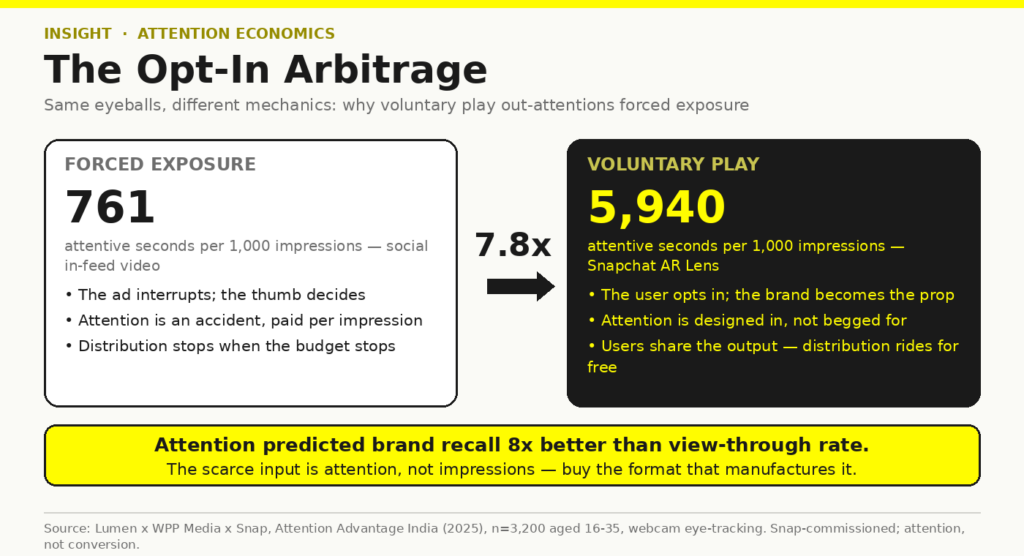
Here is the arbitrage: auctions still price Lenses largely as inventory, while the format manufactures attention and distribution the auction does not charge full price for. Buyers who understand the mechanism are, in effect, purchasing an underpriced input.
The catch is that the arbitrage only holds while the experience stays voluntary and worth sharing. Bolt a hard sell onto a Lens and you have rebuilt the interruption you were escaping — at premium prices. The scarcity was never screen time. It was willingness. Formats that earn willingness will keep outperforming formats that interrupt it, on any platform that figures this out.