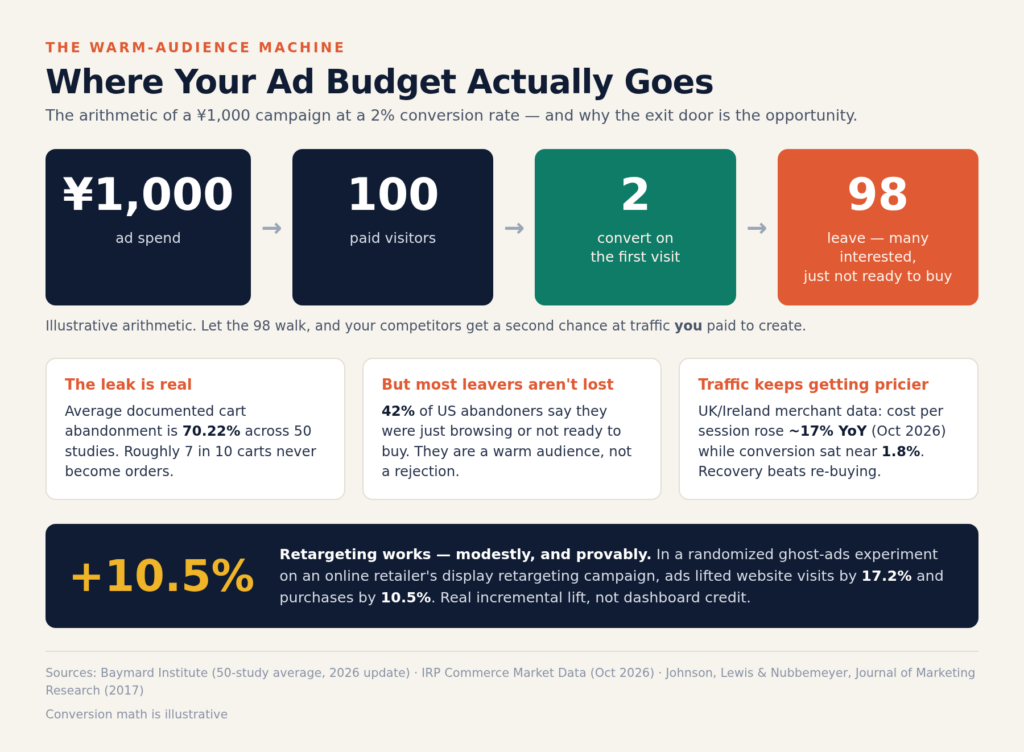
Here’s a piece of arithmetic that should keep every performance marketer awake. You spend ¥1,000 on ads. At ¥10 a click, that buys 100 visitors. Your site converts at 2% — which, as we’ll see, is generous — so two people buy. The other 98 leave. Roughly ¥980 of the traffic you paid for walks out the door, and a real chunk of those people weren’t rejecting you. They were interested but not ready: comparing prices, waiting for payday, checking with a spouse, or simply browsing the way people browse shops on a rainy afternoon.
Let them go, and you’ve done something quietly absurd: you paid to introduce 98 warm prospects to your category, then handed them to whichever competitor bids on them next.
This isn’t a small leak in a small market. The 2026 edition of China’s Internet Marketing Development Report, produced by the Zhongguancun Interactive Marketing Lab with the Miaozhen Marketing Science Academy and Beijing Normal University, puts the combined internet advertising and marketing market at about ¥1.6075 trillion for 2025, up 12.62% year over year — with roughly seven of every ten yuan flowing to the top platforms. The report’s diagnosis of the squeeze is blunt: traffic keeps getting pricier while conversion gets harder. When acquisition costs rise faster than conversion rates, recovering the visitors you already bought stops being a nice-to-have. It becomes the highest-leverage line in the budget.
This playbook covers the full stack: how to segment those 98 people by intent, how to run the plays on Baidu, Douyin and Tencent, how to stay on the right side of China’s privacy law, and — the part most retargeting guides skip — how to measure what your ads actually caused instead of what your dashboard claims.
Warm Beats Cold — but Not by the Numbers You’ve Been Sold
Let’s kill a myth before we build anything. You’ve seen the stats: retargeted ads get ten times the click-through rate of standard display; retargeted visitors are 70% more likely to convert. Trace those numbers back and you land on a vendor infographic from 2014 that the content industry has been recycling with fresh date stamps ever since. They’re marketing folklore, not measurement.
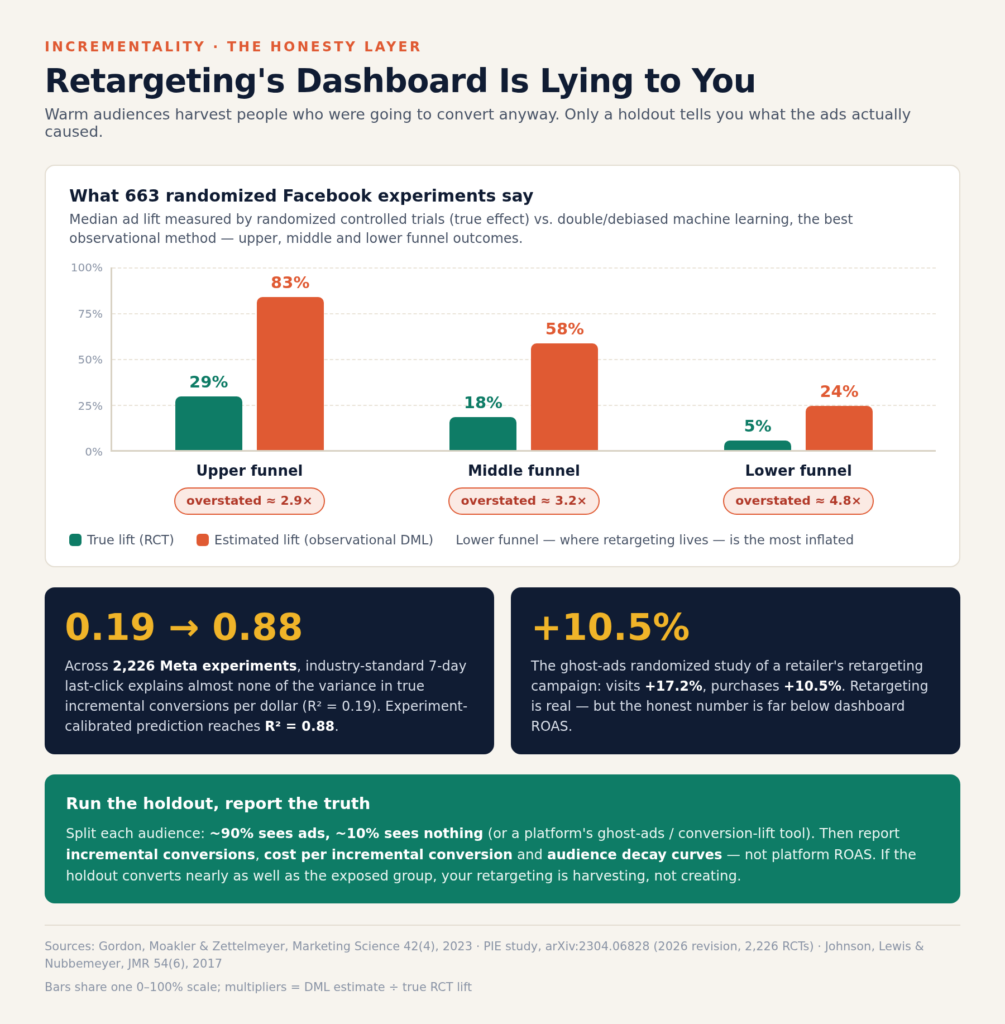
The honest evidence is better than folklore, because it’s causal. In a randomized experiment on an online retailer’s display retargeting campaign — published in the Journal of Marketing Research by Johnson, Lewis and Nubbemeyer, the researchers behind the ghost-ads methodology — retargeting lifted website visits by 17.2% and purchases by 10.5%. Not 300%. Not 10x. Ten and a half percent more purchases than an equivalent group that saw no ads.
Does that sound underwhelming? It shouldn’t. That’s incremental revenue on traffic you already paid for, measured against a true counterfactual, in a category where most “lift” is imaginary. And the baseline you’re working with is real: IRP Commerce’s first-party trading data from UK and Irish B2C merchants shows conversion rates sitting under two in a hundred sessions (1.83% in October 2026) while cost per session rose roughly 17% year over year. Different market, same physics as China’s squeeze: you’re paying more for each visitor and converting a sliver of them.
The asset you’re monetizing is baseline awareness. A warm visitor already knows who you are and roughly what you sell. The trust-building cost is partially sunk. Your job is to finish the conversation, not restart it — and to do that, you need to know where each person left off.
One boundary before we proceed: every number above is a directional benchmark from someone else’s data. Your baseline must be measured first. If you don’t know your own conversion rate by channel and device, fix that before you spend a yuan on retargeting.
The Stack: Three Primitives Before Any Campaign
Retargeting runs on three primitives, and every platform in China implements all three under different names.
Tracking. Platform-native event collection: Baidu Analytics on your site, Ocean Engine’s Event Manager for Douyin campaigns, data-source connections in Tencent’s DMP. The events that matter are the rungs of intent: page view, product view, CTA click, form submit, add to cart, purchase. If your tracking only fires on the thank-you page, you can’t retarget anyone who didn’t convert — which is the entire audience.
Audience lists. Rules that turn events into targetable pools: everyone who visited in 30 days, everyone who viewed a product page but not the cart, everyone who filled a form but never paid. Narrower rules mean higher intent and smaller pools.
Identity matching. Connecting your first-party data to platform users. In the post-PIPL, post-IDFA world, the durable version of this is hashed, consented first-party identifiers — phone numbers, WeChat OpenIDs — matched inside the platform. Probabilistic cross-app fingerprinting is the kind of thing that generates regulatory headlines, not returns.
Get these three right and the campaigns are configuration. Get them wrong and no amount of creative genius saves you.
The Intent Ladder: Segment First, Message Second
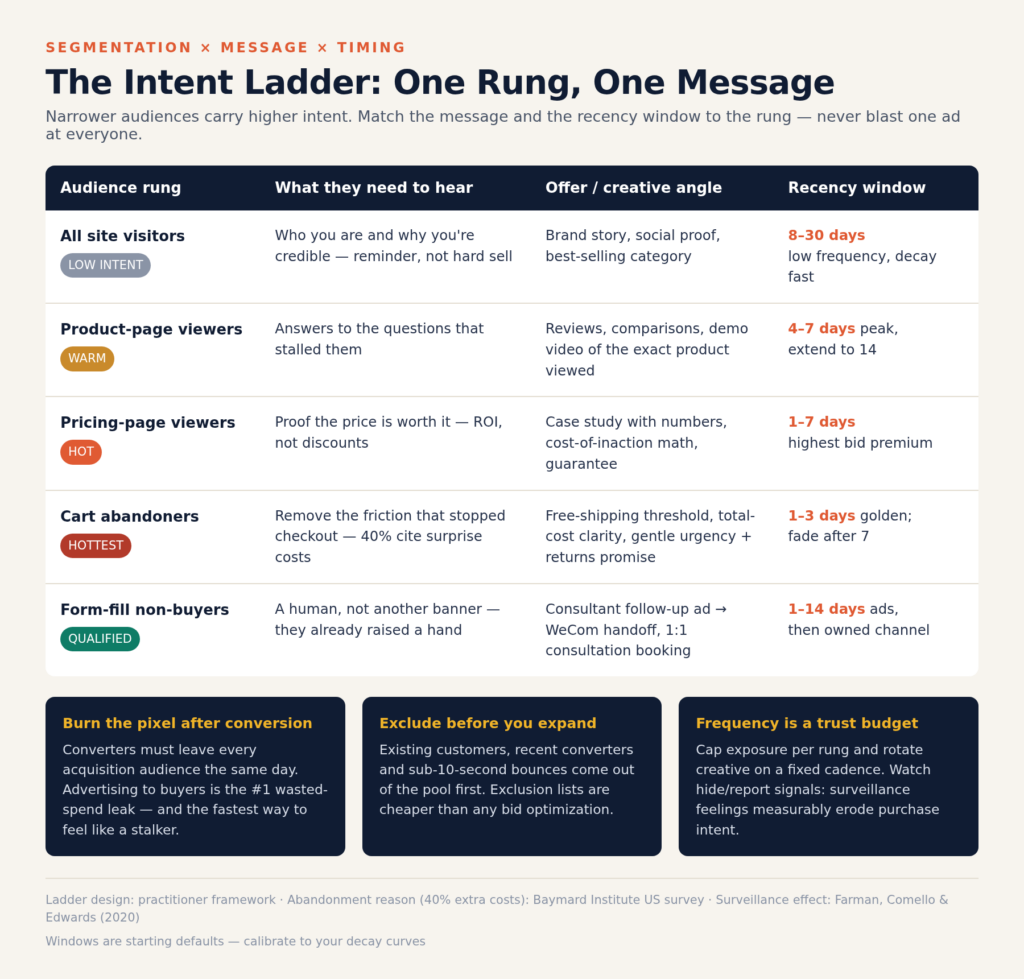
The most common retargeting failure isn’t technical. It’s treating “visited my site” as one audience. A person who bounced off your homepage in eight seconds and a person who priced your product three times this week are not the same prospect, and showing them the same 20%-off banner wastes money on one and insults the other.
Build a ladder instead. Each rung gets its own message, its own offer, its own recency window:
- All visitors get reminder creative — brand story, social proof, your best-known category. Low frequency, cheap bids.
- Product-page viewers get answers to whatever stalled them: reviews, comparisons, a demo of the exact product they viewed.
- Pricing-page viewers get proof the price is worth it. For B2B, that’s a case study with numbers and a cost-of-inaction argument — not a coupon. Someone reading your pricing page is doing math; help them finish it.
- Cart abandoners get friction removal. Baymard Institute’s meta-analysis of 50 studies puts average cart abandonment at 70.22%, and its US survey work found 42% of abandoners were just browsing — but among the rest, the top cited reason is surprise costs at checkout (40%). So the highest-converting cart-abandonment ad often isn’t an ad at all: it’s a free-shipping threshold, an all-in price shown early, a returns promise. Wrap that fix in gentle urgency and you have a campaign.
- Form-fill non-buyers get a human. They raised a hand. In China’s ecosystem the strongest play is an ad whose conversion event is adding your WeCom consultant — moving the conversation out of the auction entirely.
Recency Windows and the Decay Rule
Intent evaporates. A cart abandoner from yesterday and a homepage visitor from last month belong in different campaigns with different bids. As starting defaults — calibrate to your own decay curves — work cart abandoners hardest in days 1–3, product viewers in days 4–7, pricing viewers across the first week, and let the broad pool run 8–30 days at low frequency. Watch conversion rate by days-since-visit; when a cohort’s rate falls to your cold-traffic baseline, stop paying warm prices for it.
Exclusions: The Cheapest Optimization You’ll Ever Make
Three lists should exist before your first campaign launches: existing customers, recent converters, and sub-ten-second bounces. Converters must exit every acquisition audience the same day they convert — advertising discounts to people who just paid full price is the number-one wasted-spend leak in retargeting, and it trains your best customers to wait for coupons. Baidu’s search platform supports converter exclusion windows out of the box, from same-day to six months; on Douyin and Tencent you build the exclusion from purchase events or uploaded order lists. Exclusion lists cost nothing and routinely beat bid tuning for ROI.
Baidu: Buy Back the Search, Not Just the Banner
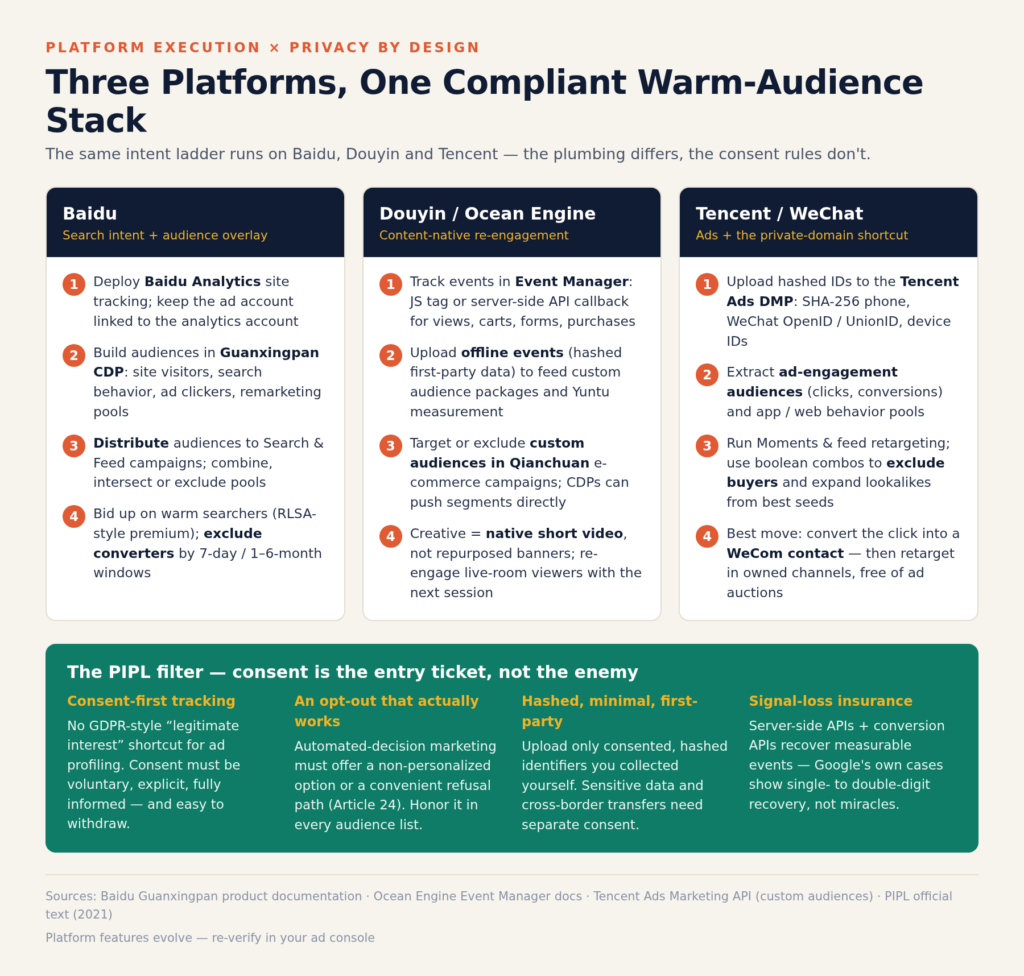
Baidu’s retargeting stack centers on Guanxingpan, its audience platform (cdp.baidu.com), which now manages the custom audiences for search campaigns. You build pools there — site visitors tracked via Baidu Analytics, search-behavior audiences, people who clicked your ads, remarketing segments — then distribute them to Search and Feed campaigns, combining, intersecting or excluding pools with an audience calculator.
The highest-intent play is the search overlay, China’s answer to RLSA: when a past visitor searches your category again, bid up. This is qualitatively different from a display banner chasing someone around the web. The user is raising their hand a second time, in your category, with a query. Layer your warm audience on top of your existing keywords, apply a bid premium for the pool, and let the smart-bidding system flex within it. Keep your strongest audiences at the front of the binding order — Baidu’s own product guidance says ordering matters for delivery.
One operational quirk worth knowing: migrated legacy audiences carry a three-month validity and need renewal; audiences actively serving auto-renew. Audit expiry dates monthly, because a silently expired pool looks exactly like a demand collapse in your reports.
Douyin: Retarget With Content, Not Banners
On Ocean Engine, the plumbing lives in Event Manager — the successor to conversion tracking. It manages your assets (landing pages, apps, mini-programs) and the events they emit, collected either by JavaScript tag or server-side API callback. Its offline-events module accepts hashed first-party data uploads that feed custom audience packages, Yuntu measurement and modeling. Qianchuan, the Douyin e-commerce ad platform, targets and excludes those custom audiences directly, and CDPs can push segments into it programmatically.
The strategic point is creative. Douyin is a content environment; a repurposed banner retargeting ad reads as an interruption and gets swiped. The native play is a short video that answers the hesitation your event data reveals — an unboxing for product viewers, a founder explaining the pricing for pricing-page viewers, a livestream clip for cart abandoners. If you run live commerce, your live-room viewers are a built-in warm audience: re-engage them with the next session’s preview instead of letting the relationship die between streams. Treat each retargeting video as the second episode of a story the user already started watching.
Tencent: The Ad Is the Bridge, WeCom Is the Destination
Tencent’s DMP accepts hashed first-party identifiers — SHA-256 phone numbers, WeChat OpenIDs and UnionIDs, device IDs — plus audiences extracted from ad engagement and connected app or web behavior. You can expand lookalikes from your best seeds, combine pools with boolean logic, and use everything directly in delivery across Moments and Tencent’s feed inventory. The WeChat ecosystem also supports remarketing to people who already follow your official account or added your WeCom contacts — warming the warm, essentially.
But the strongest Tencent play isn’t better ad targeting. It’s graduation. In most ecosystems, retargeting means renting the same person from the auction again and again. In WeChat, a retargeting click can become a WeCom contact — and from that moment, your follow-ups travel through owned channels at zero media cost. For high-consideration purchases and B2B, design the retargeting ad’s conversion event as the WeCom add, then run the nurture sequence in one-to-one chats and communities. The ad is the bridge; the private domain is the destination. That’s the structural advantage global platforms can’t copy.
Privacy Is the Design Constraint, Not the Enemy
Here’s the plot twist most retargeting content still hasn’t absorbed: the cookie apocalypse was canceled. In April 2025 Google announced Chrome would keep its existing third-party cookie approach, and in October 2025 it retired ten Privacy Sandbox technologies — including Topics and Protected Audience — citing low adoption. The web’s tracking substrate didn’t disappear; the replacement project did.
In China, that headline is a distraction, because the binding constraint was never cookies. It’s the Personal Information Protection Law, in force since November 2021, and it changes retargeting design in four concrete ways.
Consent is the entry ticket. PIPL Article 13 lists the lawful bases for processing, and there is no GDPR-style legitimate-interest shortcut for ad profiling. Consent must be voluntary, explicit and fully informed (Article 14), with a convenient withdrawal path. Practically: your tracking notice must actually say you do personalized advertising, and your audience uploads must contain only people who agreed to marketing use.
The opt-out must work. Article 24 requires that automated-decision marketing offer either a non-personalized option or a convenient way to refuse. Honor refusals inside every audience list, not just in the app settings screen. Penalties for serious violations reach ¥50 million or 5% of prior-year turnover — this is not a checkbox exercise.
Hashed, minimal, first-party. Sensitive personal information needs separate consent (Article 29), and cross-border transfers need it too (Article 39) — which matters if your CDP sits outside China. Upload hashed identifiers you collected yourself; never purchased lists.
Server-side is insurance, not absolution. Conversion APIs and server-side tagging recover events that browser restrictions eat. Google’s own published case study — vendor data, note the interest — reports enhanced conversions adding 3% more measured Search conversions and 20% on YouTube for retailer MandM Direct. Real, single-to-double-digit recovery. But server-side plumbing doesn’t launder unconsented data; it just delivers it more reliably.
Meanwhile the platforms keep lowering the activation bar: in December 2025 Google cut minimum audience sizes to 100 active users across Search, Display and YouTube. Small, consented, precise lists are now a viable strategy almost everywhere — and in China they’re the only kind that’s legitimately yours. Compliance isn’t the enemy of performance. It’s the filter that separates an asset from a liability.
Frequency: The Stalker Threshold Is Real
Every retargeting program has a hidden liability: the moment helpful persistence reads as surveillance. This is measured, not vibes. In a controlled study published in the Journal of Broadcasting & Electronic Media (Farman, Comello and Edwards, 2020; 280 participants — a lab study, so treat magnitudes cautiously), behaviorally targeted ads raised purchase intent directly but simultaneously triggered perceived marketing surveillance, which flowed through threat and psychological reactance into worse ad attitudes and lower purchase intent. The targeting that helps you also arms the mechanism that hurts you.
Operate accordingly. Cap frequency per rung — hottest audiences tolerate more touches because the message is more useful; broad pools should see you rarely. Rotate creative on a fixed cadence so the fourth impression isn’t the first impression wearing a trench coat. And monitor negative signals — hide rates, report rates, comment sentiment on Douyin — as leading indicators. When they spike, your audience isn’t fatigued; it’s alarmed. Pull frequency down before the trust you’re monetizing burns off, because baseline awareness, once soured, is expensive to rebuild.
Measurement: Your Retargeting Dashboard Is Lying
Now the uncomfortable part. Warm-audience campaigns harvest people who were going to convert anyway, and platform reporting happily takes the credit. This is the best-documented failure in advertising measurement. Across 663 randomized Facebook experiments analyzed in Marketing Science (Gordon, Moakler and Zettelmeyer, 2023), true median ad lifts were 29%, 18% and 5% for upper-, mid- and lower-funnel outcomes — while the best observational method, double/debiased machine learning, estimated 83%, 58% and 24%. Overstatement by roughly three to five times, and the lower funnel — where retargeting lives — is where honest lift is smallest and reported lift is most inflated. The follow-up PIE study, spanning 2,226 Meta experiments, found industry-standard seven-day last-click attribution explains almost none of the variance in true incremental conversions per dollar (R² of 0.19), while experiment-calibrated prediction reaches 0.88.
So run the holdout. Split each audience: roughly 90% sees your retargeting, 10% sees nothing (or use the platform’s conversion-lift/ghost-ads tooling, which implements exactly this logic). Then report three numbers: incremental conversions, cost per incremental conversion, and the decay curve by audience age. If your holdout converts nearly as well as your exposed group, your campaign is harvesting, not creating — cut budget or fix the message. The ghost-ads researchers showed this measurement can be done an order of magnitude cheaper than old-school split tests. There’s no longer an excuse for reporting dashboard ROAS as if it were profit.
The 14-Day Launch Checklist
- Days 1–3 — Tracking audit. Verify every intent event fires on every platform you’ll use; test server-side callbacks; confirm consent notices cover personalized advertising and opt-outs propagate to audience lists.
- Days 4–6 — Ladder build. Create the five rung audiences plus the three exclusion lists. On Baidu, build in Guanxingpan and distribute; on Ocean Engine, configure Event Manager assets and offline feeds; on Tencent, connect data sources and upload hashed pools.
- Days 7–10 — Creative per rung. One message per rung, native to its platform. Fix the checkout friction your cart-abandoner ads promise to remove — otherwise you’re advertising a lie.
- Days 11–14 — Launch with holdouts. Every audience splits exposed/unexposed from day one. Set frequency caps, schedule creative rotation, and define the incremental-conversion report before spend starts, not after the first flattering dashboard screenshot.
The Bottom Line
The 98 who left aren’t lost revenue; they’re unfinished conversations you already paid to start. Segment them by where they stopped talking, answer that specific hesitation on the platform where they spend time, keep the whole machine consented and hashed and capped — and measure what you caused, not what you claimed. Do that, and retargeting stops being the creepy banner economy and becomes what it should have been all along: the warm-audience machine, the highest-ROI lever in a market where every new visitor costs more than the last.