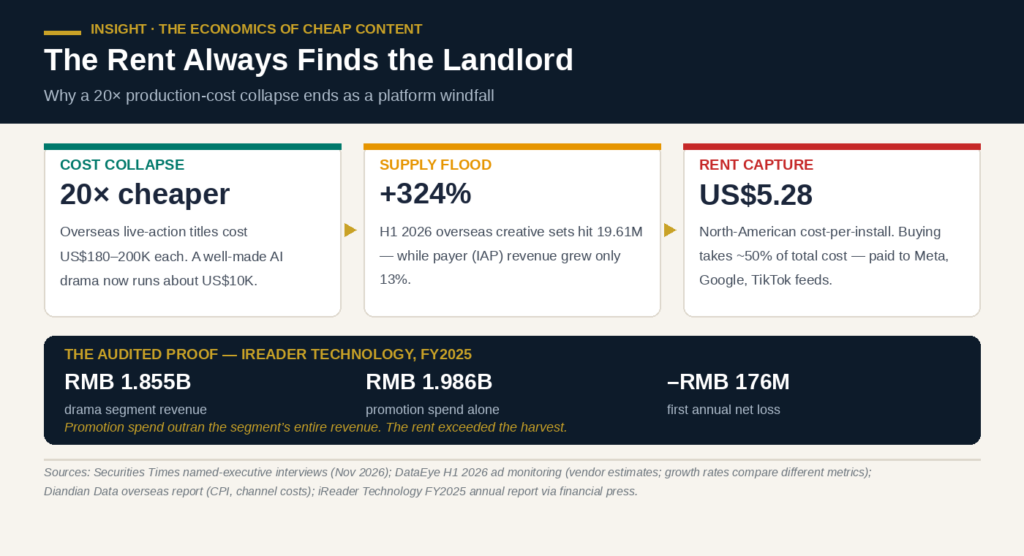
Here is a contradiction that should bother you. Making an overseas short drama got roughly twenty times cheaper in a year — from US$180,000–200,000 per live-action title to about US$10,000 for a well-made AI drama, per named executives interviewed by Securities Times in November 2026. Yet producers say they are losing more money than before. How does a twenty-fold cost cut make an industry poorer?
The Economist Who Explains Your Ad Budget
Two centuries ago, David Ricardo noticed that when grain prices rose, farmers did not keep the gains — landlords raised rents until the surplus landed in their pockets. The lesson generalizes: when one input becomes cheap and abundant while another stays fixed and scarce, competition transfers the savings to whoever owns the scarce input.
In the short-drama pipeline, production was never the land. Attention is the land — the finite feed inventory inside Meta, Google, and TikTok, which absorb roughly 65%, 20%, and 10% of overseas short-drama ad spend, per Diandian Data. Studios are tenant farmers; the platforms are the landlords. AI just handed every tenant a twenty-times-better plow.
Watch the Rent Move
The mechanism runs in three steps. The cost floor collapses, so entry explodes: DataEye counted 19.61 million overseas ad creative sets in H1 2026, up 324% year over year. Every entrant bids for the same fixed pool of eyeballs — payer revenue grew only 13% — so the auction price per viewer climbs. The savings flow straight into the landlords’ fees: North American cost-per-install has reached US$5.28, and media buying eats about half of total overseas cost. The plow got cheaper; the rent got dearer.
The Audit That Proves It
You do not have to take a vendor’s word for it. iReader Technology’s 2025 annual report shows short-drama segment revenue of RMB 1.855 billion, up 139% — and promotion spending alone of about RMB 1.986 billion, 95.5% of selling expenses. The rent exceeded the harvest. The company posted its first annual loss since its 2017 IPO: RMB 176 million. That is a tenant farming at a loss so the landlord can post record revenue.
Why Nobody Can Stop Farming
Why not walk away? Because each bet stays individually rational: a US$10,000 title plus a traffic buy carries a small chance of a huge payoff, and quitting cedes the lottery to rivals. This is the rent-dissipation trap — free entry into a fixed-prize contest drives aggregate spending toward the prize’s value. The platforms need no malice; the tenants bid the rent up themselves, one campaign at a time.
What This Means If You Buy Ads
Three implications travel beyond short dramas. Do not book production savings as margin — assume the auction will claim them. Escape rent capture by owning land (first-party audiences, private domains, direct distribution) or growing a better crop (hooks, insight, and iteration speed that win the same auction at lower effective cost). And watch the rent line, not the production line: treat cost-per-acquisition as your true cost of goods. The drama was never the product. The savings were never yours.



