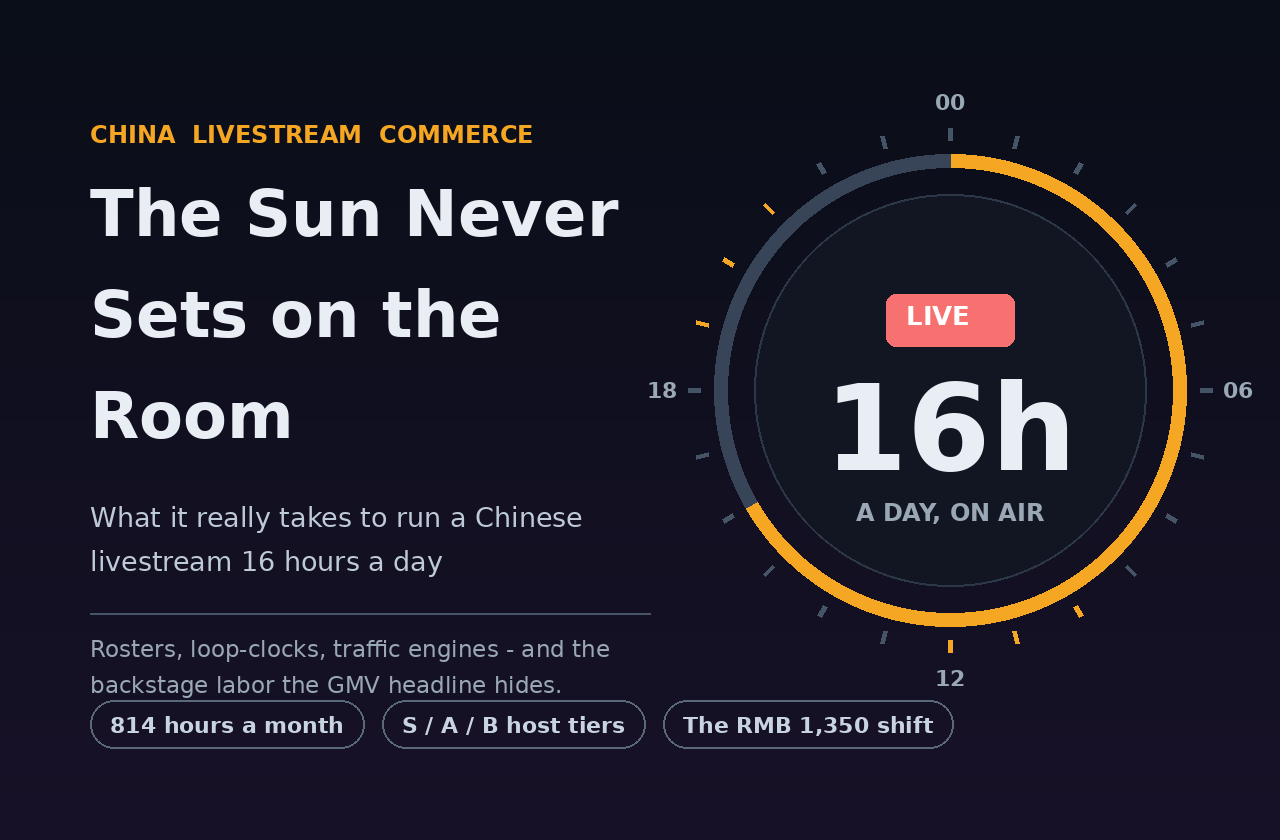
Somewhere in Shenzhen, a young woman sits down at a console behind a womenswear livestream. She checks every product link, every size chart, every stock count. Twelve hours later she stands up, settles the session, and collects RMB 1,350 — about 190 US dollars. She never appears on camera. The host gets the applause; she gets the spreadsheet.
Now multiply that shift across a roster, wrap it in a repeating five-minute sales script, feed it with a short video posted every hour, and you get one of the most misunderstood machines in global commerce: the Chinese livestream room that never closes. Operators call it the sun-never-sets room. Outsiders call it a stamina miracle. It is neither. It is a schedule.
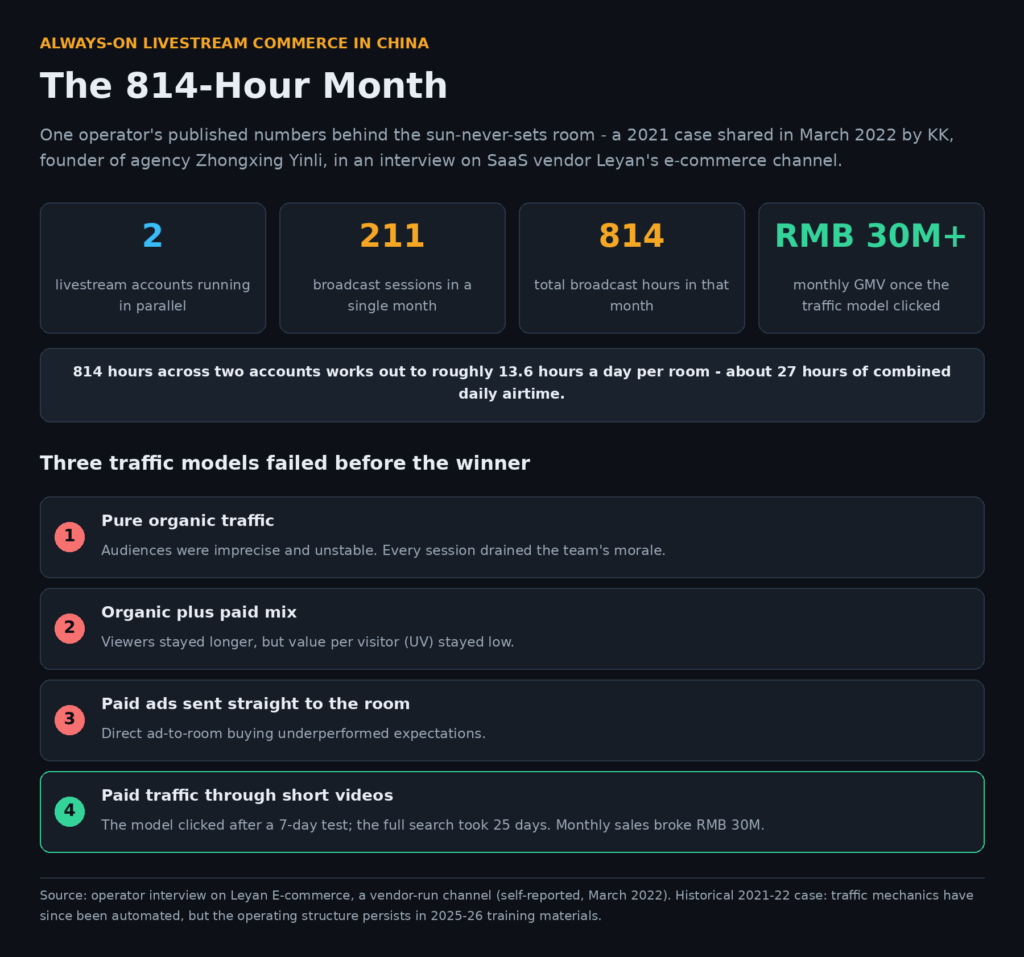
Here is the arithmetic that proves it. In one documented month, an agency called Zhongxing Yinli ran two livestream accounts through 211 sessions totaling 814 broadcast hours — roughly 13.6 hours a day per room, about 27 hours of combined daily airtime — and crossed RMB 30 million in monthly sales. But the numbers only worked after three other traffic models failed. That failure sequence is the real story, and almost nobody retells it.
This piece walks through how a 16-hour day actually gets built: the roster, the loop-clock, the traffic engine, the nightly debrief, the labor nobody photographs — and the synthetic night shift now arriving with a legally mandated label.
The Sun-Never-Sets Room, Defined
The term dates to September 2021, when Make Friends — the livestream company built around entrepreneur Luo Yonghao — announced it would run its Douyin room 7×24. Trade press at the time noted it was the first team on the platform to commit to round-the-clock broadcasting, and the nickname stuck. Co-founder Tong Wei told an industry conference that livestreaming is a business unconstrained by space or time, so the room should never close.
The logic was blunt: traffic arrives at 3 a.m. too, and an empty room wastes it. By 2022, with the era’s mega-hosts fading from view, the model spread across Douyin, Taobao and Kuaishou. Today the format is industrial. During the 2025 Singles’ Day festival, a livestream base in Qingdao’s Licang district ran 62 rooms around the clock with more than 700 hosts rotating through them, serving appliance giants like Haier, Hisense and Xiaomi. The base told local official media it had passed 500 million cumulative views by November 10, with sales up 60% year over year.
One room, many faces, zero dead air. That is the product. Everything below is the factory behind it.
The 814-Hour Month: One Operator’s Arithmetic
Let’s go back to the case with published numbers. KK, founder of the agency Zhongxing Yinli, described the operation in a March 2022 interview on the e-commerce channel of Leyan, a customer-service SaaS vendor — a vendor-published, self-reported account, and a historical one from 2021-22. Treat it as a documented operating blueprint, not a current benchmark.
The setup: two brand accounts broadcasting almost around the clock, 211 sessions and 814 hours in a single month, monthly GMV beyond RMB 30 million. Impressive — until you read the sequence that produced it.
Three Traffic Models Failed First
KK’s team did not start with a winner. They started with losses:
- Pure organic traffic. Audiences were imprecise and unstable. Every session, in KK’s telling, drained the team’s will.
- Organic plus paid mix. Viewers stayed longer, but value per visitor stayed low. Dwell without conversion is just expensive company.
- Paid ads pointed straight at the room. Direct ad-to-room buying underperformed.
The breakthrough was the hardest road: paid traffic routed through short videos into the room. A seven-day test showed the model working — sales up, viewers up, value per visitor up. The full validation took 25 days. Only then did the month cross RMB 30 million.
Read that again slowly. The 814 hours were capacity. The validated short-video-to-room traffic model was the business. Teams that copy the hours without copying the validation are buying an empty theater and paying to keep the lights on.
The Roster: S Opens, A Converts, B Extends
How do you physically staff 16-plus hours a day without burning out one human? You stop hiring heroes and start grading shift resources.
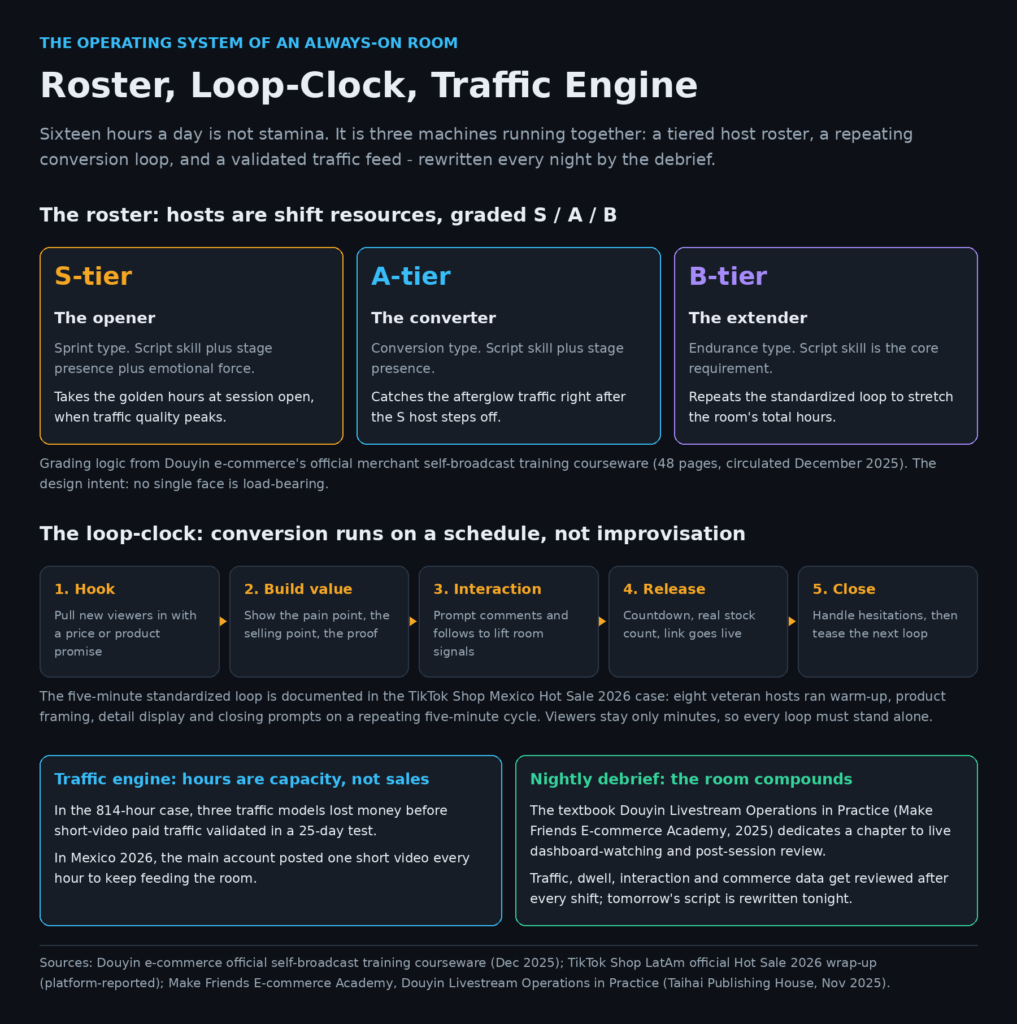
Douyin e-commerce’s official merchant self-broadcast training courseware — a 48-page deck circulated in December 2025 — lays out the tier system plainly:
- S-tier hosts are the openers. Sprint types, trained on script skill, stage presence and emotional force. They take the golden hours when a session opens and traffic quality peaks.
- A-tier hosts are the converters. Script plus presence. They catch the afterglow — the warm audience left behind when the S host steps off.
- B-tier hosts are the extenders. Script skill is the core requirement. They repeat the standardized loop, stretching total hours into the long tail of the night.
Notice what this design does: it makes the star replaceable. The system outlasts any face — which is exactly what Make Friends engineered when it pushed its founder’s share of company GMV below a third and kept dropping it. Industry scheduling guides built from analyzing 100-plus rooms recommend rotating hosts roughly every two hours and co-hosts every four, with a standby host for sick days. A 12-hour broadcast day typically means three hosts, two co-hosts and a floater. Six people so one room can look effortless.
The Loop-Clock: Conversion on a Timer
Walk into an always-on room at any minute and you will hear the same structure: hook, product story, proof, interaction prompt, countdown, release. Then it starts again.
This is not laziness. It is engineering for a brutal fact: viewers stay only minutes. Every loop must stand alone, because the person watching now arrived thirty seconds ago and will leave in two minutes. The five-minute standardized loop is documented in the freshest case we have — TikTok Shop’s official wrap-up of Mexico’s Hot Sale festival in mid-2026. Personal-care brand Wavytalk, working with agency LiveLab, ran an unbroken marathon of more than 200 broadcast hours, held an average of about 600 concurrent viewers, and cleared over 2,500 orders. Eight veteran hosts rotated on three shifts, each delivering the same five-minute cycle: warm-up, product framing, detail display, closing push.
The operations crew watched conversion and revenue-per-thousand-views metrics by the hour and adjusted. Platform rules matter here too: Chinese commerce platforms penalize fake countdowns and phantom stock, so the compliant version of the loop runs on real inventory and honest timers. The rhythm is manufactured; the scarcity must be real. And the loop is only as good as the roster member delivering it — which is why grading matters more than charisma.
The Traffic Engine: Hours Are Capacity, Not Sales
Here is the sentence to tattoo on the planning doc: hours do not sell; validated traffic sells.
In the 814-hour case, the room lost money on three traffic models before short-video paid traffic worked. In the Mexico case, the main account posted one short video every hour, all day, to keep feeding the room — the same short-video-to-room pipeline KK validated in 2021, now run like a metronome. Two cases, five years apart, one lesson: the broadcast schedule is downstream of the traffic plan, never the reverse.
Before you extend hours, run the cheap test. KK’s team found its answer in 25 days. What is your equivalent budget — and are you willing to fail three times inside it?
The Nightly Debrief: Why the Room Compounds
The machine has a memory. The textbook Douyin Livestream Operations in Practice, written by Make Friends’ e-commerce academy and published in November 2025, devotes a full chapter to dashboard-watching during the stream and structured review after it: traffic data, dwell data, interaction data, commerce data — then host performance, then content.
In practice the console operator logs anomalies all shift; after close, the team replays the tape against the numbers and rewrites tomorrow’s script. Shift handovers get special attention, because viewer counts dip when faces change, and the crew plans promotions to bridge the gap. A room that debriefs nightly is not repeating yesterday — it is compounding. A room that just stays open is merely tired.
The Labor the GMV Headline Hides
Back to Shenzhen. The woman at the console is Lin Xiaoxiao — real name Lin Zhaoxia — a 24-year-old who became nationally famous in 2025 when a three-minute job-interview video drew over 100 million views. In it, with a junior-high education and years of floor experience, she calmly pushed the offer higher — the employer’s trial-period base of RMB 8,000 plus a raise upon confirmation — and then turned even that improved job down, because building a brand-new account from zero felt too risky.
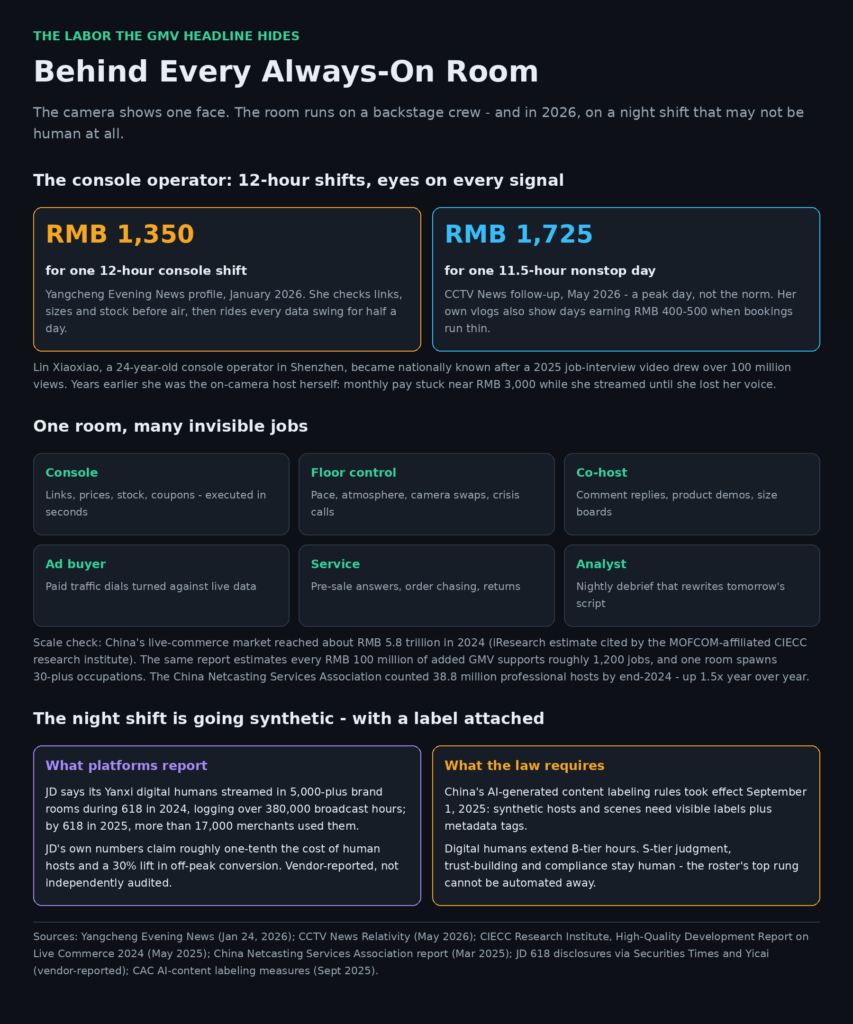
The Yangcheng Evening News profile from January 2026 describes her working day: seated, never relaxed, tracking viewer counts, comment rhythm and conversion curves while anticipating the host’s next line — switching links, flagging stock, patching mistakes within seconds. Twelve hours, RMB 1,350. A CCTV News follow-up in May 2026 caught a peak day: 11.5 nonstop hours, RMB 1,725. Her own vlogs also show slow days earning RMB 400-500. That is the honest range of gig work, not a salary legend.
Her earlier life is the part that should give pause. As an on-camera host in Guangzhou, she streamed until she lost her voice — and still earned barely RMB 3,000 a month, while a boss who valued the traffic called her in at night to cover shifts.
Dong Chenyu, a Renmin University researcher who has studied streamers since 2020 — including twelve months working as a floor controller across five entertainment-streaming rooms — argues that the industry’s real base is its vast backstage workforce, not its overnight-rich myths. His fieldwork focused on entertainment rather than commerce streaming, but the console profile above shows the same structure holding in e-commerce: the visible host is the output; the invisible crew is the machine. On July 31, 2024, China’s labor ministry formally recognized online host as an official occupation — a small bureaucratic sentence standing on tens of millions of very long shifts.
The Numbers Behind the Marathon
Some scale context, from institutional rather than operator sources. The research institute of the China International Electronic Commerce Center, affiliated with the commerce ministry, put the 2024 live-commerce market at roughly RMB 5.8 trillion — an iResearch estimate the report adopts — close to 40% of national online retail. Its report estimates that every RMB 100 million of added GMV supports around 1,200 jobs, and that a single room spawns more than 30 occupations. The China Netcasting Services Association’s 2025 report counted 833 million livestream viewers and 38.8 million professional hosts by the end of 2024 — the host count up 1.5 times in a year.
The same association’s survey found 54.2% of respondents watch commerce streams frequently, and nearly half of all viewers have bought something after watching short videos or livestreams — most of those purchases unplanned. An always-on room is not a quirky channel tactic inside that system. It is the system’s standard unit of production: a storefront that catches demand the moment it forms, at 3 p.m. or 3 a.m.
The Synthetic Night Shift — With a Label Attached
The obvious question: can software take the graveyard shift? Increasingly, yes — for the B-tier hours.
JD reported that its Yanxi digital humans broadcast in more than 5,000 brand rooms during the 2024 mid-year festival, logging over 380,000 hours; by the 2025 festival, more than 17,000 merchants were using them. JD’s own figures claim roughly one-tenth the cost of human hosts and a 30% conversion lift in off-peak slots. Those are vendor-reported numbers selling a vendor product — directionally useful, not audited. Merchants interviewed by financial press have been more sober: digital hosts fill idle hours cheaply, but trust-building and distinctive content still belong to people.
And the night shift now comes with paperwork. China’s AI-generated content labeling measures, issued by four regulators, took effect on September 1, 2025: synthetic video and virtual scenes must carry visible labels plus metadata identification. An unlabeled digital host is not a growth hack; it is a compliance incident waiting to happen.
What Brands Should Actually Do
If you are tempted by the format, build it in this order:
- Validate the traffic model first. Run a time-boxed test of short-video-to-room paid traffic before committing to permanent hours. Budget for failure — the documented case failed three times.
- Write the loop before the roster. A five-minute standalone script anyone can deliver beats a brilliant host with no structure.
- Grade and rotate. Openers on golden hours, converters on the afterglow, extenders on the tail. Two-hour host rotations, standby coverage, planned handover bridges.
- Staff the backstage honestly. Console, floor control, co-host, ad buyer, service, analyst. Price those shifts into the model or the GMV headline is fiction.
- Debrief nightly or don’t bother. The compounding comes from the review, not the runtime.
- Use digital humans for the tail, labeled. Keep humans where judgment, trust and compliance live.
The Counterargument, and Its Limit
Fair objections exist. The founding case is from 2021-22; traffic mechanics have since been automated, and its GMV reflects that era’s cheaper attention. True — which is why the durable evidence here is the structure, still taught in official 2025 courseware and still visible in the 2026 Mexico case. Another objection: 16-hour days grind people down. The labor reporting agrees, unambiguously. The model is only sustainable with roster depth, honest shifts and real rest — fail that, and you are not running a broadcast operation, you are running attrition with a ring light.
The Bottom Line
A Chinese livestream running 16 hours a day is not a feat of endurance. It is a roster graded like a sports team, a script looped like a shift bell, a traffic engine validated like a lab experiment, and a debrief that turns each night into tomorrow’s edge. The documented 814-hour month worked only after three traffic models failed — and it ran on twelve-hour console shifts that the GMV headline never mentions. Copy the machine, not the miracle. And when the night shift goes synthetic, label it.