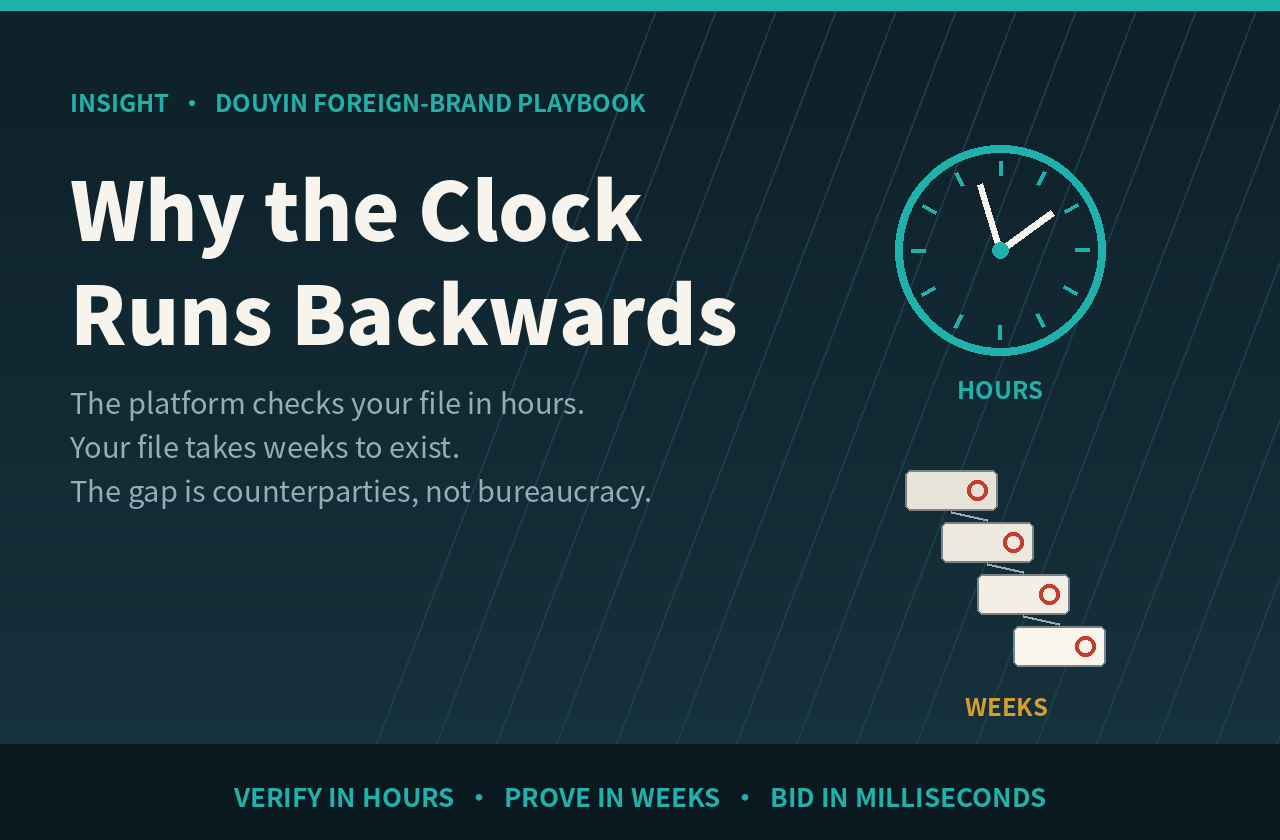
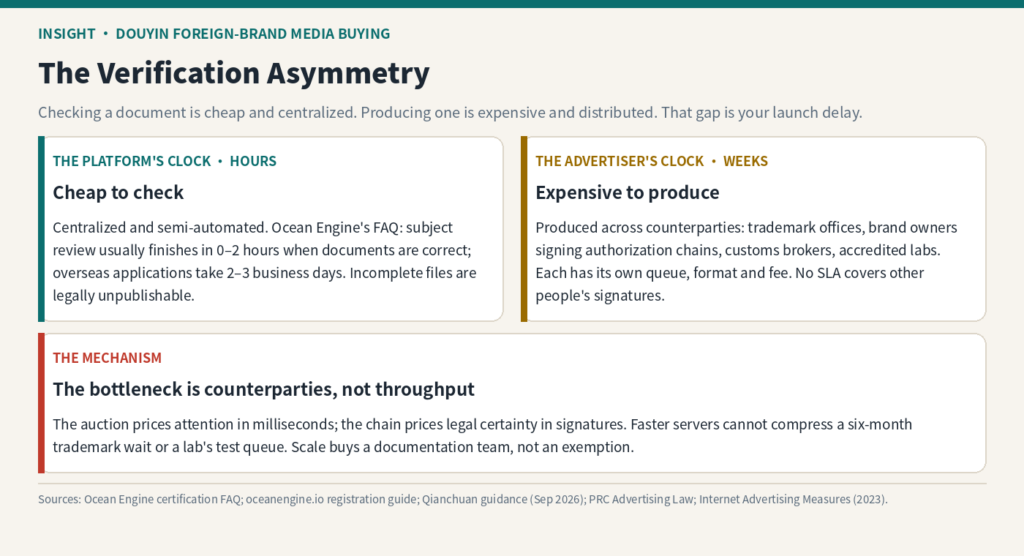
Here is a riddle hidden inside the platform’s own documentation. Ocean Engine’s certification FAQ says subject-qualification review usually completes within zero to two hours when the paperwork is correct. The official international route quotes two to three business days for overseas applications. Yet foreign brands routinely describe account readiness as a multi-week ordeal. Both things are true. The resolution is the insight: verification is cheap and centralized; evidence production is expensive and distributed. The bottleneck was never the platform’s throughput. It is the number of counterparties standing between you and a complete file.
Why Checking Is Nearly Free
Start with the platform’s side of the ledger. Checking a document is a solved, industrial problem: match the licence against the national credit registry, compare names across certificates, verify a seal, flag a missing attachment. The same checklist runs thousands of times a day, so it gets automated, staffed and fast. And the law gives the platform every incentive to make it fast and strict — China’s Advertising Law forbids publishing ads whose supporting documents are incomplete, and the 2023 Internet Advertising Measures require identity registration and three-year archives. A publisher that checks quickly and rejects cleanly is protecting itself. The hours-clock is real because checking is the platform’s core competency.
Why Proving Is Structurally Slow
Now your side. A complete qualification file is not written; it is manufactured, across organizations you do not control. The trademark registration certificate lives with a national trademark office whose timeline is measured in months — the platform’s own six-month threshold for pending marks quietly acknowledges this. The authorization chain requires a brand owner’s signature, and if any letter in the chain forbids sub-delegation, you must renegotiate, not resubmit. Customs declarations depend on importers and brokers. A UPF50+ claim needs an accredited lab’s test queue. Each counterparty has its own format, fee, legal department and holiday calendar. No SLA can cover other people’s signatures — which is why the platform publishes review times but never readiness times. It cannot.
The Mechanism, Stated Plainly
Douyin runs two clocks by design. The auction prices attention in milliseconds. The qualification chain prices legal certainty in signatures. Faster servers compress the first clock and do nothing to the second. This explains three otherwise puzzling observations at once: why “open an account in days” is both officially true and practically misleading; why big brands seem to skip the queue (they don’t — they employ people whose entire job is compressing counterparty latency); and why the smartest operational move is a claim-evidence library, which converts distributed production into centralized reuse.
The takeaway for a foreign brand: stop optimizing the step the platform already made fast. Map your counterparties, start their clocks first, and treat the qualification chain as a supply chain — because that is exactly what it is.