Ask a media buyer where the reach is, and they’ll point you to the short-video feeds. Ask where the belief is — the kind that survives a comment section, a two-week deliberation and a price comparison — and in China, a surprising number will point you to Bilibili.
That distinction is the whole story. Bilibili’s creator economy runs on a different unit than Douyin or Xiaohongshu. It doesn’t sell views by the truckload. It sells trust by the minute: long-form videos, made by creators the audience calls UP-masters, watched by people who came to decide something. A phone upgrade. A car. A career pivot. And after years of losses, the machine built on that trust finally printed money — which makes now the right moment to understand how it actually works, and how brands should buy into it without breaking it.
We’ll walk through the numbers, the marketplace where deals get done, the three pockets a creator earns from, and a five-move playbook you can lift straight into your next China brief.
A Profitable Platform Changes the Conversation
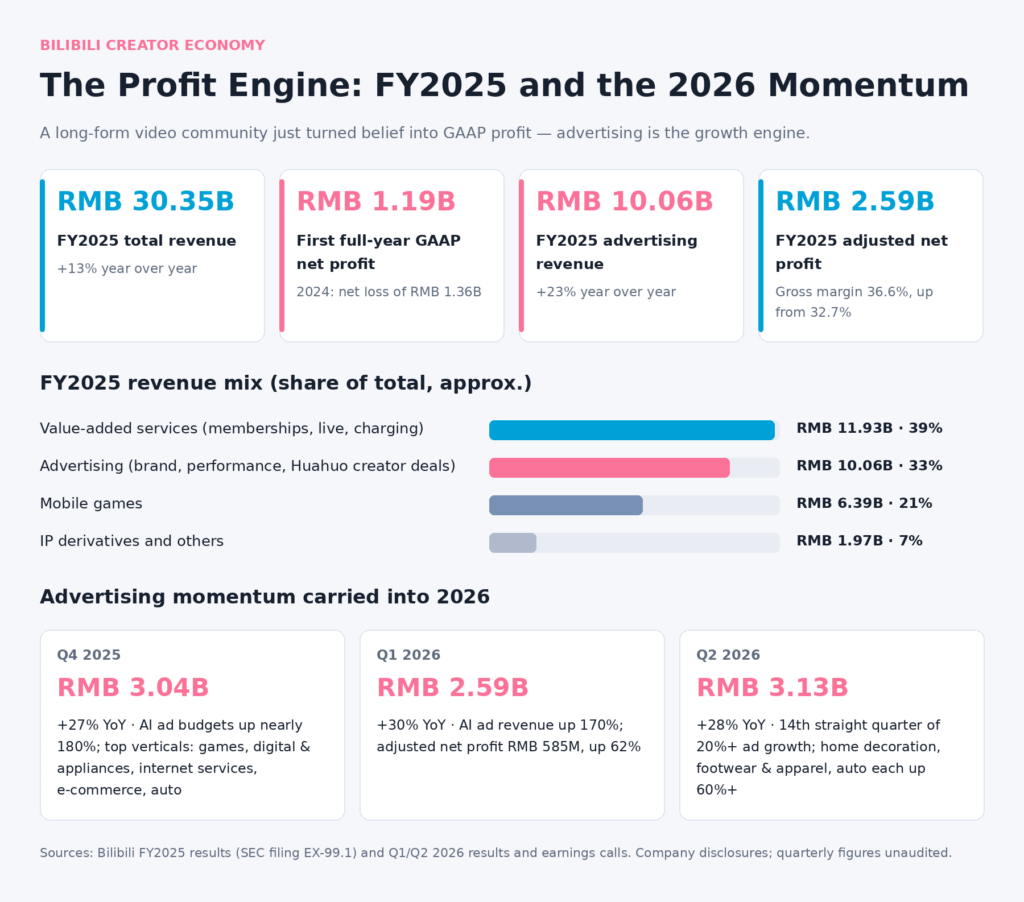
For most of its history, Bilibili was the beloved money-loser of Chinese internet culture. Not anymore. In fiscal 2025, the company posted total net revenues of RMB 30.35 billion, up 13% year over year, and its first full year of GAAP profitability: net profit of RMB 1.19 billion, against a net loss of RMB 1.36 billion in 2024. Adjusted net profit reached RMB 2.59 billion, and full-year gross margin climbed to 36.6% from 32.7%.
What paid for the turnaround? Advertising. Ad revenue hit RMB 10.06 billion in 2025, up 23%, roughly a third of the total and the fastest-growing major line. In the fourth quarter alone, advertising grew 27% to RMB 3.04 billion, while daily active users reached 113 million and average daily time spent rose 8% to 107 minutes. Read those two numbers together and you see the bet: more engaged minutes, monetized more precisely, without torching the community that produces them.
The Momentum Didn’t Stop at New Year
Skeptics called 2025 a one-off. The next two quarters disagreed. In Q1 2026, advertising grew 30% to RMB 2.59 billion, and adjusted net profit rose 62% to RMB 585 million. In Q2, ad revenue grew another 28% to RMB 3.13 billion — the fourteenth consecutive quarter of 20%-plus ad growth. Growth broadened beyond games and gadgets: home decoration, footwear and apparel, and automotive advertising each grew more than 60% year over year as the platform’s young users aged into mortgages, wardrobes and family cars.
The company’s own framing is blunt: its users are maturing, and advertisers are following them up the consideration ladder. Keep that ladder in mind — it explains everything about how creator deals are priced.
Meet the UP-Master: Three Pockets, One Job
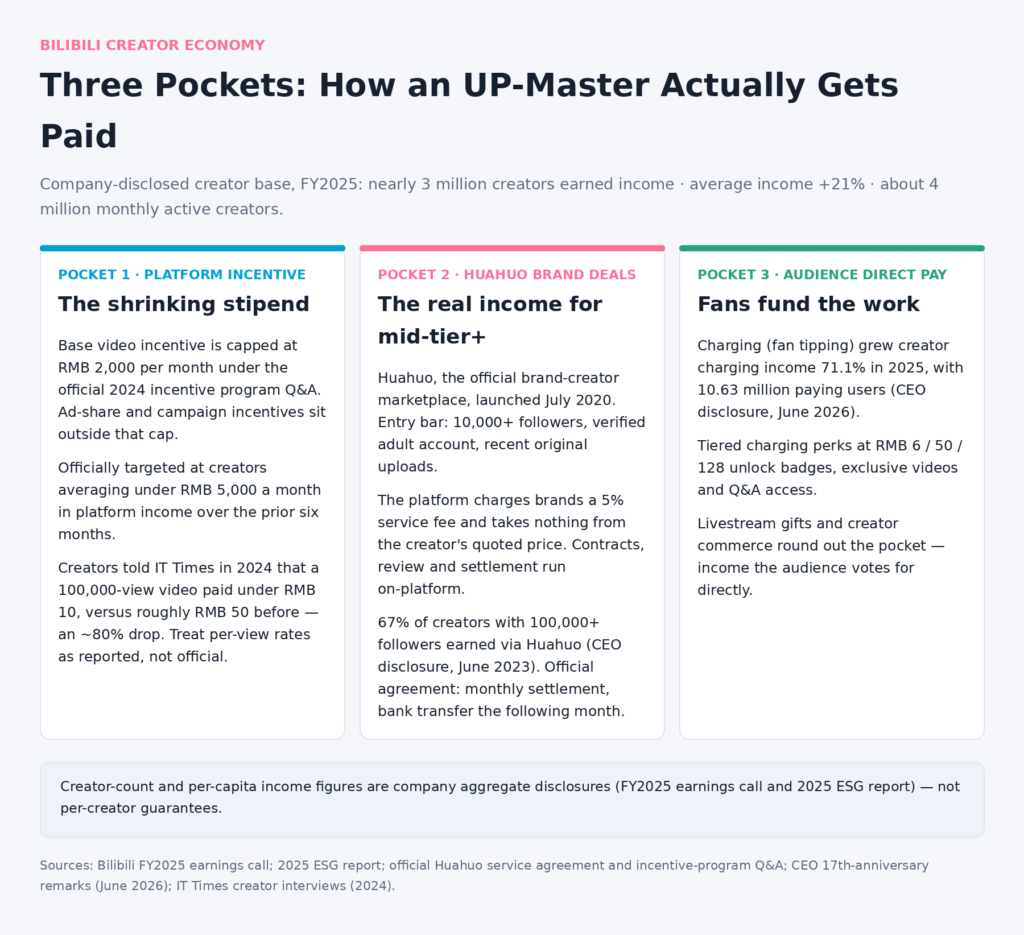
The creator base is the supply side of this economy, and it’s bigger than most Western marketers assume. Per Bilibili’s FY2025 disclosures and its 2025 ESG report, about 4 million creators are active monthly, nearly 3 million earned income during the year, and per-capita creator income grew 21%. The counts of creators at the 10,000, 100,000 and million-follower tiers each grew about 20%; the pool above 1,000 followers expanded more than 30%.
But “earned income” hides a brutal distribution. To understand who thrives and who quits, follow the money into its three pockets.
Pocket One: The Shrinking Stipend
The platform’s creation-incentive program pays creators for original, non-commercial videos. It was never meant to be a salary, and the official rules make that explicit: under the 2024 program Q&A, the base video incentive is capped at RMB 2,000 per month, and it’s aimed at creators whose platform income averaged under RMB 5,000 a month over the prior six months. Ad-share and campaign bonuses sit outside that cap, but the direction of travel is clear — the subsidy era is over.
Creators feel it. In 2024 interviews with IT Times, UP-masters described a 100,000-view video earning under RMB 10, versus roughly RMB 50 for similar content before the rules changed — about an 80% drop. Those are creator-reported figures, not official rates; Bilibili has never published a per-view payout table, and you should distrust anyone who quotes you one with decimal-point confidence. But the sentiment is documented and widespread: for small and mid-tier creators, the stipend is consolation, not income.
Pocket Two: Brand Deals Do the Heavy Lifting
For anyone above roughly 10,000 followers with a commercial vertical, the real money is the brand deal — and on Bilibili, brand deals flow through Huahuo, the official creator marketplace we’ll unpack in a moment. This is the pocket that funds teams, equipment and the two-week deep-dive video that makes the audience trust you in the first place.
Pocket Three: The Audience Pays Directly
The fastest-growing pocket is the most emotional one. Charging — Bilibili’s fan-tipping system, with perk tiers at RMB 6, 50 and 128 unlocking badges, exclusive videos and Q&A access — grew creator charging income 71.1% in 2025, with 10.63 million users paying, per CEO Rui Chen’s June 2026 anniversary disclosure. Add livestream gifts and creator commerce, and you have a pocket where the audience votes with its wallet. When a fan pays RMB 50 to support a reviewer, that’s not charity. It’s a subscription to credibility — and it’s exactly the asset brands are renting.
Huahuo: The Marketplace Where Trust Gets Priced
Huahuo launched in July 2020 as the official bridge between brands and UP-masters: standardized contracts, script review, escrow-style settlement, data dashboards. The economics are creator-friendly by design. The platform charges brands a 5% service fee and takes nothing from the creator’s quoted price. Entry requires at least 10,000 followers, a verified adult account and recent original uploads.
Over time, the side door was welded shut. From October 2022, creators above 100,000 followers must route commercial deals through Huahuo; from November 2023, that rule extended to video deals for creators above 10,000 followers. Private off-platform deals risk throttling and penalties. Settlement follows the official service agreement: monthly, by bank transfer the following month.
How deep does the marketplace run? In June 2023, Chen disclosed that 67% of creators with 100,000-plus followers had earned income through Huahuo — a dated figure, but a telling one: for the professional tier, this isn’t a side channel, it’s the channel. And brands stick around. In Huahuo’s first year, official disclosures put brand sign-ups up 2,050% year over year with a 75% brand re-order rate. Treat that 2021 number as directional history, not a current benchmark — but note what it says about the product: depth keeps re-selling itself.
Why Vertical Trust Outprices Raw Reach
Here’s the pricing logic that confuses buyers raised on CPM. Huahuo generates system reference quotes from audience and performance data, but the market’s real variable isn’t follower count — it’s the precision of belief. A 30,000-follower reviewer whose audience genuinely waits for his camera verdicts can command more than a 300,000-follower comedy account whose viewers came for the jokes and leave before the pitch.
So experienced buyers audit differently: comment-section quality, audience purchasing power, upload consistency, and how natural the creator sounds when speaking a sponsor’s name aloud. Formats range from fully custom videos to integrated segments, spoken endorsements and hands-on reviews — priced by production effort and fit, not a follower-multiplier formula. If a vendor hands you a neat equation for what an UP-master “should” cost, smile and ask for the comment sections instead.
One underrated signal: in 2023 Bilibili replaced public play counts with accumulated watch minutes. The platform literally changed its scoreboard from clicks to time — the same trade brands are making.
The Long-Form Advantage: Content That Keeps Working
Feed ads are fireworks: bright, loud, gone. A good Bilibili integration is a lighthouse. Because the platform behaves like a search engine and a library — people arrive with questions and binge back-catalogs — a well-made review keeps surfacing in search and recommendations for months, quietly converting deliberating buyers long after launch week.
The infrastructure increasingly proves it. In Q4 2025, ad revenue from search, PC and TV-screen scenarios grew more than 60% year over year, with some scenarios above 200%. Campaigns optimized for deeper conversions grew over 40%. And under the open-loop e-commerce strategy, the Xinghuo program with Taobao/Tmall (2023) and Jinghuo with JD (October 2023) pipe creator-driven conversions back to brand storefronts — so “the video worked” is becoming a measurable sentence rather than a matter of faith.
The Community Vets the Ad for You
There’s a QA layer money can’t buy: danmaku, the flying comments that scroll across the video itself, plus a famously forensic comment culture. If an integration is lazy or dishonest, the audience annotates it in real time. If it’s genuinely useful, viewers timestamp it, defend it, and link it to friends who are mid-decision. Your ad gets peer-reviewed by the exact people you’re targeting. Brief accordingly.
The Brand Playbook: Five Moves
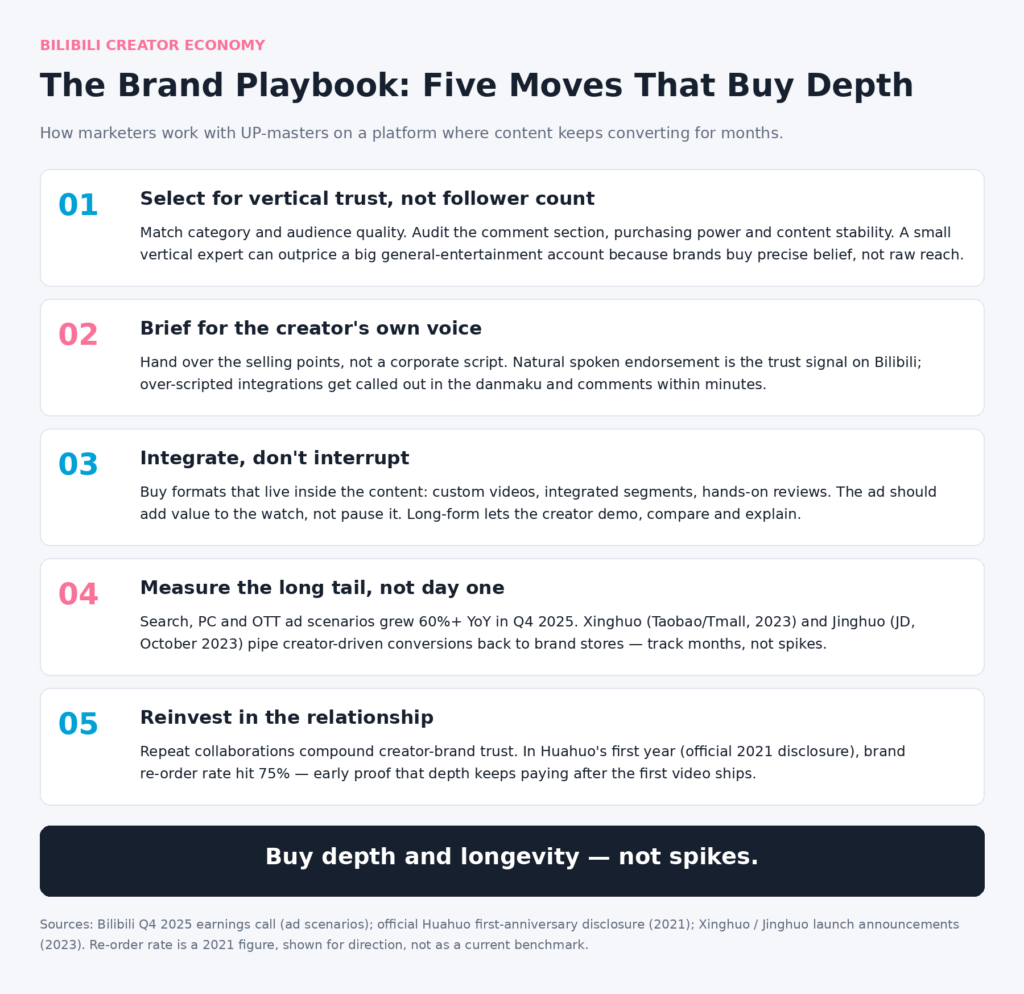
Move one: select for vertical trust, not follower count. Match category and audience quality first. The small expert beats the big entertainer for considered purchases — that’s the entire pricing logic of this platform in one sentence.
Move two: brief for the creator’s voice. Hand over selling points, demo units and hard constraints; leave the script alone. Over-scripted reads get flagged by the community within minutes, and the creator’s credibility — the thing you’re paying for — is the collateral damage.
Move three: integrate, don’t interrupt. Buy formats that live inside the content. The best Bilibili ads add value to the watch: the teardown that explains why the battery lasts, the road trip that happens to be sponsored. Long-form gives you room to demonstrate, compare and concede flaws — and a conceded flaw sells harder than a claimed perfection.
Move four: measure months, not spikes. Wire up Xinghuo or Jinghuo attribution before launch, then track search-driven views and conversions across a quarter. Judging a Bilibili integration by day-one ROI is like judging a lighthouse by its first ship.
Move five: reinvest in the relationship. Repeat collaborations compound: the creator learns your product, the audience learns to expect you, and the second video converts better than the first. One-offs are transactions; partnerships are assets.
The Honest Caveats
The Squeeze Is Real
A profitable platform doesn’t automatically mean prosperous creators. The incentive cuts pushed mid-tier UP-masters into a cost squeeze that Chinese tech media has documented since 2024 — production costs of thousands of RMB per video against shrinking baseline payouts, with brand deals the only reliable bridge. Coverage in 2026 described waves of mid-tier creators pausing updates. The ecosystem is K-shaped: commercial verticals like digital, automotive, beauty and knowledge keep attracting budgets, while beloved-but-unmonetizable genres — meme remixes, pure comedy — struggle. For brands, the practical lesson is uncomfortable but simple: pay fairly and promptly. You are renting an asset the platform is under-maintaining.
The Pause-Ad Test
In April 2026, Bilibili began showing pause-page ads on mobile — probabilistic, below the player, closable. Creators can switch them off, but the official notice ties the revenue to their incentive earnings, so opting out costs them money. Users revolted; commentators accused the platform of outsourcing its commercialization guilt to creators; the stock rose about 6% in the week after the announcement. Both reactions are true at once, and that tension is the platform’s core risk. Every new ad surface taxes the trust your campaign depends on. Watch the community’s temperature, not just the earnings deck.
What to Watch Next
Three threads deserve your attention. First, AI money: AI-related ad budgets grew nearly 180% year over year in Q4 2025, 170% in Q1 2026, and AI advertiser revenue more than doubled in Q2 — Bilibili’s tech-savvy audience is where AI products go to find early adopters, and AI-content watch time itself grew 53%. Second, the macro: broker previews ahead of the Q3 2026 report, scheduled for November 24, cluster around 20% ad growth with consumer budgets softening — the trust premium holds up better in a downturn than raw reach does, but nobody is immune. Third, the creation tools: AIGC lowers production barriers and floods feeds with sameness, which — counterintuitively — raises the scarcity value of a human voice the audience already believes.
The Takeaway
Bilibili turned belief into a P&L line. Behind FY2025’s first annual profit sits a marketplace that prices vertical trust over raw reach, creators whose audiences fund them directly, and content that keeps converting for months. Buy depth, brief for the native voice, integrate without interrupting, measure the long tail, and treat creators as partners rather than inventory. The platform’s own scoreboard already switched from clicks to minutes. Your media plan should make the same trade: on Bilibili, you’re not buying views. You’re buying the reason someone finally decides.