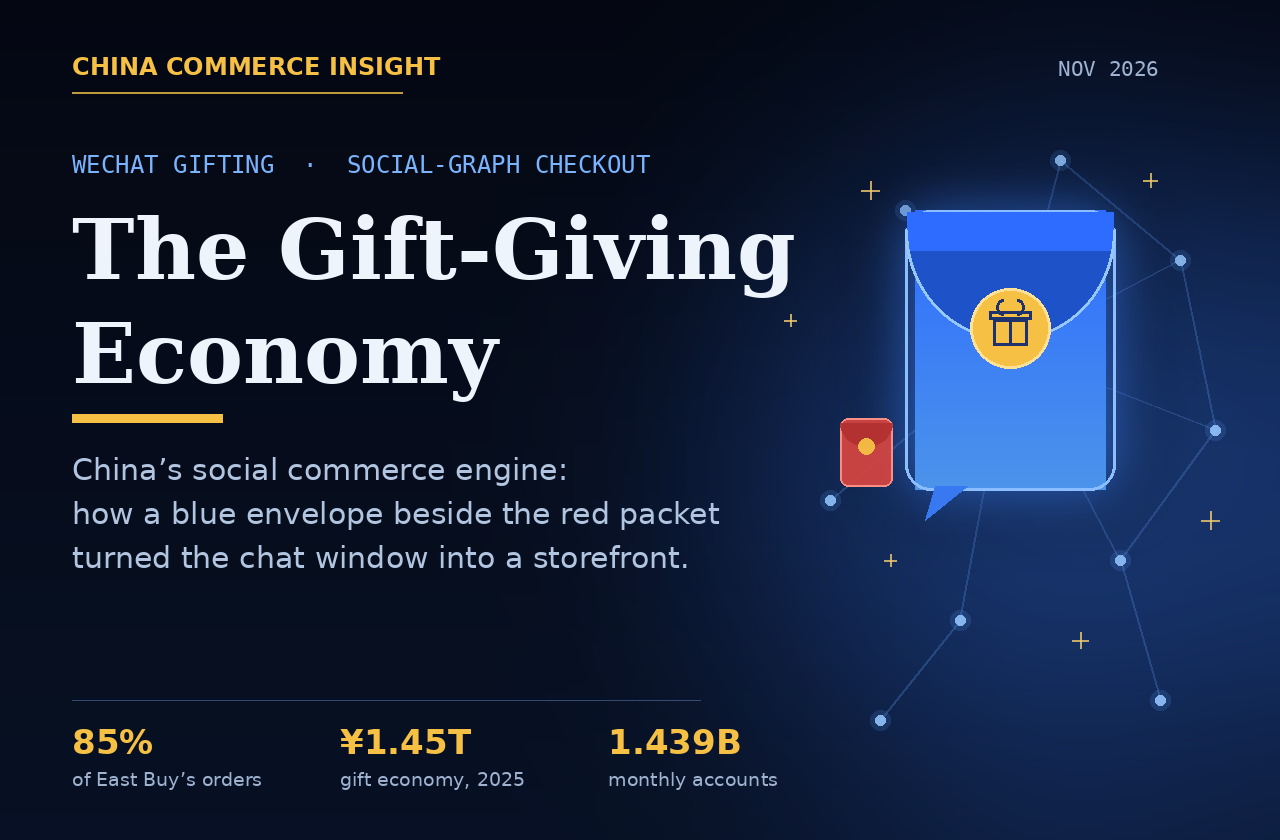
China has quietly bolted a checkout onto its social graph. WeChat’s gifting feature — the blue envelope that now sits beside the red packet in the chat window — lets a sender pay for a product and deliver it like a message, while the recipient supplies the shipping address and lands in the merchant’s store as a brand-new customer. The pattern is no longer theoretical: gifting drove 85% of East Buy’s WeChat store orders by early 2025, and daily gift orders jumped roughly four-fold during the 2026 Spring Festival. Underneath sits a gift economy that iiMedia Research sizes at about ¥1.45 trillion in 2025. The engine is real but deliberately slow — Tencent still refuses to disclose absolute GMV — so the winning move for brands is to design for the gift, not the cart.
A Blue Envelope Beside the Red One
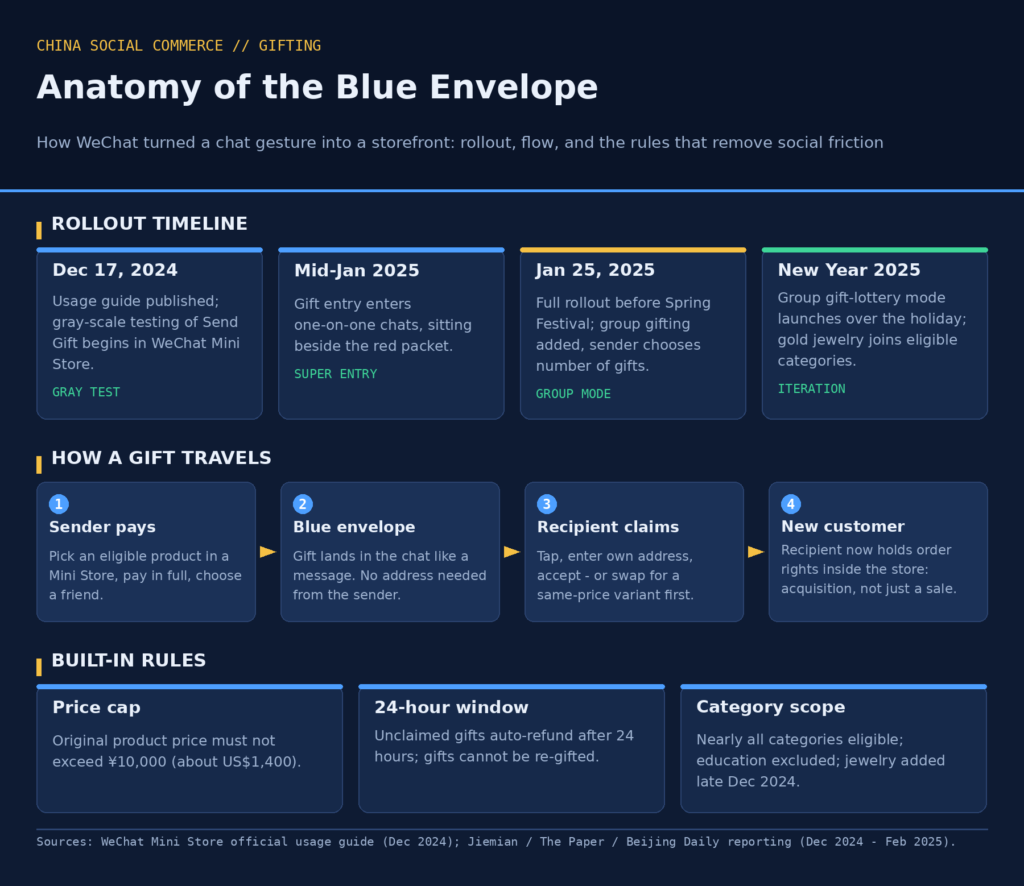
The rollout shows how methodically Tencent built this. On December 17, 2024, WeChat Mini Store published a usage guide for a new “Send Gift” function and began gray-scale testing; within two days the news had moved markets, sending WeChat-commerce concept stocks surging. By mid-January 2025 the gift entry appeared inside one-on-one chats, right next to the red packet — arguably the most valuable real estate in Chinese consumer internet. On January 25, days before Spring Festival, the feature rolled out to all users and expanded into group chats, where one sender can buy multiple gifts and let group members claim them. A group gift-lottery mode followed over the New Year holiday.
The mechanics are deceptively simple. You pick an eligible product, pay, and the gift arrives in your friend’s chat as a blue envelope. They tap it, enter their own address, and accept — or swap it for a same-price variant first. Unclaimed gifts refund automatically after 24 hours. Gifts cannot be re-gifted, and the eligible pool covers nearly everything except education products, capped at an original price of ¥10,000 (roughly US$1,400); jewelry, excluded at launch, joined the test before the year ended.
Notice what disappeared: the awkward address request, the size guessing, the returns drama. The social friction of gifting was engineered out; the social pleasure — the surprise, the ritual — was kept.
The ¥1.45 Trillion Backdrop
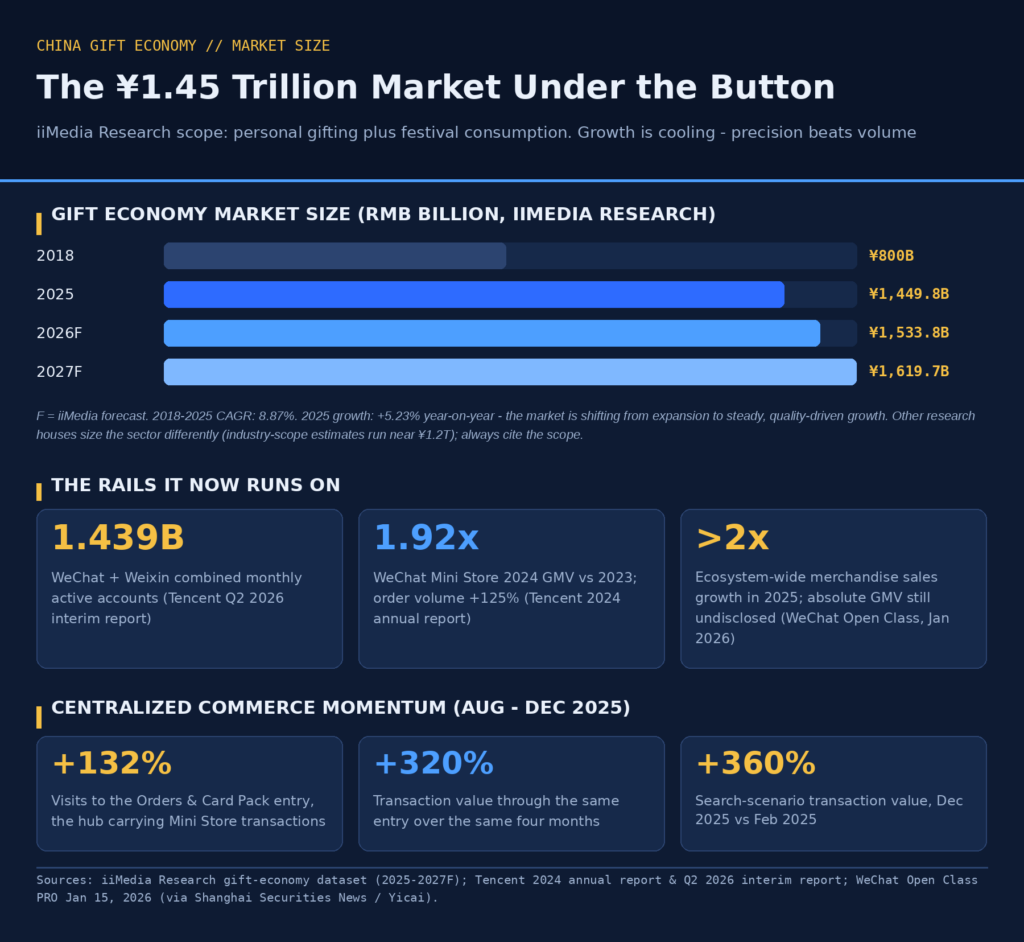
Why bother? Because gifting in China is not a niche seasonal behavior — it is infrastructure for relationships. iiMedia Research, a major Chinese consumer-data firm, estimates the country’s gift economy grew from ¥800 billion in 2018 to about ¥1.45 trillion in 2025, an 8.87% compound annual pace, and projects roughly ¥1.53 trillion in 2026 and ¥1.62 trillion in 2027. One caveat: research houses draw the boundary differently, so treat this as iiMedia’s scope (personal gifting plus festival consumption). The more useful signal is the curve’s shape — growth has cooled from double digits to around 5% a year, shifting the market from selling more gifts to selling better-chosen ones.
Meanwhile, the distribution layer is already built. Tencent’s Q2 2026 interim report put combined WeChat and Weixin monthly active accounts at 1.439 billion. Nobody downloads anything new: the storefront, the payment rail and the social graph are the same app.
Four Mechanisms That Make Gifting Pure Social Commerce
Strip away the festival packaging and the feature is a machine with four moving parts, each breaking an assumption Western social commerce takes for granted.
The Buyer Is Not the User
In ordinary e-commerce, the payer is the consumer. Gifting splits them apart: the sender buys a relationship outcome — gratitude, affection, face — while the recipient experiences the product. Your product page must persuade someone to give, not to own. East Buy’s store lead told Beijing Daily that higher-ticket items with emotional value and festive meaning win in gifting scenarios. Fruit dominated the brand’s top five gifted products.
Distribution Is the Social Graph
A gift travels through a chat thread or a group, not through a recommendation feed. That means zero paid acquisition for the impression that matters most — a trusted friend handing you a product. East Buy’s team described shifting from search optimization, livestream seeding and ad buying to chain reactions between users. When one purchase triggers a dozen claims in a family group, the acquisition math echoes the 2014 red-packet playbook that turned WeChat Pay into a national habit overnight.
Every Recipient Is a Potential Customer
Here is the part marketers should underline: to accept a gift, the recipient opens your Mini Store, enters an address, and gains order-management rights. A person who never shopped your store is now inside your private-domain machinery, with a completed transaction and a warm association. East Buy moved to link its app membership with WeChat store purchases precisely to convert recipients into retained members. The gift is the ad, the checkout and the loyalty enrollment in one gesture.
Gift-Worthy Beats Luxurious
A December 2024 research note from Soochow Securities — broker estimates, not platform data — found domestic beauty brands moving fastest into the channel, counting roughly 352,000 units sold via Kans’s WeChat store and 217,000 via Chando, while several international prestige brands had no self-operated store at all. The analysts’ framing is worth quoting in spirit: the branding opportunity is being “gift-worthy,” which does not mean expensive. It means appropriate — beauty sets, snacks, small appliances, standardized products that carry meaning without carrying risk. Spring Festival data confirmed it at the cheap end: snacks, candy and chocolate, and plush toys were the holiday’s hottest gift trio.
What the Numbers Actually Show
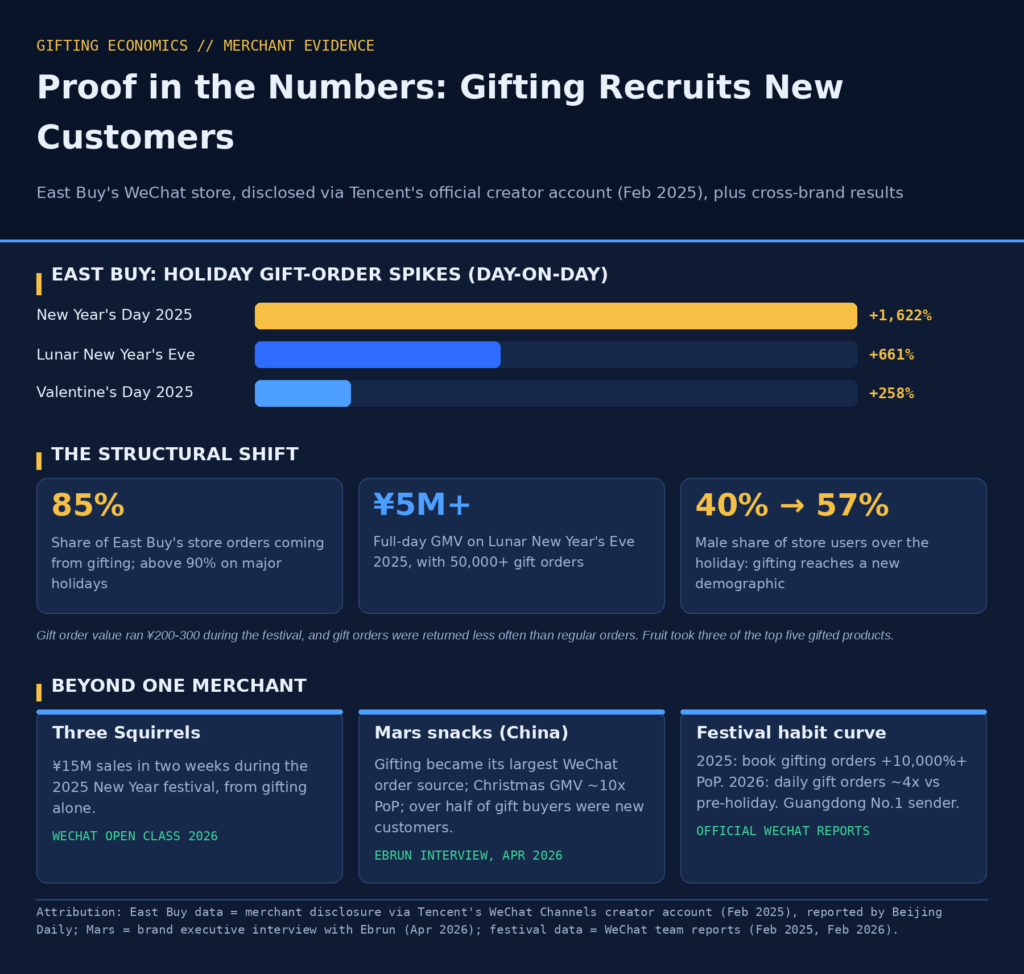
The cleanest evidence comes from East Buy, the education-company-turned-retailer whose WeChat store became the breakout merchant. On January 20, 2025, the company disclosed, single-day sales passed ¥1 million — 80% of it from gifting. In late February 2025, Tencent’s own WeChat Channels creator account published the holiday curve: gift orders on New Year’s Day rose 1,622% versus the previous day; on Lunar New Year’s Eve the store logged more than 50,000 gift orders, up 661% day-on-day, with full-day GMV above ¥5 million; Valentine’s Day added another 258% jump.
The structural numbers beat the spikes. Gifting reached 85% of total orders, exceeding 90% on major holidays; average gift order value ran ¥200–300. Male buyers rose from 40% of users to 57% over the holiday — gifting recruits the demographic content commerce struggles to reach. Gift orders were also returned less often than regular orders — a quiet boost to unit economics.
Zoom out and the platform trend agrees. Tencent’s 2024 annual report, released in March 2025, said WeChat Mini Store GMV reached 1.92 times the 2023 level, with order volume up 125%, and named the gifting feature as an innovation growth point for merchants. Early trials pointed the same way: media reports credited Luckin’s packaged-coffee line with over 10,000 single-day sales of a ¥19.9 coconut-latte gift set in late December 2024 — media-reported, not a company filing, but consistent across outlets.
Spring Festival Was the Stress Test
WeChat’s 2025 Spring Festival report, covering New Year’s Eve through day five, showed Guangdong, Shandong and Zhejiang as the top gift-receiving provinces — with gifts reaching Xinjiang and Tibet. The dark horse was books: gifting orders for classics and parenting encyclopedias grew more than 10,000% period-on-period. The blue envelope did not just move snacks; it made “send your nephew a book” a normal act.
A year later, the 2026 report showed the habit compounding: daily gift orders jumped around four-fold versus the pre-holiday period, and Guangdong topped the nation in both red packets and blue envelopes sent. Two consecutive festivals, same direction, bigger base — habit formation, visible in platform data.
The Engine Runs Year-Round
If gifting only worked at Spring Festival, this would be a seasonal promotion. The 2026 evidence says otherwise. In an April 2026 interview with e-commerce outlet Ebrun, the e-commerce head of Mars’s snacks business in China said gifting had become the largest order source on its WeChat channel: Christmas gifting GMV grew roughly ten-fold period-on-period, the New Year shopping festival doubled it, and more than half of gifting buyers were new customers. Smaller occasions work too: Teacher’s Day mints were a hit.
Tencent’s January 2026 Open Class PRO added another: snack giant Three Squirrels generated ¥15 million in two weeks during the 2025 New Year shopping festival using gifting alone. Birthdays, thank-yous, apologies, housewarmings — the relationship calendar never stops, and every date now has a checkout attached.
Everyone Can Copy the Button. Nobody Can Copy the Graph.
Taobao shipped its own gifting feature to all users on January 8, 2025, with a thoughtful design: a shareable token plus a four-digit security code, a 24-hour claim window, same-price variant swaps, and the ability to send gifts through WeChat, DingTalk or even SMS. On paper, it is more flexible than WeChat’s version.
But flexibility is not the moat. Taobao must borrow the social graph — its gifts travel as links that recipients paste back into a shopping app. WeChat’s gifts never leave the conversation where the relationship lives. It is the same asymmetry that decided the red-packet wars: a payment feature inside a social app beats a social feature inside a payment app. Copying a code between apps versus one tap in the family group — that friction gap compounds with every festival.
The Counterarguments Deserve a Fair Hearing
Skeptics have real material. At Tencent’s January 2025 staff meeting, Pony Ma asked outsiders not to over-hype the feature: WeChat intends to spend five years or more becoming an e-commerce “ecosystem connector” — slow work, fine products. Tencent even withdrew its “blue packet” trademark applications that month. And when a leaked set of meeting minutes circulated in December 2024 claiming explosive early numbers — 300 million whitelisted users, nearly ¥400 million GMV — Tencent’s PR chief Zhang Jun publicly dismissed the commercial plans as rumor. Those viral figures are unverified; this article deliberately does not use them.
The caution extends to disclosure. At the January 2026 Open Class, WeChat said ecosystem-wide merchandise sales more than doubled in 2025, brand-merchant GMV grew at 4.3 times the platform’s pace, and the Orders & Card Pack entry saw visits rise 132% and transaction value 320% from August to December 2025 — yet still no absolute GMV. Growth multiples without a denominator invite skepticism — fair enough.
Two more objections: gifting might cannibalize self-purchase, and brands are renting WeChat’s graph, not owning it. Mars’s majority-new-customer gifting, East Buy’s lower return rates and male-user expansion suggest incrementality, not substitution. Platform dependence is real, which is why the playbook below insists on converting recipients into owned relationships. The engine is Tencent’s; the relationships you earn through it can be yours.
The Checkout Goes Offline: Macau’s Gift Codes
The most underrated development happened offline. On November 28, 2025, backed by Macau’s Economic and Technological Development Bureau, the Macau Livestreaming Association and Tencent opened the first offline WeChat gift experience store near Senado Square, aggregating souvenirs from more than 20 local merchants. Tourists scan a product’s gift QR code, pay, and send Macau treats to friends back home as blue envelopes — no shopping bags, no customs friction. Orders are placed in Macau and fulfilled from a warehouse across the border in Zhuhai, a “front store, back warehouse” model.
Context matters: Macau drew over 30 million visitor arrivals in the first ten months of 2025, more than 70% from the mainland. If the gift code becomes as standard in souvenir shops as the payment QR code, gifting stops being a feature and becomes a physical retail rail.
The Brand Playbook: Design for the Gift, Not the Cart
What should a marketer actually do on Monday? Five moves, in order.
- Audit your catalog for gift-worthiness. Would a reasonable person send this to a colleague, a parent, a friend — at this price, in this packaging, with this meaning? Standardized, low-risk, emotionally legible products win. If the answer is no, create gift SKUs rather than discounting self-use ones.
- Open the store and join the gift zones. Run a WeChat Mini Store, enable gifting on eligible SKUs, and enroll in the platform’s seasonal gift zones, which now run through Spring Festival, Valentine’s Day and Women’s Day. Write gift-facing copy: who it is for, what occasion it fits, what it says about the sender.
- Engineer the unboxing ritual. The blue envelope is the ritual’s first act; your packaging is the second. Festive presentation, a card, a reveal worth filming — the recipient’s delight is your next acquisition channel, because delighted recipients become senders.
- Merchandise the whole relationship calendar. Build occasion pages for birthdays, thank-yous, apologies, Teacher’s Day, housewarmings — not just the two mega-festivals. East Buy runs dedicated gifting zones segmented by recipient; copy that structure.
- Convert recipients into owned relationships. A claimed gift is a warm lead with an address. Follow with membership enrollment, service-account subscription and private-domain invitations — the compliant, value-first kind. The sender paid for the product; the recipient is the asset.
Conclusion: The Storefront Is a Relationship
Strip the story to one sentence: in China, the social graph has become the checkout, and the gift is its native currency. The blue envelope industrializes a behavior — relationship maintenance through presents — that predates every platform involved. The verified data shows real merchant economics, real demographic expansion and a two-festival habit curve; Tencent’s restraint reminds us the absolute scale remains unproven. Both things are true. The winners will not wait for GMV disclosure — they will design gift-worthy products, build the social-graph checkout, and treat every recipient as the beginning of a relationship. The cart asks “what do you want to buy?” The gift asks “who do you want to be to someone?” That second question has a much bigger market.