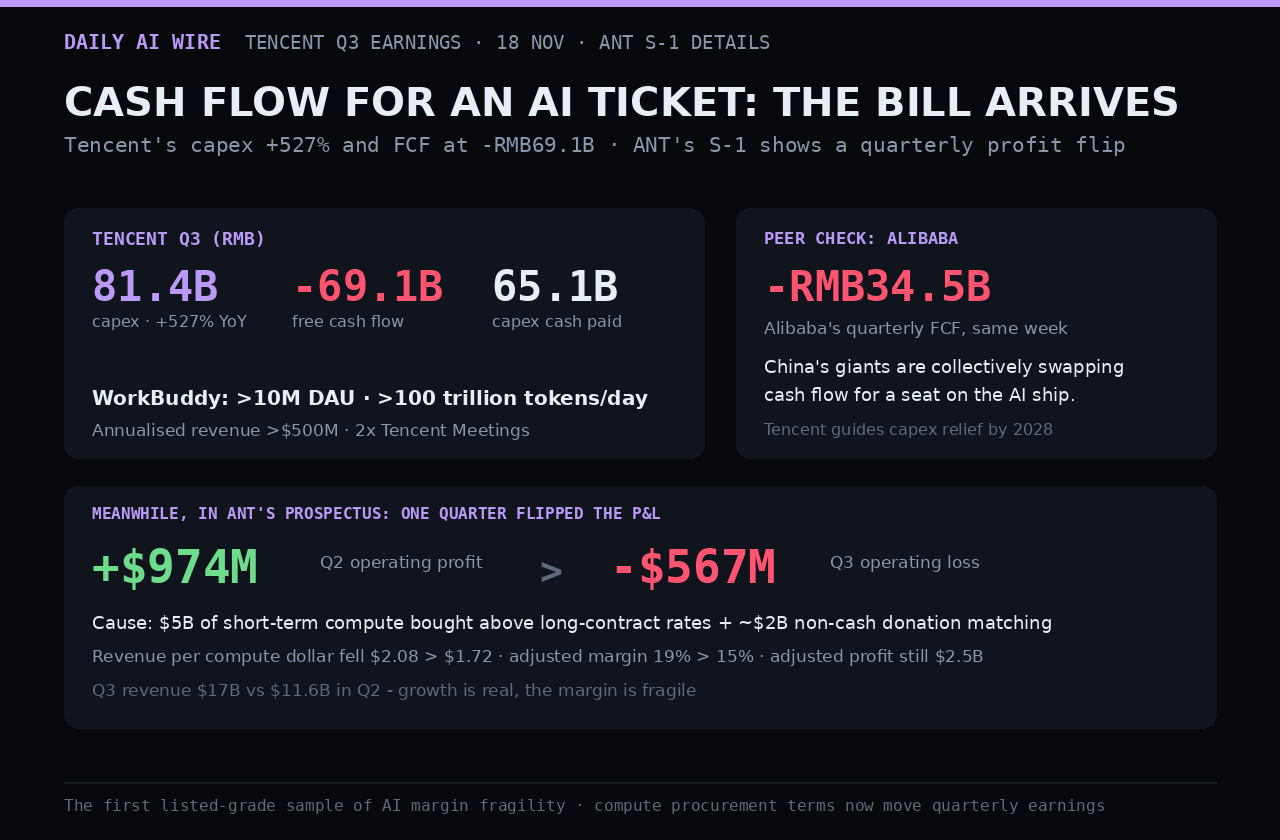
Tencent’s Q3 2026 results, released the evening of November 18 and dissected through November 20, quantify what buying an AI seat costs: capex hit RMB 81.4 billion, up 527% year over year (RMB 65.1 billion in cash paid), free cash flow went to negative RMB 69.1 billion, and new AI products dragged quarterly operating profit by ~RMB 15.2 billion — with Alibaba posting negative RMB 34.5 billion FCF the same week, China’s giants are collectively swapping cash flow for a boarding pass. The demand side is not imaginary: WorkBuddy now tops 10 million DAU and consumes over 100 trillion tokens daily — China’s largest AI app by token burn — with President Lau Chi Ping saying its trailing-seven-day annualized revenue exceeds $500 million, more than double seven-year-old Tencent Meetings, and 60% of China’s top-100 enterprises signed since the June enterprise launch; management guides capex relief by 2028. The same news cycle delivered the listed-grade cautionary sample: Anthropic’s S-1 shows Q3 revenue of $17 billion (vs $11.6 billion in Q2) yet a GAAP swing from +$974 million operating profit to a $567 million loss — driven by $5 billion of short-term compute bought above long-contract rates plus ~$2 billion of non-cash donation matching — with revenue per compute dollar falling from $2.08 to $1.72 and adjusted margin sliding 19% to 15% (adjusted profit still $2.5 billion). Growth is real; the margin is fragile; procurement terms now move quarterly earnings.