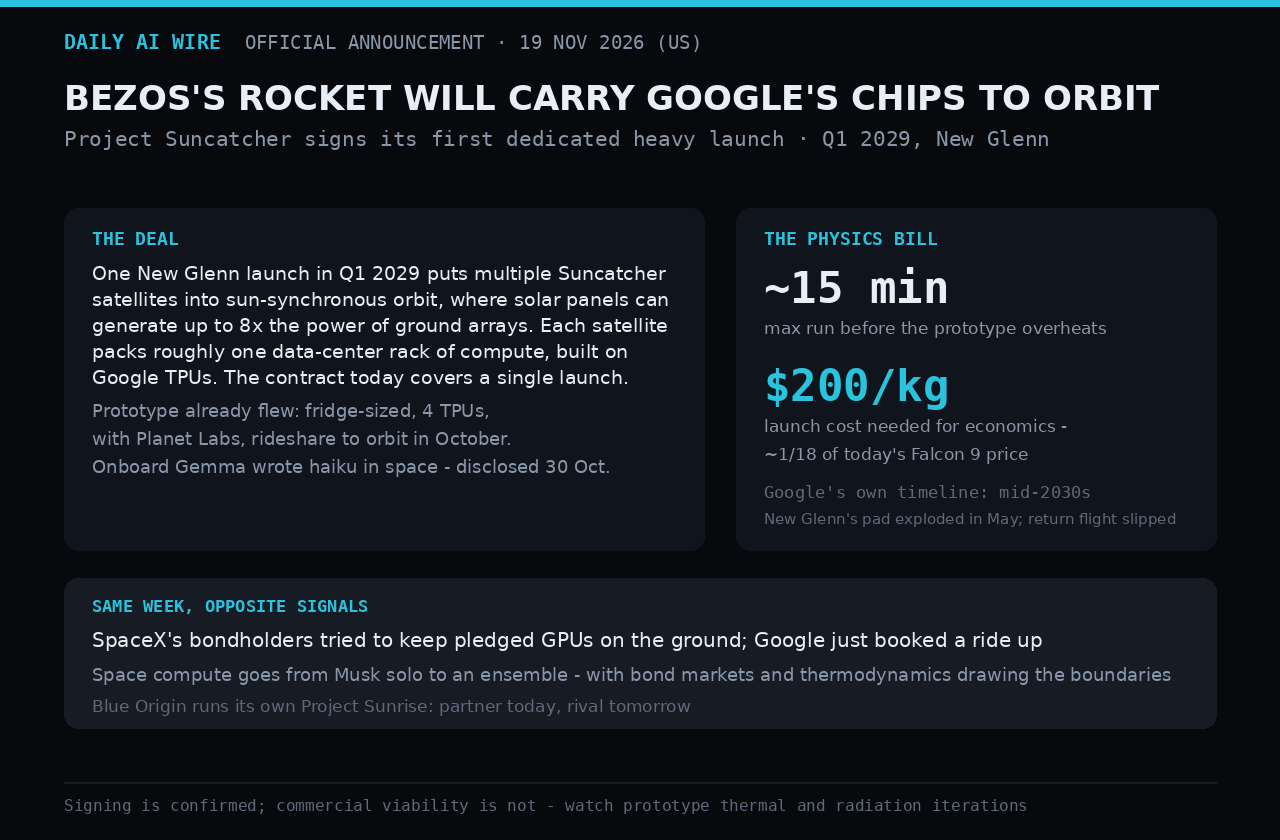
Google and Blue Origin announced on November 19 (US time) that Project Suncatcher — Google’s bid to put AI compute in space — has booked its first dedicated heavy launch: a New Glenn rocket in Q1 2029 will carry multiple satellites into sun-synchronous orbit, where solar panels can generate up to eight times the power of ground arrays, each satellite packing roughly one data-center rack of compute built on Google TPUs. The proof of concept already flew: a fridge-sized prototype with four TPUs, built with Planet Labs, reached orbit on an October rideshare, and Google disclosed on October 30 that the onboard Gemma model generated haiku in space — its claimed first orbital TPU-inference demo. The physics bill is brutal: thermal limits cap the prototype at ~15-minute runs, and Google’s own economics require launch costs near $200/kg — about 1/18 of today’s Falcon 9 price — which it does not expect before the mid-2030s. Execution risk is real too: New Glenn’s pad exploded in May, and the current contract covers a single launch. The timing is the story — the same week SpaceX’s bondholders tried to keep pledged GPUs on the ground, Google booked a ride up: space compute goes from a Musk solo to an ensemble, with bond markets and thermodynamics drawing the boundaries, and Blue Origin’s own Project Sunrise making it partner today, rival tomorrow.