Everyone told offline retail it was dying. For a decade, the funeral notice practically wrote itself: e-commerce eats the shelf, the mall empties out, the store closes. So explain this. In July 2026, a tea brand in Guangzhou opened a shop that makes drinks slower than its standard stores, charges more for them, and still had customers queuing over three hours on opening day. In Shanghai, a value retailer known for cheap household goods built a nearly 2,000-square-meter plush-toy theme park that did more than RMB 150 million in sales in its first year. In Tokyo’s Ginza, a Chinese cosmetics brand that had sold online-only in Japan for four years planted a flagship among the global luxury houses.
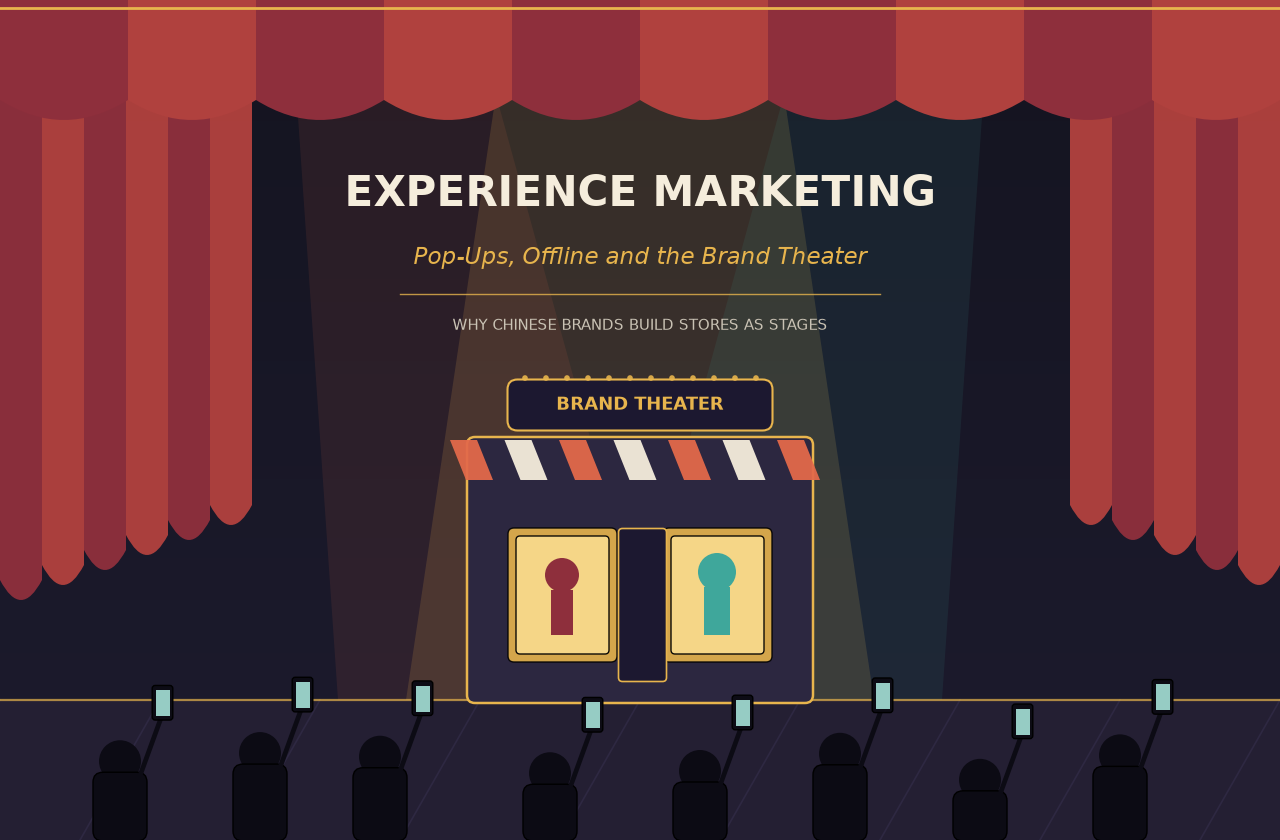
None of these stores exist to move inventory efficiently. They exist to be worth posting about. The shelf moved online years ago. What stayed offline is the stage — and the brands directing the best theater are quietly running the most efficient media channels in China.
The Store’s Job Changed: From Selling to Being Worth Posting
The intellectual groundwork is older than you might think. Back in 1998, B. Joseph Pine II and James Gilmore argued in Harvard Business Review that economies progress from commodities to goods to services to experiences — and that an experience happens when a company uses services as the stage and goods as props to create a memorable event. Nearly three decades later, Chinese brands are running that play at retail scale, with one twist Pine and Gilmore couldn’t have anticipated: the audience brings its own broadcast equipment.
A theater store’s output isn’t transactions. It’s photos, check-ins and social posts. The visitor walks in as a customer and walks out as a distribution channel. When Miniso’s founder Ye Guofu talks about consumers lacking places worth visiting, experiences worth their time and scenes worth posting, he’s not describing retail. He’s describing a content studio with a cash register attached — and the register is increasingly optional.
Five Stages, Five Scripts
Heytea Craft: Slowness as a Product
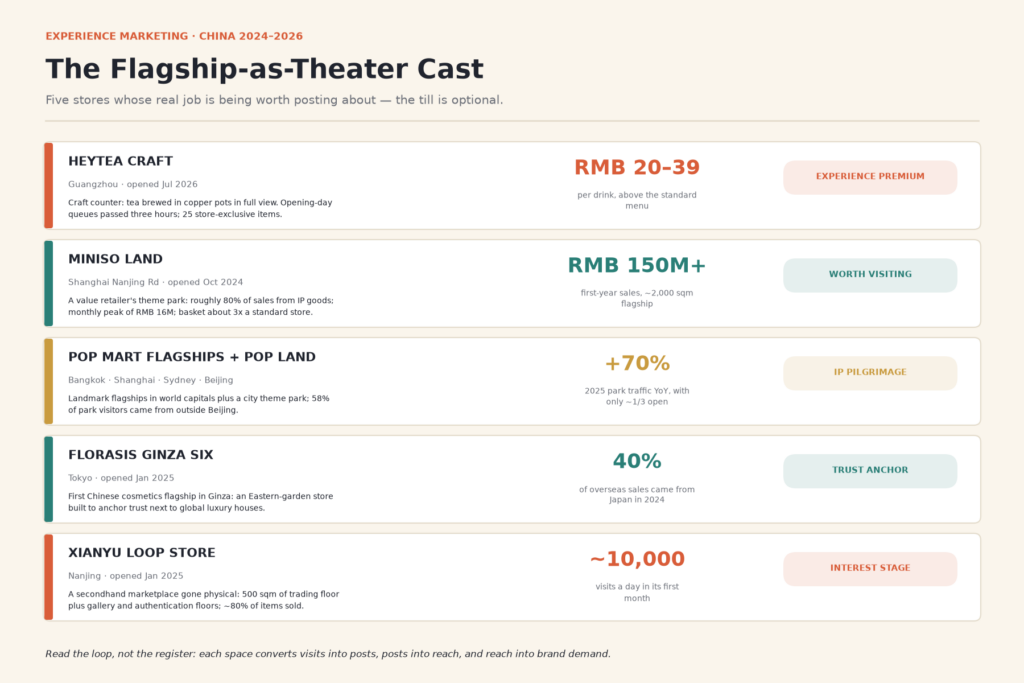
Heytea’s first Craft store opened in Guangzhou’s Shipaiqiao district in July 2026, rebuilt from a ten-year-old location. There’s no QR-code ordering and no speed promise. Instead, a long open counter runs through the whole space while tea masters brew milk tea in copper pots, hand-pour single-origin teas through copper mesh, and roll dark chocolate on marble slabs — all in full view. The 25 store-exclusive items run RMB 20 to 39, above the standard menu. Trade press noted the obvious: this store produces fewer cups per hour than a standard one. That’s the point. In an industry dragged down by 9.9-yuan price wars, Heytea built a store whose job is to prove the brand deserves to cost more. The Shanghai Lab 2.0 that opened in February 2026 runs the same logic across four labs — bake, cake, tea, gelato — where combination ordering pushes the average basket past RMB 40.
Miniso LAND: The Value Retailer Builds a Theme Park
Miniso’s Nanjing East Road flagship in Shanghai is the loudest proof that experience isn’t a luxury-only game. Roughly 80% of its sales come from IP-licensed products. It passed RMB 100 million in nine months, peaked at RMB 16 million in a single month, and crossed RMB 150 million in its first year — with a basket about three times a standard store’s. The design firm behind it described the approach as hiding the shelves and borrowing the narrative logic of an amusement park. Ye Guofu has since announced plans to close and rebuild roughly 80% of Miniso’s store network — some 6,000 locations — around bigger, themed formats, and by mid-2026 the company already ran over 100 park-format stores in China with ambitions for 1,200 to 1,500.
Pop Mart: Flagships as Pilgrimage Sites
Pop Mart’s 2025 annual report reads like a theater company’s tour schedule: revenue up 184.7% to RMB 37.12 billion, 630 stores worldwide, and new landmark flagships in Bangkok, Shanghai and Sydney. But the deepest experience bet is POP LAND, its theme park inside Beijing’s Chaoyang Park. In 2025, with only about a third of the park open for renovation, visitor traffic still grew 70% year over year. The guest mix surprised management: 58% of visitors came from outside Beijing, and nearly 60% weren’t family groups. Fans arrive with suitcases. The park has been profitable since 2024, ranked among Beijing’s top inbound-tourist attractions, and a second phase is planned for 2027.
Florasis Ginza Six: Presence as Proof
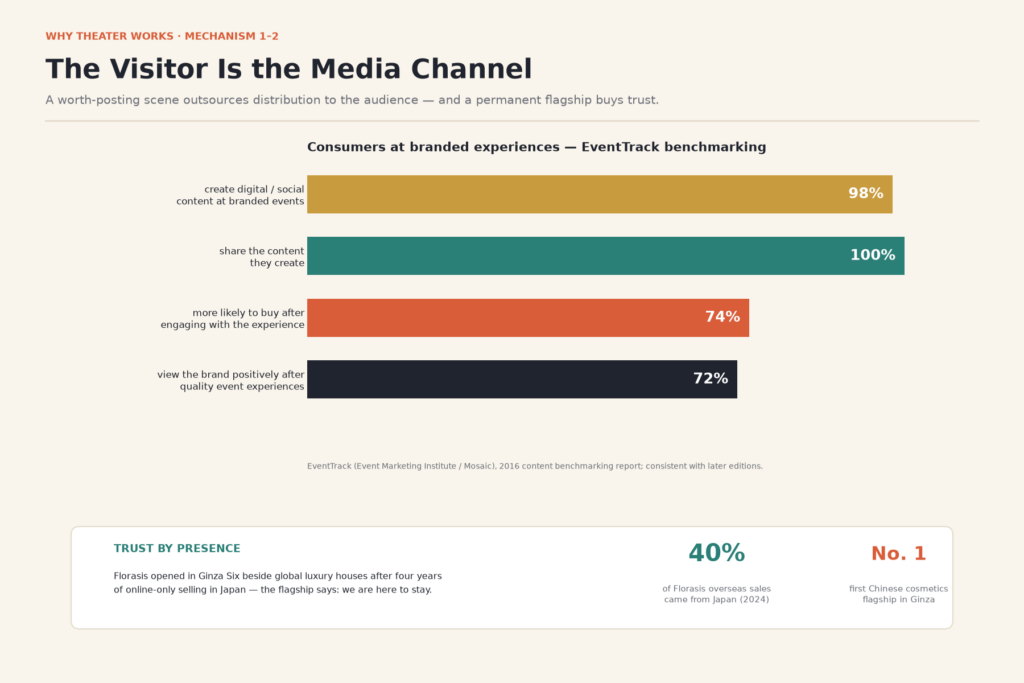
When Florasis opened at Ginza Six in January 2025 — the first Chinese cosmetics flagship in Ginza — it wasn’t chasing foot traffic. Japan already accounted for 40% of its overseas sales, built through Amazon and local retailers since 2021. The flagship’s job is different: an Eastern-garden interior among Chanel and Dior says we are here to stay. For a brand exporting cultural aesthetics, permanent physical presence in the world’s most demanding beauty district is trust infrastructure, not a sales channel.
Xianyu’s Loop Stores: Trust You Can Touch
Alibaba’s secondhand marketplace Xianyu went physical with Loop Stores, and the Nanjing location shows why. About 800 square meters across three floors — a 500-square-meter trading floor, a street-art gallery level, an authentication floor — drawing roughly 10,000 visits a day in its first month, with about 80% of its 3,500 consigned items sold. A consignor told the local paper she’d never dared sell online but trusted a store she could walk into. Xianyu plans stores in 100 cities over five years. For a platform where the average completed deal involves 37 chat messages, the store collapses distance and doubt in one visit.
Why Theater Works: Four Mechanisms
Mechanism 1 — Social Currency: The Visitor Is the Channel
The audience does the advertising. The EventTrack benchmarking studies from the Event Marketing Institute found that 98% of consumers create digital or social content at branded experiences — and 100% of those creators share it. Even better for the brand: 72% of consumers say a friend’s post about a branded experience makes them more likely to buy. That’s peer distribution at zero marginal media cost. The scene isn’t decorated for the customer. It’s art-directed for the customer’s camera.
Mechanism 2 — The Trust Anchor
A flagship is a hostage to fortune, and that’s exactly why it works. Rent in Ginza or on Nanjing Road is a public, expensive commitment. Consumers read permanence as proof: a brand that signs a multi-year lease in a landmark district isn’t going to vanish with your warranty claim or your prepaid balance. Xianyu’s consignors said it plainly — seeing the store made them comfortable handing over their goods.
Mechanism 3 — The Experience Premium
Heytea’s Craft menu sits above its standard pricing because the visible craft is the product upgrade. The customer paying 39 yuan isn’t buying better leaves; they’re buying the twenty minutes of copper-pot ritual they watched and filmed. And the premium doesn’t stay in one store — it radiates. One flagship that convincingly stages craftsmanship gives the whole network permission to resist the price war.
Mechanism 4 — The Offline-Online Loop
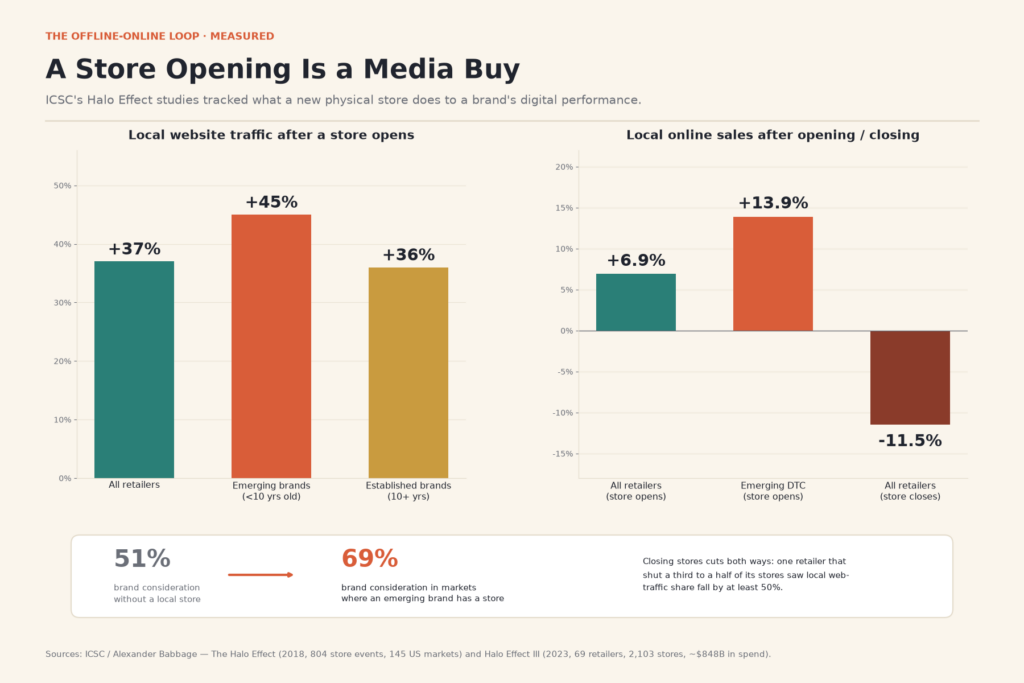
This is where the skeptics get answered with data. ICSC’s Halo Effect research, run with Alexander Babbage, tracked 804 store openings and closings across 145 US markets and found that opening a store lifts local website traffic by 37% on average — 45% for emerging brands. The third installment went further, analyzing roughly 848 billion dollars of spending across 69 retailers and 2,103 stores: a store opening lifts online sales in its trade area by 6.9%, rising to 13.9% for emerging direct-to-consumer brands. Closing a store cuts local online sales by 11.5%. The store isn’t competing with the website. It’s feeding it.
What Everyone Gets Wrong
The first error is treating these stores as failed retail. Judged by sales per square meter alone, a theater store can look mediocre — Heytea’s Craft store deliberately serves fewer cups per hour. But you don’t judge a billboard by how many people buy things underneath it. Starbucks understood this in 2017 when it opened its 2,700-square-meter Shanghai Reserve Roastery and literally called the concept a theater of coffee. The second error is assuming experience means luxury. Miniso built its park on value retail; Xianyu built its stage on secondhand goods. The worth-posting logic works at every price tier. The third error is dismissing pop-ups as gimmicks. Temporariness is the mechanism: a store that disappears next week creates the same urgency as a limited drop, and urgency is what turns a visit into a post today rather than someday.
The Counterargument, and Where It Breaks
Fair objections exist. Theater stores often lose money at the store P&L level — true, and irrelevant only if the loop is measured. Novelty decays; the queue that proves you can generate hype doesn’t prove anyone will pay 39 yuan in month six. And attribution is genuinely hard: which online order came from which store visit? These are real risks, not straw men. Pop Mart’s answer is instructive — it renovates two-thirds of its park at once precisely because a static set stops being worth posting. The experience must refresh while the story stays constant.
The Playbook for Marketers
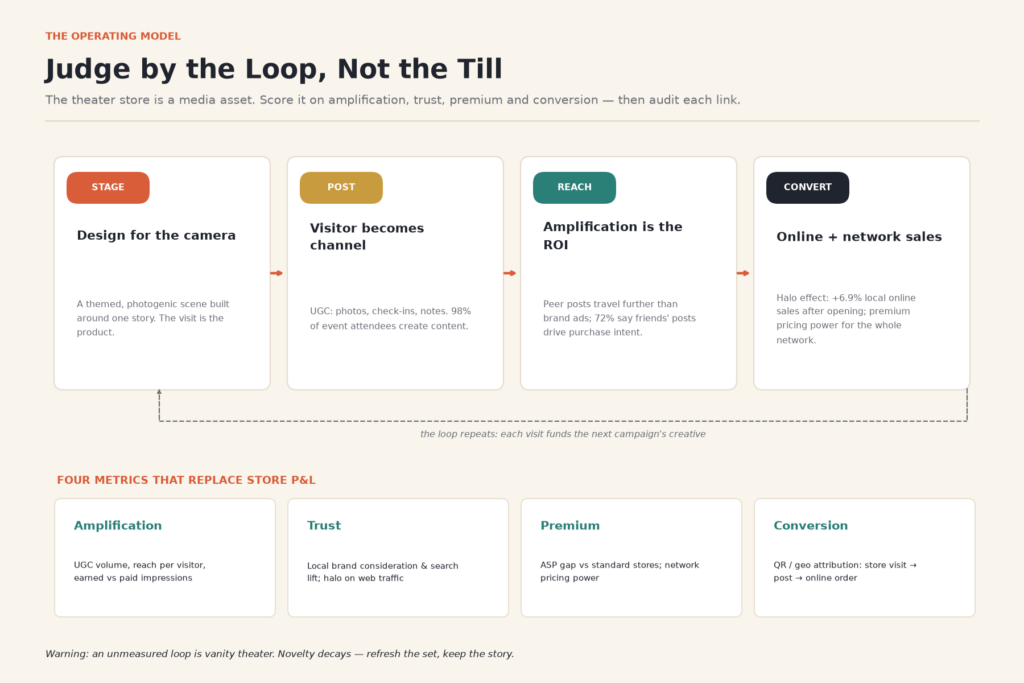
Design for the camera: one coherent theme, positive cues, no visual noise that contradicts the story — Pine and Gilmore’s principles, now with a distribution payoff. Budget the flagship as media spend and demand media metrics: earned reach per visitor, UGC volume, local search and consideration lift. Instrument the loop with QR bridges, geo-lift analysis and post-to-purchase tracking before you sign the lease. Use pop-ups as scarcity rituals, not permanent fixtures. And treat the flagship as trust infrastructure when entering a skeptical new market.
Conclusion
Offline didn’t die. It auditioned for a new role and got it. The shelf belongs to e-commerce now, but the stage belongs to whoever directs it best — and Heytea, Miniso, Pop Mart, Florasis and Xianyu are all directing the same play: make the visit worth posting, let the audience carry the message, and collect the return in trust, premium and online conversion. Judge the theater by the loop, not the till. The brands that learn to stage-manage will earn amplification the shelf never could.