Your keyword list has a problem: it was built for a machine that no longer exists. The old search engine took your two-word query, matched it against pages, and handed back ten blue links. The new one takes a full human question, tears it into sub-questions you never typed, runs a dozen searches in parallel, and stitches the results into one answer that most people never click past. If your content strategy still starts with a spreadsheet of keywords, you’re preparing for yesterday’s exam.
This module is about the replacement: a user-question map. Not a brainstorm. Not a list of “topics we should cover.” A structured inventory of 300+ real questions, harvested from four channels where buyers actually ask things, graded by how close each question sits to a purchase decision, and wired into every piece of content you ship. Think of it as the navigation system for GEO — generative engine optimization — work. Without it, you’re guessing. With it, you know.
Why AI Search Runs on Questions, Not Keywords
Here’s the shift in one sentence: keywords describe topics, questions describe decisions — and AI engines optimize for decisions.
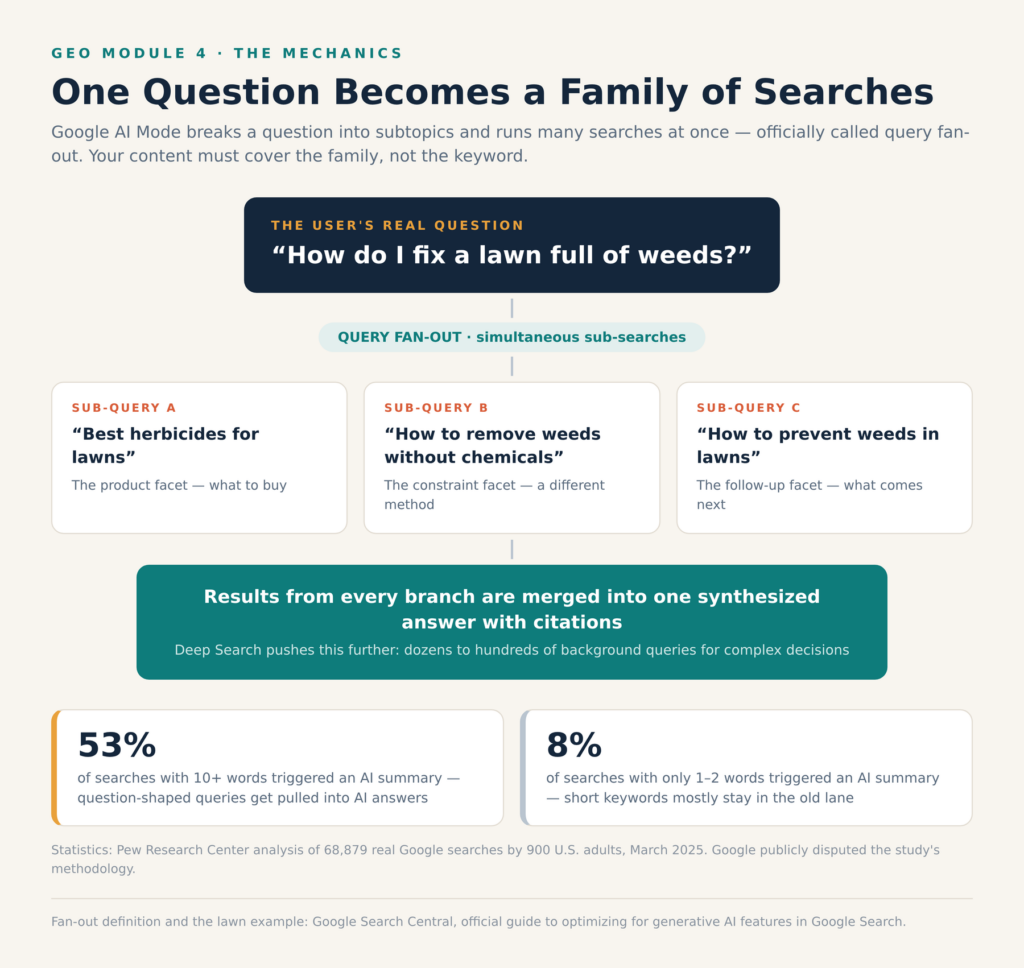
Google’s own documentation is refreshingly blunt about the mechanics. Its Search Central guide to generative AI features describes a technique called query fan-out: when someone asks AI Mode a question, the model breaks it into subtopics and issues multiple related searches simultaneously, then combines what comes back into a single grounded answer. Google’s official example is beautifully mundane. Ask “how to fix a lawn full of weeds,” and the system may fan out into “best herbicides for lawns,” “how to remove weeds without chemicals,” and “how to prevent weeds in lawns.” Three different facets — product, constraint, prevention — none of which the user typed.
Notice what just happened. One question became a family. And your page about “lawn weed killer” — the keyword you so carefully optimized — only answers one member of that family.
Query Fan-Out: The Fan Is Wider Than You Think
This isn’t a fringe behavior. Google announced at its I/O conference in May 2026 that AI Mode had passed one billion monthly users, with query volume more than doubling every quarter since launch and the average AI Mode query running roughly three times the length of a traditional search. For genuinely complex decisions, Google’s Deep Search feature goes further: the company and its Search product VP Robby Stein have described it issuing dozens or even hundreds of background queries before writing its report-style answer.
The behavioral data backs this up from the user side. Pew Research Center — an independent, nonprofit research organization — tracked the actual browsing of 900 U.S. adults through March 2025, covering 68,879 unique Google searches. About 18% of those searches produced an AI summary. But the trigger rate was wildly uneven: only 8% of one- or two-word queries got an AI summary, while 53% of queries with ten or more words did. Question-shaped, context-rich searches are precisely the ones the AI layer swallows. (For balance: Google publicly disputed Pew’s methodology, calling its query set unrepresentative. The direction of the finding, though, matches what publishers see in their own analytics.)
The Answer Is a Chain, Not a Snapshot
There’s a second reason questions beat keywords, and it’s about what happens after the first answer. In a February 2026 recap of Google Search chief Liz Reid’s remarks at an IAB leadership meeting, Think with Google stated plainly that a significant portion of AI Mode queries now lead to a follow-up question. The search session has become a conversation: “What does it cost?” leads to “What’s included at that tier?” leads to “How does it compare to the alternative?” leads to “How long until I see results?”
A keyword list can win you one link in one answer. A question map can win you the whole chain — first mention, cited source, and the follow-ups where the actual decision gets made. That’s the strategic bet of this module: cover the family and the conversation, not the phrase.
What a Question Map Actually Is
Let’s get concrete, because “map” sounds abstract. A user-question map is a working database with four columns that matter: the question in the user’s own words, its source channel, its priority grade, and its assigned content anchor — the page and format responsible for answering it.
The academic foundation for why this works comes from the paper that named the field. Researchers from Princeton, IIT Delhi, Georgia Tech and the Allen Institute for AI published “GEO: Generative Engine Optimization” at KDD 2024, the flagship data-mining conference. They described generative engines as systems that decompose input queries into simpler sub-queries before retrieval — the fan-out pattern, formalized — and showed across a large benchmark of diverse queries that content optimization could lift a source’s visibility in generated answers by up to 40%. Two honesty notes before you tattoo that number on your forearm: it’s a maximum under the paper’s specific test conditions, and a July 2026 critical survey by Sciences Po researcher Olivier Martinez, reviewing 45 GEO studies, concluded that no technique yet shows a stable effect across platforms. The lesson isn’t “GEO guarantees 40%.” The lesson is that retrieval happens at the sub-question level, so coverage should be planned at the sub-question level.
That’s what the map does. It converts an invisible machine process into a visible editorial to-do list.
The Four Collection Channels
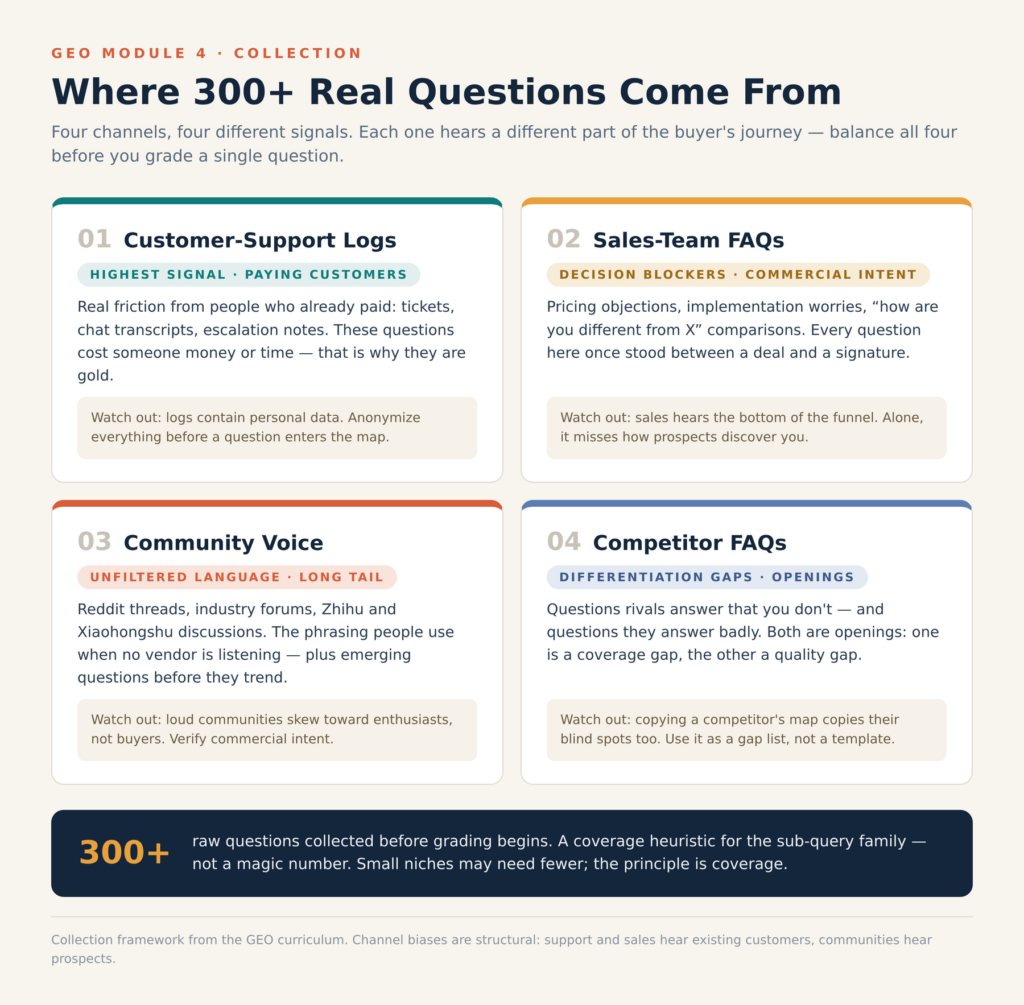
Where do 300+ real questions come from? Not from a keyword tool’s “people also ask” scrape — those are the engine’s guesses about questions. You want the questions themselves, from four channels that each hear a different part of the buyer’s journey.
Channel 1: Customer-Support Logs — The Highest Signal
Support tickets are questions that cost someone money or time. These people already paid you, and they still got stuck. That makes their questions the highest-signal material you own: real friction, real phrasing, real stakes. Mine ticket subjects, chat transcripts and escalation notes. “Does the integration sync historical data or only new records?” is worth ten blog posts about “seamless integration.”
One non-negotiable: support logs contain personal data. Anonymize everything — names, emails, account IDs, order details — before a question enters the map. The map stores questions, not customers.
Channel 2: Sales-Team FAQs — The Decision Blockers
Your sales team keeps a mental list of the questions that kill deals. Pricing objections. Implementation fears. “How are you different from X?” Security questionnaires, procurement thresholds. Every one of these questions once stood between a signature and a silence. Interview your reps, read call notes, collect the objection-handling docs. These are your commercial-intent questions, and they cluster near the bottom of the funnel where money moves.
Channel 3: Community Voice — The Unfiltered Language
Reddit threads, industry forums, Zhihu and Xiaohongshu discussions: this is how people phrase questions when no vendor is listening. The vocabulary is different — messier, more specific, more honest — and it’s exactly the language AI engines retrieve and synthesize from.
Don’t take my word for the retrieval part. Pew’s browsing study found Wikipedia, YouTube and Reddit collectively accounted for about 15% of the sources cited in Google AI summaries, with government sites adding roughly 6%. A three-month Semrush study covering 230,000+ prompts and over 100 million citations across ChatGPT search, Google AI Mode and Perplexity found Reddit appearing in close to 60% of ChatGPT responses in early August 2025. Two caveats you should internalize: Semrush sells AI-visibility tracking, so treat its studies as vendor research; and “share of responses containing a domain” is a different metric from “share of all citations” — headlines routinely conflate them. The same study watched that Reddit figure collapse to around 10% by mid-September, which tells you something else important: citation patterns move fast, and community mining is a habit, not a one-off scrape.
Channel 4: Competitor FAQs — The Gap List
Read your competitors’ FAQ pages, help centers and comparison content with a pencil. Two lists emerge: questions they answer that you don’t (coverage gaps), and questions they answer badly — vaguely, evasively, without numbers (quality gaps). Both are openings. An AI engine synthesizing “best option for a 10-person team” will happily cite the vendor who actually answers the 10-person-team question. Just remember: copying a competitor’s map wholesale copies their blind spots too. Use it as a gap list, never as a template.
Why 300+? Coverage, Not Magic
The 300+ target is a heuristic, and it deserves an honest defense rather than mystical numerology. Fan-out means one buyer question can spawn a family of sub-searches across definition, pricing, method, comparison, risk and follow-up facets. A map of 50 questions almost certainly misses whole facets; a map of 300 raw questions, collected across four channels with different biases, usually achieves family coverage for a mid-complexity product. A narrow niche might saturate at 150. A sprawling B2B platform might need 500. The number serves the principle: collect widely enough that no important facet of the decision is invisible to you. Stop when new collection stops producing new question types — that’s your real finish line.
Grading: P0, P1, P2
Raw volume is useless without triage. Grade every question by one criterion: how close does it sit to a buying decision?
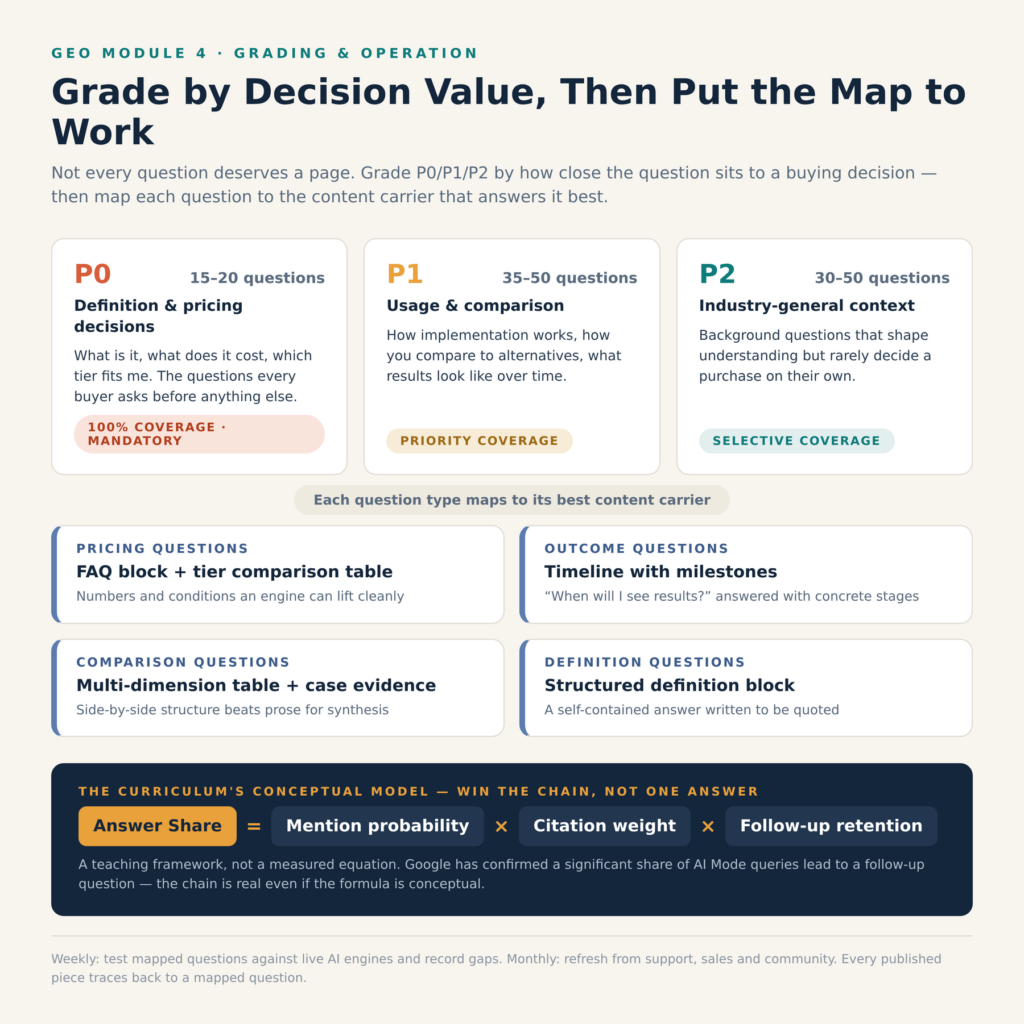
P0 — roughly 15 to 20 questions — covers what your product is and what it costs. Definition and pricing decisions. Every buyer asks these before anything else, so coverage is mandatory: 100%, no exceptions, no “we’ll get to it next quarter.”
P1 — roughly 35 to 50 questions — covers usage, implementation and comparison. How does onboarding work? How do you compare to the alternative? What do results look like at month three? These get priority coverage because they’re where shortlists are won and lost.
P2 — roughly 30 to 50 questions — covers industry-general context. Background questions that shape understanding but rarely decide a purchase alone. Cover selectively, when they support a P0 or P1 cluster or when nobody else answers them well.
Anchor Mapping: Match the Carrier to the Question
Grading tells you what to answer; anchor mapping tells you where and in what shape. Each question type has a natural content carrier that AI engines can lift cleanly: pricing questions want an FAQ block plus a tier comparison table; outcome questions want a timeline with concrete milestones; comparison questions want a multi-dimension table backed by case evidence; definition questions want a self-contained structured definition block written to be quoted verbatim.
A word of discipline here, straight from Google’s official guide: you don’t need special markup for this. Google explicitly says llms.txt files, artificial content chunking, rewriting content just for AI, and over-emphasis on structured data are things you can ignore — no special schema is required to appear in AI Overviews or AI Mode. What the guide says matters most is unique, genuinely useful content organized so readers can navigate it. Tables and definition blocks earn their place because they help humans scan and machines extract — not because they’re secret ranking levers.
The Answer-Share Formula: A Framework, Not Physics
The curriculum summarizes the goal as: Answer Share = mention probability × citation weight × follow-up retention. Say it plainly: this is a conceptual teaching model, not a measured equation. Nobody can hand you coefficients. But each factor points at something real and observable. Mention probability: does the engine name you at all for this question family? Citation weight: when it names you, does it lean on your page as a source — and how prominently? Follow-up retention: when the user asks the next question in the chain, are you still there?
The multiplication is the insight. A brand that’s mentioned everywhere but cited nowhere converts poorly; a brand cited on question one but absent from questions two through five loses the decision mid-conversation. Google’s own confirmation that follow-ups are now a significant share of AI Mode behavior makes the third factor impossible to wave away. You’re not fighting for one answer. You’re fighting for a conversation.
Run the Map Like an Operating System
A map on a shelf is a souvenir. Three operating rhythms turn it into infrastructure.
Weekly validation: take your mapped P0 questions and actually ask them to ChatGPT, AI Mode, Perplexity and Gemini. Record whether you’re mentioned, whether you’re cited, and who’s winning instead. The Semrush data on Reddit’s sudden citation collapse is your reminder that engine behavior shifts without announcement — a map that isn’t tested against live engines is assumed, not known.
Monthly refresh: new questions flow in from support, sales and community. Products change, competitors ship, buyers invent new phrasings. Re-grade as needed; promote questions whose decision-value has risen.
Cross-team alignment: support, sales and content share one map. When a support lead sees a recurring ticket, it enters the map; when content ships an answer, support links to it. One source of question-truth, three teams reinforcing it. Every published piece should trace back to a mapped question — if it can’t, ask why you’re publishing it.
Four Mistakes That Quietly Kill Question Maps
First: collecting only product questions. The decision chain includes industry context, comparisons and usage realities. A map of pure product FAQs covers one facet of the family and starves the rest.
Second: questions that are too vague to answer. “How to do marketing” is a topic wearing a question mark. “How much does GEO cost for a 10-person B2B team?” is answerable, gradeable, and mappable. Specificity is answerability.
Third: build-and-shelve. The map gets lovingly assembled in a sprint, then never consulted. Without the weekly test and the production linkage, you’ve built a museum exhibit.
Fourth: ignoring channel bias. Support and sales only hear from people who already found you. If your map is 90% support tickets, you’ve mapped your existing customers’ confusion and none of your prospects’ discovery. Balance the four channels deliberately.
Honest Caveats Before You Start
Three lines to keep taped to your monitor. The 300+ figure is a coverage heuristic, not a law — small niches need fewer questions, and the family-coverage principle is the point. The answer-share formula is a framework for thinking, not a metric you can report to your CFO as fact. And the research ground is still shifting: the KDD paper’s “up to 40%” is a conditional maximum, credible surveys dispute cross-platform stability, and vendor citation studies carry commercial interests. Build the map because covering real buyer questions is defensible strategy on its own merits — it would be good practice even if the GEO acronym had never existed.
The Bottom Line
AI engines decompose questions into families of searches, users continue the conversation with follow-ups, and most readers never click past the synthesized answer. In that world, the keyword list is a relic and the question map is the working tool. Collect 300+ real questions from support logs, sales FAQs, community threads and competitor gaps. Anonymize the personal data. Grade P0/P1/P2 by decision proximity. Map each question to the carrier that answers it best — tables, timelines, definition blocks that help humans first. Then run the map: test weekly against live engines, refresh monthly, and make every piece of content trace to a mapped question. Stop guessing what users ask. You have four channels full of people telling you, in their own words, every single day.