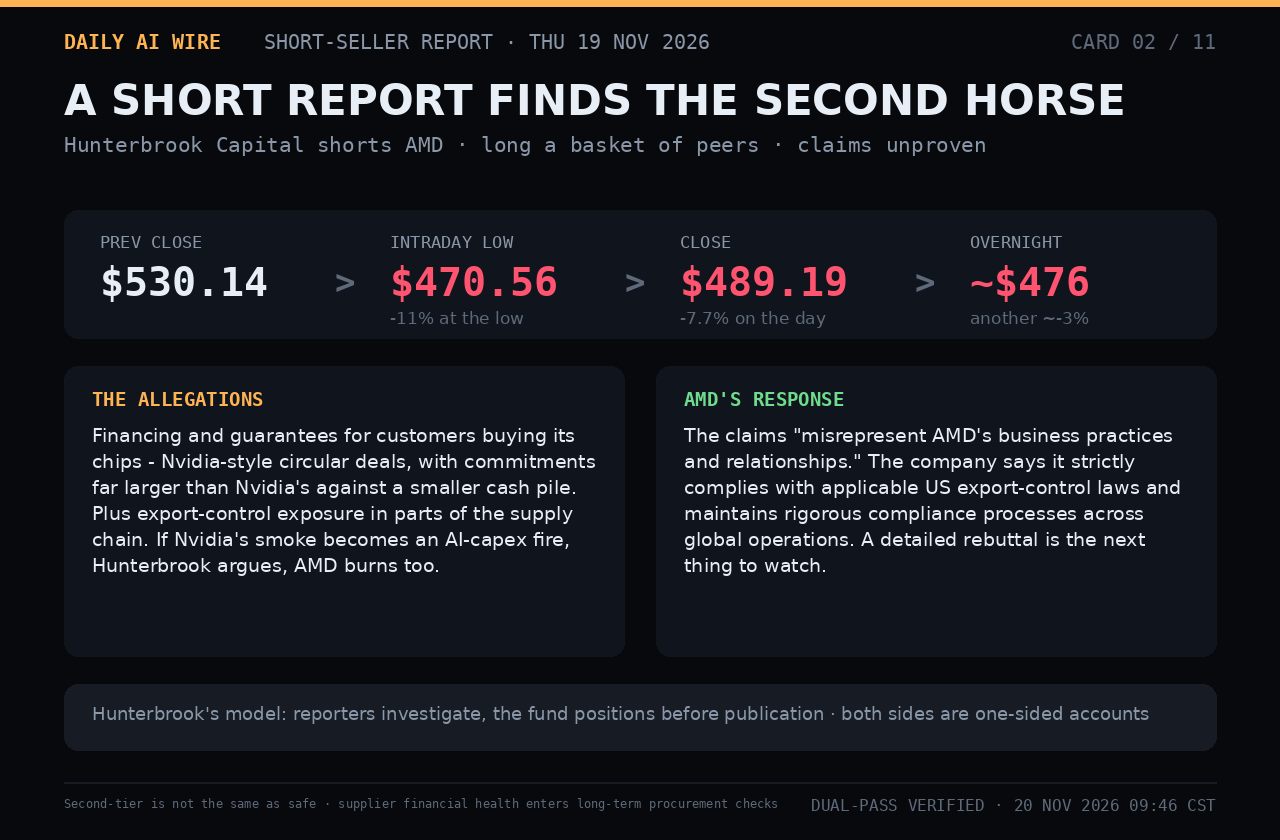
Also on Thursday, November 19, investigative hedge fund Hunterbrook Capital published a short report on AMD, arguing the chipmaker increasingly finances and guarantees the customers who buy its chips — Nvidia-style circular deals, but with commitments far larger than Nvidia’s against a smaller cash pile. The report also flags export-control exposure in parts of AMD’s supply chain. The market did not wait for a rebuttal: AMD plunged as much as 11% intraday to $470.56 — the weakest Nasdaq-100 name at that moment — before closing at $489.19, down 7.7%, then shedding another roughly 3% to around $476 in overnight trading reported Friday morning Beijing time. AMD says the claims “misrepresent AMD’s business practices and relationships” and that it strictly complies with US export-control law. Remember Hunterbrook’s model: its reporters investigate, and the fund positions before publication. Both sides are one-sided accounts — but the second-tier-is-safer trade just took a direct hit, and supplier financial health now belongs in every long-term AI procurement review.